

Summary The Mercedes-Benz diesels we work on come from a small number of engine families that Mercedes fitted across its cars and vans alike, so this page starts from the engine and ends at the page written for your model. We rebuild the turbochargers from the four-cylinder CDI engines, and the electronic turbo actuators from the 2.2, 2.7 and 3.0 V6 CDI, in our Epsom workshop. Turbo rebuilds start from £185, actuator repairs from £100 + VAT, and every repair carries a lifetime, unlimited-mileage warranty.
One four-cylinder diesel, the OM651, appears in our listings under twelve Mercedes model names, from the SLK roadster to the Sprinter van.
A Mercedes turbo fault is easier to route than the number of badges suggests. Find the engine, decide whether the fault sits in the turbocharger or in the electronic actuator bolted to it, and the tables below take you to the listing or repair page for your car.
- Cars and vans covered: A-Class, B-Class, CLA, GLA, C-Class, E-Class, CLK, CLS, GLK, GLC, SLK, SLC, S-Class, Sprinter, Vito, Viano, V-Class and Citan diesels
- Engine families: the 1.5 (OM607 and OM608), the 2.2 (OM611 and OM646), the later four-cylinder OM651, the 2.7 five-cylinder and the 3.0 V6 (OM642)
- Two different repairs: a rebuild of the turbocharger, or a rebuild of the electronic actuator on its own
- What finds your page: the model and engine, then the year and power output
- What confirms the unit: the reference on its label, or the unit itself on our bench
- Prices: turbo rebuilds from £185; replacement turbochargers from £450; actuator repairs from £100 + VAT
- Bench time: typically one to three working days for a turbo, one to two for an actuator
- Warranty: lifetime, unlimited mileage, on every repair
Find Your Mercedes: Model, Engine and Page
Start with the model, read across to the engine, then follow the link. Where a model was sold with more than one diesel, each engine size has its own turbo listing, and on each listing you choose your year and power output to see which turbochargers are catalogued for your car.
| Model | Diesel engines in our data | Turbo rebuild | Electronic actuator |
|---|---|---|---|
| A-Class | 1.5 (OM607, OM608) | A-Class 1.5 | — |
| B-Class | 1.5 (OM607, OM608) | B-Class 1.5 | — |
| CLA | 1.5 (OM607, OM608) | CLA 1.5 | — |
| GLA | 1.5 (OM607) | GLA 1.5 | — |
| Citan | 1.5 (OM607, OM608) | Citan 1.5 | — |
| C-Class | 2.2 (OM611, OM646), OM651, 2.7 five-cylinder, 3.0 V6 | C-Class 2.2 · C-Class 2.1 | Mercedes C-Class |
| E-Class | 2.2 (OM611, OM646), OM651, 2.7, 3.0 V6, 3.2 | E-Class 2.2 · E-Class 2.1 | Mercedes E-Class |
| CLK | 2.2 (OM646), 2.7 five-cylinder, 3.0 V6 | Repair Form | Mercedes CLK |
| CLS | OM651, 3.0 V6 | CLS 2.1 · CLS 2.2 | Mercedes CLS |
| GLK | OM651 | GLK 2.1 · GLK 2.2 | — |
| GLC | OM651 | GLC 2.1 | — |
| SLK | OM651 | SLK 2.1 | — |
| SLC | OM651 | SLC 2.1 | — |
| S-Class | OM651 | Repair Form | — |
| Sprinter | 2.2 (OM611, OM646), OM651, 3.0 V6 | Sprinter and Vito turbo repair | Sprinter and Vito |
| Vito | 2.2 (OM611, OM646), OM651, 3.0 V6 | Sprinter and Vito turbo repair | Sprinter and Vito |
| Viano | 2.2 (OM646, OM651) | Viano 2.2 | — |
| V-Class | 2.2 (OM611), OM651 | V-Class 2.2 · V-Class 2.1 | — |
A dash in the actuator column means we have no model page for that car’s actuator, not that the car has none; the plug check in the next section tells you what yours carries. “Repair Form” means there is no turbo listing for that model, and the online Repair Form is the way in. The Sprinter and Vito page links on to the four van listings, where the 2.1 and 2.2 headings need more care than the car listings do.
If your Mercedes is not in the table at all, it can still be sent in. Give us the reference from the turbocharger’s label and your vehicle details on the Repair Form, and we confirm what it is before you post anything.
Turbo or Actuator? Which Repair You Need
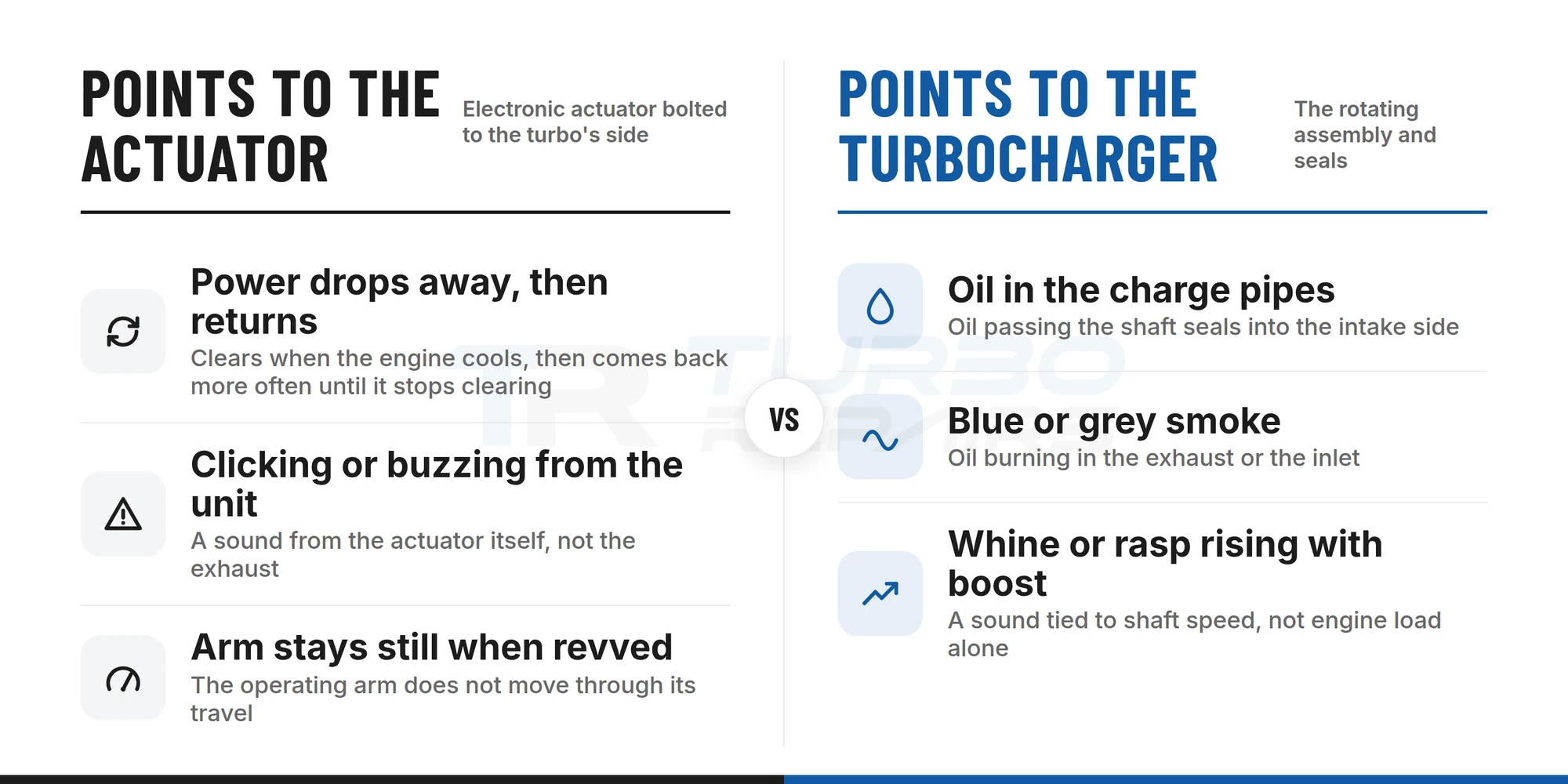
On a Mercedes CDI a boost fault can come from two different parts: the turbocharger itself, or the electronic actuator bolted to its side that moves the ring of vanes inside it. Both store the same boost codes and both put the car into limp mode. What differs is what has to come off the car and what the repair costs.
Signs that point at the actuator. Power that drops away intermittently, clears when the engine is switched off and left to cool, then returns more often until it stops clearing at all, is the pattern our Mercedes actuator pages document model by model. Clicking or buzzing from the unit, and an operating arm that stays still when the engine is revved, point the same way.
Signs that point at the turbocharger. Oil in the charge pipes, blue or grey smoke, oil use climbing between services, and a whine or rasp that rises with boost belong to the turbo’s rotating assembly and seals. Our guide to common turbocharger problems sorts those signs by where in the unit they start.
Two checks settle most cases before anything is posted:
- Look for a plug. An electronic actuator is a moulded unit with a wiring connector clipped into it. A vacuum actuator is a metal can with a rubber hose and no wiring. We rebuild the electronic type; a vacuum can is not part of this service.
- Feel the vanes. With the actuator unbolted, move the turbocharger’s vane lever through its travel by hand. If it moves freely, the actuator is the suspect and is the only part to send. If it binds or will not move, the vanes are seized and the turbocharger needs the work. Our E-Class actuator page sets that check out step by step, wiring checks included.
The Four-Cylinder CDI Engines
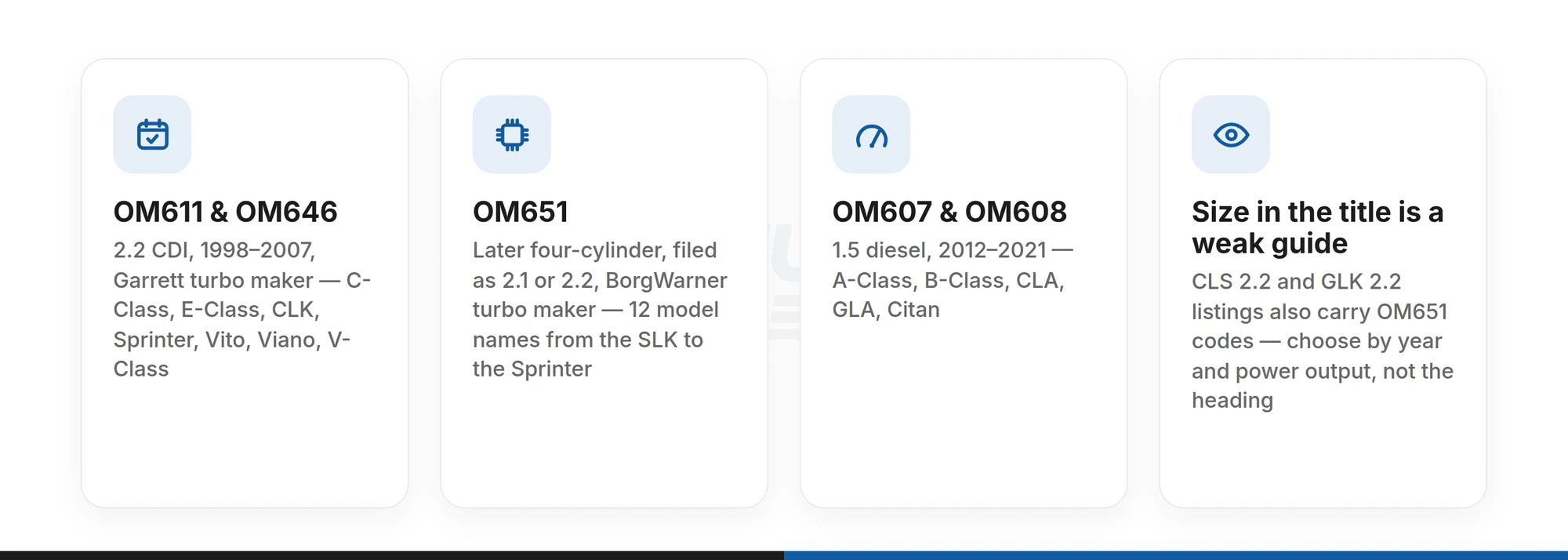
The four-cylinder turbochargers we rebuild for Mercedes fall into three engine families. The engine codes on our listings say which one a car belongs to, and the family decides which listings and which pages apply.
| Engine family | In our data | Models it appears under |
|---|---|---|
| OM611 and OM646 | The earlier 2.2 CDI. The C-Class and E-Class 2.2 listings run from 1998 to 2007 and name Garrett as the turbo maker | C-Class, E-Class, CLK, Sprinter, Vito, Viano, V-Class |
| OM651 | The later four-cylinder, filed as both 2.1 and 2.2. The car listings name BorgWarner as the turbo maker | C-Class, E-Class, CLS, GLK, GLC, SLK, SLC, S-Class, Sprinter, Vito, Viano, V-Class |
| OM607 and OM608 | The 1.5, catalogued from 2012 to 2021 across its models | A-Class, B-Class, CLA, GLA, Citan |
One engine, twelve model names
The OM651 is why a model name gets you less far on a Mercedes than you might expect. Its engine codes run through our listings for twelve models, from the SLK and SLC roadsters through the C-Class, E-Class and CLS to the GLK and GLC, the S-Class, and the Sprinter, Vito, Viano and V-Class vans.
Sharing an engine narrows the turbocharger; it does not choose it. The C-Class 2.1 listing alone catalogues eight turbocharger part numbers, and the E-Class 2.1 and SLK 2.1 listings five each. So the year and power output take you to a shortlist on the listing, and the label on your unit settles which one it is.
The 2.1 and 2.2 in a listing title
On the C-Class and E-Class, our car listings divide at the engine change: the 2.2 listings carry the OM611 and OM646 codes on Garrett units, and the 2.1 listings the OM651 on BorgWarner units. Elsewhere the size in a title is a weaker guide, because the CLS 2.2 and GLK 2.2 listings also carry OM651 codes. Choose by year and power output rather than by the size in the heading. Why sellers file the same engine under both sizes is explained on our Sprinter and Vito turbo repair page, so it is not repeated here.
When there are two turbochargers on one engine
Some OM651 versions, in cars as well as vans, are catalogued with a two-stage BorgWarner assembly: two turbochargers built to work as one. If yours looks like two units joined together, send it as it came off and photograph every label first, including any (I) or (II) after a number. How those numbers work, and why one can mean the pair or a single stage, is covered on the Sprinter and Vito page.
The 2.2 CDI actuator
On the OM646 2.2 in the C 220, E 220 and CLK 220 CDI, and in the 2.2 Sprinter, the vanes are moved by an electronic actuator that we rebuild on its own. If the checks above point at the actuator on one of those, start from the Mercedes C-Class, Mercedes E-Class, Mercedes CLK or Sprinter and Vito actuator page rather than sending the turbocharger.
The 3.0 V6 CDI and Its Actuators
The 3.0 V6 CDI, the OM642 family, sits behind the C 320 and C 350 CDI, the CLK 320 CDI, the CLS 320 and 350 CDI, the E 280 and E 320 CDI, the Sprinter 219 to 519 CDI and the Vito, and our actuator pages also record it against the ML and R-Class. Its Garrett variable-nozzle turbocharger sits in the vee between the two cylinder banks, with a Hella electronic actuator on its side setting the position of the vanes.
On this engine the actuator is worth ruling in or out before the turbocharger is touched. It unbolts from the outside of the turbo and is rebuilt on its own from £100 + VAT, typically in one to two working days, and it comes back needing no programming or coding.
Each model page below covers the actuator references recorded for that car, so they are not repeated here:
- Mercedes C-Class: the W203, W204 and W205 diesels, including the C 320 and C 350 CDI
- Mercedes CLK: the 220, 270 and 320 CDI, three engines under one badge
- Mercedes CLS: the 320 and 350 CDI and the four reference combinations listed against them
- Mercedes E-Class: the W211 CDIs, where an E 320 CDI badge can sit on a 3.2 rather than the V6
- Sprinter and Vito: the V6 vans, and the 2.2 four-cylinder vans alongside them
The 2.7 five-cylinder in the C 270, E 270 and CLK 270 CDI carries a different turbocharger and actuator again, and is covered on those same pages. Every other car we repair actuators for is on our electronic turbo actuator repairs list.
If the vane check shows seized vanes, the turbocharger itself needs the work. There is no V6 turbo listing, so complete the Repair Form with the reference from the turbo’s label and we confirm the unit before you post it.
Turbo Repairs · Epsom workshop
Vanes free or seized? Send the part the check points to
Tell us the model, the engine and what the plug and vane checks showed, then post either the actuator or the turbocharger. We identify it against your car before any work starts, and you hear from us if anything does not match.
Lifetime, unlimited-mileage warranty · Mail-in from the UK and internationally · Bench-tested and calibrated before it ships
The A-Class
In our listings the A-Class diesel is the 1.5, catalogued from 2012 to 2019 at 90 to 116 bhp under engine codes 607951 and 608915, with two turbocharger part numbers across those years. The same engine codes run through the B-Class, CLA, GLA and Citan listings.
The same engine as the Renault and Nissan 1.5 dCi
The Mercedes 1.5 is a Renault engine. Trade listings give it as K9K / OM607 and K9K / OM608, and list the Mercedes A-Class, B-Class, CLA, GLA and Citan in the same entries as the Renault Clio, the Dacia Duster and the Nissan Qashqai 1.5 dCi, whose turbo families our Qashqai page sets out.
A shared engine is not a shared part. It explains why an A-Class turbo turns up in listings for a Renault or a Nissan, but it does not make a unit sold for one of those cars right for your A-Class. Match the reference on your own label, or send the unit itself.
Not every A-Class is a 1.5
Trade listings also catalogue turbochargers for the earlier A 160 and A 180 CDI with a 2.0 diesel, for A-Class models with the 2.1 CDI, and for the turbocharged petrol A-Class. We have no listing for those. Complete the Repair Form with the label reference and your registration, and we confirm the unit before anything is posted.
What an A-Class turbo costs
Rebuilding your own A-Class turbocharger starts from £185, and a replacement turbocharger from us starts from £450. Removal and refitting are extra, and the rebuild price is confirmed once the unit has been stripped and measured, because it depends on how much of the original is still within specification. Our guide to turbo repair prices explains what moves a job up its range.
How to Send Your Mercedes Turbo or Actuator In
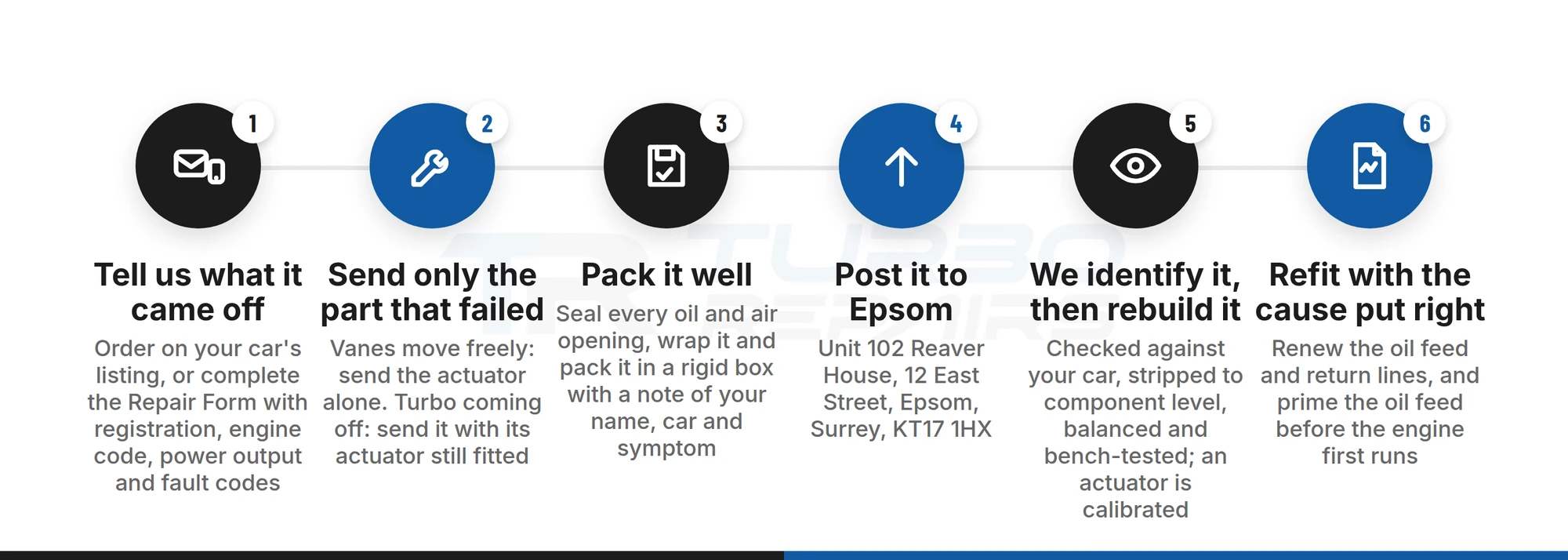
The route is the same for a turbocharger and an actuator, and for a model that is in the tables above or not.
- Tell us what it came off. Order on your car’s listing, or complete the online Repair Form with the registration, the engine code if you have it, the power output, any fault codes, how the fault behaves, and a photograph of every label on the unit.
- Send only the part that failed. If the vanes move freely, send the actuator on its own; the turbocharger stays on the engine. If the turbo is coming, send it with its actuator still fitted, and send a two-stage assembly whole, as it came off.
- Pack it well. Seal every oil and air opening, wrap the unit and pack it in a rigid box so nothing can move, with a note inside giving your name, the car and the symptom. Our FAQs cover packing and postage.
- Post it to the workshop at Unit 102 Reaver House, 12 East Street, Epsom, Surrey, KT17 1HX, United Kingdom.
- We identify it, then rebuild it. The unit is checked against the car you gave us, and if the two disagree we contact you before work starts. It is stripped to component level, rebuilt on genuine OE or OEM-grade parts, and balanced and bench-tested; an actuator is calibrated and returned needing no coding. Bench time is typically one to three working days for a turbo and one to two for an actuator.
- Refit with the cause put right. Renew the oil feed and return lines rather than reusing them, and prime the oil feed before the engine first runs. Our guide to removing, refitting and priming a turbocharger takes you through it.
Independent garages and main dealers send units for their customers’ Mercedes cars and vans the same way, and every repair carries a lifetime, unlimited-mileage warranty, with no mileage cap and no time limit.
Mercedes Turbo Repair FAQ
How much does a Mercedes turbo repair cost?
Rebuilding your own Mercedes turbocharger starts from £185, and a replacement turbocharger from us starts from £450. An electronic actuator repair starts from £100 + VAT. Removal and refitting are extra, and the rebuild price is confirmed once the unit has been stripped and measured.
How do I know whether it is the turbo or the actuator?
Look for a wiring plug on the actuator, then, with the actuator off, move the vane lever by hand. If the vanes move freely, the actuator is the suspect and can be sent on its own. If they bind, the turbocharger needs the work. Oil in the charge pipes or blue smoke points at the turbo whichever way the check goes.
Is the A-Class 1.5 diesel turbo the same as a Renault or Nissan one?
The engine is the same family: trade listings give it as the Renault K9K, under the Mercedes codes OM607 and OM608. That does not make any one turbocharger interchangeable between them. Match the reference on your own label, or send your unit in and it is identified on the bench.
My Mercedes has two turbochargers joined together. Can you rebuild it?
Yes. Some OM651 versions are catalogued with a two-stage assembly. Send it complete, with photographs of every label, and we identify each stage before work starts. Our Sprinter and Vito turbo page explains how the numbers on those assemblies work.
My model is not in the table. Can you still help?
The table shows the Mercedes models we have listings and pages for, not every turbocharger or actuator we can work on. Complete the Repair Form with the reference from the label and your vehicle details, and we advise before you post anything.
Will a rebuilt Mercedes actuator need coding?
No. You get your own actuator back, calibrated and bench-tested, and it refits without programming. Clearing the stored fault codes once it is back on is sensible.
Final Thoughts
Mercedes built a long list of model names on a short list of diesel engines, and that is the useful fact for anyone with a boost fault. The engine family tells you which listings and pages apply, the year and power output narrow the shortlist, and the label on the unit finishes the job.
The other decision comes first, though: turbocharger or actuator. A plug and a vane lever that moves by hand can save a turbo coming off an engine that did not need it, and a seized lever tells you the actuator was never the whole story.
Turbo Repairs · Epsom workshop
From an A-Class 1.5 to a V6 Sprinter, send us the part that failed
Complete the Repair Form with the engine and every label reference, then post the turbocharger or the actuator to Epsom. It is identified against your car, rebuilt at component level and bench-tested before it comes back ready to refit.
Lifetime, unlimited-mileage warranty · Mail-in from the UK and internationally · Bench-tested and calibrated before it ships