

Summary We rebuild the turbocharger from Honda’s 2.2 diesel, the engine trade listings file as the N22A2 in the Civic, CR-V and FR-V and as the N22B3 in the later CR-V. You or your garage remove the turbo and post it to us. It is stripped to component level, measured, rebuilt on genuine OE or OEM-grade parts, balanced and bench-tested, then returned ready to refit. Rebuilds start from £185 + VAT, bench time is typically one to three working days, and every rebuild carries a lifetime, unlimited-mileage warranty.
All three turbochargers listed for this engine are Garretts, and none of them is the unit most CR-V turbo searches turn up. Honda sells its 1.5 petrol CR-V as the VTEC Turbo, so on this car the word turbo is a model name, and the part on a 2.2 diesel is found by its engine code and the number on its label.
Two different Garretts are listed for the same N22A2 engine code, the 802014 on 140 bhp rows from 2005 to 2008 and the 759394 on 138 bhp CR-V rows from 2007 to 2010, so a 2007 or 2008 CR-V can match both on engine code, year and power.
This page is for Honda owners, and the garages working on their cars, dealing with a failing turbocharger on the 2.2 diesel. It shows how to confirm which version of the engine you have, which Garrett each version is listed with, what wears out inside it, the checks worth making before anything is unbolted, and how a rebuild runs from the form to the refit.
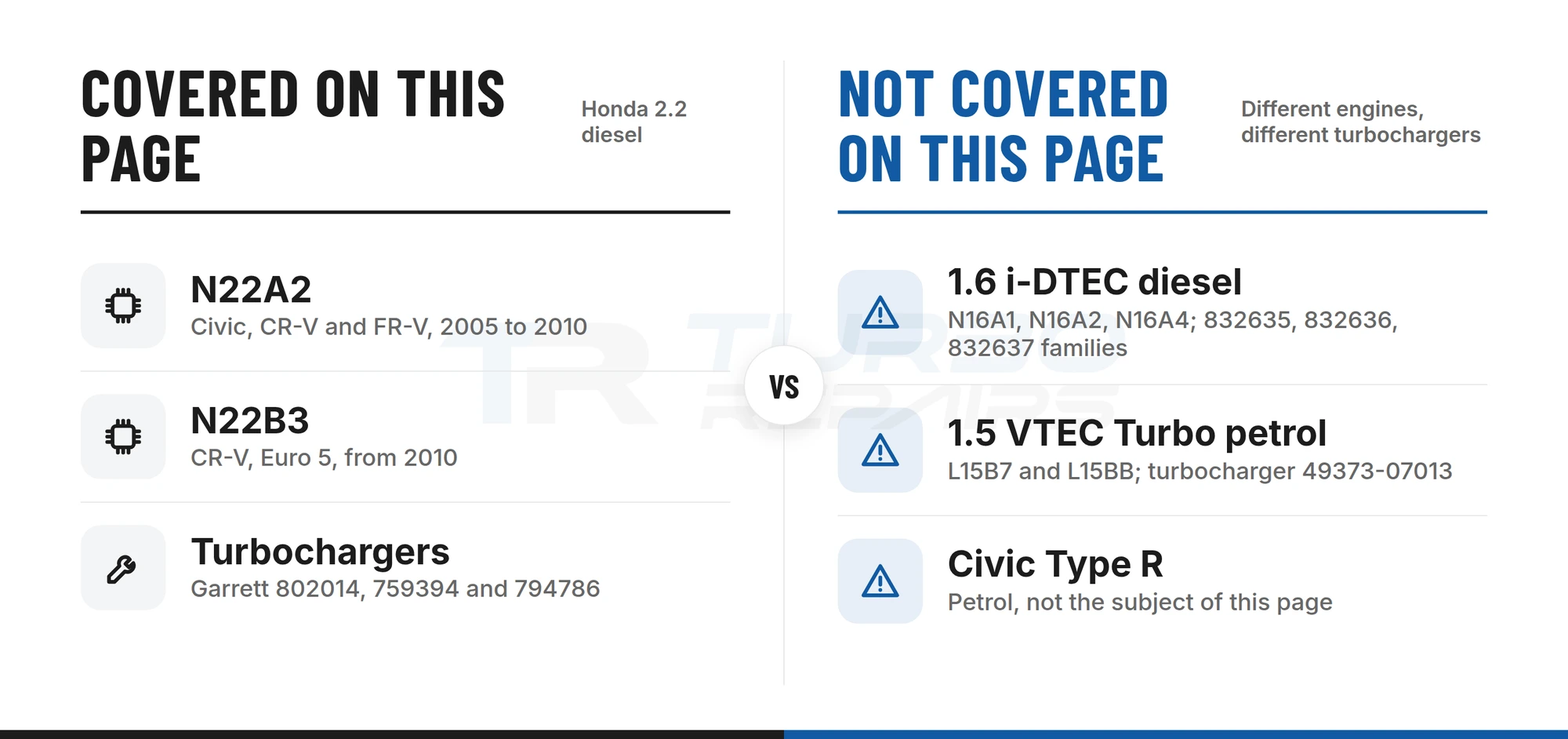
- Covered here: the 2.2 diesel listed as the N22A2 in the Civic, CR-V and FR-V, and as the N22B3, the Euro 5 version, in the CR-V from 2010
- Not covered here: the 1.6 i-DTEC diesel, the 1.5 VTEC Turbo petrol and other petrol Hondas, including the Civic Type R
- Turbochargers listed: three Garretts, the 802014, the 759394 and the 794786
- The quickest tell: the Garrett number on the turbo’s own label; the engine code, year and power narrow it down, but on some 2007 and 2008 CR-Vs they leave two candidates
- Price: rebuilding your own turbocharger from £185 + VAT; a replacement turbocharger from £450 + VAT
- Turnaround: typically one to three working days on the bench, plus postage each way
- Warranty: lifetime and unlimited mileage
- Getting started: the online Repair Form
Which Honda 2.2 Diesel Is Yours: N22A2 or N22B3?
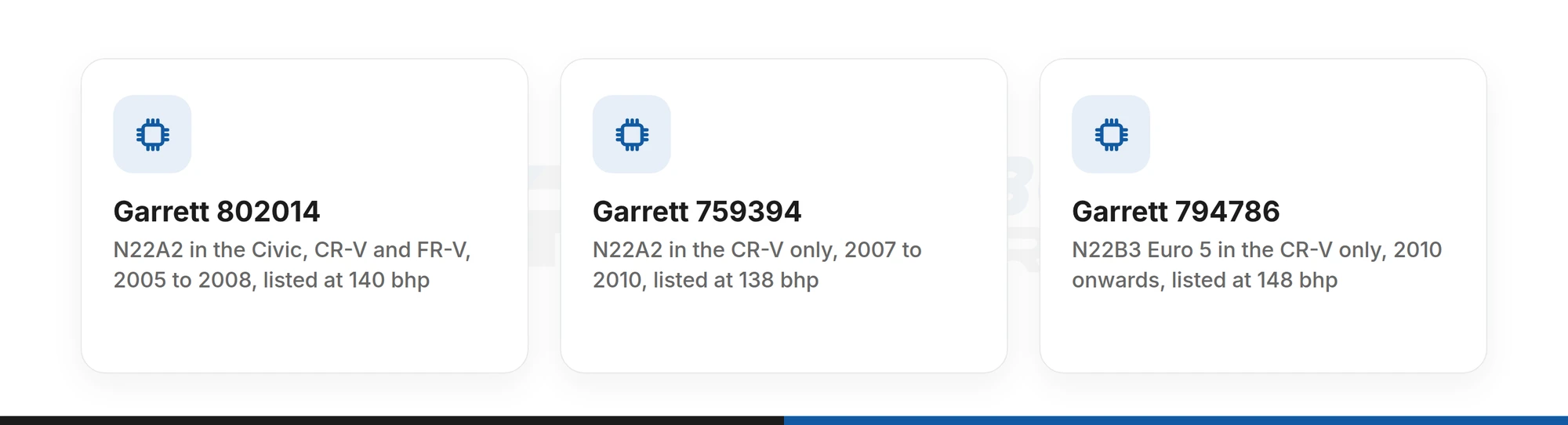
Trade listings split Honda’s 2.2 diesel into two engine codes. The N22A2 is listed in the Civic, the CR-V and the FR-V, on rows running from 2005 to 2010. The N22B3 is listed in the CR-V alone, described as the Euro 5 version, from 2010 onwards. Between them they carry three different Garrett turbochargers.
| Engine code | Listed in | Years listed | Power listed | Garrett turbo listed | Honda numbers printed with it |
|---|---|---|---|---|---|
| N22A2 (listed with RMA and RSR) | Civic, CR-V, FR-V | 2005 to 2008 | 140 bhp | 802014 (listed as 802014-5001S) | 18900RSRE010M2; 18900RMAE010M2 |
| N22A2 (listed with R06) | CR-V | 2007 to 2010 | 138 bhp | 759394 (listed as 759394-5002S) | 18900RFWWG020M2 (see below) |
| N22B3, Euro 5 | CR-V | 2010 onwards | 148 bhp | 794786 (listed as 794786-5001S) | 18900RFWWG020M2 (see below) |
Start with the model, the registration date and the engine’s power output. A Civic or FR-V 2.2 diesel points at the N22A2 and the 802014. A CR-V from 2010 at the higher output points at the N22B3 and the 794786. The CR-V is the only car listed with all three turbochargers at one time or another, so a CR-V owner has the most to confirm.
An i-DTEC badge does not settle the engine size
The i-DTEC name on a Honda diesel does not, on its own, tell you which engine is under the bonnet. Trade listings carry a 1.6 i-DTEC CR-V on engine codes N16A1, N16A2 and N16A4, with turbochargers in the 832635, 832636 and 832637 families, and a 1.6 i-DTEC Civic, CR-V and HR-V on the 840213. None of those references is shared with the 2.2, so confirm the engine size before anything else.
The same goes for the petrol cars. The CR-V VTEC Turbo and the Civic with the 1.5 VTEC Turbo are listed on engine codes L15B7 and L15BB with a turbocharger of their own, the 49373-07013. Neither they nor the Civic Type R are the subject of this page.
The Garrett Turbochargers on the Honda 2.2
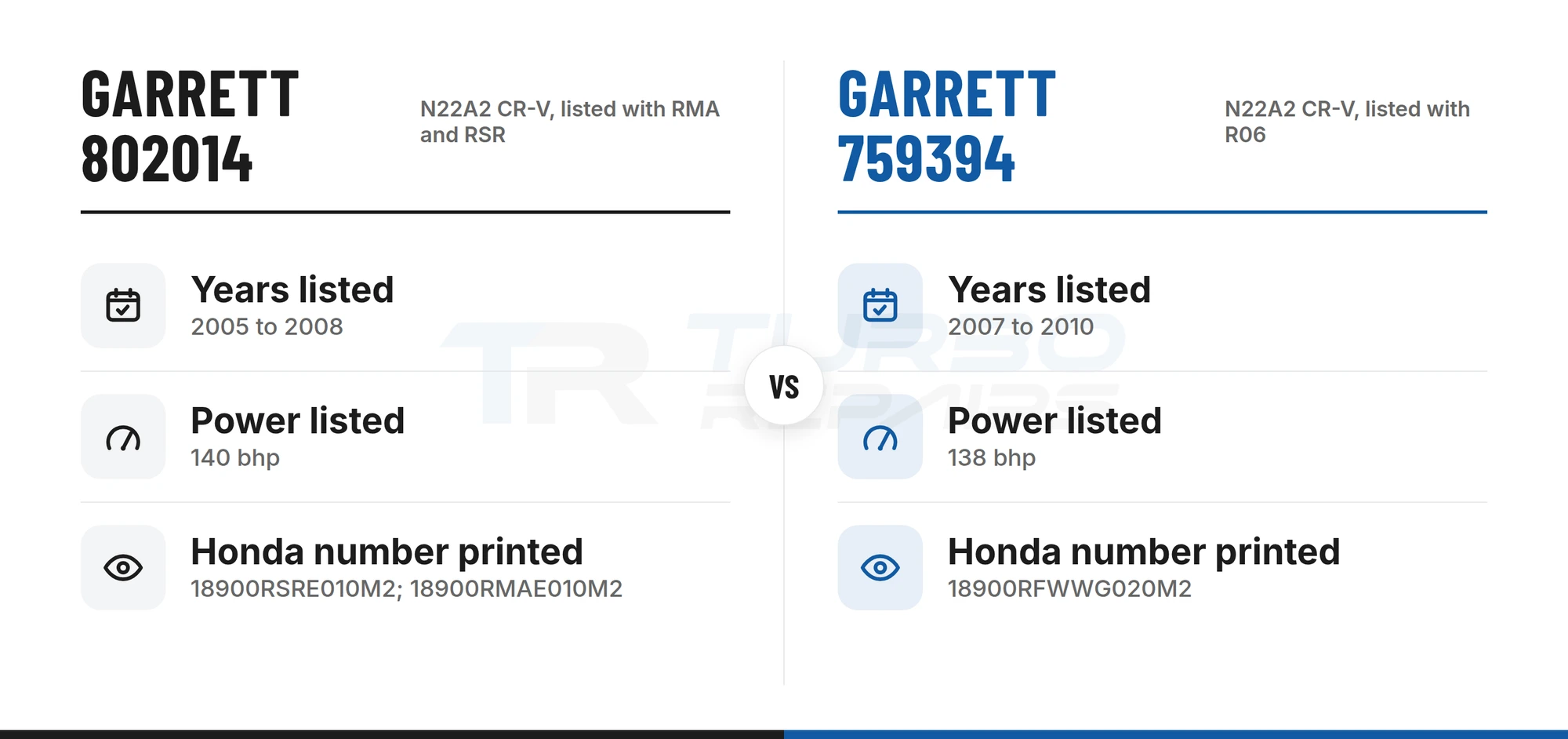
Every 2.2 diesel turbocharger in the listings is a Garrett, and there are three of them. The 802014 is listed across the most cars: the N22A2 in the Civic, CR-V and FR-V from 2005 to 2008, at 140 bhp. The 759394 is listed on the N22A2 in the CR-V from 2007 to 2010, at 138 bhp. The 794786 belongs to the N22B3, the Euro 5 CR-V from 2010, at 148 bhp.
Where the engine code runs out
On most engines the engine code gets you to the turbocharger. On the N22A2 it gets you to two. The 802014 and the 759394 are both listed for N22A2 CR-Vs, their year ranges overlap across 2007 and 2008, and their power figures sit two bhp apart. A CR-V from those two years can match both entries on engine code, year and output.
The listings separate them with three-letter codes after the engine code, RMA and RSR against the 802014 and R06 against the 759394. Unless you already know which of those applies to your car, the label on the turbocharger is the quicker tell. Photograph it before the unit is cleaned or packed, and put every digit on the Repair Form.
Why the Honda number is not enough on its own
The Honda numbers printed in these listings all begin 18900, and listings often show one beside the Garrett reference. Treat them with care. One published catalogue prints the same Honda number, 18900RFWWG020M2, against both the 759394 and the 794786, two different Garretts listed for two different engine codes. From the listing alone there is no way to tell whether that is one number genuinely shared across both or a copying slip.
Either way, the number that tells the three turbochargers apart is Garrett’s, not Honda’s. The 802014, the 759394 and the 794786 are three different parts, and that six-digit Garrett reference is the one to read from your label and the one we work from.
Why a CR-V turbo search shows you the wrong car
Search for a CR-V turbo and most of what comes back is about a petrol car. Honda sells the 1.5 petrol CR-V as the VTEC Turbo, so the word turbo is part of that model’s name, and the top results are used-car listings and launch material for it. Even the specialist listings are divided: one lists 2.2 diesel Garretts for the CR-V, another lists only the 1.6 i-DTEC and 1.5 petrol turbochargers.
None of that is wrong, but none of it is about your engine. Search with the engine size and fuel, or better still with the Garrett number from the label, and you are looking for the part rather than the model.
Turbo Repairs · Epsom workshop
Whichever Garrett is on your 2.2, it comes back rebuilt as yours
Put the model, the year and every number from the label on the Repair Form, then post the turbocharger in. We identify it against its Garrett reference, strip and measure it, and confirm the price before any rebuild work goes ahead.
Lifetime, unlimited-mileage warranty · Mail-in from the UK and internationally · Bench-tested and calibrated before it ships
What Fails on a Honda 2.2 Diesel Turbo
The listings for this engine record part numbers, not failure patterns, so this page does not claim a fault peculiar to the Honda 2.2. What it can describe is how the turbocharger itself wears, which is the same in principle on each of the three Garretts.
Each is a turbine wheel and a compressor wheel on one shaft, spinning in a bearing housing on a film of pressurised engine oil, with a seal at each end. The bearings, the thrust parts and the seals are the parts designed to wear. The wheels, the shaft and the housings are meant to outlast them, and when a unit comes off early enough they often still can.
Failure tends to move outwards from the bearings. Once the shaft can run off-centre, the seals stop holding oil back, so oil reaches the intake on one side and the exhaust on the other. Left running long enough, a wheel touches its housing. How much of the unit is still worth rebuilding is decided mostly by how long it was driven after the first symptom.
Most of what ends a turbocharger’s life starts outside it: an oil supply that is interrupted or dirty, something drawn in through the intake or arriving through the exhaust, or the shaft being driven faster than it was designed to spin. That is why the checks in the next section matter as much as the rebuild, and why a unit refitted onto the same fault fails the same way.
The listings do not describe how boost is controlled on these three Garretts, so this page does not describe it either. The mechanism on your unit is inspected and set on the bench as part of the rebuild. If there is a component with an electrical plug on the side of your turbocharger, mention it on the Repair Form.
The N22B3 is listed as the Euro 5 engine. If your car has a diesel particulate filter, its condition is part of the turbocharger’s working conditions too, and our guide on whether a blocked DPF can cause turbo failure explains how the two affect each other.
Symptoms and the Checks That Come First
A worn turbocharger on the 2.2 gives the signs any diesel turbo gives: a whine or siren that rises with engine speed, blue or grey smoke, oil use between services, a loss of pull, and a boost fault stored by the engine management. None of them on its own proves the turbocharger has failed. Our guide to turbo failure symptoms sorts them by where in the unit they start and lists the cheaper faults that imitate them.
Before the turbo comes off, work through these:
- Check the oil. Look at the level, the condition and the service history. A turbocharger that ran short of oil, or on old oil, will do the same again after a rebuild unless the cause is found.
- Check the boost pipework. A split hose or a loose clip between the turbocharger, the intercooler and the intake can cause a boost fault and a loss of power on a healthy turbo.
- Look at the compressor wheel. With the intake pipe off the turbocharger, look for chipped or rubbed blades and for marks on the housing where the wheel has touched. Either one means the unit should come off.
- Read the codes and note when the fault appears. A boost code records a disagreement between the pressure asked for and the pressure measured, not the part responsible. Our guide to overboost and underboost codes explains how to read one.
- Stop when the noise is new and rising. A mechanical noise that is getting louder, or sudden heavy smoke, is a reason to stop driving and have it checked, because the longer a failing turbo runs, the less of it is left to rebuild.
If those checks point at the turbocharger itself, the unit comes off. Our guide to refitting and priming a turbocharger covers the removal and the refit, including priming the oil feed before the first start.
Our Honda Diesel Turbo Rebuild
You, or the garage that looks after the car, remove the turbocharger and post it to us at Unit 102 Reaver House, 12 East Street, Epsom, Surrey, KT17 1HX, United Kingdom. Independent garages send units in for their customers the same way. From there, our turbocharger rebuild service runs in this order:
- Complete the online Repair Form with the registration, the model, the year, the power output, the mileage, the symptoms, any stored fault codes and every number on the turbo’s label. If the label is missing or unreadable, say so.
- Pack and post. Send the unit complete, with every port plugged. Our FAQs page covers packing and postage.
- Identified before it is opened. The unit is matched to its Garrett reference from the label, or on the bench where the label has gone, so it is rebuilt to the specification of the turbocharger it actually is.
- Stripped and measured. Turbo specialists take it down to component level and measure the shaft, wheels, bearing bores and housings against the original specification.
- Rebuilt. Bearings, thrust parts and seals are renewed with genuine OE or OEM-grade components that meet or exceed the original, and a part with a known design weakness is uprated rather than put back.
- Balanced, bench-tested and returned. The rotating assembly is balanced and the unit is run on the bench, then boxed and posted back ready to refit.
Bench time is typically one to three working days from arrival, plus postage each way, and every rebuild carries a lifetime, unlimited-mileage warranty. Tell us on the form whether the failure followed an oil warning, a missed service or recent engine work. The bench shows what happened to the bearings; only you know what the car went through beforehand.
What a Honda 2.2 turbo rebuild costs
| Route | Price with us | What it covers |
|---|---|---|
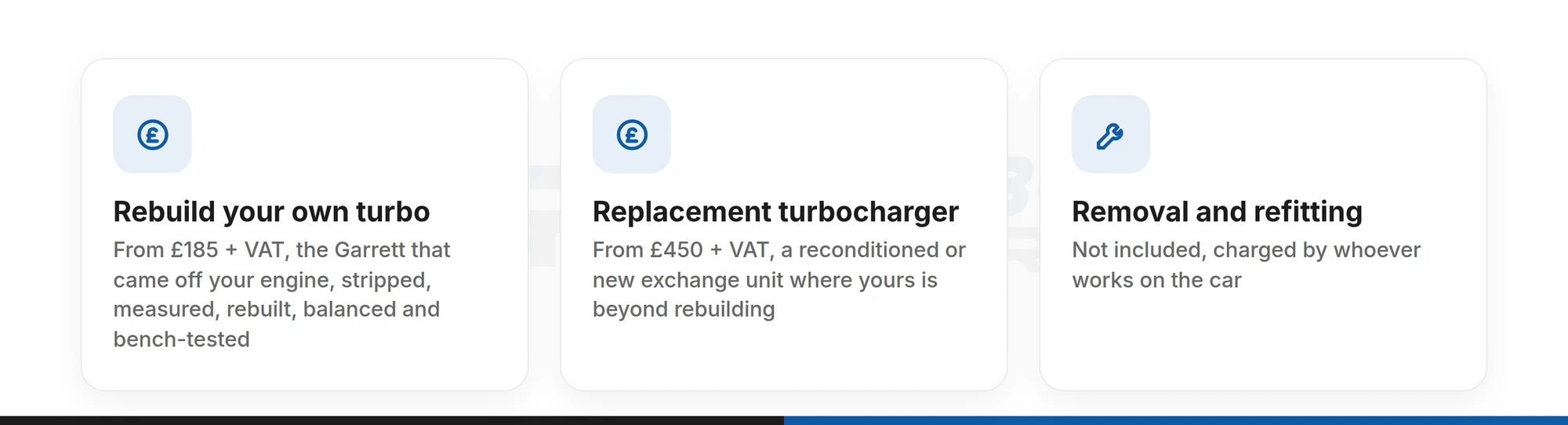
| Rebuild of your own turbocharger | From £185 + VAT | The Garrett that came off your engine, stripped, measured, rebuilt, balanced and bench-tested |
| Replacement turbocharger | From £450 + VAT | A reconditioned or new exchange unit, where yours is beyond rebuilding |
| Removal and refitting | Not included | Charged by whoever works on the car |
The price is confirmed once the unit has been stripped and measured, before any further work goes ahead. A bearings-and-seals rebuild sits at the bottom of the range; a wheel, shaft or housing that fails inspection moves it up. If too much of the unit has gone for a rebuild to make sense, we say so. Our guide to turbo repair and replacement prices covers the parts and labour that sit around the unit as well.
On the 2.2 there is one more reason to rebuild what came off: it is already the right Garrett. A replacement has to be matched to one of three references, and on an N22A2 CR-V the engine code alone will not choose between two of them.
Honda 2.2 Diesel Turbo FAQ
How much does a Honda CR-V 2.2 diesel turbo repair cost?
Rebuilding your own turbocharger with us starts from £185 + VAT, and a replacement turbocharger starts from £450 + VAT. Removal and refitting are charged separately by whoever does the work, and your exact price is confirmed once the unit has been inspected.
Which turbo does my Honda CR-V 2.2 diesel have?
The listings give three: the 802014 on the N22A2 from 2005 to 2008 at 140 bhp, the 759394 on the N22A2 from 2007 to 2010 at 138 bhp, and the 794786 on the Euro 5 N22B3 from 2010 at 148 bhp. On a 2007 or 2008 CR-V the first two overlap, so the Garrett number on the label settles it.
Is the Civic 2.2 diesel turbo the same as the CR-V’s?
Sometimes. The listings put the 802014 on both the Civic and the CR-V, with the FR-V as well, on the N22A2 from 2005 to 2008. The 759394 and the 794786 are listed for the CR-V only, so a later CR-V does not share its turbocharger with the Civic.
Do you rebuild the 1.6 i-DTEC or the 1.5 VTEC Turbo?
They are not covered on this page, because both use different turbochargers from the 2.2. If you have one of them, put the number from its label on the Repair Form and we will tell you whether we can rebuild it.
Can I keep driving with a failing turbo?
Not once there is a rising mechanical noise or heavy smoke, because the longer a failing turbocharger runs, the less of it is left to rebuild. A boost fault with no noise and no smoke is worth checking at the pipework first, since a split hose can produce the same fault on a healthy turbo.
Do you fit bigger or upgraded turbos to the CR-V?
No. We rebuild the turbocharger your engine was built with, to its original specification. Upgrade turbochargers are a different job, and we do not supply or fit them.
How long does it take, and what is the warranty?
Bench time is typically one to three working days from arrival, plus postage each way. Every rebuild carries a lifetime, unlimited-mileage warranty with no time limit.
Final Thoughts
Honda’s 2.2 diesel has a short turbo list, three Garretts across two engine codes, but a CR-V owner can still get it wrong. The word turbo leads searches to the petrol car, the engine code leaves two candidates on some 2007 and 2008 CR-Vs, and a Honda number copied from a listing may not describe the unit on your engine.
The Garrett number on the label cuts through all of it, and a rebuild of the unit that came off does not need matching at all. Check the oil, the pipework and the codes first, take the turbo off before a worn bearing takes the wheels with it, and send it in complete.
Turbo Repairs · Epsom workshop
Keep the Garrett your Honda already carries
Send the turbo in with the Repair Form and the numbers from its label. It is matched to its Garrett reference, rebuilt and proved on the bench, and returned ready to go back on your CR-V, Civic or FR-V with no part number left to match.
Lifetime, unlimited-mileage warranty · Mail-in from the UK and internationally · Bench-tested and calibrated before it ships