

Summary The turbo on your car is identified by the label on the turbocharger itself, not by the registration or the model name. Find the plate or label on the housing, photograph every number on it, and send those photographs with your vehicle details. The turbo maker’s own reference is the one that decides the rebuild, and the shape of each number tells you whose reference you are looking at.
Below: why the car alone cannot answer the question, where the label sits, how Garrett, BorgWarner, IHI and Mitsubishi numbers are built, what to do when the label has gone, and exactly what to send when you book.
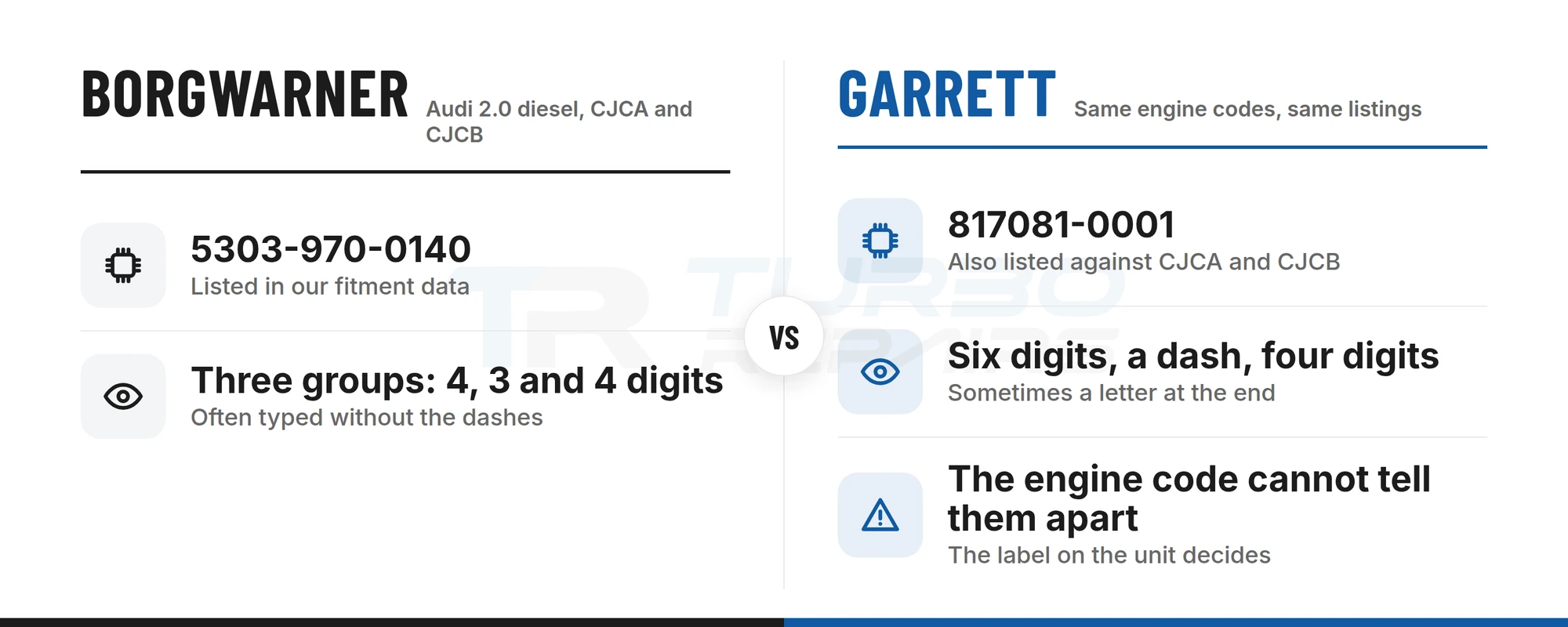
In our fitment data, Audi’s CJCA and CJCB 2.0 diesel engine codes are listed against both a BorgWarner turbocharger and a Garrett, so even the engine code can leave two makers on the shortlist.
Most answers to this search hand you a box for your registration. That box returns what is catalogued for the vehicle, and on a lot of engines that is a list of turbochargers rather than one. This guide works from the other end: the unit bolted to your engine, and the numbers its maker put on it.
Why the Car Is Not Enough to Identify the Turbo
A carmaker rarely fits one engine with one turbocharger for the whole of that engine’s production. Power outputs change, emissions rules change, suppliers change, and the same engine code can end up carrying units from more than one turbo maker. A parts catalogue keyed to the vehicle has to show all of them.
Our own fitment data shows how wide that gets. Audi’s CJCA and CJCB 2.0 diesels are listed against a BorgWarner unit, 5303-970-0140, and against a Garrett, 817081-0001. BMW’s N47D20C 2.0 diesel is listed with a Mitsubishi TF035 under 49335- references and with an IHI RHV4 under numbers such as 781232103, and the two overlap in power output. Our BMW N47 turbo repair page shows how output narrows that choice; it does not remove it.
Melett, which manufactures turbocharger parts for the repair trade, says the same thing on its own vehicle search: many different turbo models are fitted to similar applications, and the only way to be 100% accurate is to get the turbo number from the actual turbo. That is the rule this guide follows.
There is a second reason. On an older car, the turbocharger fitted today may not be the one it left the factory with, and a replacement from another source can carry a different reference. The label describes what is on the engine now, which is the only thing a rebuild can be matched to.
Where the Label Is, and What to Photograph
Turbo makers mark their units with a riveted plate or a printed label on the housing. BorgWarner’s identification guidance states that its nameplate is fitted to the compressor housing, the intake side of the unit. On many installations the label faces the bulkhead or sits partly under a heat shield, so expect to look for it rather than see it straight away.
You can often read it with the turbocharger still on the engine. Take off the plastic engine cover, find the turbo where the exhaust manifold meets the intake pipework, and use a torch with your phone’s camera, or a small inspection mirror, for the faces you cannot see directly. Work with the engine cold: the turbine side runs at exhaust temperature.
What to photograph:
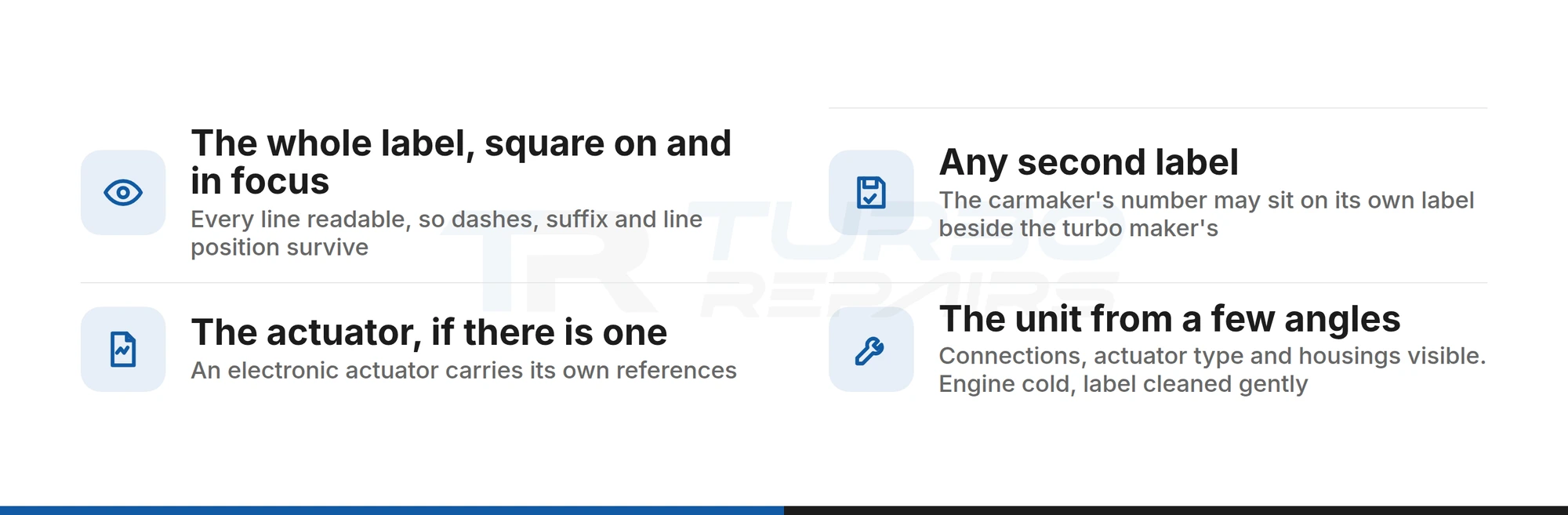
- The whole label, square on and in focus, with every line readable. A single number copied by hand loses the dashes, the suffix and the line it came from.
- Any second label. The carmaker’s number may share the plate with the turbo maker’s, or sit on a label of its own. Photograph both.
- The actuator, if there is one. An electronic actuator carries its own references, separate from the turbocharger’s.
- The unit from a few angles, so the connections, the actuator type and the housings can be seen.
Clean before you shoot. A rag and a little degreaser will lift an oil film; a wire brush or an abrasive pad can take the printing off with it.
Garrett Labels
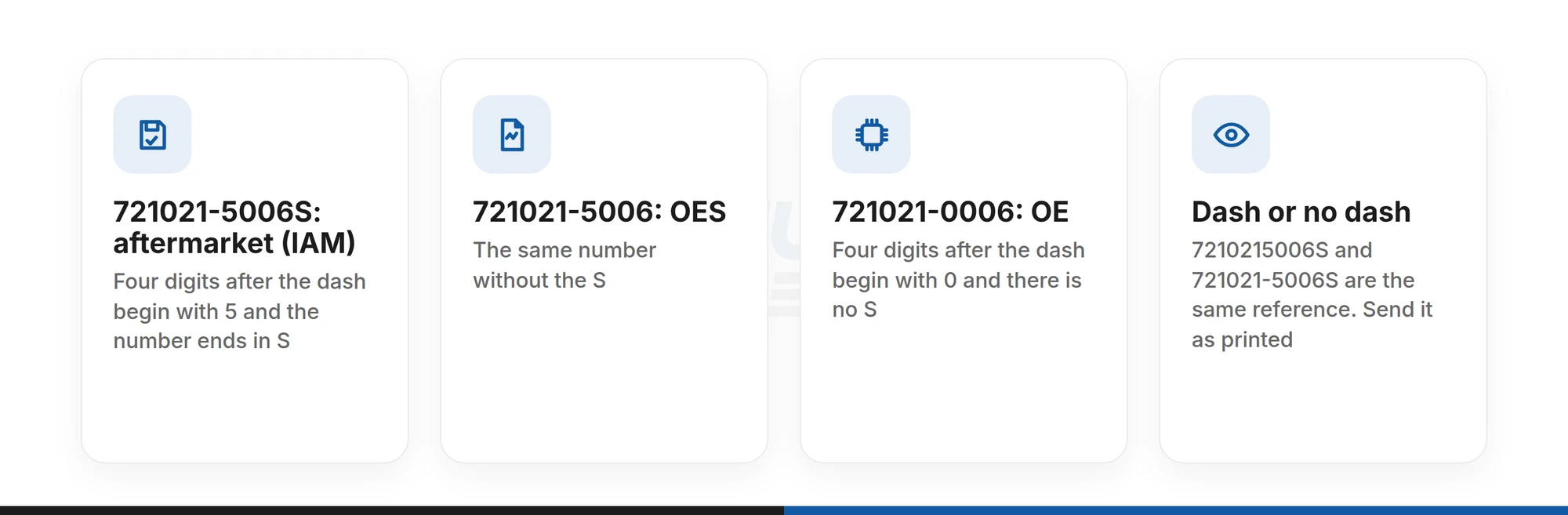
Garrett part numbers have a fixed shape: six digits, a dash, four digits, and sometimes a letter at the end. Garrett’s own part-number guidance uses 721021-5006S as its example, and explains that the end of the number records how the unit was supplied:
- Aftermarket (IAM): the four digits after the dash begin with 5 and the number ends in S, as in 721021-5006S.
- OES: the same number without the S, as in 721021-5006.
- OE: the four digits after the dash begin with 0 and there is no S, as in 721021-0006.
Garrett also notes that its system recognises the number with or without the dash, so 7210215006S and 721021-5006S are the same reference. Most Garrett numbers in our fitment data are in the OE form: 717858-0004 on an Audi A4 2.0 diesel, for example, and 817081-0001 on the A4, A5, A6 and Q5. Send whichever form is printed on your label, exactly as printed.
Labels and listings often carry a model designation too, such as GT2052V or GTA1749V. That is a type and size code shared by many different turbochargers, not the part number. Our Garrett GT2052V repair page explains the difference on one common unit, and the GT1749V page shows how many separate references can sit under a single designation.
BorgWarner Labels
BorgWarner’s turbocharger identification guidance lists three numbers on its nameplate: the OEM part number given by the vehicle or engine manufacturer, a serial number unique to that individual turbocharger, and BorgWarner’s own part number, inherited from the former 3K/Schwitzer numbering. BorgWarner calls its own number the most useful for all service purposes, so read that one first. Our BorgWarner turbo repair page sorts the prefixes we rebuild.
It is written in three groups of four, three and four digits, as in 5303-970-0140 or 5435-970-0012, and is often typed without the dashes. The first group points at a family: 5303 on many K03-family units, 5435 on the 35-series KP and BV units, 5439 on the 39-series. It points rather than names. In our fitment data 5303 also covers the BV43 on Audi 2.0 diesels, and a 5435 can be a BV35 as well as a KP35.
The middle group moves around between listings for what is sold as one unit; one seller lists 970, 971 and 988 forms of a single KP35 base number. A middle group that differs from your label is not, on that alone, a different turbocharger. Our KP35, KP39 and BV39 repair page covers that family in depth, and the K03 and K04 repair page walks through the nameplate on that frame.
The serial number does not identify the model, but photograph it anyway. BorgWarner notes that it refers to details such as the production date, and it belongs to your unit alone.
IHI and Mitsubishi (MHI) Labels
Mitsubishi Heavy Industries
MHI numbers take one consistent shape: 49, three more digits, a dash and five digits, as in 49135-05830 or 49335-00510. The first five digits place the unit in a family, and the five after the dash identify one build within it. On BMW’s 2.0 diesels, for instance, the TF035 appears under both 49135- and 49335- references in our fitment data. Our Mitsubishi MHI turbo repair page maps each prefix to the engines it is fitted to, and a Mitsubishi label does not mean a Mitsubishi car.
IHI
IHI is the maker where the whole label matters most, because IHI units are often catalogued under something other than one long IHI number. In our fitment data they appear under short IHI codes such as VV14 and VV20, under longer references such as VF40A132, and on some engines only under the carmaker’s number. The RHF4V on Mercedes four-cylinder diesels in the C-Class, E-Class and GLK is listed as A6510900086, a Mercedes-Benz number, and one Sprinter and Viano unit is catalogued as VV21-A6510901180: an IHI code and a Mercedes number joined into a single reference.
IHI’s model names, such as RHF4 and RHV4, describe a family in the same way Garrett’s GT codes do. Mazda’s earlier 2.2 diesel, for example, is listed with VJ-series IHI units, and our Mazda 6 and CX-5 2.2 diesel page shows how the label separates them. On an IHI, the code, any long number and the carmaker’s reference may each be the one a catalogue files the unit under, so photograph all three.
When the Label Is Missing or Unreadable
A label on a turbocharger lives beside the exhaust, so it does not always survive. Printing bakes off, plates corrode, and a previous repair may have painted over one or removed it. A missing label makes identification slower, not impossible.
Start with what survives. A carmaker’s number on a separate label, the actuator and its own references, and whether that actuator has an electrical connector or a vacuum pipe all narrow the field. So do the vehicle details on your V5C.
With the unit in hand, the turbocharger identifies itself by measurement. The trade’s parts databases are built for exactly this: Melett describes more than 150,000 turbo build sheets in its catalogue, and its tools match a compressor wheel or a shaft and wheel by dimensions to within 0.5 mm. Wheel sizes, housing castings and the actuator narrow the build to a short list, and the vehicle details settle the rest.
So if the label has gone, do not pick a number from a listing that looks about right. Send the photographs and the vehicle details first. If those cannot pin the unit down, post it in and it is identified on arrival, with the result confirmed to you before any work starts.
Turbo Repairs · Epsom workshop
Label gone, or a number you cannot place?
Send your photographs and vehicle details through the repair form and we identify the unit before it leaves your hands. Where the photographs cannot settle it, the bench can.
Lifetime, unlimited-mileage warranty · Mail-in from the UK and internationally · Bench-tested and calibrated before it ships
Which Numbers to Send When You Book
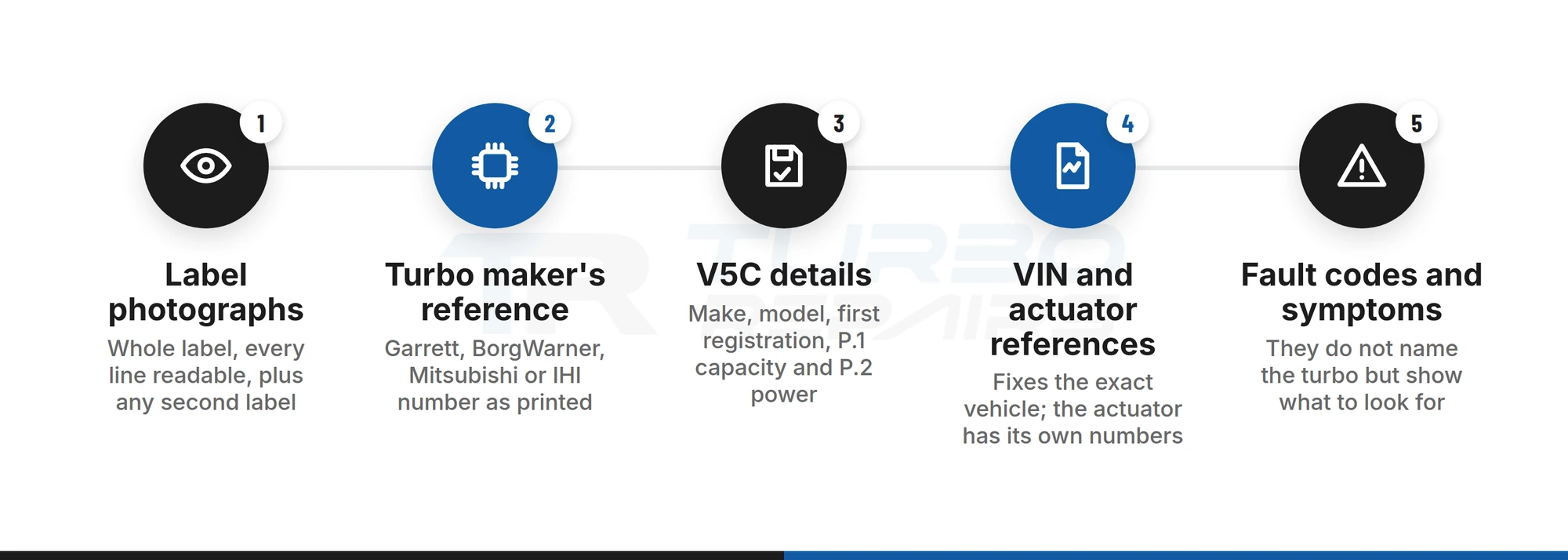
The repair form asks for your vehicle and the fault. These are the details that let us identify the unit before you post it, in order of how much they help:
- Photographs of the whole label, every line readable, plus any second label. If you type a number out as well, copy it exactly, dashes and suffix included.
- The turbo maker’s reference, if you can pick it out: the six-digit Garrett number with its four-digit suffix, the BorgWarner number in its three groups, the 49-prefixed Mitsubishi number, or the IHI code.
- Vehicle details from the V5C: make, model, date of first registration, cylinder capacity (P.1) and power output (P.2). On several engines the power output is what sorts one turbocharger from another.
- The VIN, also on the V5C. It does not name the turbo, but it fixes the exact vehicle the label is being matched against.
- The actuator’s references, if it has an electronic one. On a Hella unit those are a 6NW number and a G-code, and our Hella actuator index shows how to read them.
- The stored fault codes and what the car is doing. They do not identify the turbo, but they tell us what to look for when it arrives. Our guide to turbo actuator fault codes explains what each kind of code points at.
That is enough to confirm the unit and quote it before anything is posted. Turbocharger rebuilds start from £185 + VAT and electronic actuator repairs from £100 + VAT; where a turbo is past rebuilding, a replacement starts from £450 + VAT. If the actuator is the only part that has failed, our guide to turbo actuator replacement cost compares the routes.
Where your vehicle already has a rebuild listing, the shop lists rebuilds by vehicle, and the label still decides which unit the work is done on. Garages booking a unit in for a customer can use the same list; the label photograph saves more time than anything else on it.
Turbo Part Number FAQ
Can I find my turbo part number from my registration?
Not reliably, and we do not offer a registration lookup. A registration identifies the vehicle; a parts catalogue then shows every turbocharger listed for that vehicle, which on many engines is more than one. Use the registration to narrow the field, then send a photograph of the label so the unit on your engine decides.
Is the size code (e.g. GT2052V) the part number?
No. Names such as GT2052V, GTA1749V, K03 or TF035 describe a type or frame size shared by many different turbochargers. The part number is the full reference: six digits, a dash and four on a Garrett, three groups on a BorgWarner, 49 followed by three digits, a dash and five on a Mitsubishi. Our GT2052V page explains the difference on one common unit.
What if the label has burnt off?
Send photographs of the unit, any other labels, the actuator and your vehicle details first. If that does not settle it, post the turbocharger in. It is identified by measurement on arrival, and the result is confirmed with you before any work starts.
Which number matters most if the label has several?
The turbo maker’s own reference. BorgWarner describes its own part number as the most useful for service, and in our fitment data Garrett and Mitsubishi units are catalogued under their makers’ numbers too. The carmaker’s number is still worth sending, because some units, IHI ones especially, are catalogued under it.
Do the letters at the end of a Garrett number matter?
They record how the unit was supplied. Garrett’s own example gives 721021-5006S as the aftermarket form, 721021-5006 as OES and 721021-0006 as OE. Send the number exactly as it is printed on your label and we take it from there.
How can I tell whether my car has a turbo at all?
The badge is the quickest clue: a T in TDI, TSI, TFSI or TDCi usually means turbocharged, though not every T does, and GTI and TT are exceptions. The handbook will say for certain. Under the bonnet, the turbocharger is the snail-shaped unit bolted where the exhaust manifold’s pipes gather into one, although on many modern engines a cover hides it.
Final Thoughts
Every number on a turbocharger label was put there by someone with a different job: the carmaker numbering a part in its own system, the turbo maker numbering a build, and a serial that belongs to one unit only. Knowing whose number you are reading is most of the work, and the shape of the number tells you that at a glance.
A registration gets you to a shortlist; the label gets you to one turbocharger. Photograph it before anything else is done, and the quote, the rebuild and the part that comes back all start from the unit that is actually on your engine.
Turbo Repairs · Epsom workshop
Identify it from the label, then rebuild the turbo you already have
Complete the repair form with your vehicle details and a photograph of the label, and we confirm the unit and the price before you post anything. Once it arrives, a rebuild is typically completed in one to three working days.
Lifetime, unlimited-mileage warranty · Mail-in from the UK and internationally · Bench-tested and calibrated before it ships