

Summary The Garrett GT1749V is a family rather than a single turbocharger, and on this family the letters either side of 1749 sort the engine before the six-digit number sorts the turbo. In our fitment data every GTB1749VK sits on a BMW N47 or a Mercedes OM646, every GTB1749MV on a VW-group 2.0 TDI at 161 or 168 bhp, and a GTA1749MV turns up on engines as far apart as a Golf’s, a Transit’s and a Vectra’s. This page maps each variant to the cars it is catalogued for, sends you to the page written for your engine, and sets out how we rebuild your own unit, from £185 plus VAT.
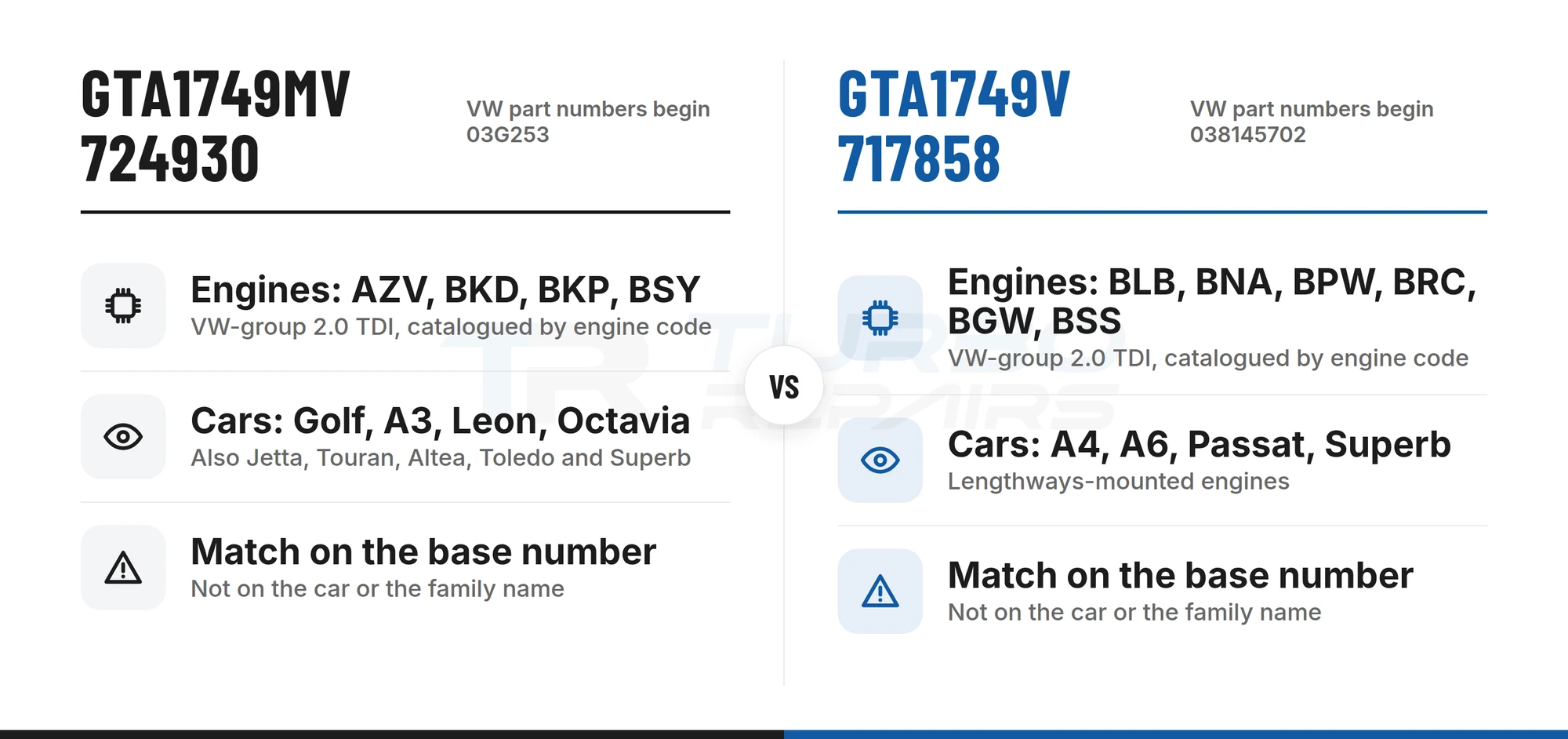
A 2003 VW Passat 2.0 TDI can carry either of two GT1749s: a GTA1749V, 717858, on the BGW engine, or a GTA1749MV, 724930, on the BKD, each under its own run of VW part numbers.
- The family in our fitment data: 93 turbocharger numbers under 26 Garrett base numbers, across Audi, BMW, Ford, Mercedes-Benz, Seat, Skoda, Vauxhall and Volkswagen.
- Designations catalogued: GTA1749V, GTA1749MV, GTA1749MVK, GTB1749MV, GTB1749VK, GT1749V, GT1749MV and GT1749V(S2).
- Engine families: VW-group 2.0 TDI, Ford 2.0 TDCi and the earlier Duratorq 2.0, Vauxhall 1.9 CDTi, BMW M47TU and N47 2.0d, and the Mercedes OM646 2.2 in the Sprinter.
- Vane control: both vacuum and electronic actuators occur in the family. A pipe or a plug on the actuator tells you which you have.
- Cost: rebuild from £185, replacement from £450, electronic actuator repair from £100, all plus VAT. Fitting is not included.
- Turnaround and cover: turbo rebuilds typically take 1 to 3 working days; every rebuild carries a lifetime, unlimited-mileage warranty.
Most pages that rank for this turbocharger sell one unit for one group of cars. The GT1749 name reaches much further than any single listing suggests, which is why a part sold as “the GT1749V” can be the wrong turbo for a car that genuinely has one.
This page is the map. How a Garrett designation is read, and how the variable vanes inside it move, are covered on our Garrett GT2052V page; here the question is which GT1749 your engine carries, and where to go next.
The GT1749 Variants and Where Each One Is Fitted
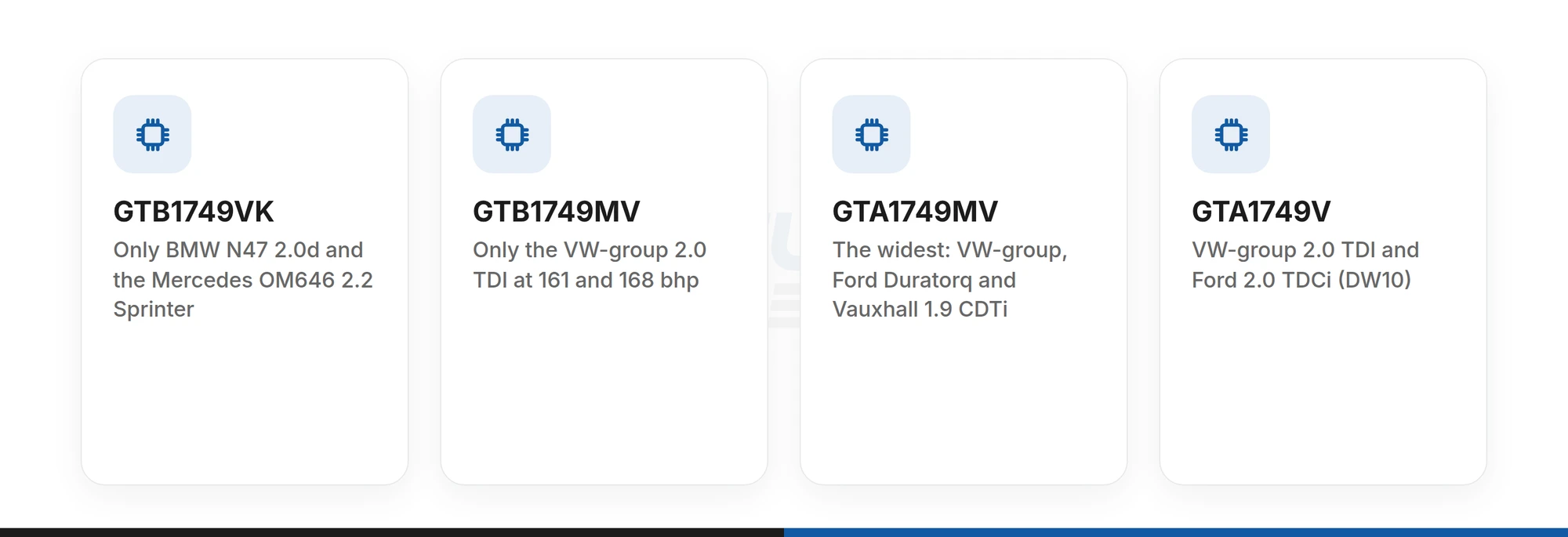
The table groups our fitment data by the designation each turbocharger is catalogued under. Each row names the Garrett base numbers behind that designation and the engine family they are listed for. The base number, the six digits before the dash on the label, is still what identifies your unit; the designation only narrows the search.
| Designation as catalogued | Garrett base numbers | Engine family and codes listed | Makes and models |
|---|---|---|---|
| GTA1749V | 717858 | VW-group 2.0 TDI: BLB, BNA, BPW, BRC, BGW, BSS | Audi A4 and A6, VW Passat, Skoda Superb |
| GTA1749V | 758219 | VW-group 2.0 TDI: BRE, BRF, BVF, BVG | Audi A4 and A6, VW Passat |
| GT1749V(S2) | 712077 | VW-group 2.0 TDI: BLB, BNA, BPW, BRC, BGW, BSS | Audi A4 and A6, VW Passat, Skoda Superb |
| GTA1749V | 728768, 753847, 760774, 765993 | Ford 2.0 TDCi: DW10BTED4 and DW10 BTED 4S | Ford Focus, C-Max, Galaxy, S-Max, Kuga, Mondeo |
| GTA1749MV | 724930, 838946, 756062 | VW-group 2.0 TDI: AZV, BKD, BKP, BSY and others | Audi A3; VW Golf, Jetta, Passat, Touran; Seat Altea, Leon, Toledo; Skoda Octavia, Superb |
| GTB1749MV | 757042 | VW-group 2.0 TDI at 161 and 168 bhp: BMN, BMR, BUY, BUZ | Audi A3; VW Golf, Jetta, Passat, Touran; Seat Altea, Leon, Toledo; Skoda Octavia |
| GTA1749MV | 704226, 714467 | Ford’s earlier Duratorq 2.0: Duratorq DI, and FIFA in the Transit | Ford Mondeo, Transit |
| GTA1749MVK | 728680 | Ford Duratorq 2.0, listed as Puma | Ford Mondeo |
| GTA1749MV | 740080, 752814, 755042, 755373, 767835 | Vauxhall 1.9 CDTi, 8-valve: Z19DT, Z19DTL, JTD 8V | Vauxhall Astra, Zafira, Vectra, Signum |
| GTA1749MV and GT1749MV | 755046, 766340, 773720; 740067 | Vauxhall 1.9 CDTi, 16-valve: Z19DTH, M741 DTH | Vauxhall Astra, Zafira, Vectra, Signum |
| GTB1749VK | 767378 | BMW N47 2.0d | BMW 1 Series, 3 Series, X1 |
| GTB1749VK | 759688 | Mercedes OM646 2.2 | Mercedes-Benz Sprinter |
| GT1749V | 750431 | BMW M47TU 2.0d, 147 bhp | BMW 1, 3 and 5 Series |
Read down the first column and a pattern appears. The GTB1749VK in our data sits only on the BMW and Mercedes engines, and the GTB1749MV only on the higher-output VW-group 2.0 TDI. The plain GTA1749MV is the widest of all, spread across three manufacturers’ engines that share nothing else.
The Mondeo’s 728680 is the busiest single base number in the family, listed in our data under sixteen different dash numbers. That is why two Mondeo turbos can both be genuine 728680 units and still differ in their build detail.
VW’s own part number splits the VW-group units
On the VW-group cars, VW’s reference separates the variants as cleanly as the Garrett one. In our data the 717858 and 712077 units carry VW numbers beginning 038145702, the 758219 units 03G145702, and the 724930 and 757042 units numbers beginning 03G253. A UK specialist sells the 717858 specifically for the lengthways-mounted 1.9 and 2.0 TDI in the A4, A6, Passat and Superb, under the same 038145702 numbers.
So a Passat owner holding a 038145702 part and a Golf owner holding an 03G253 part both own GT1749s, and neither should buy the other’s.
Which Cars Carry a GT1749-Family Turbo
The GT1749 is the same kind of unit on every engine in the table, but the reasons it fails, and what else has to be put right, belong to the engine. Each engine family below has its own page, and that page is the one to read next.
Audi, Seat, Skoda and Volkswagen 2.0 TDI
The largest share of the family. Most of the 2.0 TDI rows for the Golf, A3, Leon, Octavia, Touran and the BKD-engined Passat are GTA1749MV or GTB1749MV units. Our VW Golf TDI turbo page covers the engine-code changeover that decides which turbo a Golf of a given year has. For the lengthways-mounted cars, the Audi A4 TDI turbocharger rebuild page covers the A4 and its particulate-filter context.
Where no model page exists, the listing for your car gives the rebuild price for your year and output: Audi A3 2.0 TDI, Seat Leon 2.0 TDI, Skoda Octavia 2.0 TDI, VW Passat 2.0 TDI and VW Touran 2.0 TDI.
Ford 2.0 TDCi, the earlier Duratorq and the Transit
In our fitment data the DW10-coded Ford 2.0 TDCi units, 728768, 753847, 760774 and the Kuga’s 765993, are all catalogued as GTA1749V. Our Ford 2.0 TDCi turbo page covers how those turbos are shared across the Focus, C-Max, Kuga, S-Max, Galaxy and Mondeo. The 2000 to 2002 Transit 2.0 on the FIFA engine carries a GTA1749MV, 714467, and has its own Ford Transit turbo rebuild page.
The Mondeo’s Puma-coded 728680 is catalogued with a Hella electronic actuator, which the Ford Mondeo 2.0 TDCi actuator page covers. Supplier listings put the same Ford-derived GT1749V family on the Jaguar X-Type 2.0 and 2.2 diesel. Citroen’s 136 bhp 2.0 HDi, on the DW10BTED4S, is catalogued with a GT1749V on 756047; our Citroen turbo repair page covers that engine.
Vauxhall 1.9 CDTi
Every 1.9 diesel row for the Astra, Zafira, Vectra and Signum in our data is a GT1749-family unit: nine base numbers, split between the 8-valve and 16-valve engines. Our Vauxhall Astra and Zafira CDTi turbo page explains why the 1.9 is a different engine from the 1.6 and 1.7 CDTi, and which references go with which output.
BMW 2.0d
Two BMW engines carry the family. The N47 is catalogued with the GTB1749VK, 767378, at its lower outputs, and our BMW N47 2.0d turbo page covers how power output sorts the N47’s turbochargers. The earlier M47TU at 147 bhp carries a GT1749V, 750431, in our data for the 1, 3 and 5 Series; there is no separate page for it, so the Repair Form is the place to start.
Mercedes-Benz Sprinter 2.2
The OM646-engined Sprinter is catalogued with a GTB1749VK, 759688, in our data. The Mercedes Sprinter and Vito turbo page covers which OM646 vans carry it and which carry a different layout.
What Fails on a GT1749V
The parts that wear on a GT1749 are the same whichever engine it came off. What differs is how quickly, and that is set by the engine’s oil, its duty and its exhaust.
The vane ring. Soot and oil vapour bake onto the vanes and their pivots until the ring moves late, partly or not at all. Boost then overshoots or falls short of what the engine management asked for, a fault is stored and power is cut. Why a ring that frees itself on a long run is still getting worse is covered in our guide to variable-vane turbos.
Bearings and thrust parts. The shaft turns on engine oil, and one UK remanufacturer lists the 724930’s cooling type as oil. On that unit the oil is doing two jobs, lubricating the bearings and carrying heat out of the centre housing. Stretched service intervals, a part-blocked feed pipe and switching off straight after a hard run all take from both.
Seals. Worn seals let oil into the intake or the exhaust: blue smoke, an oily intercooler, oil used with no visible leak. A restricted drain or high crankcase pressure produces the same symptoms through healthy seals, so the seals are the last thing to condemn.
The compressor wheel. Debris drawn in through the intake chips the blades, and a shaft that has worn its bearings lets the wheel touch its housing. A damaged wheel is replaced, never dressed and refitted.
In most failures the cause sits on the engine rather than in the turbo, which is why a new or rebuilt unit fitted without finding it goes the same way. Our guide to common turbocharger problems sorts the symptoms by where on the shaft they start, and the one on whether a blocked DPF can cause turbo failure covers the most common exhaust-side cause on these diesels.
Turbo Repairs · Epsom workshop
Send your GT1749 with its label photographed
The label decides which of the 26 base numbers you have, and with it the parts the rebuild needs. Post the turbocharger in with a clear photograph of the label and the car’s details, and it is identified, tested as received and stripped before anything is renewed.
Lifetime, unlimited-mileage warranty · Mail-in from the UK and internationally · Bench-tested and calibrated before it ships
Vacuum or Electronic Vane Control on the GT1749
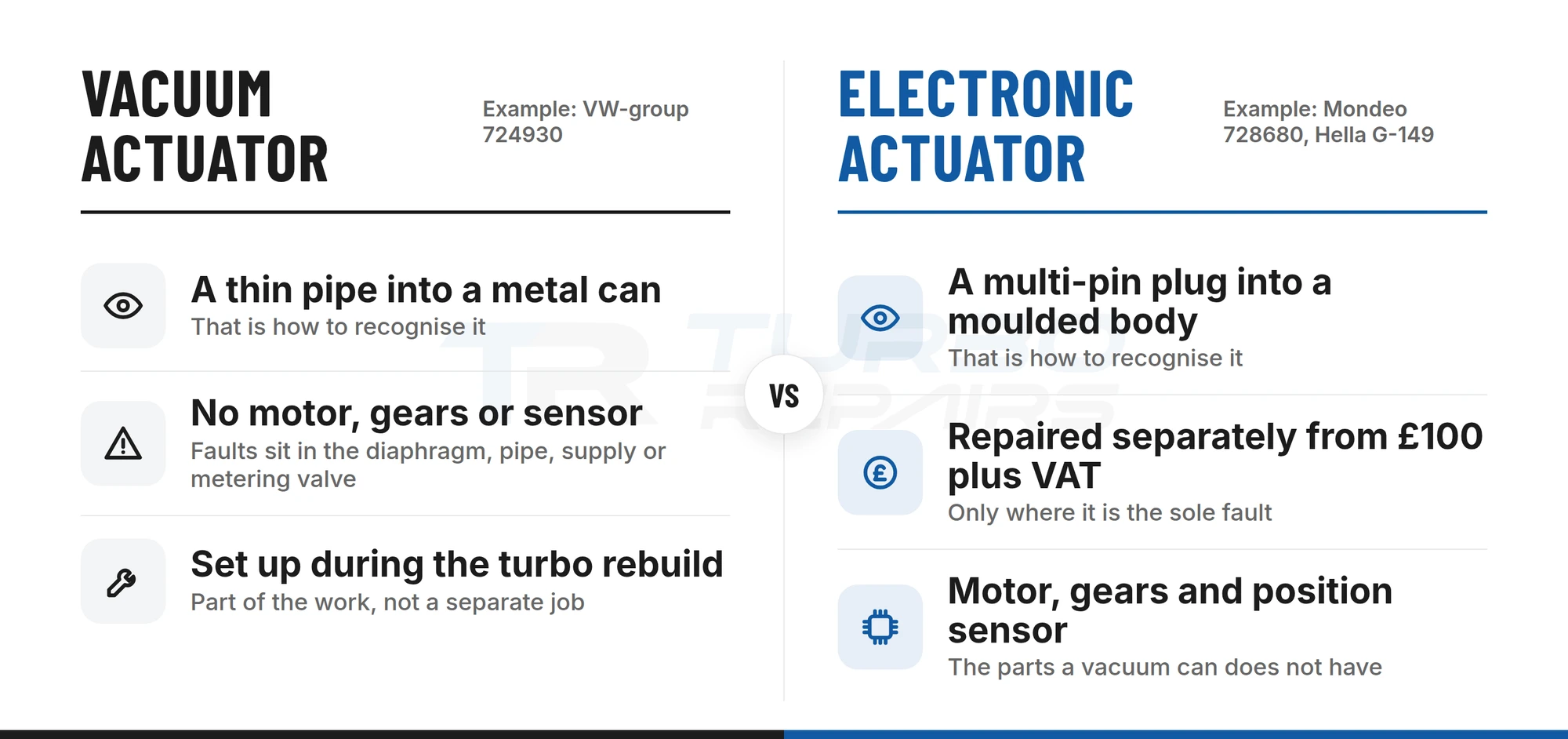
The family is built with both kinds of vane control. One UK remanufacturer lists the VW-group 724930 as vacuum-actuated, while the Mondeo’s 728680 carries a Hella electronic actuator catalogued as G-149.
The kind on your turbo changes the job. A thin pipe into a metal can means vacuum; a multi-pin plug into a moulded body means electronic. Our Mondeo actuator page shows how to tell the two apart on the car and how each one fails.
An electronic actuator that has failed on its own can be rebuilt separately, from £100 plus VAT, with the turbocharger left on the engine; our turbo actuator repairs cover those units. A vacuum can has no motor, gears or position sensor to rebuild. Its faults sit in the diaphragm, the pipe, the vacuum supply or the valve that meters it, and on a vacuum-controlled GT1749 the actuator is set up as part of the turbo rebuild.
Our Garrett GT1749V Rebuild
Take the turbocharger off, complete the Repair Form, and post the unit to Unit 102 Reaver House, 12 East Street, Epsom, Surrey, KT17 1HX, United Kingdom. Units come in from across the UK and internationally, from private owners and from garages rebuilding a customer’s turbo. What goes back is the unit you sent, not a substitute from a shelf.
- Identified before it is opened. The label is read and the base number, dash number and designation recorded. If the label has burned off, the unit is identified on the bench from its housings and nozzle ring.
- Tested as received. The vane mechanism and the rotating assembly are checked before stripping, so the report describes what actually failed.
- Stripped, cleaned and measured. Every component is measured against original specification. Wear outside tolerance means renewal, not reassembly.
- Rebuilt. Bearings, seals and thrust parts are renewed; any wheel, shaft, nozzle ring or housing that fails inspection is replaced with genuine OE or OEM-grade parts, or uprated where the original has a known weakness.
- Balanced and set up. The rotating assembly is balanced, the vane mechanism proved through its full travel, and the actuator set to the turbo it sits on.
- Tested again. The finished unit is bench-tested before it is packed.
If the inspection shows the turbo is too far gone to rebuild sensibly, we tell you and recommend a replacement before any work goes ahead. Rebuilds typically take one to three working days from the unit reaching us, plus postage each way.
What it costs
- Rebuilding your own GT1749: from £185 plus VAT. The listing for your car gives the fixed price for your year and output.
- A replacement turbocharger: from £450 plus VAT, for a unit that is not worth rebuilding.
- An electronic actuator repair: from £100 plus VAT, only where your GT1749 carries an electronic actuator and that is the only fault.
None of these covers removal, refitting, gaskets, a new oil feed pipe or fresh oil. How those figures compare with the wider market is set out in our turbo repair and replacement prices guide.
What to send with it
- A clear photograph of the label, including the digits after the dash.
- The make, model, year and power output; your V5C gives the power in kilowatts at section P.2.
- The engine code if you have it, and any fault codes stored.
- Whether the actuator takes a pipe or a plug.
On refit, renew the oil feed pipe and gaskets, change the oil and filter, and prime the oil feed by cranking without starting before the engine first runs. Our guide to replacing a turbocharger sets out the refit step by step.
Garrett GT1749V FAQ
Is my turbo a GT1749V, a GTA1749MV or a GTB1749VK?
The label on the turbocharger says which, and the table on this page shows the engines each designation is catalogued for. The six-digit base number on the same label is what identifies the unit itself. If the label is unreadable, send the unit anyway: it is identified on the bench before any work starts.
Is the BKD turbo a GT1749V?
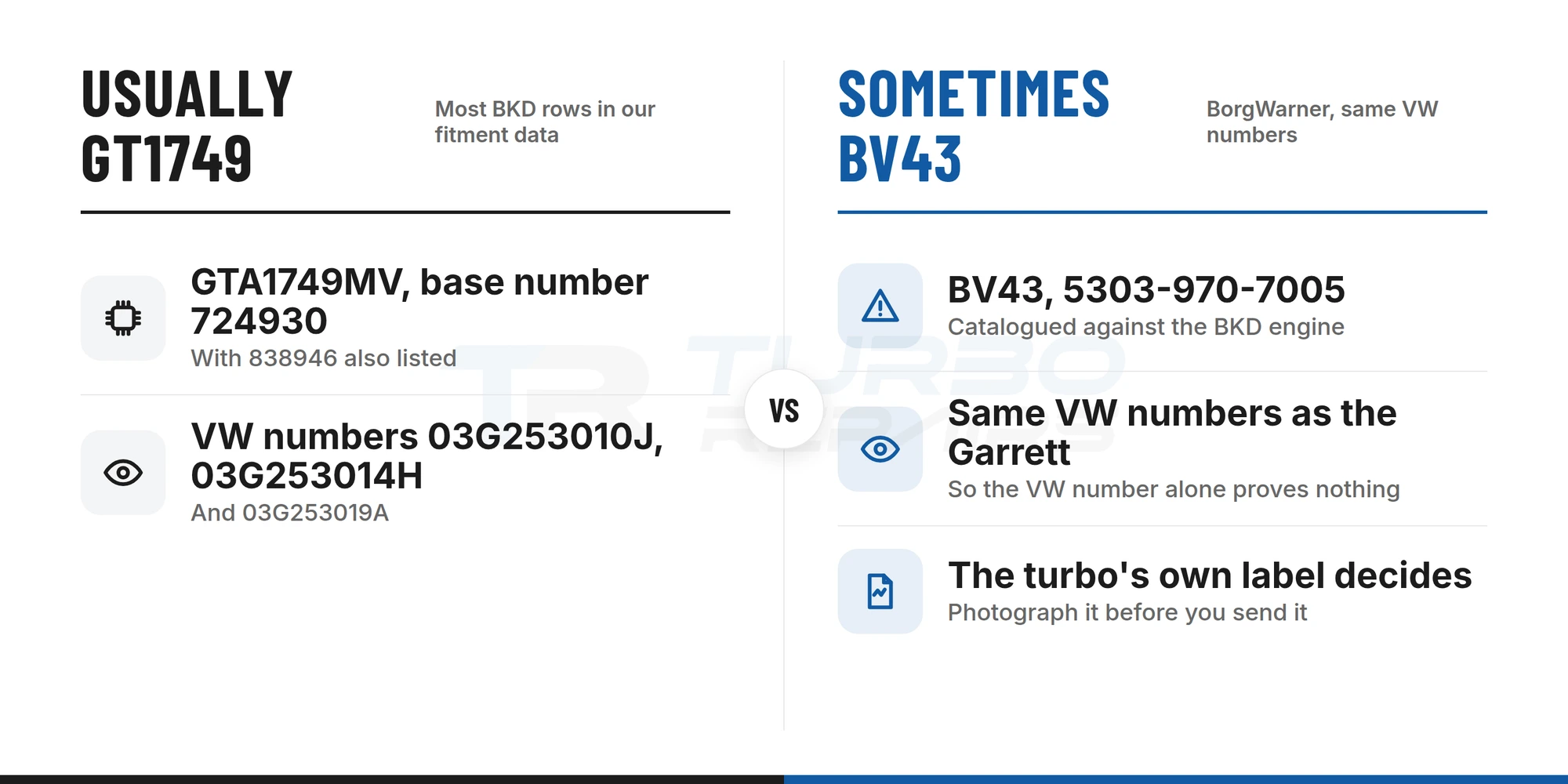
Usually. Most BKD rows in our fitment data are GTA1749MV units on the 724930 base number, with 838946 also listed. But a BorgWarner BV43, 5303-970-7005, is listed against the BKD under the same VW numbers, 03G253010J, 03G253014H and 03G253019A, so the VW number alone does not prove you have a Garrett. The turbo’s own label does.
Can a 724930 replace a 717858, or the other way round?
Do not treat them as interchangeable. They share the GT1749 name but are catalogued for different VW-group installations, under different VW part numbers: 03G253 for the 724930, 038145702 for the 717858. Match any replacement on the base number of the unit you are taking off.
Do you build hybrid or upgraded GT1749s?
No. This page is about rebuilding a GT1749 to its original specification, with uprated components only where the original design has a known weakness. We do not build hybrid or upgraded versions.
How much does a GT1749V rebuild cost?
From £185 plus VAT to rebuild your own unit, or from £450 plus VAT for a replacement turbocharger. An electronic actuator repair on its own is from £100 plus VAT. Removal and refitting are charged separately by whoever does the work.
How long does a GT1749V rebuild take?
Typically one to three working days from the unit reaching our workshop, plus postage each way.
What warranty comes with the rebuild?
A lifetime, unlimited-mileage warranty, with no mileage cap and no time limit.
Final Thoughts
The GT1749 went into more diesel engines than almost any owner would guess, from Golfs and Mondeos to Vectras, BMWs and Sprinters. That reach is the reason so much of what is written about “the GT1749V” is true of somebody else’s car.
The route through it is short. The designation on the label narrows the engine family, the base number names the unit, and the page for your engine covers what put the turbo under strain. From there, a rebuild of your own unit starts from £185 plus VAT and comes back set up for the engine it came off.
Turbo Repairs · Epsom workshop
Your own GT1749, rebuilt for the engine it came off
Complete the Repair Form with your car, year and output, then post the turbocharger in. It is identified from its label, stripped, measured, rebuilt, balanced and bench-tested, and if it is past saving we tell you before any work starts.
Lifetime, unlimited-mileage warranty · Mail-in from the UK and internationally · Bench-tested and calibrated before it ships