

Summary Turbo actuator replacement does not have to mean a new turbocharger. When the electronic actuator is the part that failed and the vanes it drives still move freely, three routes replace less than the whole unit — rebuilding your own actuator, fitting a new one where one is sold for your turbo, or fitting a used one — and only a seized vane mechanism or a worn turbocharger genuinely calls for the turbo itself. Our electronic actuator rebuilds start from £100 + VAT.
Below: why the dealer quote is for a whole turbocharger, whether the actuator can be bought on its own, the four routes side by side, what each price includes, and when the actuator alone will not cure the car.
A genuine Volkswagen parts listing sells a turbo actuator repair kit, but only for a few engine codes with specific turbochargers, so whether the actuator can be bought on its own is decided by your engine, not by the fault.
The search usually starts with a quote: a fault code that points at the turbo actuator, and a price for a complete turbocharger written underneath it. That quote is normally honest about what the garage can order. It is not necessarily a description of what has failed, and the gap between those two things is what this guide sorts out.
Why the Dealer Quote Is for a Whole Turbocharger
A main dealer prices a repair from the manufacturer’s parts catalogue, and that catalogue decides the smallest thing that can be ordered. Where the actuator is not listed as a separate part for your engine, the turbocharger assembly it is bolted to becomes the smallest orderable part. An actuator fault and a turbocharger fault then produce the same line on the quote.
How narrow the catalogue can be shows in a genuine Volkswagen parts listing for a Turbo Repair Kit (Actuator), part number 03L 198 716 L. The listing itself notes that the kit applies only to a few engine codes with specific turbochargers, and asks for a registration or VIN before it will confirm compatibility. Even within one manufacturer, then, whether the actuator can be ordered on its own depends on which engine and which turbocharger are in the car.
There are also two reasons a whole-turbo quote makes sense from the dealer’s side of the counter. A complete turbocharger replaces the vane mechanism along with the actuator, so it cures the fault whichever of the two caused it — and a boost-control code cannot tell those two apart. It also means nobody has to establish which part failed before the car goes back to its owner.
What that certainty costs is everything else that comes apart when a turbocharger is changed. On most cars the actuator unbolts with the turbo left on the engine, so an actuator-only repair leaves the oil feed and return lines, the manifold joints and the gaskets alone. A whole-turbo job disturbs all of them, and it is a much larger job than removing one bolt-on unit.
Can You Buy the Actuator on Its Own?
Often, yes — though not always from the dealer, and not for every turbocharger. Outside the manufacturer’s own catalogue there are three other places a replacement comes from, and each one hands you a different job afterwards.
- New aftermarket actuators. UK sellers list new electronic actuators against specific turbocharger and OE numbers. A Ford Transit 2.2 TDCi unit, for example, is sold under the Hella reference 6NW010430-22 alongside the Garrett turbocharger number 797863-0073, and BorgWarner actuators for VW group 2.0 TDI engines are listed under 5440 references.
- Reconditioned exchange actuators. A unit rebuilt from someone else’s core and sold against the return of yours, in some cases with a deposit held until your old actuator arrives.
- Used actuators. Units taken off other cars by breakers, sold as found.
An actuator being listed for your car is not the same as it being the right one. Units that look identical can differ by turbocharger number, engine code, connector, calibration range and rod length, which is why sellers ask for the references rather than the model name. On a Hella unit those are the G-reference and the 6NW number on the casing, and our guide to reading the Hella number on your unit shows which vehicles each one covers.
The other difference between a new unit and your own is calibration. An electronic actuator’s position sensor reports a raw electrical signal, not a measurement of travel, and that signal only means something once the unit knows which reading is the vane mechanism fully closed and which fully open on the turbocharger it is bolted to. That is why calibration belongs to your turbo rather than to the part, and why some suppliers note that their new actuators need calibrating or adapting on the car after they are fitted.
Four Options Side by Side: Rebuild, New Actuator, Used Unit or Whole Turbo
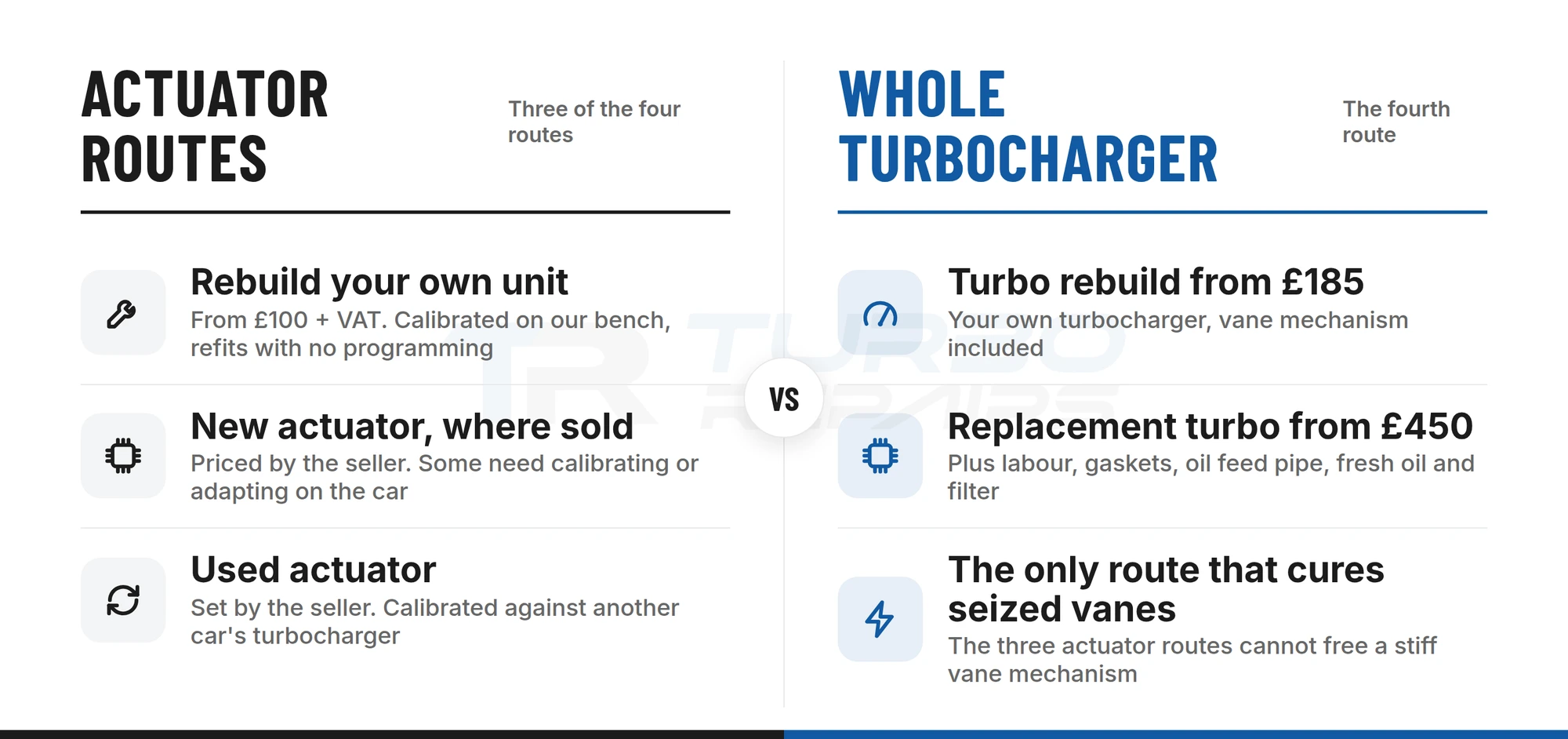
The four routes are best compared by what each one actually replaces, and by who is left responsible for the calibration and the diagnosis.
| Route | What it replaces | Calibration | Cures seized vanes? | Price |
|---|---|---|---|---|
| Rebuild your own actuator | The worn parts inside it: motor, gear train, position sensor, seals, board connections | Set on our bench to the specification the unit’s own reference demands; refits with no programming | No | From £100 + VAT |
| New actuator, where one is sold | The whole actuator | Depends on the unit and the vehicle; some need calibrating or adapting on the car | No | Set by the seller, per part |
| Used actuator | The whole actuator, for one of unknown age and duty | Set up against another car’s turbocharger | No | Set by the seller |
| Whole turbocharger | The turbocharger, including its vane mechanism | Depends on how the replacement is supplied | Yes | Turbo rebuild from £185 + VAT; replacement turbo from £450 + VAT |
Three of the four rows answer an actuator fault. Only the last answers a turbocharger fault, and the column asking whether a route cures seized vanes is the one that decides which half of the table you belong in.
Rebuild your own actuator
The unit that failed is tested as it arrives, before it is opened, so the fault is established as a measurement rather than inferred from the code that came with it. Worn parts are renewed rather than cleaned, components with a known weakness in the original design are uprated, and the unit is calibrated and signed off before it is packed. Because it goes back onto the turbocharger it came off, nothing has to be matched or taught to the car.
A new actuator
A sound choice when one is catalogued against the exact references on your unit and you know how it will be set up once it is on. The questions to ask the seller are which references it matches, whether it needs calibrating or adapting after fitting and who does that, and whether it is sold as an exchange against the return of your old unit.
A used actuator
The lowest outlay of the four, and the one with the least known about it. The unit has spent its working life holding positions against exhaust gas on another engine, so its motor and gears have done an unknown amount of the wear that retired yours, and its calibration belongs to a turbocharger you will never see.
A whole turbocharger
The right answer when the turbocharger itself is the problem: vanes seized beyond freeing, a worn rotating assembly, oil where it should not be. For a fault confined to the actuator, it replaces a great deal of sound hardware to reach one bolt-on part.
What Each Option Costs, and What the Price Includes
Comparing headline figures only works if each one is buying the same thing, and they are not. Here is what sits behind each price.
Rebuilding your own actuator — from £100 + VAT. That covers the test as received, the component-level rebuild, calibration and a sign-off test before the unit leaves; our page on how a rebuilt actuator is tested sets out both tests. The exact figure depends on which components need renewing, and you are told it before any work goes ahead. Turnaround is typically one to two working days from the unit arriving, plus postage each way, and the repair carries a lifetime, unlimited-mileage warranty.
A new actuator — the seller’s price, per part. We do not reproduce other sellers’ figures here, because they vary by part and change. Check what the price covers before comparing it: whether setting up on the car is included or left to you, whether a deposit is held until your old unit is returned, and what warranty applies.
A used actuator — the breaker’s price. Whatever it costs, budget for the possibility of fitting it twice. If it turns out to be worn, or will not settle on your turbocharger, the removal and refit labour is spent a second time.
A whole turbocharger — from £185 + VAT for a rebuild of your own, from £450 + VAT for a replacement. On top of the unit sit the items no turbo price includes: removal and refitting labour, new gaskets and an oil feed pipe, fresh oil and a filter. Our guide to what a turbo rebuild or replacement costs breaks that bill down line by line.
For every route except the last, fitting is the same short job: the actuator unbolts from the turbocharger and disconnects at its link arm. Whoever does it charges for that labour, and it does not change with the route you choose.
Turbo Repairs · Epsom workshop
Price the part that failed, not the turbo around it
Send your electronic actuator in on its own and it is tested before it is opened, so you know what failed and what it costs before any work starts. The turbocharger stays on the engine while it is away.
Lifetime, unlimited-mileage warranty · Mail-in from the UK and internationally · Bench-tested and calibrated before it ships
When Replacing the Actuator Alone Will Not Fix It
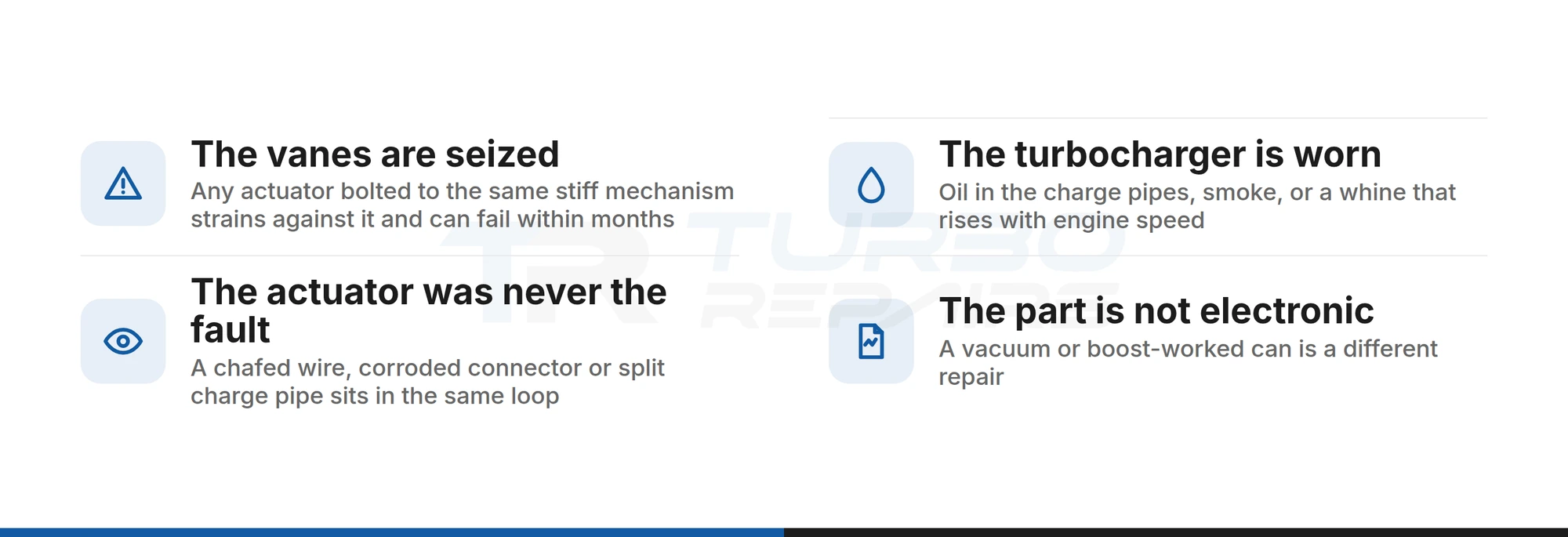
An actuator route only works when the actuator is the whole of the fault. Four situations break that assumption, and each one sends you to a different part of the table.
The vanes are seized. Carbon stiffens the vane ring on a variable-geometry turbocharger, the actuator works harder on every movement, and eventually its gears strip or its motor gives out. Rebuilt, new or used, any actuator bolted back onto the same mechanism faces the same resistance, which is why a replacement fitted to an untouched mechanism can fail within months. Before choosing any actuator route, it is worth checking whether the vanes are seized; if they are, freeing them usually means the turbocharger comes off for a rebuild in its own right.
The turbocharger is worn. Oil in the charge pipes, smoke, or a rising whine that follows engine speed come from the turbocharger’s rotating assembly, not from anything an actuator controls. Our guide to common turbocharger problems sorts those signs by where in the unit they start.
The actuator was never the fault. A boost-control code names a loop, and a chafed wire, a corroded connector or a split charge pipe sits in that loop too. When an actuator is tested as received, “healthy” is one of the possible results, and it is the result that stops a good part being replaced.
The part is not electronic. Some turbochargers carry a vacuum or boost-worked can with a pipe and no wiring, and some models were built with either type. A can is a different job: we diagnose it and supply the correct replacement rather than repairing it, and the length of its rod matters as much as its condition. Our wastegate actuator page covers it.
How to Tell Which Option Fits Your Car
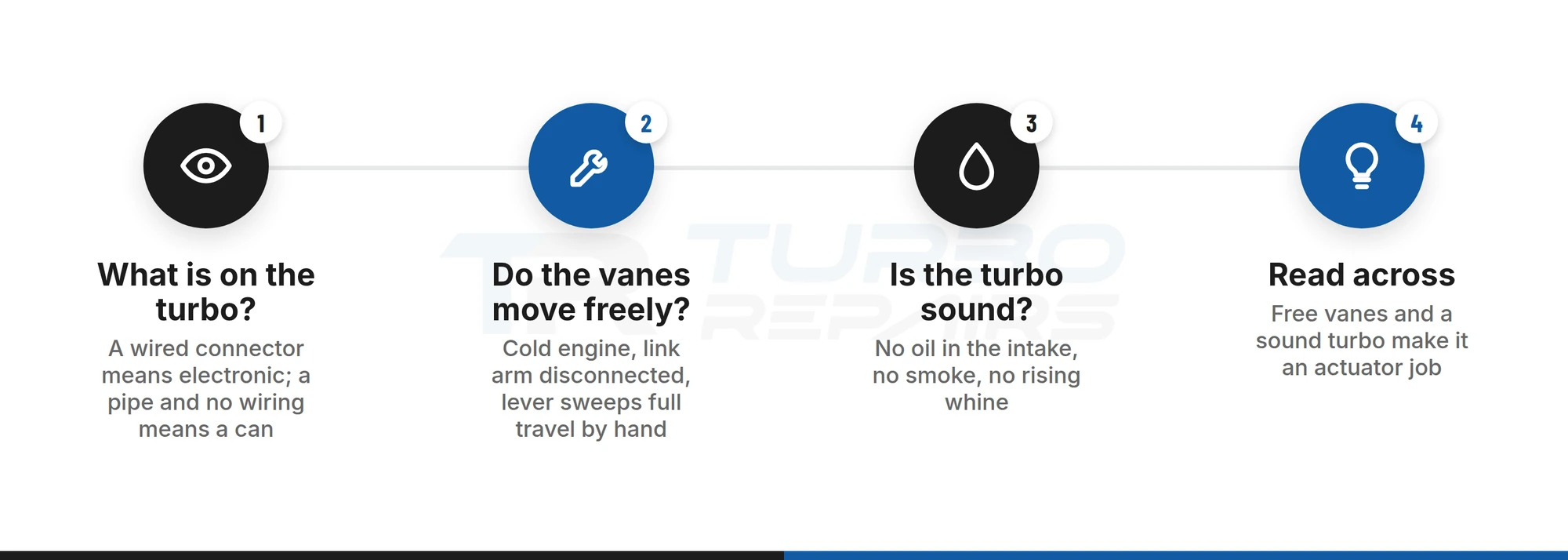
Three questions, answered in order, settle most cases. None needs anything more than the bonnet up and a phone camera.
- What is on the turbocharger? An electrical connector on the actuator body means an electronic unit; a pipe and no wiring means a vacuum or pressure can. Photograph every marking on the casing from every side, rather than copying down one number.
- Do the vanes move freely? With the engine cold and the actuator’s link arm disconnected, the vane lever should sweep its full travel smoothly by hand. Stiff, notchy or short of travel means the mechanism comes first.
- Is the turbocharger itself sound? No oil in the intake pipework, no smoke, and no whine that rises with engine speed.
Then read across:
- Electronic, vanes free, turbocharger sound. This is an actuator job. Rebuilding your own unit is the route that needs no matching and no setting up on the car; a new unit is the alternative where one is catalogued against your exact references and you know how it will be calibrated.
- Vanes stiff or seized, turbocharger otherwise sound. The turbocharger comes off to have the mechanism freed or renewed, and the actuator is assessed separately, because one that has been fighting stiff vanes has often worn its gears doing it.
- Turbocharger worn. A turbo rebuild or replacement is the job, with the actuator again checked on its own merits.
- Not sure. Send the references, the vehicle and the stored codes first, and the unit can be identified before anything is unbolted.
Independent garages face the same decision on their customers’ cars and use the same route: the actuator comes off, is posted in with its references and the codes, and goes back on rebuilt. Our electronic turbo actuator repair pages list the vehicles we cover, though it is the reference on the casing rather than the badge that decides whether a unit can be rebuilt.
Turbo Actuator Replacement FAQ
Can you just replace a turbo actuator?
Yes, when the actuator is the only thing wrong. That means an electronic unit that has failed on its own account, a vane mechanism that still moves freely by hand, and a turbocharger with no oil leaks, smoke or bearing noise. If the vanes are seized, a new or rebuilt actuator on the same mechanism will strain against it and fail again.
How much does it cost to replace a turbo actuator?
Rebuilding your own electronic actuator with us starts from £100 + VAT, with the exact figure confirmed after testing and before any work goes ahead. A new actuator is priced by its seller and varies by part. Replacing the whole turbocharger instead starts from £185 + VAT for a rebuild of your own unit or £450 + VAT for a replacement, plus the labour and parts to fit it.
Does a new actuator need coding or calibrating?
It depends on the unit and the vehicle. Some new actuators are sold ready to fit; others need calibrating or adapting with diagnostic equipment once fitted, and the seller should tell you which. Your own actuator, rebuilt, is calibrated on our bench to the specification its reference demands and refits with no programming.
Is a used actuator from a breaker worth fitting?
It is the route with the least known about it. The unit’s calibration was set against another car’s turbocharger, and its motor and gears have done an unknown amount of work. If it does not settle on your turbo, the labour to fit it is spent twice.
Why will the dealer not sell the actuator separately?
Usually because the manufacturer’s parts catalogue does not list it as a separate part for your engine, which leaves the turbocharger assembly as the smallest thing the dealer can order. Where the catalogue does list one — a genuine Volkswagen actuator repair kit is listed for a few engine codes with specific turbochargers — the picture changes, but only engine by engine.
Final Thoughts
A quote for a whole turbocharger answers the question of what can be ordered. The question that matters on your car is smaller: which part failed, and does anything it drives need attention too. Answer that first and the four routes sort themselves out, because three of them are actuator jobs and only one is a turbocharger job.
The deciding check costs nothing. If the vanes sweep freely and the turbocharger is sound, the fault is the size of the actuator, and so is the repair. If they do not, no actuator of any kind will cure the car on its own, and the money is better spent on the mechanism it was fighting.
Turbo Repairs · Epsom workshop
Have the actuator that failed rebuilt and calibrated to your turbo
Complete the repair form with your vehicle, the stored codes and the references from the casing, then post the actuator in. It comes back rebuilt at component level and ready to refit, typically one to two working days after it arrives.
Lifetime, unlimited-mileage warranty · Mail-in from the UK and internationally · Bench-tested and calibrated before it ships