

Summary We rebuild the turbochargers from classic turbocharged cars: the Saab 99 Turbo, 900 and 9000, the Ford Escort RS Turbo and Sierra RS Cosworth, and Volvo’s T5 models. You post in the turbo from your own car, and it is stripped, measured, balanced and run on the bench before it goes back on. Below, each car is set out with the turbo makers our sources name for it.
The Saab 9000 alone has been fitted with at least four different turbochargers, two of them Garrett T3s, one cooled by oil and one by water.
- Cars covered: Saab 99 Turbo, 900 and 9000; Ford Escort RS Turbo and Sierra RS Cosworth; Volvo T5 models
- Makers our sources name: Garrett, Mitsubishi and BorgWarner, depending on the car
- Cooling: both oil-cooled and water-cooled centre housings appear on these cars
- Quote: we do not quote before we have seen the unit.
- Warranty: lifetime, with no mileage limit
Why Classic Turbos Need a Specialist Rebuild
These cars come from the years when turbocharging moved off the race track and the commercial engine and onto ordinary road cars.
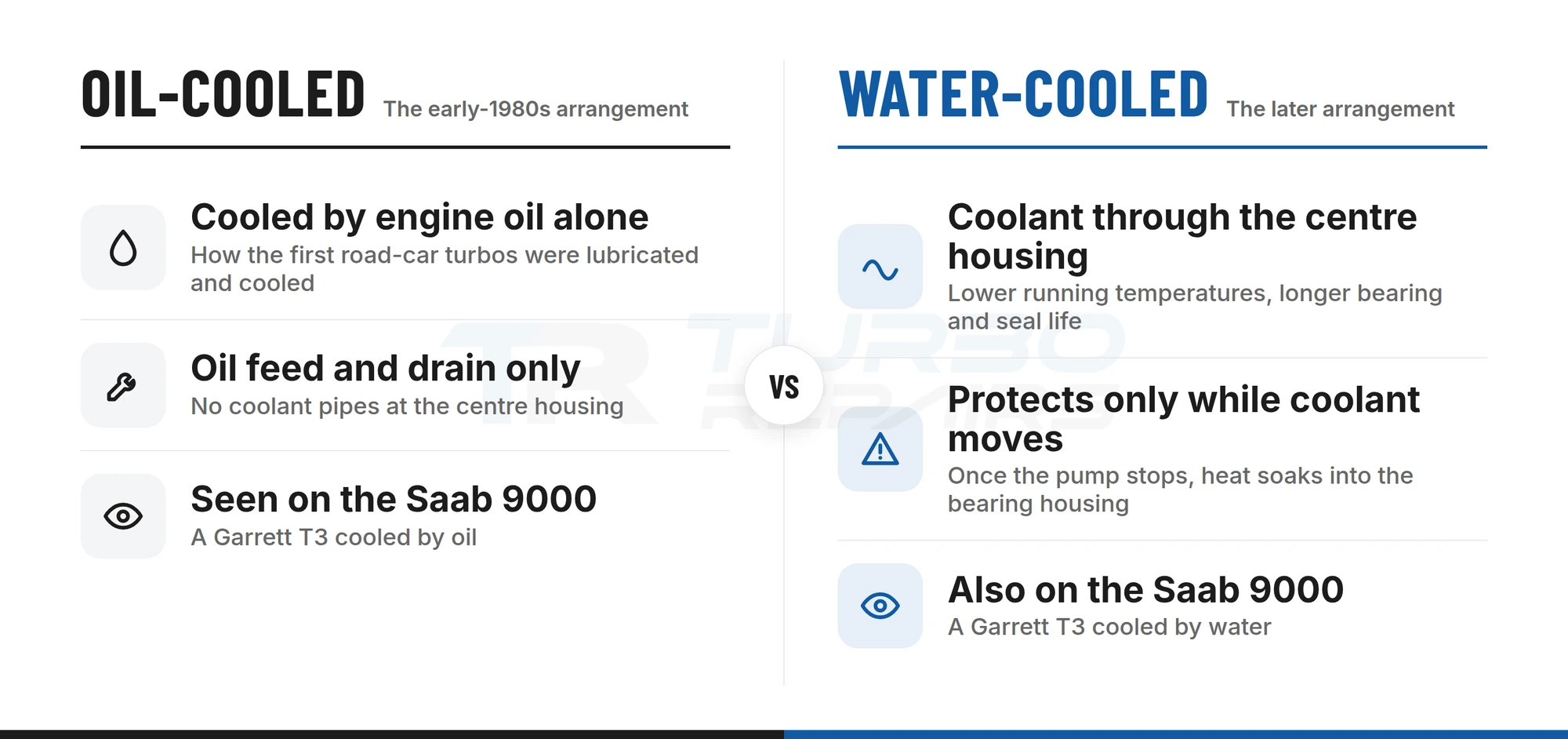
Car makers began fitting turbochargers in the early 1980s, and those units were lubricated and cooled by engine oil alone. A water-cooled unit followed, with lower running temperatures and longer bearing and seal life. Both kinds turn up on this page, and the Saab 9000 has been fitted with each.
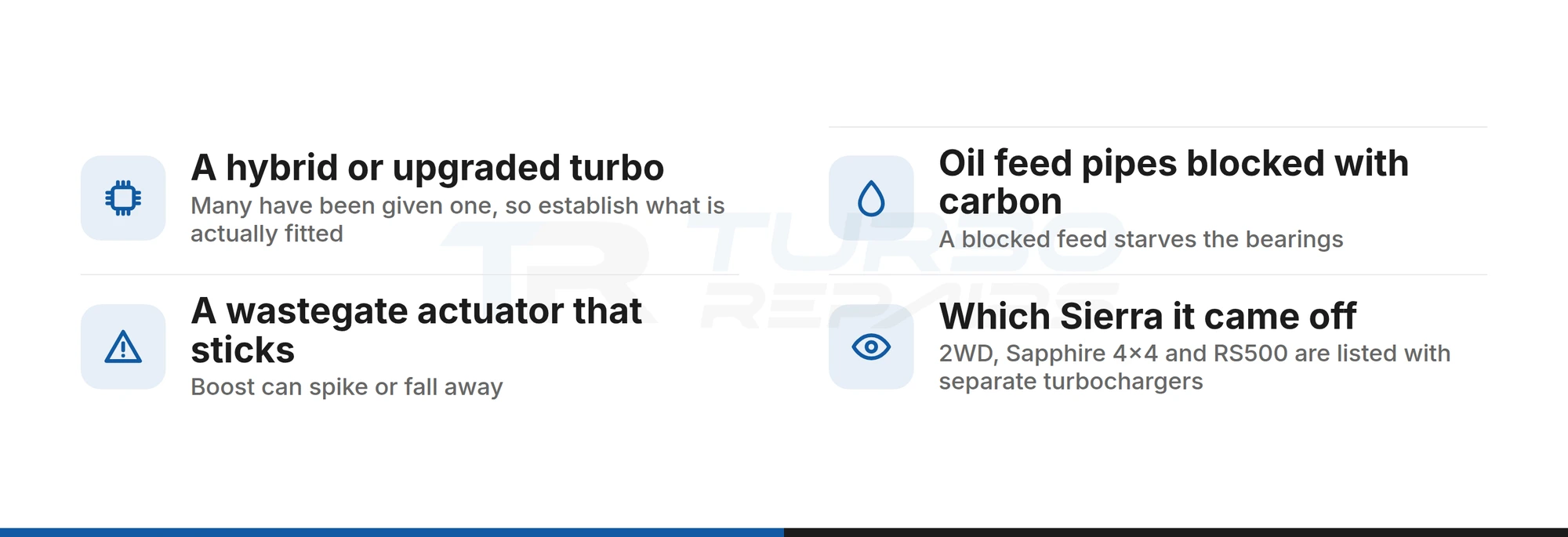
Age raises a second question: the turbo on a car this old may not be the one fitted at the factory. One Sierra Cosworth buying guide notes that many have been given hybrid or upgraded turbos, so establishing what is fitted matters.
Three things want settling before parts are chosen: who made the unit, how it is cooled, and whether it is still the specification the car was built with. The table shows what our sources name; the label on your own turbo has the final say. What every standard job covers is on our turbo rebuild hub.
| Car | Engine, as the sources give it | Turbo family the sources name | What decides |
|---|---|---|---|
| Saab 99 Turbo | 2.0 (1985 cc) | Garrett; no family named | The label on the unit |
| Saab 900, classic shape | 8-valve and 16-valve | Garrett T3 on most; Mitsubishi TE05 on some | The label; both makers are listed for one model |
| Saab 9000 | Early 2.0 (B201, B202); later engines not named | Garrett T3, oil-cooled or water-cooled; Garrett T25; Mitsubishi TD04 | The label, and coolant pipes at the centre housing |
| Ford Escort RS Turbo | CVH | No maker named in our sources | The label; the unit may have been changed |
| Ford Sierra RS Cosworth | YB 2.0 | Garrett T3/T04; the RS500 its own T04 | The label; 2WD, 4×4 and RS500 are listed apart |
| Volvo 850 T5 and T5-R; C70, S70 and V70 T5 to 2004 | 2.3 five-cylinder (B5234T3, B5234T5) | Mitsubishi TD04HL | The label; a straight or angled compressor outlet |
| Volvo S60 R and V70 R; S60 and V70 T5, 2005 to 2009 | 2.5 five-cylinder (B5254T4) | BorgWarner K24 | The label |
| Volvo C70, S40 and V50 T5 | 2.5 five-cylinder (B5254T3) | K04 | The label |
Saab 99 Turbo, 900 and 9000
Saab 99 Turbo
The 99 Turbo arrived as a three-door combi coupé, with a two-door saloon following, and its turbocharged 2-litre engine produced 145 PS. The turbocharger was designed and built by Garrett AiResearch.
Saab left the block, crankshaft, bearings and connecting rods standard. The work went into what surrounds the turbo: revised valves and camshaft, a larger exhaust and radiator, an oil cooler, and Saab’s own wastegate, set up to give boost at low engine speeds.
It was treated as a specialist car from new. In the UK, not every Saab dealer was authorised to sell and service the Turbo, and those that were went through training first. None of our sources names the Garrett family on the 99, so the label on your unit is the reference the rebuild works from.
Saab 900, classic shape
Specialist listings put a Garrett T3-based unit on most 8-valve and 16-valve classic 900s, with a Mitsubishi TE05 on some; one lists the Mitsubishi against the 900 SPG from 1987 to 1994. The 900 built from 1994 is listed with a Garrett T25, which one listing dates from 1992, so the year alone does not settle it.
Saab 9000
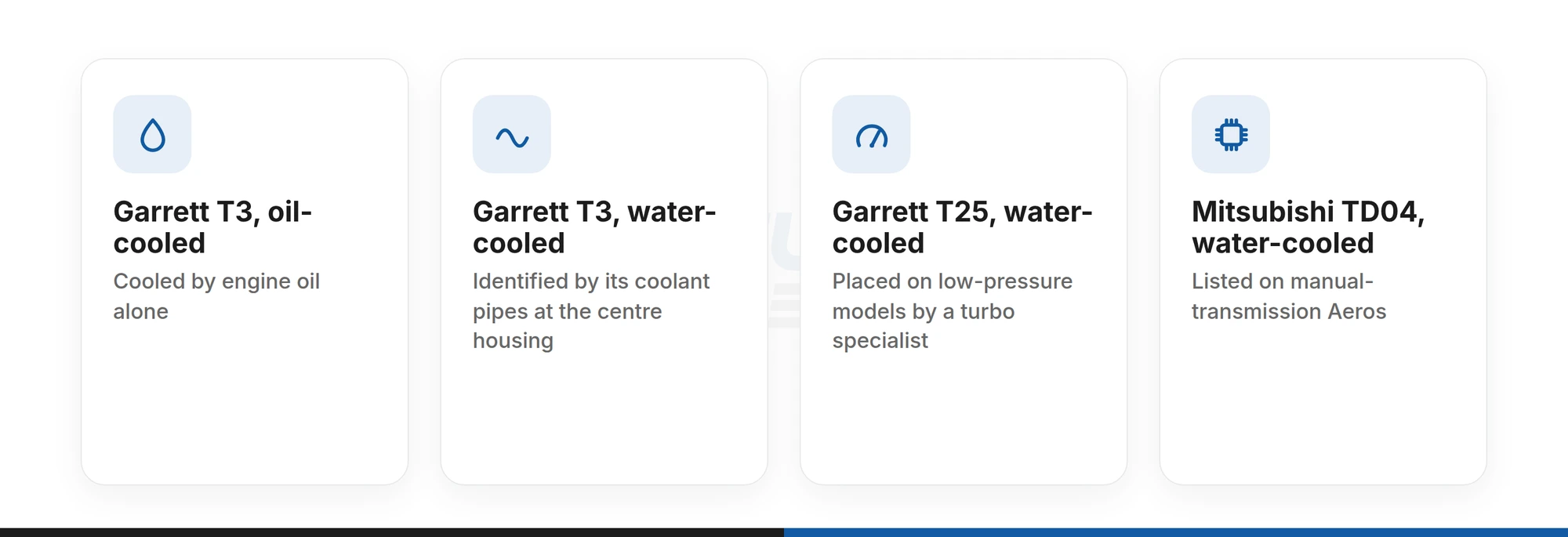
A detailed 9000 owner’s removal procedure lists at least four turbos fitted to the car: a Garrett T3 cooled by oil, a Garrett T3 cooled by water, a water-cooled Garrett T25 and a water-cooled Mitsubishi TD04, the last on manual-transmission Aeros. A turbo specialist places the T3 on the early 2.0 engines and the T25 on low-pressure models.
Ford Escort RS Turbo and Sierra RS Cosworth
Two Fords, two engines: the Escort RS Turbo uses the CVH, the Sierra RS Cosworth the YB 2.0. For a current model, see our Ford turbo rebuild page.
Escort RS Turbo
None of the specialist sources we hold names the turbocharger an Escort RS Turbo left the factory with, so we do not name one here. They do show a car people modify: aftermarket wastegate actuators are sold for it, and performance specialists list tuning work for its CVH engine.
Sierra RS Cosworth
One Sierra Cosworth buying guide gives standard cars a Garrett T3/T04, and the RS500 its own T04 arrangement with a larger compressor wheel. A Cosworth parts specialist lists separate turbochargers for the 2WD Sierra and Sapphire, the Sapphire 4×4 and the RS500, and describes the standard RS500 replacement as no longer available from Garrett or Ford.
The buying guide’s turbo warnings take in its surroundings too: oil feed pipes that block with carbon and starve the bearings, and a wastegate actuator that sticks, letting boost spike or fall away.
Volvo T5: One Badge, Several Turbochargers
T5 is a badge Volvo carried across several generations of five-cylinder petrol car, and the turbo underneath changed with them. One rebuild specialist’s application list puts a Mitsubishi TD04HL on the 850 T5 and T5-R and on the C70, S70 and V70 T5 to 2004, and a BorgWarner K24 on the S60 R, the V70 R and the 2005 to 2009 S60 and V70 T5. UK listings add a K04 on the 2.5 in the C70, S40 and V50 T5.
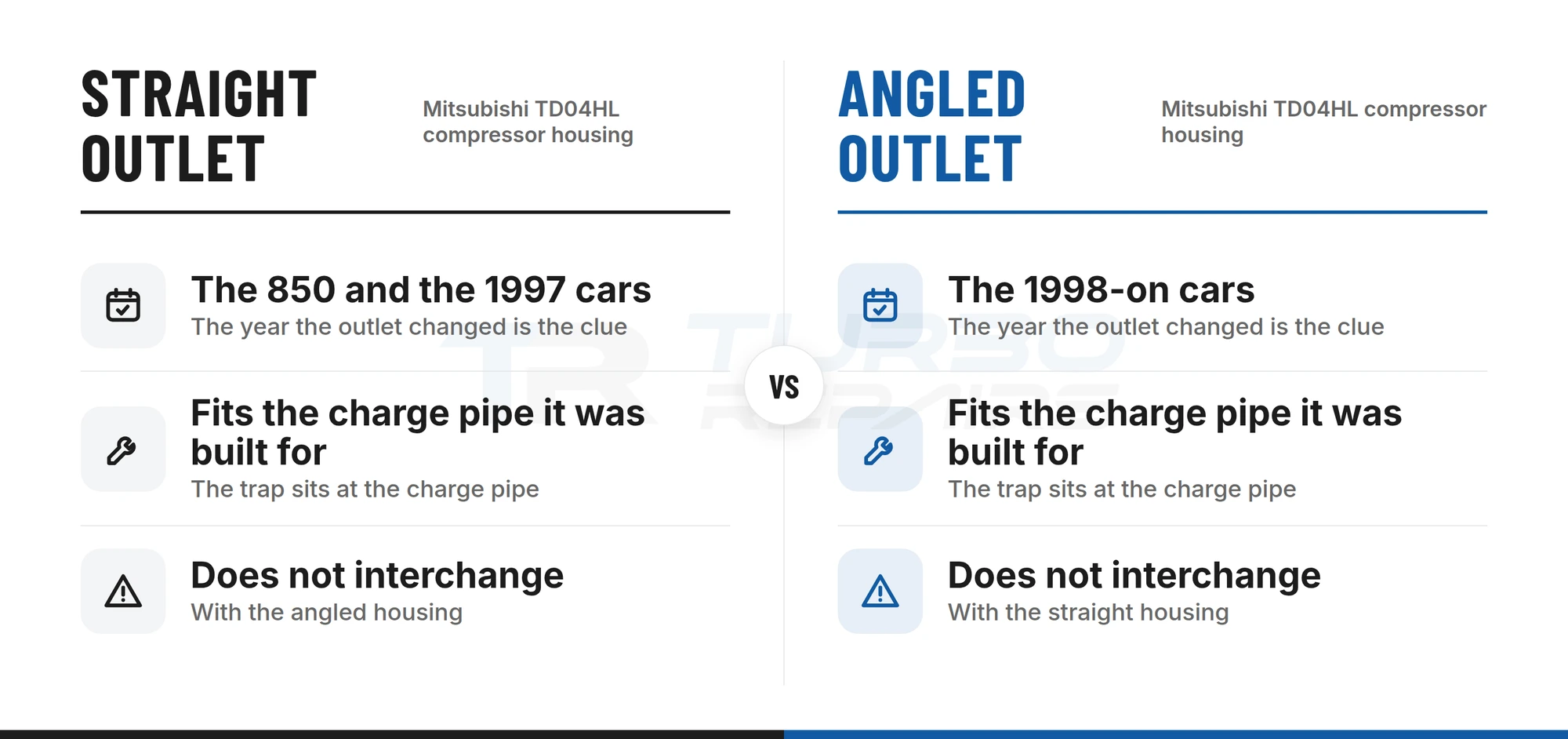
The TD04HL cars hide a trap at the charge pipe. The 850 and the 1997 cars use a compressor housing with a straight outlet, the 1998-on cars an angled one, and the two do not interchange.
The TD04HL is water-cooled, which protects it after a hard drive only while coolant is moving; once the pump stops, heat soaks into the bearing housing, and years of hot shutdowns build carbon in the oil passages. The plastic connectors on its coolant lines also turn brittle and crack, removing that cooling altogether.
What We Check Before a Classic Turbo Is Rebuilt
The bench work on a classic follows the same stages as every turbo we rebuild:
- We establish what caused the failure before deciding what to renew, because a turbo that failed on a contaminated oil feed will fail again if the feed is not dealt with at the same time.
- Bores, journals and thrust faces are then measured against specification rather than judged by eye.
- Journal bearings, thrust bearing and collar, piston-ring seals, O-rings and circlips are renewed as standard, never refitted.
- The shaft-and-wheel assembly is balanced on its own, then the fully assembled core is spun to operating speed on a VSR (vibration sorting rig) machine and trimmed until residual vibration is inside limits.
- The finished unit is then run and checked for free rotation, oil-tightness and correct actuator travel before it is packed.
Our guide to how a turbo is rebuilt walks through each stage, and our page on turbocharger balancing explains the VSR step. We do not quote before we have seen the unit.
An oily turbo is not always a worn one. A restricted intake or exhaust, a blocked oil drain, or crankcase pressure from worn piston rings can each push oil past sound seals. A published Volvo turbo rebuild article advises checking those four areas before condemning the turbo. Our guides to what causes turbo failure and how long turbos last cover the rest.
Turbo Repairs · Epsom workshop
Your classic’s turbo, measured before anything is chosen
Send the turbo from your Saab, Ford or Volvo with the Repair Form and everything on its label. It is stripped and measured on the bench. We do not quote before we have seen the unit.
Lifetime, unlimited-mileage warranty · Mail-in from the UK and internationally · Bench-tested and calibrated before it ships
How to Send Your Classic Turbo In
- Tell us the vehicle and the symptoms on the Repair Form, and include everything printed on the turbo’s label.
- Have the turbo removed. The unit needs to be off the vehicle; if you are not doing that yourself, your local garage can handle the removal and the refit.
- Pack it properly. The wheels are the vulnerable part in transit. Blank the ports, wrap the unit, and use a rigid box with plenty of padding around the compressor and turbine ends, then send it to Unit 102 Reaver House, 12 East Street, Epsom, Surrey, KT17 1HX, United Kingdom.
- Refit with care. On refit, renew or thoroughly flush the oil feed pipe, fit new gaskets, change the engine oil and filter, and prime the turbo with clean oil before the first start.
Classic Turbo FAQ
Can you rebuild the turbo from a Saab 99 Turbo?
Yes. Post it in with the Repair Form and everything on its label. It is stripped and measured on the bench, we do not quote before we have seen the unit, and the Garrett family is read from the label rather than assumed.
Is my classic’s turbo oil-cooled or water-cooled?
The saab9000.com removal procedure describes water-cooled turbos by their coolant pipes. A turbo with only an oil feed and drain is oil-cooled.
Should the wastegate actuator come with the turbo?
Yes. The wastegate actuator is checked and its rod length set on the bench as part of the rebuild.
Final Thoughts
A classic turbo carries two histories: the car’s and its own. The car’s tells you which maker to expect.
The turbo’s own, how it was cooled, how it was shut down and whether it was ever swapped, tells you what the bench is likely to find.
Turbo Repairs · Epsom workshop
Send in the turbo from your Saab, Escort, Sierra or Volvo
Fill in the Repair Form with the car, the engine and everything on the label, then post the turbo in with its actuator attached. It comes back stripped, rebuilt, balanced and run, ready to go on the car it came off.
Lifetime, unlimited-mileage warranty · Mail-in from the UK and internationally · Bench-tested and calibrated before it ships