

Summary A wastegate is a valve on the exhaust side of a turbocharger that lets part of the exhaust gas bypass the turbine wheel. Gas that goes round the turbine does no work on it, so opening the gate slows the shaft and caps the boost, protecting the engine and the turbocharger from pressure rising unchecked.
On factory turbos it is most commonly a flap built into the turbine housing, opened by a pneumatic can or an electronic actuator. When it goes wrong, the fault sits in the flap, the pivot it turns on or the actuator that moves it, and each needs a different repair.
A wastegate cannot add boost: shut, it sends all the exhaust through the turbine, so everything it does to boost it does by deciding how much exhaust the turbine never sees.
What Is a Wastegate?
A wastegate is a valve that controls how much exhaust gas reaches the turbine wheel. Closed, it sends the whole exhaust flow through the turbine housing. Open, it lets a portion of that flow take a short cut around the turbine and straight into the exhaust downstream.
So the wastegate never makes boost; the turbine does. The gate decides how much exhaust the turbine is not allowed to use, and the further it opens, the lower the boost.
Why a turbo needs that limit at all is covered in our guide to how a turbo works. Not every turbo has a wastegate: on most variable-vane diesel turbos the vanes do the controlling and no exhaust bypasses the turbine, as our VNT turbo guide explains.
Internal and External Wastegates
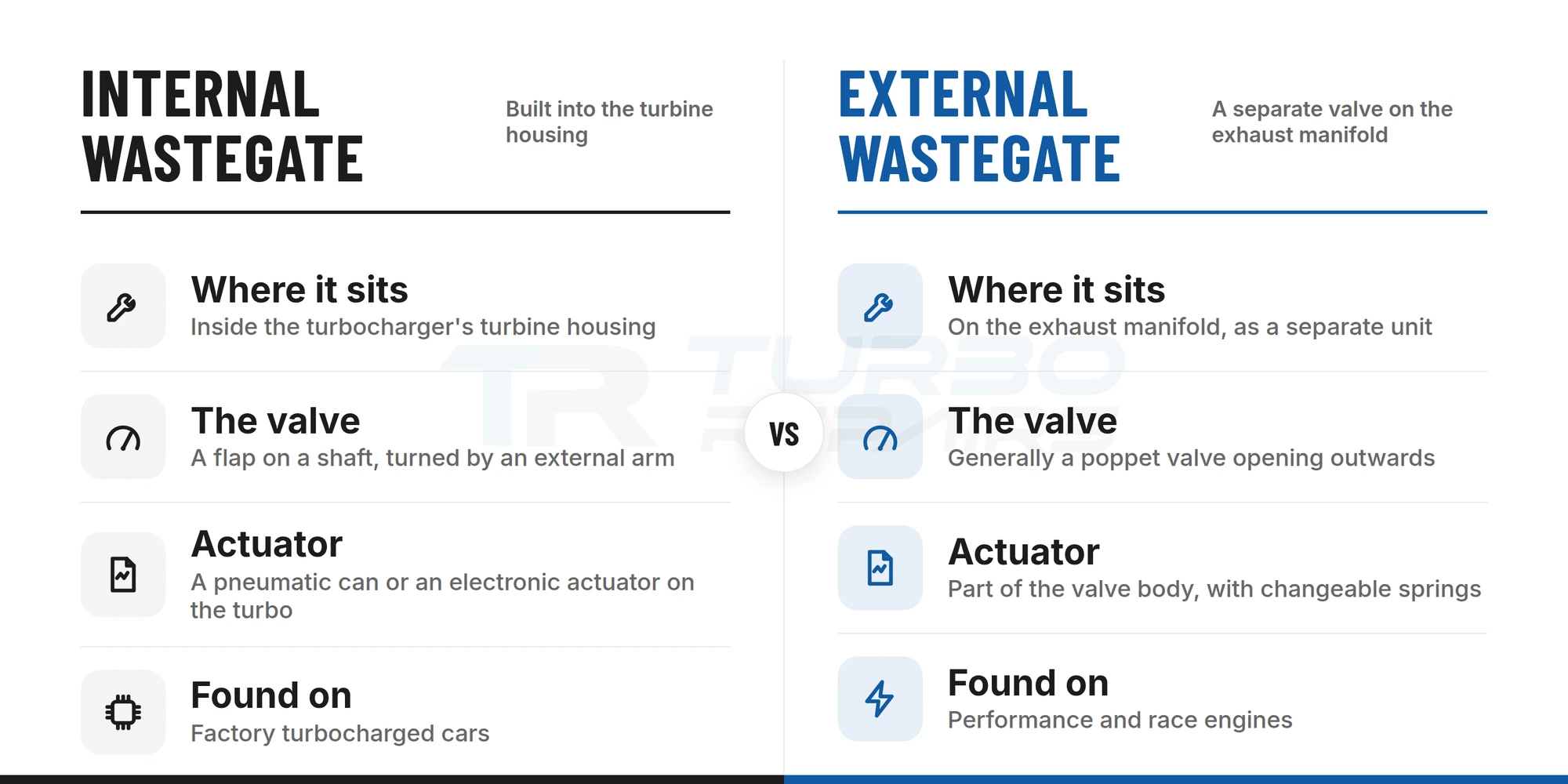
An internal wastegate is built into the turbine housing: a flap on a shaft, with an arm outside linked to the actuator. The bypassed gas rejoins the exhaust downstream of the turbine. It needs no extra pipework, which is why it is the most common layout on factory turbocharged cars, and its actuator is typically sealed and not adjustable from the factory.
An external wastegate is a separate valve on the exhaust manifold, which has to be built with a dedicated port for it. Free of the turbine housing, it can be larger, and it regulates boost more precisely at high engine speed, where a small internal flap can struggle to pass enough gas. When a gate cannot pass enough, boost keeps rising past its target: boost creep.
| Internal wastegate | External wastegate | |
|---|---|---|
| Where it sits | Inside the turbocharger’s turbine housing | On the exhaust manifold, as a separate unit |
| The valve | A flap on a shaft, turned by an external arm | Generally a poppet valve opening outwards; butterfly valves are far less common |
| Bypassed gas goes | Back into the exhaust downstream of the turbine | Back into the exhaust, or straight to atmosphere |
| Actuator | A pneumatic can or an electronic actuator on the turbo | Part of the valve body, with changeable springs |
| Found on | Factory turbocharged cars | Performance and race engines |
On a factory wastegated turbo, expect the internal layout; the rest of this guide is about that one.
How the Wastegate Controls Boost, and Where the Actuator Fits
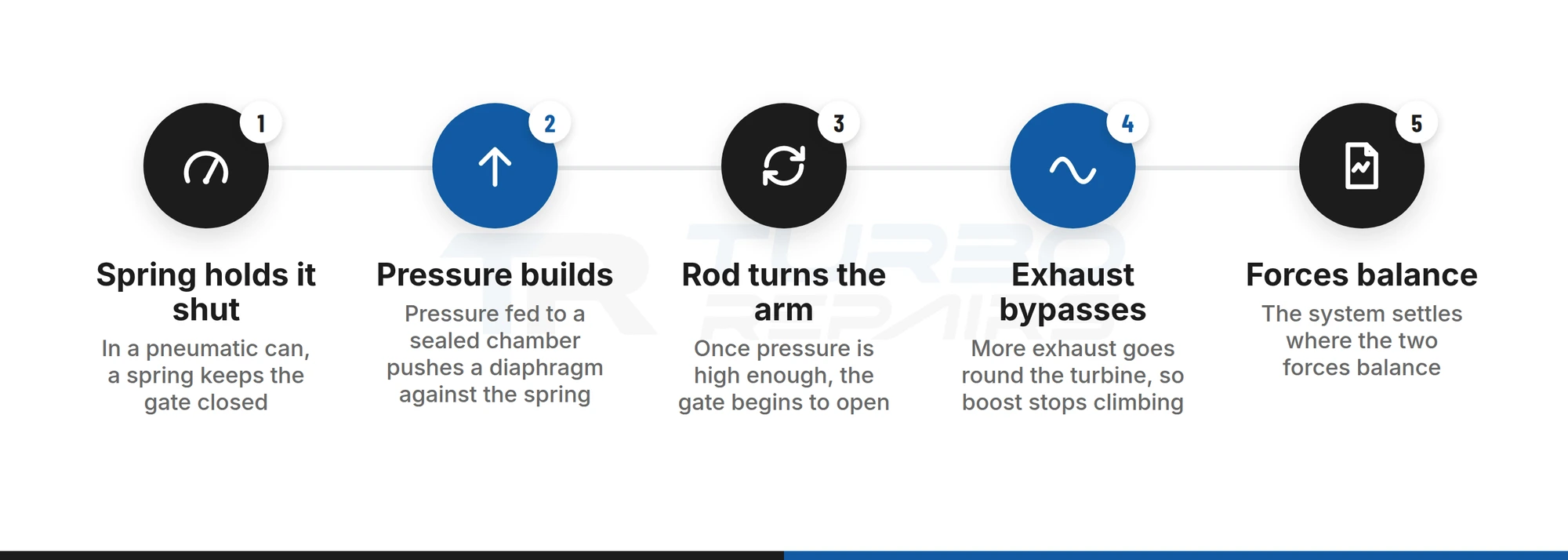
The gate is only a valve; the actuator decides when it opens. In a pneumatic can, a spring holds the gate shut. Pressure fed to a sealed chamber pushes a diaphragm against that spring, and once it is high enough the rod turns the arm and the gate begins to open. More exhaust bypasses the turbine, boost stops climbing, and the system settles where the two forces balance.
The source of that signal depends on the engine; see wastegate actuator repair. On a pneumatic gate, the engine changes boost by changing the signal, not by touching the gate. Exhaust pressure in the manifold also pushes on the valve, which is why a factory-sized turbo can lose boost at high engine speed: back pressure forces the gate open against its spring.
An electronic actuator replaces the pressure signal with a motor, a gear train and a position sensor, so the engine management commands a position and reads back where the flap actually is. That lets the gate do jobs a spring cannot. Hyundai, describing the electronic wastegate on one of its turbocharged petrol engines, explained that the gate is opened when boost is not needed, cutting exhaust back pressure to save fuel, and held open during cold starts so the catalytic converter warms up sooner. The actuator itself is explained in what a turbo actuator does.
What Goes Wrong: Seized Flap, Worn Pivot, Failed Actuator
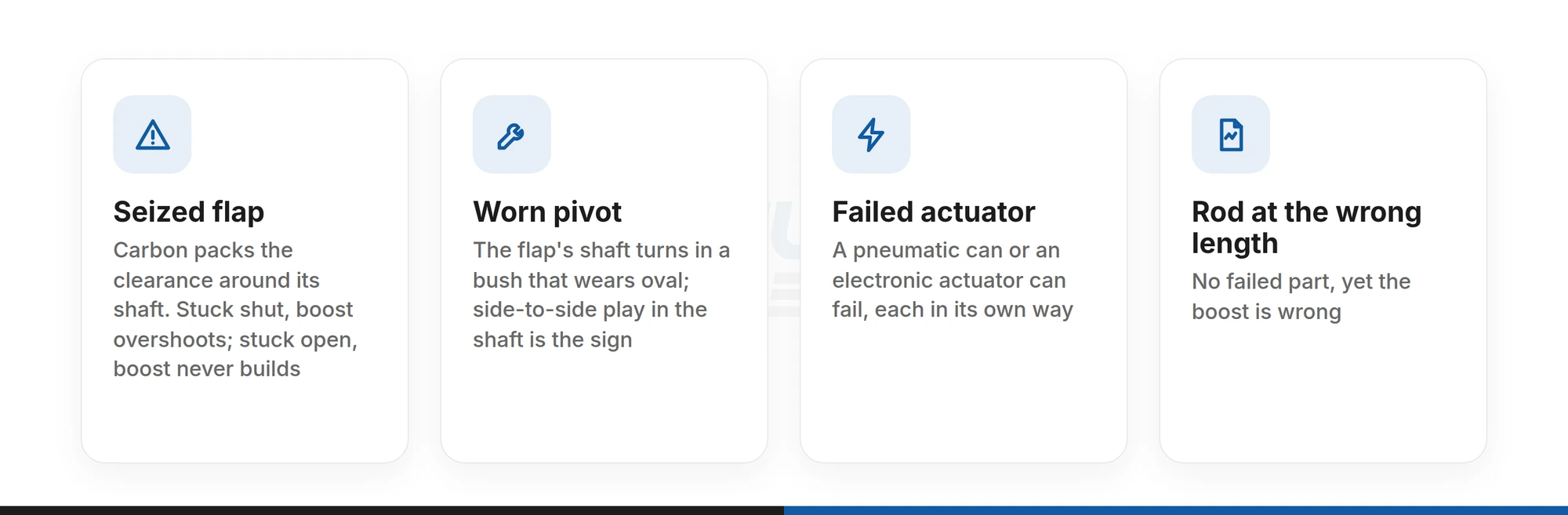
A wastegate fault starts in one of three places. From the driver’s seat they look alike.
A seized flap. The flap sits in the exhaust stream, heated, cooled and coated in soot over and over, until carbon packs the clearance around its shaft and it binds. Stuck shut, it cannot bleed off exhaust and boost overshoots. Stuck open, the turbine is starved and boost never builds. Either way, the actuator tends to get the blame.
A worn pivot. The flap’s shaft turns in a bush that wears oval; side-to-side play in the shaft is the sign.
A failed actuator. A pneumatic can or an electronic actuator can fail, and each fails in its own way; how each type is diagnosed is on our wastegate actuator repair page.
One fault involves no failed part: an actuator rod fitted at the wrong length. Why that alone gives the wrong boost is covered on the same page.
Turbo Repairs · Epsom workshop
A flap that will not move is a turbo job, not an actuator job
If the wastegate arm binds or wobbles by hand, the wear is inside the turbine housing and a new actuator will not cure it. Post the turbocharger in and we establish what failed before deciding what to renew.
Lifetime, unlimited-mileage warranty · Mail-in from the UK and internationally · Bench-tested and calibrated before it ships
Wastegate Faults vs Other Boost Faults
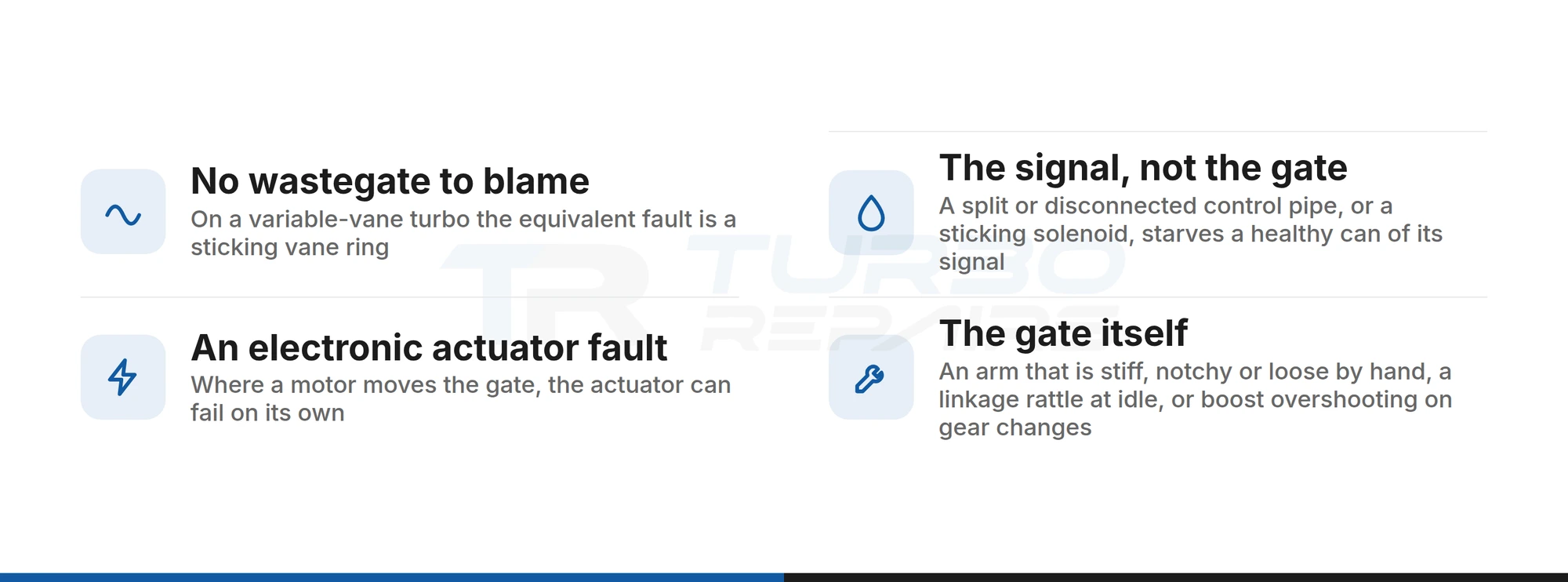
An overboost or underboost code says the boost missed its target, not why. This is how to separate the wastegate from the other suspects.
- No wastegate to blame. On a variable-vane turbo the equivalent fault is a sticking vane ring.
- The signal, not the gate. A split or disconnected control pipe, or a sticking solenoid, starves a healthy can of its signal; a failed hose can cause uncontrolled boost straight away.
- An electronic actuator fault. Where a motor moves the gate, the actuator can fail on its own; see turbo actuator symptoms.
- The gate itself. An arm that is stiff, notchy or loose by hand, a linkage rattle at idle, or boost overshooting on gear changes. A sticking wastegate valve can cause that overshoot, though long control pipework can too.
What to Do Next
Before buying anything, move the wastegate arm by hand: a stiff, notchy or loose arm points to the turbine housing, not the actuator. The full check is on our wastegate actuator repair page.
- Stiff, notchy or with play: the fault is in the turbine housing, which is turbocharger work. In a turbo rebuild a worn flap bush and pivot are renewed rather than reinstalled worn, the actuator rod length is set, and the unit is bench-tested before it is packed, typically within 1–3 working days.
- Free, but boost is still wrong: the actuator, its setting or its signal is next.
- Overboosting, surging or repeatedly in limp mode: do not drive further than you have to. Boost the gate cannot limit is the case that damages engines.
Prices are in our guide to turbo repair costs.
Wastegate FAQ
Where is the wastegate on my turbo?
On a factory turbo it is inside the turbine housing, the hot side bolted to the exhaust manifold. You cannot see the flap, but you can see the arm on the outside of the housing and the rod linking it to the actuator.
Is a wastegate the same as a blow-off or dump valve?
No. A blow-off or diverter valve sits on the intake side and releases or recirculates pressurised air trapped when the throttle closes. The wastegate sits on the exhaust side, so the “chuff” you hear when lifting off is not the wastegate.
Can I drive with a stuck wastegate?
Stuck open, the car is flat and is likely to be derated: unpleasant rather than immediately destructive. Stuck shut is the serious case, because boost can climb past what the engine and turbocharger were designed for.
Does a wastegate fault mean a new turbo?
No. A worn flap bush and pivot are renewed in a turbo rebuild. A failed pneumatic can is replaced rather than rebuilt, and an electronic wastegate actuator can be repaired at component level.
Final Thoughts
A wastegate is the part of a turbocharger built to throw energy away. With the gate shut the turbine gets all of the exhaust, and every bit of boost control after that is a decision about how much it is not allowed to use, made by a flap on a pivot and an actuator outside the housing.
That split is why the faults get misread. The actuator is the part you can see and the part that gets replaced, while the flap and its pivot wear in the exhaust stream where nobody looks. Move the arm by hand before anything is bought.
Turbo Repairs · Epsom workshop
A worn wastegate pivot is renewed, not refitted
Tell us what the car is doing and post the turbocharger in. It is stripped, a worn flap bush and pivot renewed, the actuator rod set, and the unit balanced and run on the bench before it comes back.
Lifetime, unlimited-mileage warranty · Mail-in from the UK and internationally · Bench-tested and calibrated before it ships