

Summary Yes. Turbo bearings can be replaced, but not with the turbo on the car and not on their own: they sit inside the centre housing, behind the compressor wheel, so the turbocharger has to come off and be stripped, and renewing them is part of a full rebuild. On every journal-bearing rebuild we carry out, the journal bearings, thrust bearing and collar are renewed as standard, never refitted; on a ball-bearing unit the cartridge is the part renewed.
Whether your turbo runs on journal bearings or a ball-bearing cartridge changes what gets replaced. It does not change what has to follow: once the rotor has been taken apart, the assembled core must be balanced again.
A bearing exists to keep the wheels spinning without touching their housings, so a worn one is judged less by its own condition than by what it let reach metal: the shaft, the bore it sat in and the wheels.
Can Turbo Bearings Be Replaced?

They can, and in a proper rebuild they always are. Bearings and seals are among the parts a turbocharger is designed to have renewed, while the housings and castings around them are usually sound.
What you cannot do is replace them in place. The compressor wheel has to come off the shaft before the bearings, thrust parts and seals can be reached, so the turbo comes off the engine and the core is taken apart.
The bearings are the simple part of the job. What decides it is what a worn bearing has done to everything around it:
- The shaft journals the bearings run on, which dirty oil can score and a broken-down oil film can wear.
- The bearing housing bore. As our turbo rebuild page sets out, a bore worn past its limits is only worth rebuilding if the casting can be replaced economically.
- The thrust faces, which carry the shaft’s movement along its own axis.
- The wheels. Once play lets the compressor wheel rub its housing, the rebuild needs a new wheel and a fresh balance as well.
That is why bores, journals and thrust faces are measured against specification on our bench rather than judged by eye. Shaft play with intact wheels and worn journal or thrust bearings is a straightforward rebuild; damage beyond the bearings adds to what has to be renewed.
Journal Bearings and Ball Bearings: How They Differ
Garrett divides turbocharger bearing systems into two types, hydrodynamic (journal) bearings and ball bearings, and describes the hydrodynamic type as the one used in the vast majority of past and present turbos. Either way the load is heavy: Garrett notes the wheels can spin 60 times faster than the maximum engine speed of a typical modern diesel. Our guide to how a turbo works shows where the bearings sit among the other parts.
Journal bearings: the shaft rides on oil
In a journal-bearing turbo the engine oil does more than lubricate. It forms the film the shaft actually runs on, and Garrett says that film also controls the motion of the shaft and wheels. The bronze bearings come in two kinds:
- Fully floating: two separate bearings that turn at roughly half the speed of the shaft, with an oil film inside and outside each one.
- Semi-floating: a one-piece bearing that does not rotate, whose outer film mainly damps shaft movement. Garrett says most small, high-speed passenger vehicle turbos use this design.
A thrust bearing, separate or built into the journal bearing, controls movement along the shaft. The BorgWarner K03 and K04 is a typical example, its shaft running in oil-fed journal bearings. Because the shaft has to sit in a film of oil, a journal-bearing turbo is built with some radial play.
Ball bearings: one cartridge does both jobs
A ball-bearing turbo carries its shaft in a cage of balls. Garrett explains that the ball bearing combines the journal and thrust functions in a single package, with reduced clearances and lower power losses that improve turbine and compressor performance. One UK specialist adds that the design reduces contact load, needs less oil and spools faster. Garrett says ball bearings, previously used only for racing and fast road applications, were launched on production VNT turbos for passenger vehicles.
There are no separate journal bearings to renew: the bearing cartridge is the part replaced, and its play standard is different, so a ball-bearing turbo should never be judged by the radial float that is normal on a journal-bearing one. Our Garrett GT28R page covers a ball-bearing unit we rebuild, where the cartridge is the item a rebuild renews.
Why Turbo Bearings Fail: Oil, Contamination and Boost Load
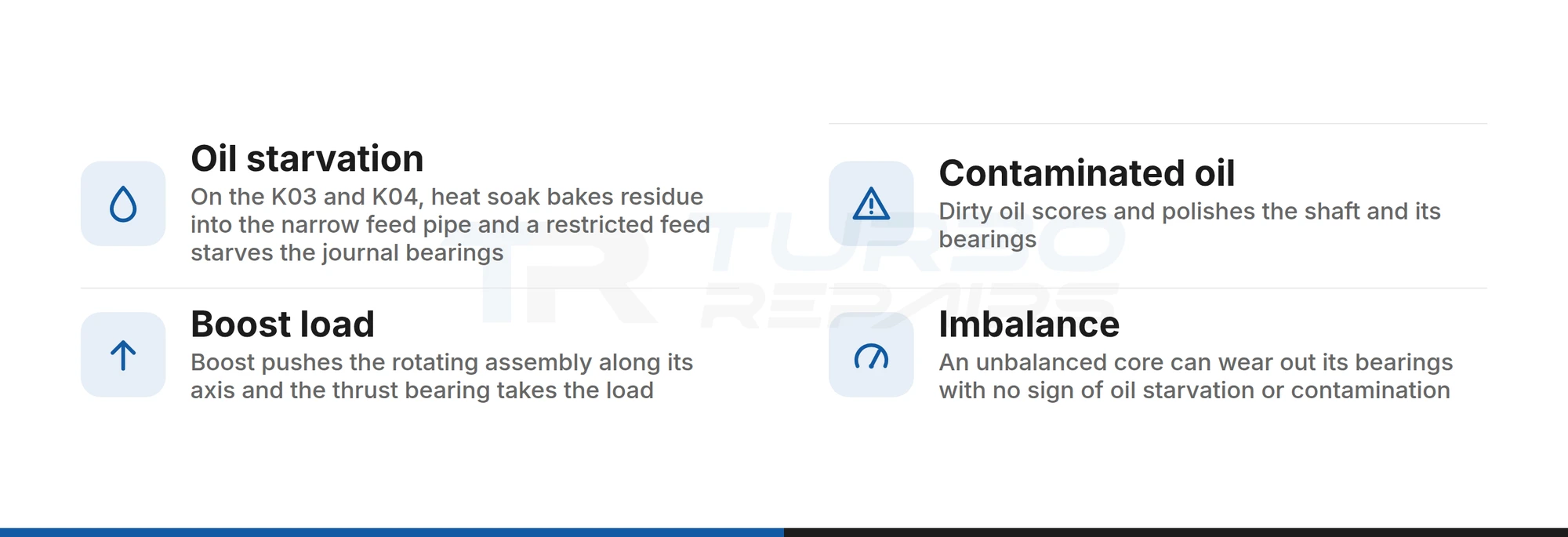
Our guide to what causes turbo failure covers each cause in full. Seen from the bearing, they come down to one thing: the oil film is lost, dirtied or overloaded.
- Oil starvation. On the K03 and K04, heat soaking back into the centre housing after shutdown bakes residue into the narrow feed pipe, and a restricted feed starves the journal bearings.
- Contaminated oil. Dirty oil scores and polishes the shaft and its bearings.
- Boost load. Boost pushes the rotating assembly along its axis, and the thrust bearing takes that load. On the K03 and K04, kit makers state that extra axial load can flex the standard thrust parts until their faces touch, which fails the turbo immediately.
- Imbalance. Turbo component maker Melett notes that an unbalanced core can wear out its bearings with no sign of oil starvation or contamination at all.
Oil starvation and contamination start outside the turbocharger, so a turbo that failed on a contaminated oil feed will fail again, new bearings and all, if the feed is not dealt with at the same time. On refit, renew or thoroughly flush the oil feed pipe, change the engine oil and filter, and prime the turbo with clean oil before the first start.
Turbo Repairs · Epsom workshop
Find out whether it stopped at the bearings
Worn bearings are a standard rebuild. Whether the shaft, the bore or a wheel paid for them is only known once the core is stripped and measured, so post your turbo in and let the bench settle it.
Lifetime, unlimited-mileage warranty · Mail-in from the UK and internationally · Bench-tested and calibrated before it ships
Why Balancing Has to Follow a Bearing Replacement
A turbocharger’s rotor is a stack: the shaft and turbine wheel, the thrust collar, the compressor wheel and the nut that clamps them. Each wheel is balanced when it is made, but the stack is not, and the small errors in each part add up once it is clamped together.
Renewing the bearings breaks into that stack. Undoing and retightening the compressor nut on its own changes the rotor’s balance, even when every original part goes back in, and a new thrust collar changes the stack again.
An out-of-balance core can still spin sweetly by hand. At working speed it pushes the shaft through its oil film on every revolution, and the new bearings take the damage first. So our rebuilds balance in two stages: the shaft-and-wheel assembly on its own, then the assembled core spun on a VSR (vibration sorting rig) and trimmed until residual vibration is inside limits. Our page on turbocharger balancing explains why the assembled core matters more than its parts.
Marking the shaft, nut and wheel before stripping puts the parts back in the same positions. That restores their alignment, not the balance.
Bearings in a Rebuild vs a Cartridge Swap
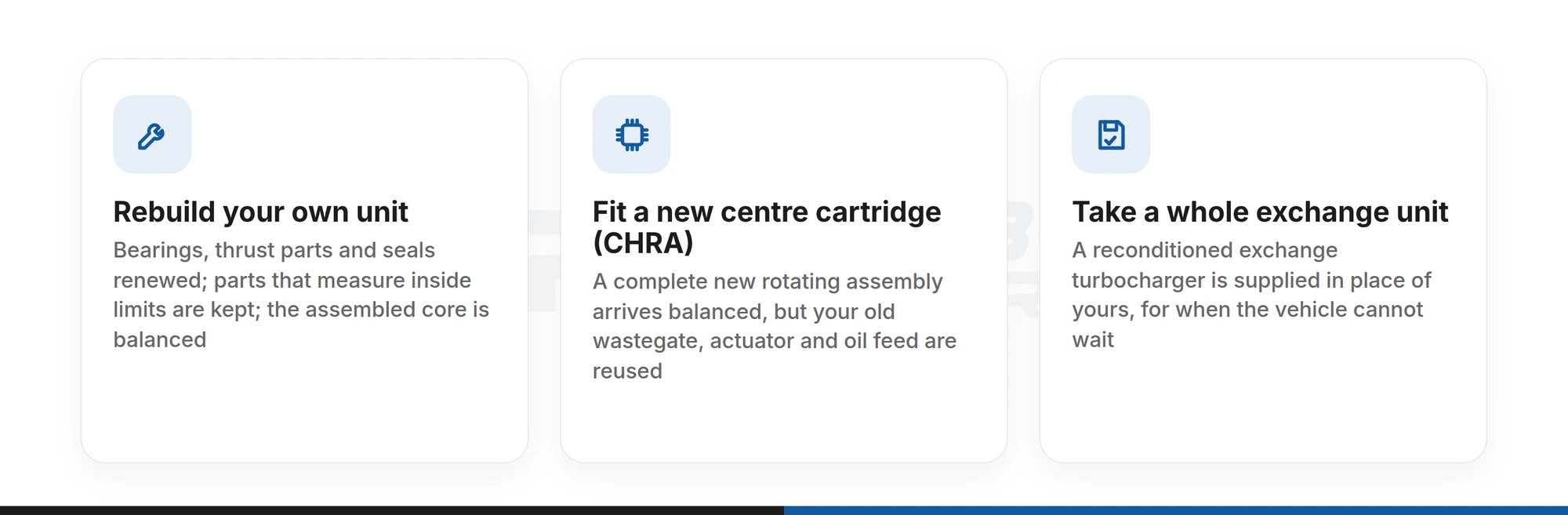
There are three ways to put sound bearings back under a turbo, and they replace very different amounts of it.
- Rebuild your own unit. The bearings, thrust parts and seals are renewed, any wheel, shaft or casting that measures inside its limits is kept, whatever does not is renewed, and the assembled core is balanced.
- Fit a new centre cartridge (CHRA). Some suppliers keep only your housings and fit a complete new rotating assembly. It arrives balanced, but your old wastegate, actuator and oil feed are all reused. For ball-bearing turbos, one UK specialist supplies replacement cartridges.
- Take a whole exchange unit. A reconditioned exchange turbocharger is supplied in place of yours, for when the vehicle cannot wait or your own turbo is past rebuilding.
Either of the first two can be done well. What decides it is whether the parts that stay were measured, and whether the assembled core was balanced.
What to Do Next

- Look at the oil supply first. Whatever wore the old bearings is still on the engine.
- Remove the turbo complete. You or your garage take it off with its housings attached; the bearings are judged on the bench, not by feel.
- Tell us the vehicle and symptoms. Complete the online Repair Form and post the unit in from anywhere in the UK or internationally.
Our in-house team rebuilds and bench-tests each turbo at our Epsom workshop, typically within one to three working days of it arriving, and every rebuild carries a lifetime, unlimited-mileage warranty. Once it is back on, our guide to how long turbos last covers the habits that look after new bearings.
Turbo Bearing FAQ
Can turbo bearings be replaced without removing the turbo?
No. The bearings sit inside the centre housing and the compressor wheel has to come off the shaft to reach them, so the turbo has to come off the engine and be stripped.
Can I fit a turbo bearing kit myself?
Kits are sold with journal bearings, a thrust bearing, seals and thrust parts. What a kit cannot do is measure the shaft and bore it goes into, or balance the reassembled core.
Is some shaft play normal?
On a journal-bearing turbo, a small radial float is designed in because the shaft rides on oil. A ball-bearing cartridge is built differently, so the same standard does not apply. Either way, play is measured against specification with the unit apart, not judged by hand.
Is it worth replacing the bearings rather than buying a new turbo?
It depends on what the strip-down finds. Worn bearings with intact wheels are a straightforward rebuild. A new turbo bolted to the same oil feed meets the same cause, so that has to be fixed whichever route you choose.
Final Thoughts
Replacing turbo bearings has never been the hard part. They are wear parts by design, and in a rebuild they are renewed whether they look worn or not. The real question is what the worn bearing stopped protecting: the shaft it carried, the bore it sat in and the wheels it held clear of their housings.
Answer that with the core stripped and measured, put right what wore the old bearings out, and balance the rotor once it is back together. Do all three and new bearings are a repair rather than a rerun of the same failure.
Turbo Repairs · Epsom workshop
New bearings, measured parts, a balanced core
Complete the Repair Form with your vehicle and its symptoms, then post the turbocharger to us complete. It is stripped, rebuilt with new bearings, balanced and bench-tested before it comes back ready to refit.
Lifetime, unlimited-mileage warranty · Mail-in from the UK and internationally · Bench-tested and calibrated before it ships