

Summary On a diesel Jaguar X-Type a failing electronic turbo actuator rarely announces itself as a turbo fault — it flashes the glow plug lamp and writes “Gearbox Fault” across the cluster, which is why so many owners spend money in the wrong place before they get anywhere near the turbocharger. We rebuild your own Hella actuator from £100, bench-test it and return it needing no coding on refit, backed by a lifetime unlimited-mileage warranty.
The closed and open limits of a vane ring differ between high-mileage turbos, so an actuator set up against someone else’s turbocharger can make your X-Type drive worse.This page is written for the owner sitting with a car that has gone flat, a warning light that makes no sense, and a dealer quote for a complete turbocharger. All three usually trace back to one unit small enough to post in a padded box.
It covers what your dashboard is really reporting, which codes mean what, whether a replacement actuator has to be calibrated to the car, how to prove the fault before you spend anything, and what our mail-in rebuild involves.
- Vehicles covered: Jaguar X-Type diesel, 2.0 TDCi and 2.2 TDCi
- Engine: Ford-derived TDCi diesel, listed at 130hp and 155hp in the trade catalogues
- Turbocharger: Garrett variable-geometry — listings covering this shared Ford and Jaguar family name it as a GT1749V
- Actuator: Hella — G-reference G-221 or G-149, Hella number 6NW008412, base number 712120 (G-36 / 6NW009206 also appears against X-Type and S-Type)
- Symptoms: flashing glow plug light, “Gearbox Fault” on the cluster LCD, limp mode, restricted or no power — intermittent at first, permanent later
- Codes: P132A, P132B, P2263
- Our solution: rebuild of your own unit — from £100, typically 1–2 working days, no coding on refit, lifetime unlimited-mileage warranty
Flashing Glow Plug Light and a “Gearbox Fault” Message? Look at the Turbo Actuator
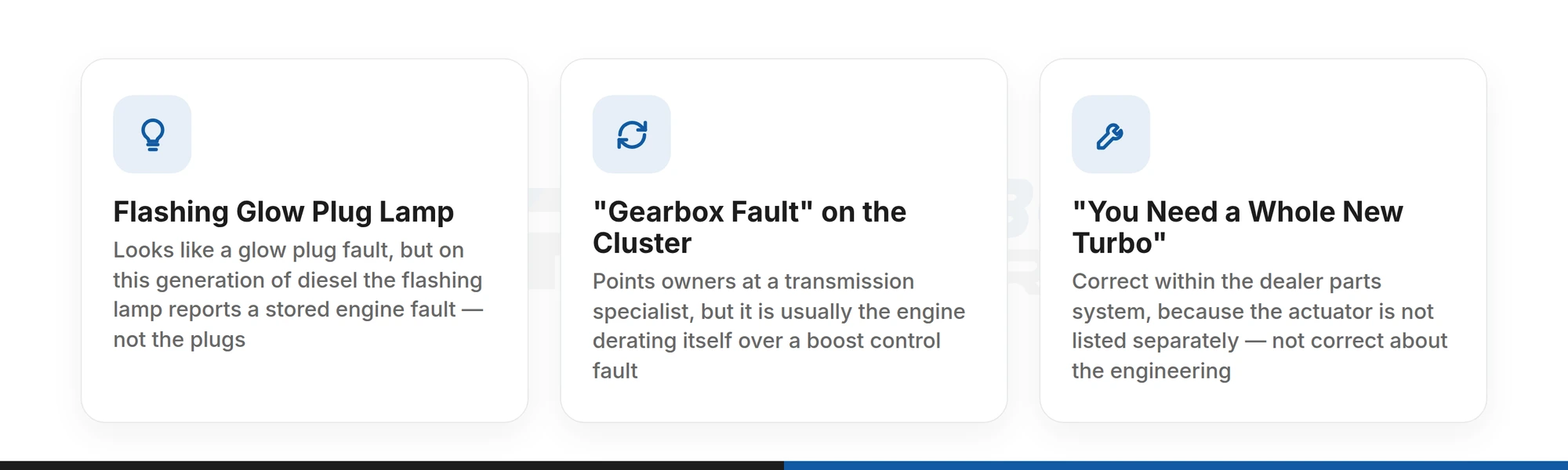
The X-Type does not put a turbo warning on the dashboard. It gives you two signals that both point somewhere else, and that misdirection is the most expensive thing about this fault.
The flashing glow plug lamp. On this generation of diesel the preheat lamp does double duty. Glowing steadily on a cold start, it means what it says. Flashing — particularly when the engine is already warm — it is reporting a stored engine fault, and it has nothing to do with the glow plugs themselves. Owners replace glow plugs over this. It does not help, because the plugs were never the problem.
The “Gearbox Fault” message on the cluster screen. This is the costly one. A message naming the gearbox sends people to a transmission specialist, and an automatic on a car of this age is a plausible enough suspect that the investigation can run a long way before anyone questions it. In the company of the symptoms below, that message is a consequence of the engine being derated, not evidence that the transmission has failed.
Put the two together — a flashing preheat lamp, a gearbox message and a car that will not pull — and the variable-geometry turbo actuator is the first thing to test, not the last.
The Symptoms, in the Order They Actually Appear
These actuators rarely die between one journey and the next. They deteriorate over months, and the stage you are at tells you how much time you have.
Stage one — it comes and goes. The car loses its urge, then a restart brings it back and everything is normal for days or weeks. This is where most owners first notice something and where most of them do nothing, because the car keeps apparently curing itself. It is not curing itself; the interval between episodes shortens.
Stage two — limp mode under load. The fault now shows up when the engine is asked to work: pulling out of a junction, joining a dual carriageway, climbing, or with the car loaded. Power collapses to a fixed low ceiling and the engine management light joins in. Limp mode is the protection, not the fault — it means the boost the control unit asked for and the boost it measured have drifted too far apart for the engine’s safety.
Stage three — permanent. Restricted performance all the time, the lamps stay lit, the message stays on the screen, and restarting changes nothing.
Anyone still at stage one has the cheapest version of this job in front of them. Left alone, a struggling actuator works harder against a mechanism that is itself getting stiffer, and the repair grows.
Fault Codes: P132A, P132B and What They Do Not Tell You
Plug a scanner into an X-Type with this fault and the codes you should expect are:
- P132A — turbocharger boost control
- P132B — turbo boost control A performance
- P2263 — turbo boost system performance
Both P132A and P132B relate directly to the variable-geometry actuator. Be ready for your tool to be unhelpful about them: depending on the scanner they display as “unknown”, or with a vague generic description along the lines of turbocharger boost control fault or performance. A blank or woolly description is not evidence that the code is unimportant — it usually means the code database in the tool does not carry the manufacturer-specific text.
Some equipment will also log P139A, P1952 or P1953 on this platform. Treat those as supporting evidence rather than as a diagnosis in their own right.
Here is the part that matters. Every one of these codes describes an outcome — the boost control system is not achieving what it was asked to achieve. None of them names a component. A worn actuator motor, a drifted position sensor, a cracked solder joint and a vane ring welded solid with carbon all store the same code, because the engine control unit only ever sees the result. The code tells you where to look, not what to buy.
“You Need a Whole New Turbocharger” — Where That Advice Comes From
Owners are routinely told by franchised dealers that the actuator cannot be replaced on its own and that the complete turbocharger has to be renewed. That advice is genuinely correct within the dealer parts system, and genuinely wrong about the engineering.
The manufacturer does not list the actuator as a separately supplied part for this vehicle. The parts catalogue offers one thing: a turbocharger with the actuator already attached. A dealer looking the part up is not being obstructive — there is simply nothing else on the screen to sell you.
Mechanically the actuator is a bolt-on unit fixed to the side of the turbocharger and connected to the vane control lever by a short link arm. It comes off on its own, it is small enough to post, and independent specialists list, supply and rebuild it as an individual component. So your decision is not really a technical one: on one side is a complete turbocharger plus the labour to remove and refit it, on the other a unit you can take off yourself and send away. The engineering does not require the first option; the parts catalogue does.
Does a Replacement Actuator Need Calibrating to the Car?
This is the question X-Type owners ask more than any other, and it is asked because the answer genuinely matters: bolt on the wrong thing and the car can drive worse afterwards than it did before.
Start with what the actuator does. It is not a switch and it does not simply push a rod to a stop. The engine control unit commands a vane position, the actuator drives its lever to that position, and a position sensor inside the housing reports back where the lever actually ended up. That commanded-to-actual relationship is what the control unit trusts to build boost.
The travel available is set by the turbocharger’s own limits — the closed and open extremes of the vane ring — and those limits are not identical from one high-mileage turbo to the next. An actuator set up against a different turbocharger can therefore command positions your vane ring does not reach, so the control unit sees boost that does not match its target, stores a fault and derates the engine. That is the mechanism behind every “I fitted a brand new actuator and now it runs like a dog” story.
Which is exactly why rebuilding your own unit sidesteps the problem. The actuator you post in is the actuator that comes back, calibrated on the bench and going back onto the same turbocharger it came off. Nothing has to be taught to the car. It is plug in, bolt on, clear the stored codes and drive.
One more thing to check before you blame a newly fitted unit. The link arm between the actuator and the vane lever is retained by a small E-clip. If that clip comes off, the arm sits loose against the actuator and will appear to move when you look at it with the bonnet up, while achieving nothing at all. It costs pence, and it is the first thing to look at when a replacement has not cured the car.
Turbo Repairs · Epsom workshop
Send us the actuator you already have
Post the unit in with your registration, your stored codes and the references off the housing, and we rebuild and calibrate the original rather than substituting a stranger’s. It comes back matched to your own turbocharger and refits without any coding.
Lifetime, unlimited-mileage warranty · Mail-in from the UK and internationally · Bench-tested and calibrated before it ships
Identifying the Actuator on Your X-Type
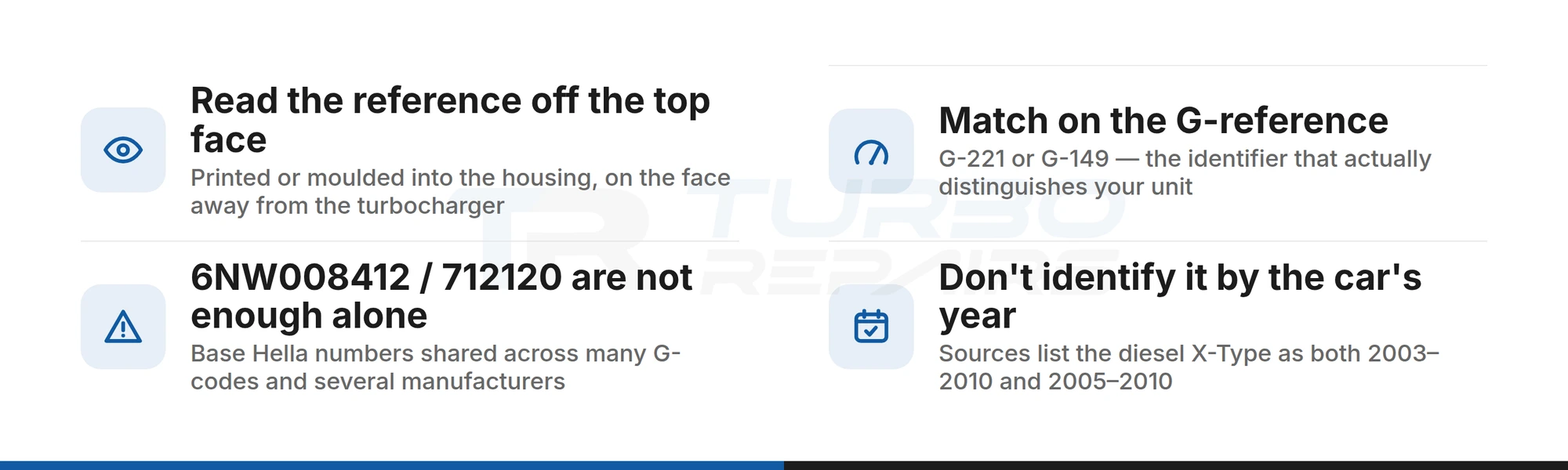
The references are printed or moulded into the top plastic section of the actuator, on the face pointing away from the turbocharger. Read them before you order, search or send anything — on this vehicle the model year will not do the job for you.
| Component | References | What it means for you |
|---|---|---|
| Actuator (Hella) | G-221 or G-149 — Hella 6NW008412, base number 712120 | The G-reference is the identifier. Both are listed against the X-Type 2.0 and 2.2 TDCi, so either can turn up on your car. |
| Also listed on X-Type and S-Type | G-36 (G-036) — Hella 6NW009206, references 752406, 752343, 758226 | The same G-36 is also listed against the 2.7 TDCi V6 Jaguars, so it is not an X-Type-only reference. Go by what is on your unit. |
| Turbocharger (Garrett) | GT1749V — 728680 and 758226-0008 / 758226-0010 appear against this family | The actuator bolts to the side of this turbo. Supplier listings cover the Ford and Jaguar 2.0 and 2.2 TDCi cars together, so treat these as a cross-check rather than a fitment guarantee. |
| Engine | 2.0 TDCi and 2.2 TDCi, listed at 130hp and 155hp | Ford-derived, and shared with the Mondeo of the period — which is why one actuator part sheet often covers both marques. |
| Years | Sources conflict: the diesel X-Type is listed variously as 2003–2010 and as 2005–2010 | Do not identify the part by the year of the car. Identify it by the references on the housing. |
Why 6NW008412 and 712120 are not enough on their own
Those two numbers are the ones most often quoted as “the X-Type actuator part numbers”, and on their own they identify almost nothing. They are base Hella references shared across a long list of G-codes and several manufacturers — the same 6NW008412 turns up on BMW 2.0-litre diesel actuators against completely different G-references, as our BMW 3 Series turbo actuator repairs and BMW X3 2.0d actuator repairs pages set out. Two actuators can carry identical Hella and base numbers, bolt on identically and still be configured for entirely different turbochargers. Match on the G-reference.
Because the hardware is shared with Ford, the same rebuild covers the equivalent commercial units — see our Ford Transit electronic turbo actuator repair. If yours is the 2.7-litre V6 rather than the four-cylinder, that is a different unit, covered on our Jaguar S-Type actuator repair page.
Why X-Type Actuators Fail
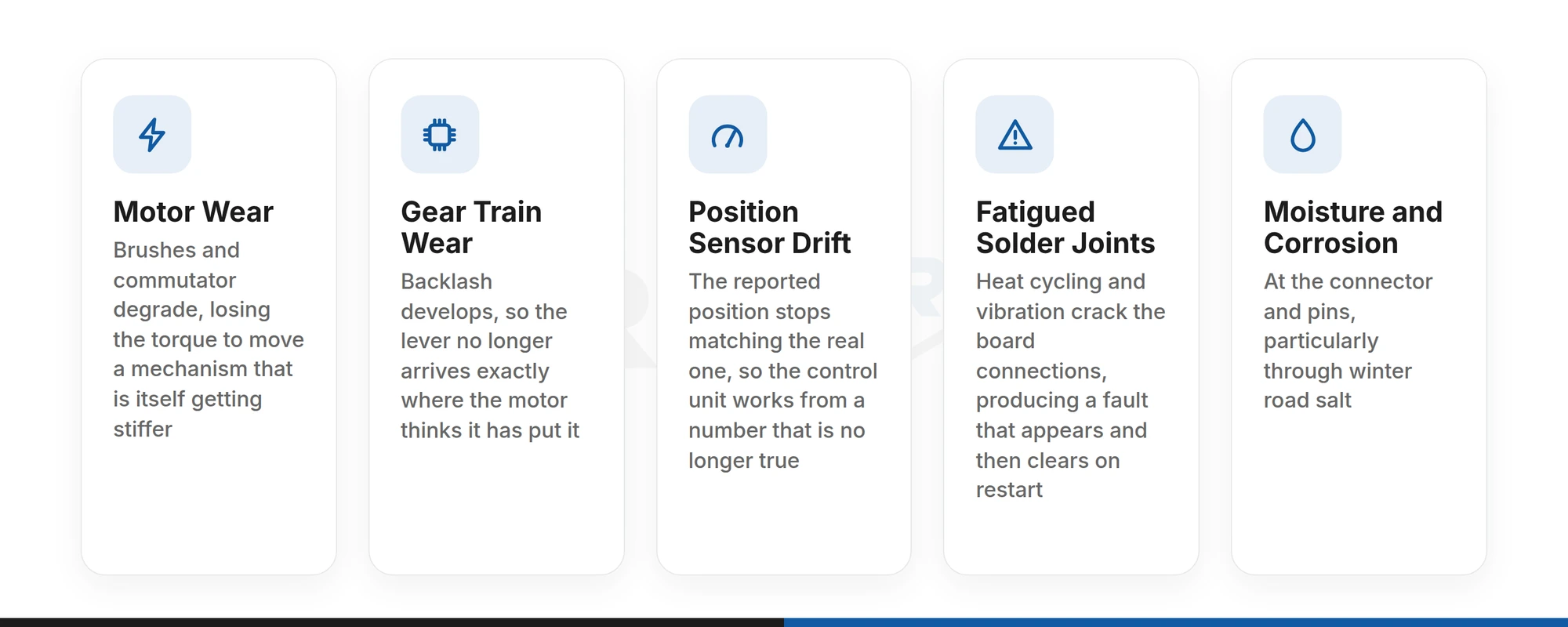
Nothing about the design is fragile in isolation. What kills these units is where they are mounted and what they are asked to push.
Inside the plastic housing are a small direct-current motor, a reduction gear train, a position sensor and a circuit board. Bolted to the side of a turbocharger, that assembly is heat-soaked every time you switch off after a run, cooled by whatever weather is passing, and vibrated continuously. The wear that follows is predictable:
- Motor wear — brushes and commutator degrade, so the motor loses the torque to move a mechanism that is itself getting stiffer.
- Gear train wear — backlash develops, and the lever no longer arrives exactly where the motor thinks it has put it.
- Position sensor drift — the reported position stops matching the real one, so the control unit is working from a number that is no longer true.
- Fatigued solder joints — the connections between the housing terminals and the board crack with heat cycling and vibration. A cracked joint makes and breaks intermittently, which is precisely what produces a fault that appears and then clears on a restart.
- Moisture and corrosion — at the connector and the pins, particularly through winter road salt.
Then there is the load. As carbon and oil mist build on the variable-vane mechanism, the actuator has to push harder each year to achieve the same travel. It is working beyond its design load long before it gives up — which is why a turbocharger left with a sticking vane ring will destroy a second actuator as cheerfully as it destroyed the first.
Four Checks Before You Send Anything
Fifteen minutes on the car will tell you whether you are dealing with the actuator or with the turbocharger behind it. A turbocharger is hot enough to burn badly, so let the engine cool properly first.
- Read the references off the housingNote the G-reference, the Hella number and the base number from the top face of the actuator, along with your registration. Identification, quotation and rebuild all depend on those, and they take a torch and a phone camera.
- Watch the arm while the engine is revvedWith the engine running and a second person raising the revs, watch the actuator arm. It should move. If it sits completely still, either the actuator is not driving or the mechanism it drives has seized — and the next check separates the two.
- Move the lever by hand, coldWith the engine off and cool, disconnect the link and move the vane lever through its full travel by hand. If it swings freely end to end with no sticking, the vane mechanism is healthy and the actuator is the suspect. If it binds, feels notchy or stops short, the vane ring is the problem and rebuilding the actuator will not cure the car.
- Check the clip, the connector and the loomConfirm the E-clip retaining the link arm is present and seated. Check the electrical connector for corrosion, spread or pushed-back pins and moisture, and follow the loom back for chafing. These faults mimic a failed actuator exactly, and cost nothing to rule out.
If check three tells you the vanes are stiff, the turbocharger needs attention alongside the actuator — our turbocharger repair and rebuild service covers that side of the work, and reconditioned units are listed in the shop.
Our Jaguar X-Type Actuator Rebuild
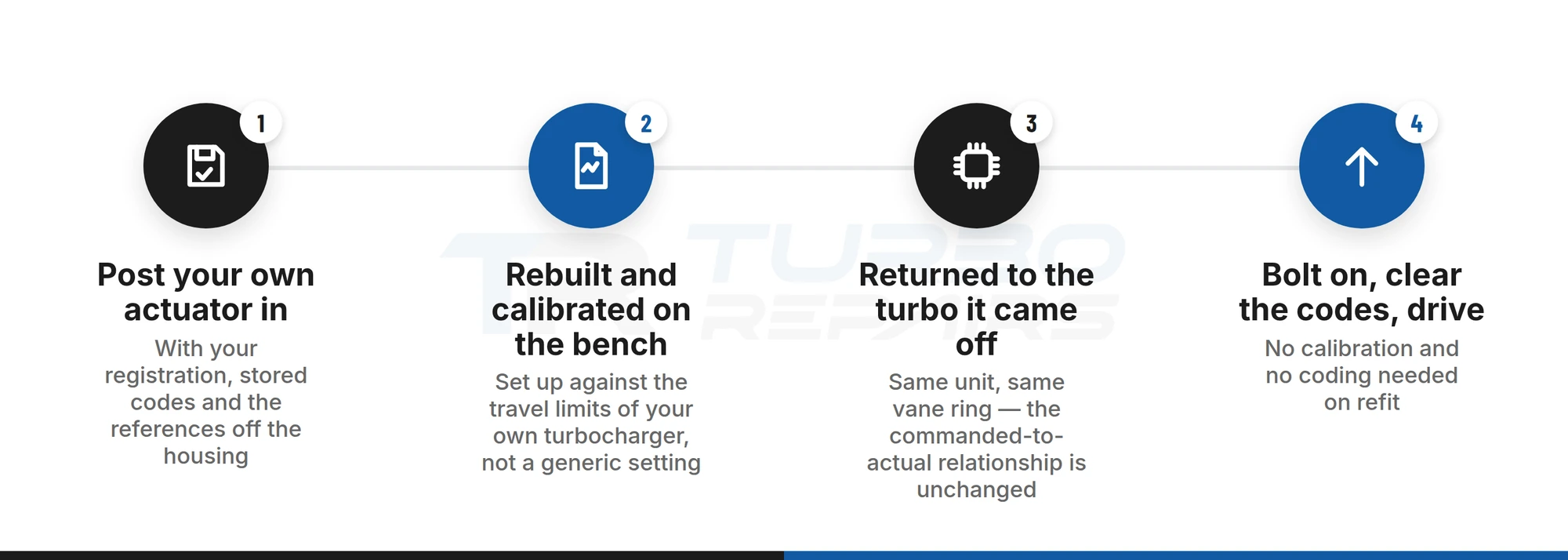
The unit you post in is the unit that comes back — your own X-Type actuator, rebuilt and recalibrated on the bench and returned to the turbocharger it came off, which is why nothing has to be coded when you refit it.
Work is carried out by our own turbo specialists and electronics engineers at our workshop at Unit 102 Reaver House, 12 East Street, Epsom, Surrey, KT17 1HX, United Kingdom. The unit is identified by its references, tested to establish what has actually failed, then stripped to component level. Worn internals — motor, gear train, position sensor and board connections — are renewed with genuine OE or OEM-grade components, the housing and connector are made good, and the rebuilt unit is calibrated and tested under load before it is packed.
What it costs and how long it takes. Actuator rebuilds start from £100, and turnaround is typically one to two working days from the unit arriving with us. Every repair carries our lifetime, unlimited-mileage warranty — no mileage cap and no time limit.
- Complete the online repair form with your registration, your stored fault codes and the references from the actuator housing.
- Remove the actuator and post it in, packed in a sturdy box with plenty of protective material around it.
- We test, identify the failure and rebuild the unit at component level.
- It is calibrated, tested and returned to you ready to bolt straight back on.
We work for private owners and for the motor trade alike — independent garages, workshops and main dealers send us units for customers’ vehicles. We accept mail-in work from the UK and internationally; if you are posting from outside the UK, get in touch before you send it and we will confirm the return shipping arrangement first. There is more on how we work on our about page, and the rest of the range sits on the electronic turbo actuator repairs hub.
Refitting It — and Making It Last
Refitting is straightforward, but three things are worth doing properly. Seat the link arm on the vane lever and make sure the retaining clip is fully home; a clip that pings off in service produces a car that behaves exactly as though the actuator has failed again. Make sure the electrical connector is dry, fully engaged and latched. Then clear the stored fault codes with a diagnostic tool — the control unit will not come out of its derated strategy while a live fault is logged, so a correctly repaired car can still feel flat until the codes are cleared.
As for making it last, the actuator’s lifespan is decided by how hard it has to push. Keep the oil to the correct specification and change it on schedule, because oil condition drives the deposits that stiffen the vane mechanism. Let the engine idle briefly before shutting down after a hard run. And if the car spends its life on short urban journeys, give it a sustained run at load regularly — the vane mechanism stays freer when it is worked through its full range rather than shuffling around at one setting every day.
Jaguar X-Type Turbo Actuator Repair FAQ
Do I need a whole new turbocharger, or can the actuator be repaired on its own?
The actuator is not listed as a separately supplied part by the manufacturer, which is why a dealer quotes a complete turbocharger. Mechanically it is a bolt-on unit on the side of the turbo with a short link arm, and it can be removed, posted to us and rebuilt on its own.
Does a rebuilt X-Type actuator need coding or calibrating when I refit it?
No. You get your own unit back, calibrated on the bench and going onto the same turbocharger it came off, so the relationship between commanded position and actual vane travel is unchanged. Bolt it on, clear the stored codes and drive.
Why is my glow plug light flashing if the fault is the turbo?
On this generation of diesel the preheat lamp also serves as an engine-fault indicator. Flashing rather than glowing steadily, it is reporting a stored engine fault — which with these symptoms is a boost control fault, not a glow plug problem. Replacing glow plugs will not change anything.
The cluster says “Gearbox Fault”. Is the gearbox the problem?
Usually not. Alongside limp mode, restricted power and a flashing preheat lamp, that message is a consequence of the engine being derated by the boost fault. Test the turbo actuator before anyone opens the transmission.
What do fault codes P132A and P132B mean on an X-Type?
P132A is turbocharger boost control and P132B is turbo boost control A performance. Both relate directly to the variable-geometry actuator. Many scanners show them as “unknown” or with a vague generic description, which does not make them any less relevant.
How do I tell whether it is the actuator or the turbo before I send anything?
With the engine off and cool, disconnect the link and move the vane lever through its full travel by hand. Free end to end means the vane mechanism is healthy and the actuator is the suspect. Stiff, notchy or short of full travel means the turbocharger needs attention first.
How much does a Jaguar X-Type turbo actuator repair cost, and how long does it take?
Rebuilds start from £100, and turnaround is typically one to two working days from your unit arriving with us. Every repair carries a lifetime, unlimited-mileage warranty.
Which X-Type models and engines does this cover?
The diesel X-Type, both the 2.0 TDCi and the 2.2 TDCi, running a Hella electronic actuator on a Garrett variable-geometry turbocharger — typically G-221 or G-149. Send us the references from the housing with your registration and we will confirm what you have.
Can I send my actuator in from outside the UK?
Yes — we accept mail-in turbochargers and actuators from the UK and internationally. Contact us before you post an international unit and we will confirm the return shipping arrangement first.
Final Thoughts
What makes this fault expensive on an X-Type is not the part. It is everything the car does to point you away from it — a lamp that implicates the glow plugs, a message that implicates the gearbox, and a parts catalogue that implicates the entire turbocharger. Three signals, all misleading, all pointing at costs that dwarf the actual repair.
The way through is unglamorous and it works. Read the references off the housing. Note what the codes say and when the symptoms appear. Move the vane lever by hand and see whether it is free. Those three things will tell you, before a penny is committed, whether you are looking at a component rebuild or a turbocharger job — and on the great majority of these cars it is the first.
Turbo Repairs · Epsom workshop
Rebuild the actuator, keep the turbocharger on the car
Send us your X-Type actuator with your registration, your stored codes and the references from the housing, and we will strip it, rebuild it at component level and calibrate it before it goes back to you. From £100, typically one to two working days, and no coding needed on refit.
Lifetime, unlimited-mileage warranty · Mail-in from the UK and internationally · Bench-tested and calibrated before it ships