

Summary We rebuild the electronic turbo actuator from the Land Rover Discovery 3, Discovery 4 and Range Rover Sport TDV6 diesels from £100 + VAT, typically in one to two working days, returned ready to refit without programming and backed by a lifetime, unlimited-mileage warranty. Two TDV6 engines sit under those three names and the parts trade catalogues them differently: the 2.7 as a single turbocharger part with no position attached, the later 3.0 as a pair. On a 3.0, the position of the turbocharger your actuator came off is part of identifying it.
The latest catalogue number for the right-hand 3.0 TDV6 turbocharger is listed for the Discovery 4 only from chassis number GA814486, so on this engine the VIN places the part where the model year cannot.
This page is for a Discovery or Range Rover Sport TDV6 that has lost its pull on a tow or a long climb, dropped into limp mode, or logged a boost fault that nobody can pin to a part. If the fault is in the electronic actuator, the unit that positions the turbocharger’s variable vanes, it can be rebuilt rather than replaced, and the turbocharger underneath it may be perfectly serviceable.
The useful work happens before a spanner is picked up: which TDV6 you have, which position the unit sits in if it is a 3.0, and whether the actuator is electronic at all. Each of those is settled at the vehicle in a few minutes, and each is set out below.
- Vehicles: Land Rover Discovery 3, Discovery 4 and Range Rover Sport (L320), TDV6 diesel
- Two engines: the 2.7 TDV6 (Discovery 3, 2004–2010; Range Rover Sport, 2005–2010) and the 3.0 TDV6 and SDV6, catalogued for the Discovery 4 and Range Rover Sport from 2009
- The 2.7 as catalogued: one turbocharger part, LR021042, with no side or position; a genuine Land Rover turbo actuator kit including rod, LR023086, for the Discovery 3 and 2005–2009 Range Rover Sport
- The 3.0 as catalogued: two turbochargers, sold as left and right on the earlier cars and as primary and secondary on the later SDV6
- Platform code: the Discovery 3 and Discovery 4 are both L319, so an “L319” listing names the body, not the engine
- Typical symptoms: power fading when towing or climbing, limp mode, the engine management light, boost codes such as P0299, P0234 and P2263
- Our service: component-level rebuild of your own electronic actuator from £100 + VAT, typically 1–2 working days, no programming on refit, lifetime unlimited-mileage warranty
2.7 or 3.0? Which TDV6 Is Under Your Bonnet
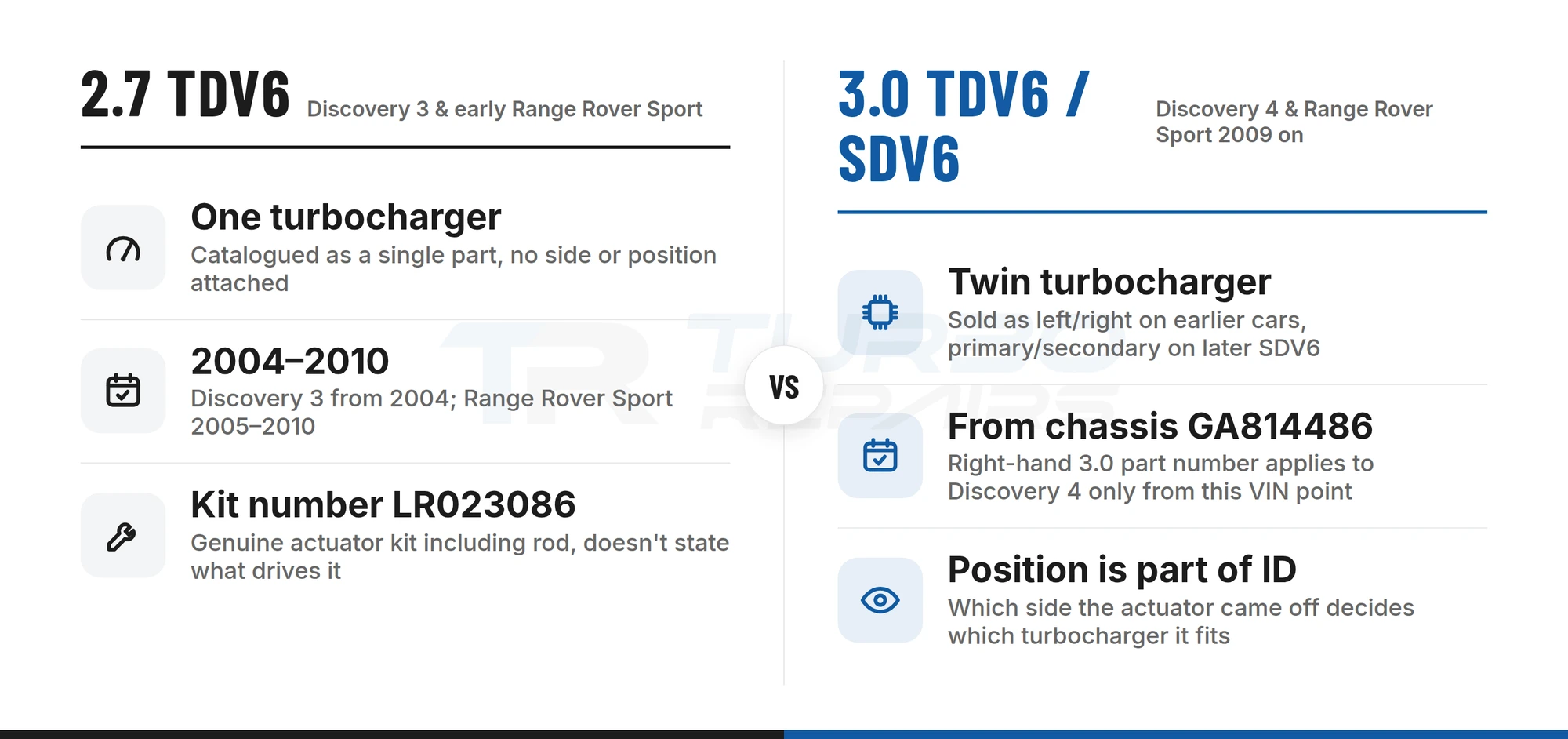
Three model names, two diesel V6s and one platform code. The Discovery 3’s diesel is the 2.7 TDV6, which our own listing covers for vehicles built from 2004 to 2010. The Range Rover Sport L320 began with the same 2.7, and 3.0 turbochargers are catalogued against it from 2009 onwards, so a late L320 can carry either engine. The Discovery 4 is catalogued with the 3.0 TDV6 and SDV6 from 2009.
The model name does not close the question, even on a Discovery 4. One Land Rover parts retailer lists the 2.7 turbocharger, its oil feed pipe and a turbo bracket bolt against both the Discovery 3 and the Discovery 4, and another sells a 2.7 TDV6 thermostat for the “Discovery 3/4”. The chassis code helps even less. Parts catalogues file the Discovery 3 and the Discovery 4 under the same L319 designation, and at least one actuator repair is sold against “Discovery (L319)” with no engine named at all.
So take the engine from the vehicle’s own records rather than its badge or its registration year. Put the registration and the VIN on the repair form and we confirm the engine before your unit is booked in; a garage can do the same with a VIN-based parts lookup. The VIN matters more on the 3.0 than on the 2.7, for a reason set out in the next section.
If yours is the 2.7
The 2.7 TDV6 is the same V6 diesel that Jaguar fitted to the S-Type. Land Rover 2.7 listings catalogue one turbocharger part with no side or position attached, and we are not going to read an installation off that and publish it here as fact. How many units your engine carries, and which one has failed, is settled at the vehicle. If you find more than one on yours, the diagnostic order on our page for the same 2.7 V6 in the Jaguar S-Type applies as written, so it is not repeated here.
Primary and Secondary on the 3.0: Why the Position Belongs in the Identification
The 3.0 is catalogued as a twin-turbocharger engine, and the parts trade names the pair in two different vocabularies. One remanufacturer sells the Discovery 4 and Range Rover Sport 3.0 TDV6 and SDV6 set, 211 to 255 hp from 2009, as a left-side and a right-side turbocharger. The same remanufacturer sells the later 3.0 SDV6 set, listed across the Discovery, Range Rover Sport, Jaguar XF and XJ at 245 to 306 hp, as a primary and a secondary. A Land Rover parts retailer joins the two, listing a 3.0 TDV6 unit for the later Range Rover, Range Rover Sport and Discovery 5 as “Right Hand (Secondary)”.
So “left”, “right”, “primary” and “secondary” are not four different parts. They are two ways of naming two positions, and a listing written in one vocabulary will rarely tell you how it maps onto the other.
| As catalogued | Reference | Listed for |
|---|---|---|
| Left-hand 3.0 TDV6 turbocharger | LR056369, superseding LR029915 and LR049590 | Discovery 4, Range Rover Sport 2009 onwards, Range Rover L405 |
| Right-hand 3.0 TDV6 turbocharger | LR128704, superseding LR049587, LR068157 and LR063777 | Discovery 4 from chassis GA814486; Range Rover L405 from KA544332; Range Rover Sport L494 from KA844363 |
| Left and right pair, 3.0 TDV6 and SDV6, 211–255 hp | 778400-0003 and 778401-0006 | Discovery 4 and Range Rover Sport, from 2009 |
| Primary and secondary pair, 3.0 SDV6, 245–306 hp | Primary 824754 or 827153; secondary 824756 | Discovery, Range Rover Sport, Jaguar XF and XJ |
| “Primary” turbocharger for the mono-turbo 3.0 | LR084606, superseding LR061996 | Discovery 5, Range Rover Sport L494, Range Rover L405 |
Every number in that table is a turbocharger reference, for the unit the actuator is mounted on, not an actuator part number. We print them because they show how the catalogue behaves, not so that you can order from them. If the turbocharger itself has failed, see our 3.0 TDV6 turbo rebuild page.
Three things follow for the actuator. First, the latest right-hand number applies to a Discovery 4 only from a stated chassis number, so the VIN, not the model year, places your vehicle in the catalogue. Second, the word “primary” also appears on the only turbocharger of a later mono-turbo 3.0, which means a search for a primary turbo actuator can return parts for a vehicle with one turbocharger rather than two. The word names a role. It does not tell you how many units an engine carries.
Third, and most useful: the two positions carry separately numbered turbochargers, so an actuator from one position is not a spare for the other, and a rebuilt actuator belongs back on the turbocharger it came off. Which boost-control hardware each position carries on your particular engine is not stated by any catalogue we can cite, and we will not guess it for you. Photograph the unit in place, note which side of the engine it sits on, and it is identified on our bench.
Is Your Actuator Electric or Pneumatic? Settling It at the Car
Catalogues describe the boost control on these engines inconsistently. Our Discovery 3 2.7 TDV6 turbocharger rebuild listing sets out how one vehicle page offers pneumatic, electric and “electronic” units for the same car. The genuine Land Rover actuator kit for the 2.7, LR023086, is described only as a turbo actuator kit including rod. An electronic Hella actuator is offered for repair against the L319 Discovery with no engine named. None of those tells you what is fitted to yours.
The vehicle tells you in under a minute, with the engine cold and switched off. Look at what feeds the actuator:
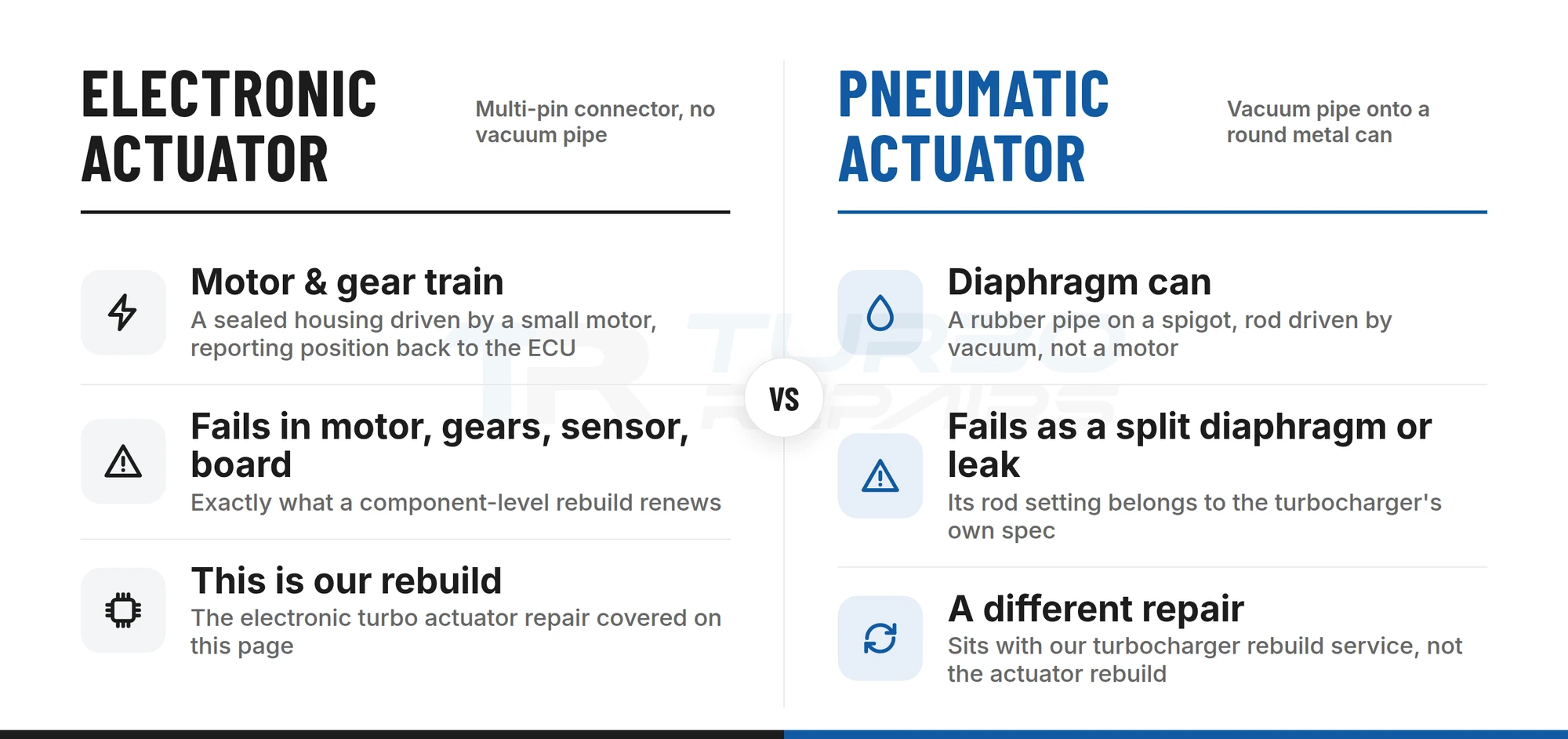
- An electrical connector and no vacuum pipe. A sealed housing with a multi-pin plug going into it is an electronic actuator: a small motor, a gear train and a position sensor, reporting back to the engine control unit. This is the unit our actuator service rebuilds.
- A vacuum pipe onto a round metal can. A diaphragm can with a rubber pipe on a spigot and a rod coming out of it is a pneumatic actuator. Whatever electrical control it has sits elsewhere in the vacuum supply, not in the can.
The distinction decides the repair. An electronic actuator fails in its motor, gears, sensor and board connections, and a component-level rebuild renews exactly those. A pneumatic can has none of them: its faults are a split diaphragm, a leaking pipe or a vacuum supply that is not arriving, and its rod setting belongs to the turbocharger’s own specification. If the pipe and supply are sound and the can itself has failed, that work sits with our turbocharger rebuild service rather than an actuator rebuild.
Symptoms on a Heavy 4×4: Where the Fault Shows First
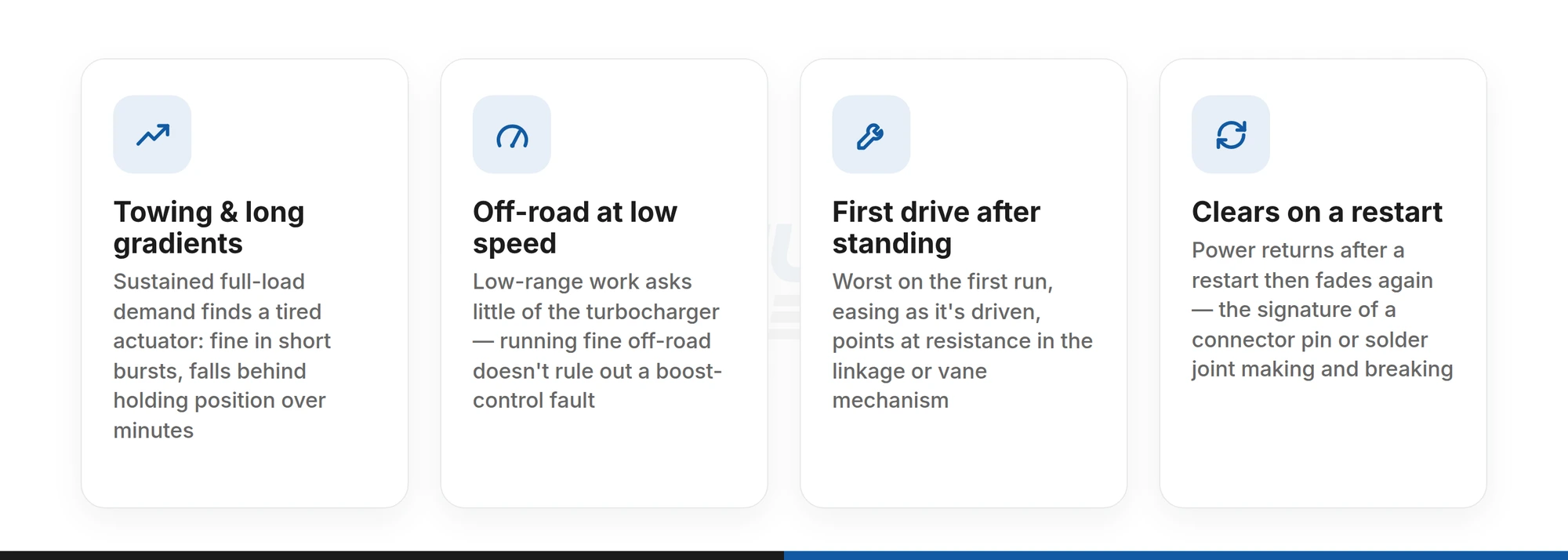
An actuator that can no longer hold the vanes where the engine control unit sends them produces a familiar set: power that fades or disappears, limp mode, the engine management light and a boost code. What these vehicles add is the situations in which it shows first, because a large 4×4 spends more of its working life asking for boost and holding it than a car does.
Towing and long gradients
Sustained full-load demand is where a tired actuator is found out. A worn motor or a gear train with backlash can place the vanes well enough in short bursts and still fall behind when asked to hold position against exhaust load for minutes at a time. A vehicle that is fine around town and derates halfway up a long motorway incline with a caravan behind it is behaving exactly as that fault predicts.
Off-road at low speed
Low-range work asks very little of the turbocharger. A vehicle that behaves perfectly on a green lane and fails on the tow is consistent with a boost-control fault, not evidence against one, so do not let a good day off-road talk you out of reading the codes.
The first drive after standing
A fault that is worst on the first run after the vehicle has stood, and eases as it is driven, points at resistance in the linkage or the vane mechanism rather than at the electronics. Pivots stiffened by carbon or corrosion loosen as they are worked. That is a mechanical load on the actuator, and it changes what you do next.
A fault that clears on a restart
Power that returns after the engine is switched off and on again, then goes, is the signature of a connection that makes and breaks: a connector pin, or a solder joint inside the actuator. Check the connector for corrosion, and for a latch that is fully home, before blaming the unit.
The codes these faults set, such as P0299, P0234 and P2263, are generic boost-control codes that any boost fault can raise. They record which way the boost missed its target, not which part missed it, and our guide to overboost and underboost codes explains what that direction does and does not rule out. On a 3.0 no boost code names a position either, so write down when the fault appeared, at what speed and under what load, while the vehicle is still showing it. Our turbo actuator symptoms guide covers reading that pattern before anything is unbolted.
Freeing a Sticking Linkage: What It Proves and What It Does Not
The most widely repeated fix for a sticking actuator on these vehicles is to reach the linkage from underneath, free it and lubricate it. It is worth doing, and on some vehicles it brings the boost back at once. It is also a test with a clear result, and the result is worth reading correctly.
If freeing the linkage restores boost, the resistance was outside the actuator’s motor, in the linkage pivots or the vane mechanism behind them. Nothing has cured that resistance, and the carbon and corrosion that stiffened the pivots once will stiffen them again. Meanwhile the actuator has been driving against it, which is precisely the load that wears a motor and strips a gear train. A freed linkage is a reason to look at the vane mechanism, not a repair.
If freeing it changes nothing, the resistance was never the problem, and the actuator’s internals or its wiring move to the top of the list.
The cleaner version of the same test separates actuator from turbocharger outright. With the engine cold and the vehicle supported on axle stands, never on a jack alone, detach the link at the actuator and move the vane lever through its full travel by hand. Free from end to end, and the actuator is the suspect. Stiff, notchy or short of travel, and the turbocharger needs attention first, because a rebuilt actuator on a binding vane ring wears out the way the original did. Do not drive with the actuator unplugged to see what happens: the control unit can then no longer place the vanes at all.
Access on these engines is the costly part of the job, and how much has to come off to reach the actuator depends on the engine and the vehicle. If your garage finds the actuator will not come off without the turbocharger, send the turbocharger complete with the actuator attached, and we assess both before anything is rebuilt. For a 2.7 where the turbocharger itself is the problem, our Range Rover Sport 2.7 TDV6 turbocharger listing and its Discovery 3 counterpart cover the rebuild.
Turbo Repairs · Epsom workshop
Vanes free, fault still there? Let the bench decide
Tell us the engine, the VIN and which side of the engine the actuator came off, then post it in with your stored codes. We test it as received, before it is opened, and tell you what has failed before any work goes ahead.
Lifetime, unlimited-mileage warranty · Mail-in from the UK and internationally · Bench-tested and calibrated before it ships
What to Photograph and Record Before Anything Is Unbolted
Once the actuator is in a box, the information on the vehicle is gone. A few minutes with a torch and a phone camera beforehand saves a round of questions later and, on a 3.0, is the only reliable record of position.
- The actuator label. Wipe the housing and photograph every number on it, manufacturer reference, any G-code and any Land Rover number, including the ones that look irrelevant. We identify from the full set, not one line of it.
- Its position. Which side of the engine it sits on, written as nearside or offside so there is no doubt about whose left is meant, and marked on the box as well. If you have seen the unit described as primary or secondary, note that too, and where.
- The engine and the VIN. 2.7 or 3.0, and the VIN from your registration document. On a 3.0 Discovery 4 the chassis number places your vehicle on one side or the other of a catalogue change.
- The fault as it happened. The stored codes and any freeze-frame data, whether it came on under tow or load, whether a restart clears it, and whether it is worse after standing.
- What has already been tried. Whether the linkage was freed and lubricated and what that changed, and whether the vane lever swept freely by hand.
One thing not to do is order on a kit number. LR023086 is catalogued as a turbo actuator kit including rod for the 2.7 in the Discovery 3 and the 2005–2009 Range Rover Sport, and the listing does not say what drives it. A kit number tells you what a supplier will send. It does not identify the unit on your engine.
Our Land Rover TDV6 Actuator Rebuild
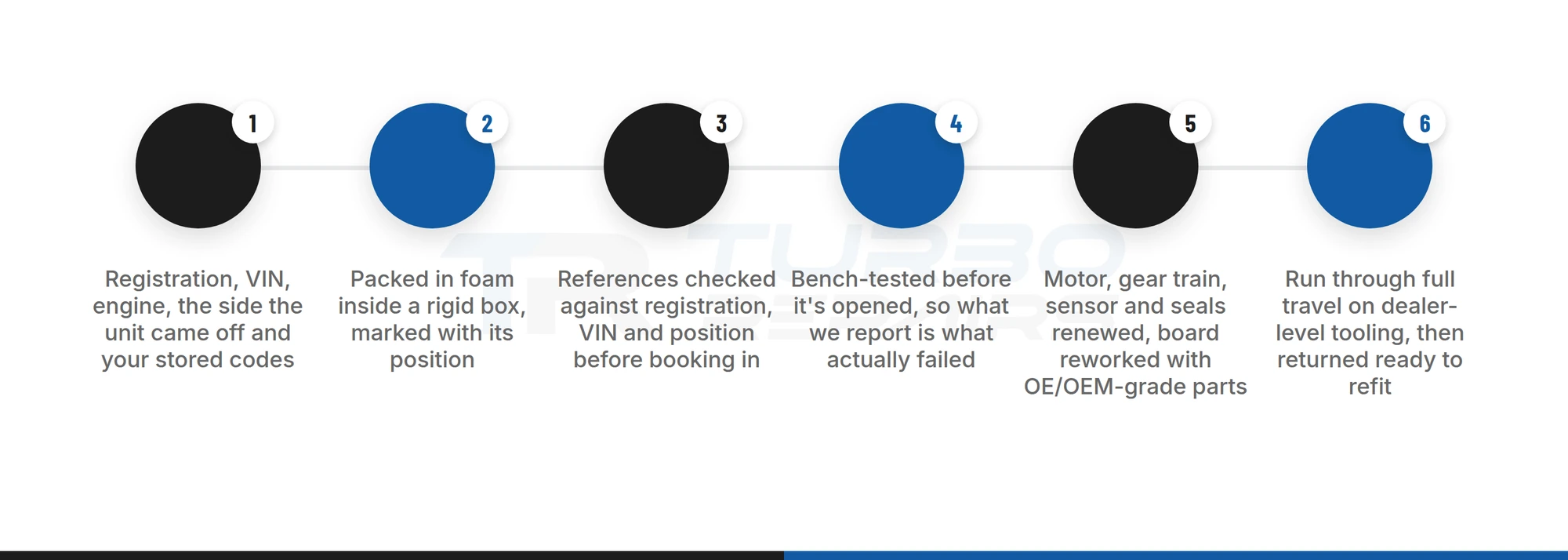
You get your own actuator back, rebuilt at component level, rather than an exchange unit. That counts for more on this engine than most: your unit is already set up for the turbocharger it came off, in the position it came from, and a rebuild keeps it that way.
The work is done in our own workshop at Unit 102 Reaver House, 12 East Street, Epsom, Surrey, KT17 1HX, United Kingdom, by turbo specialists and electronic engineers. It is a mail-in service, so the vehicle stays with you while the unit travels, and we take units from private owners and from garages sending them in on a customer’s behalf.
- Complete the repair form. Registration, VIN, engine, the side the unit came off, the label photographs, the stored codes and what the linkage and vane checks showed.
- Remove the actuator and post it. Pack it in foam or bubble wrap inside a rigid box, marked with its position; our FAQs cover packing and postage. If it cannot come off without the turbocharger, send the assembly.
- We identify it against your vehicle. The references are checked against the registration, VIN and position you gave us. If anything does not match, we tell you before work starts.
- We test it as received. The unit is bench-tested before it is opened, so what we report is what actually failed.
- We rebuild it at component level. Motor, gear train, position sensor and seals are renewed as required and the circuit board is reworked, using genuine OE or OEM-grade components, uprated where the original design is the reason the unit failed.
- We calibrate it and prove it. The rebuilt actuator is run through its full travel on dealer-level diagnostic and calibration tooling and our own test platforms, then returned ready to refit. Once it is back on, clear the stored codes, because a repaired vehicle can stay in limp mode until they are.
Repairs start from £100 + VAT, with the exact price confirmed once the unit has been identified and tested, before any work goes ahead. Turnaround is typically one to two working days from the unit reaching us, plus postage each way. Refitting needs no programming, and every rebuild carries a lifetime, unlimited-mileage warranty with no time limit. Units are accepted from across the UK and from overseas, and the full range is on our electronic turbo actuator repairs hub.
Discovery and Range Rover Sport Turbo Actuator Repair FAQ
Which TDV6 does my Discovery or Range Rover Sport have?
The Discovery 3’s diesel is the 2.7 TDV6. The Discovery 4 is catalogued with the 3.0 TDV6 and SDV6 from 2009, although some retailers also list 2.7 parts against it. The Range Rover Sport L320 can be either: the 2.7 from launch, with 3.0 turbochargers catalogued from 2009. Go by the VIN rather than the badge, and put it on the repair form so we can confirm the engine.
What is a secondary turbo actuator on a Discovery 4 or Range Rover Sport?
The 3.0 is catalogued with two turbochargers, sold as left and right on the earlier cars and as primary and secondary on the later SDV6, and one catalogue labels a right-hand unit “secondary”. A secondary turbo actuator is the boost-control actuator on the secondary position’s turbocharger. Which hardware that position carries on your engine is confirmed from the unit and its label, so note the side of the engine it came off.
Is the Discovery 3 turbo actuator electric or pneumatic?
Catalogues for this vehicle disagree, so check the vehicle. A sealed housing with a multi-pin electrical plug and no vacuum pipe is an electronic actuator, which is what we rebuild. A round metal can with a vacuum pipe on it is pneumatic, and that is a different repair.
Can I just free and lubricate the actuator linkage?
It is worth trying, as a test. If it restores boost, the resistance was in the linkage or the vane mechanism, and it will come back, having loaded the actuator in the meantime. Have the vane mechanism looked at rather than treating the job as done. If freeing it changes nothing, the actuator or its wiring is the likelier cause.
Is a Range Rover Sport actuator the same as a Discovery one?
Within the same engine the catalogues treat the two together: the 2.7 actuator kit LR023086 is listed for both the Discovery 3 and the 2005–2009 Range Rover Sport, and the 3.0 turbochargers for both the Discovery 4 and the Range Rover Sport from 2009. Even so, match on the label and the position, not the vehicle name.
Does the turbocharger have to come off to remove the actuator?
That depends on the engine and the vehicle, and access is the expensive part of the job either way. If your garage cannot remove the actuator on its own, send the turbocharger complete with the actuator attached and we assess both before anything is rebuilt.
How much does it cost, and will it need programming?
Repairs start from £100 + VAT, with the exact price confirmed after the unit has been identified and tested. Turnaround is typically one to two working days from arrival, plus postage. No programming is needed: your own unit goes back on the turbocharger it came off. Clear the stored codes once it is fitted. Every rebuild carries a lifetime, unlimited-mileage warranty.
Final Thoughts
An actuator fault on a Discovery or Range Rover Sport TDV6 is rarely hard to recognise: boost that fades on a tow, limp mode, a generic boost code. What costs money is the identification around it. Two engines hide behind three model names and one chassis code, the 3.0’s two turbochargers are named in two vocabularies, and the latest catalogue number for one of them changes partway through Discovery 4 production.
None of that has to be solved from a listing. The engine comes from the VIN, the position from where the unit sits on your engine, and the type from whether a plug or a vacuum pipe goes into it. Record those three before the unit comes off, and the actuator you post in is the one already set up for your turbocharger, which is the one we rebuild and send back.
Turbo Repairs · Epsom workshop
Rebuild the TDV6 actuator already set up for your engine
Send the unit with its position marked, your VIN and the label photographs, and we identify it, test it before it is opened and rebuild it at component level. From £100 + VAT, typically one to two working days, and it refits without programming.
Lifetime, unlimited-mileage warranty · Mail-in from the UK and internationally · Bench-tested and calibrated before it ships