

Summary We rebuild the electronic turbo actuator from the Vauxhall Insignia 2.0 CDTI from £100 + VAT. Your own actuator is tested as it arrives, rebuilt at component level, calibrated on the bench and returned ready to refit without programming, typically after one to two working days, with a lifetime, unlimited-mileage warranty.
Not every Insignia 2.0 CDTI is listed with an electronic actuator, and not every part sold as an Insignia turbo actuator is one. This page sets out which versions the listings put an electronic unit on, what to read off your own car before you buy anything, and how to separate an actuator fault from a turbocharger fault while both are still bolted to the engine.
The parts trade sells the 160 hp Insignia’s actuator under 786137, the number of the Garrett turbocharger it bolts to, and lists the 170 hp unit with no reference number at all.
On the Insignia 2.0 CDTI, the electronic actuator is the motorised unit bolted to the turbocharger that moves its boost-control mechanism whenever the engine management asks for more or less boost. It is a separate part from the turbocharger. It can be unbolted, rebuilt and refitted on its own, so a failed actuator does not by itself mean a new turbo.
- Cars covered: the Vauxhall Insignia 2.0 CDTI fitted with an electronic turbo actuator, first generation (listed 2008 to 2017) and second generation (listed from 2017)
- Electronic actuator listed for: the 160 hp (118 kW) car on the A20DTH engine, and the 170 hp (125 kW) car on both generations, alongside the Cascada and Antara at the same output
- How the trade identifies it: on the 160 hp car, by the Garrett turbocharger number 786137; on the 170 hp car, by the vehicle alone
- Not on this page: Vauxhall’s vacuum control valves, the 1.6 CDTI actuator and the petrol Insignias
- Fault codes: explained in our turbo actuator fault code guide
- Our service: your own actuator rebuilt from £100 + VAT, typically 1–2 working days on the bench, no programming on refit, lifetime unlimited-mileage warranty
Does Your Insignia Have an Electronic Actuator?
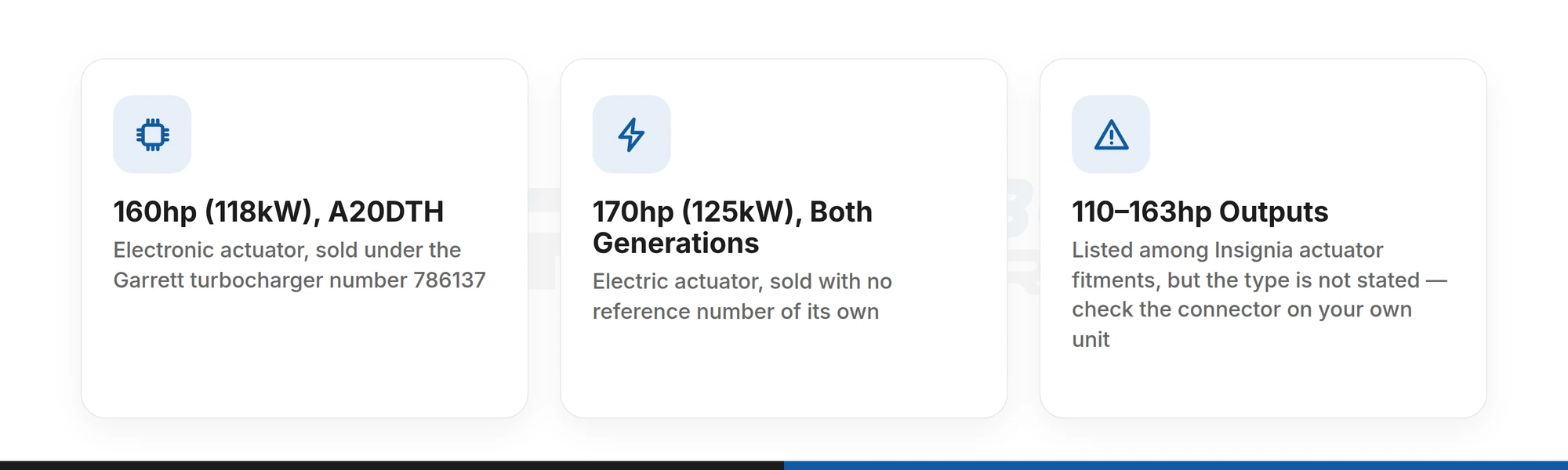
Two versions of the 2.0 CDTI are clearly listed with one. Parts listings sell an electronic actuator for the Opel and Vauxhall Insignia 2.0 CDTI at 160 hp, and one of them names the engine code, A20DTH. A separate listing sells an electric actuator for the 2.0 CDTI at 125 kW, about 170 hp, naming the first-generation Insignia from 2014 to 2017, the second-generation Insignia from 2017, and the Cascada and Antara at the same output.
The 2.0 CDTI was listed at seven outputs on the first-generation car, and the listings we reviewed do not describe the actuator on the other five. The table sets out what they do say. The years are those one actuator catalogue lists each version against, not the production run of the car.
| Output | kW (V5C, section P.2) | Years listed | What the listings say about the actuator |
|---|---|---|---|
| 110 hp | 81 kW | 2008 to 2017 | Listed among Insignia actuator fitments; type not stated |
| 120 hp | 88 kW | 2012 to 2016 | Listed among Insignia actuator fitments; type not stated |
| 130 hp | 96 kW | 2008 to 2014 | Listed among Insignia actuator fitments; type not stated |
| 140 hp | 103 kW | 2013 to 2017 | Listed among Insignia actuator fitments; type not stated |
| 160 hp | 118 kW | 2008 to 2017 | Electronic, sold under the turbocharger number 786137; engine code A20DTH |
| 163 hp | 120 kW | 2013 to 2017 | Listed with the A20DTH engine code among actuator fitments; type not stated |
| 170 hp | 125 kW | Late 2014 to 2017, and the second generation from 2017 | Electric, sold with no reference number |
“Type not stated” does not mean the car has a vacuum actuator. It means the listings are silent, and the part on your turbocharger is not. An electronic actuator is a moulded housing with an electrical connector plugged into it. A sealed can with a rod and a small vacuum pipe is a pneumatic actuator, and it is not what this service rebuilds.
That check takes a torch and a minute, and it settles the question for your car whatever its output. If you find a connector and your output is one the table leaves open, give us the output and every marking on the casing when you complete the repair form, and we confirm the unit before you post anything.
Parts sold as an Insignia turbo actuator that are something else
Search for an Insignia turbo actuator and three other kinds of part come back with it. None of them is the unit this page is about.
- Vauxhall’s vacuum control valves. Vauxhall’s own parts range sells a turbocharger boost valve, 55575611, listed for the first-generation Insignia on engine codes A20DT, A20DTC, A20DTL, A20DTJ and A20DTH, and a wastegate actuator vacuum control valve, 55599331, listed for the second-generation Insignia 2.0 diesel. These are valves that manage vacuum, sold under names that contain the words boost, wastegate and actuator. A20DTH appears in the boost valve listing and in the electronic actuator listing alike, so an engine code in a valve listing tells you nothing about how your turbocharger is controlled.
- The 1.6 CDTI actuator. The 1.6 CDTI Insignia is listed under a different actuator altogether, with references beginning 54389700003, shared with the Astra, Zafira, Meriva, Mokka and Vivaro 1.6 CDTI at 94 to 134 hp on engine codes B16DTH, B16DTN, B16DTE and B16DTJ. That listing does not say whether the unit is electronic, so the connector check above applies.
- The petrol Insignias. The 1.4 and the 2.0 Turbo petrol cars appear in the same actuator catalogues. Nothing on this page applies to them.
What an Actuator Fault Looks Like on the Insignia
A failing electronic actuator rarely announces itself as one. The car loses power or drops into limp mode, and the engine management stores a boost-control fault. The same complaint can come from a split charge hose, a corroded connector or a boost-control mechanism inside the turbocharger that has stiffened, so the symptom tells you which system to look at rather than which part to buy.
Some patterns point more firmly at the actuator than others.
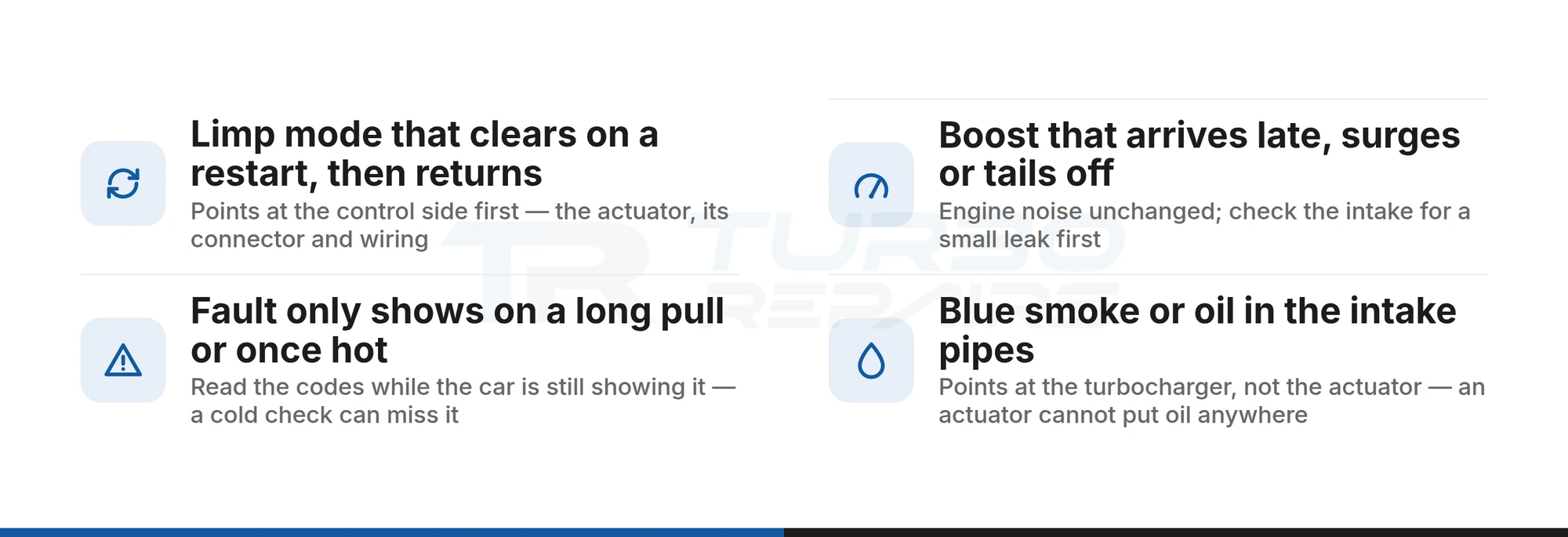
- Limp mode that clears after a restart, then comes back. A fault that comes and goes points at the control side first: the actuator, its connector and its wiring. Worn bearings and seals in the turbocharger give steadier, more physical signs.
- Boost that arrives late, surges or tails off without any change in engine noise. This fits a unit that is no longer holding the position it is sent to. It also fits a small leak in the pressurised pipework, which is why the intake gets tested before anything is unbolted.
- A fault that only shows on a long pull or once the engine is hot. Write down when it happens and read the codes while the car is still showing it, because a quick plug-in on a cold car can miss it entirely.
- Blue smoke, oil in the intake pipes or a rising whine. These point at the turbocharger rather than the actuator. An actuator cannot put oil anywhere.
Read the stored codes, and any freeze-frame data with them, before anything is cleared. Our guide to turbo actuator symptoms sorts the pattern around each symptom in more depth, and the fault code guide explains which signal each code is reporting on.
Reading the References Off Your Own Actuator
On most cars, a replacement actuator is ordered on its own reference. On the Insignia 2.0 CDTI, the listings we reviewed barely give it one.
The 160 hp car: sold under the turbocharger’s number
The electronic actuator for the 160 hp Insignia is sold as 786137. That is the Garrett turbocharger’s number, and one listing says so plainly, giving 786137 as both the manufacturer part number and the turbocharger model. The references it lists are the turbocharger’s suffixes: 786137-0001, 786137-0003, 786137-5001S, 786137-5003S and 786137-9003W.
The same listing adds four comparison numbers, 55570748, 5860381, 860335 and 95519811, and 55570748 appears in a second listing for the same part. Neither listing says whether those numbers belong to the actuator or to the turbocharger it sits on. The only string that might have been read off an actuator is the seller’s stock code, AC-G267e 7003-001-9009, and the listing does not say where it came from, so we do not treat it as a reference.
The 170 hp car: sold under no number
The electric actuator listed for the 170 hp car carries no reference number of any kind. It is identified entirely by a list of vehicles at 125 kW, across both Insignia generations, the Cascada and the Antara. A listing like that describes the car, not the part, and it leaves the buyer to trust that every car on the list uses the same unit.
What to photograph before you buy or send anything
Because the trade identifies this actuator through other things, the useful evidence is spread across the car rather than printed on one label. Record all of it before anything comes off.
- The output from your V5C. Section P.2 gives it in kilowatts: 118 kW is the 160 hp car and 125 kW the 170 hp car.
- The turbocharger’s own label. If you are buying an actuator for a 160 hp car, the number the listings match on is printed there, not on the actuator.
- Every marking on the actuator casing. Photograph each one exactly as printed, including any maker’s name, codes and date marks, whether or not a listing uses them.
- The registration and the stored codes. These let us check the car against the unit and the fault against the evidence.
If you are having the actuator rebuilt rather than replaced, none of this has to be matched. Your own unit goes back onto the turbocharger it came off, already set up for it. The photographs simply let us confirm what is coming before it is posted.
Actuator or Turbocharger? The Check Before It Comes Off
When a garage reports that the actuator is stuck, that can mean two different faults. Either the actuator has failed and can no longer move a healthy mechanism, or the mechanism inside the turbocharger has stiffened and the actuator cannot move it. The first needs an actuator repair. The second needs the turbocharger rebuilt, and a new or rebuilt actuator fitted to it would meet the same resistance from its first drive.
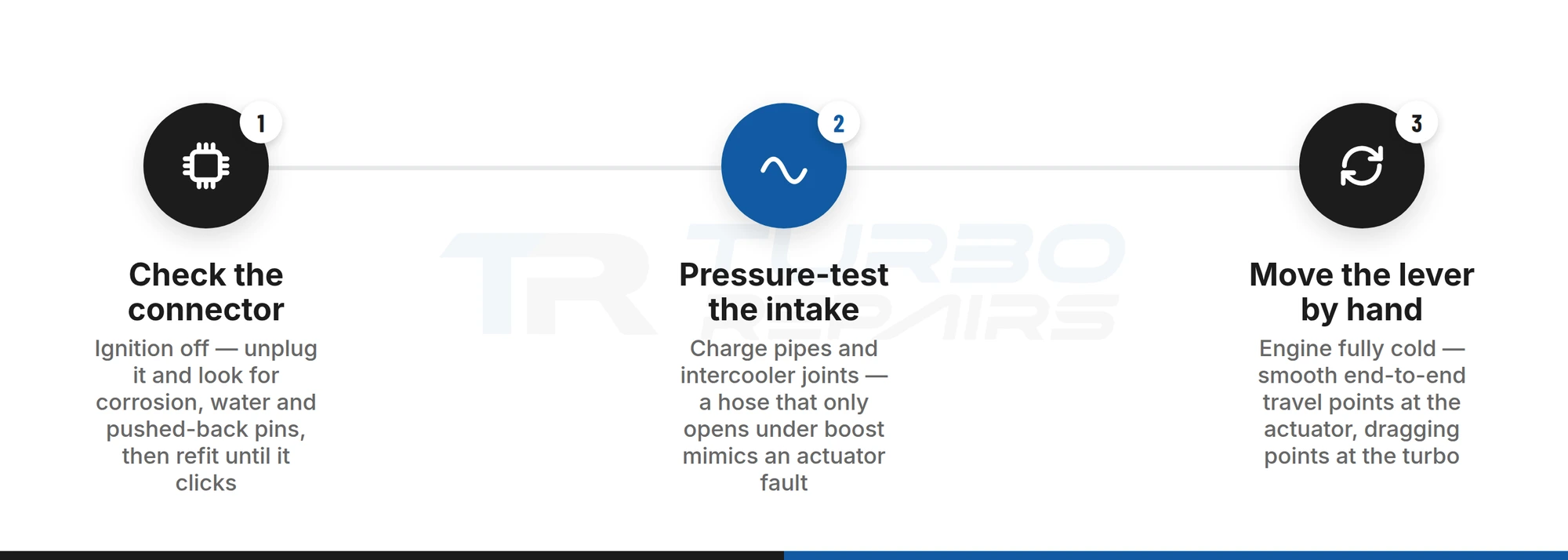
Three checks separate them, and none needs special tools.
- The connector. With the ignition off, unplug the actuator and look at both halves for corrosion, water and pushed-back pins, then refit it until it clicks home. A poor connection produces the same fault as a failed motor.
- The intake. Have the charge pipes and intercooler joints pressure-tested. A hose that only opens under boost reads as a boost-control fault, and it is far cheaper to fix than either the actuator or the turbo.
- The mechanism, by hand. Let the engine cool completely, because the turbine housing gets hot enough to burn. Where the actuator drives the turbocharger through an external link, free the link and move the turbocharger’s control lever gently through its full travel. Smooth movement from end to end points at the actuator. Dragging, catching or stopping short points at the turbocharger.
Never drive the car with the actuator unplugged to see what happens. The three checks above tell you more, and without the risk.
If the lever is stiff, the turbocharger needs the work: see our Insignia turbo rebuild page. Turbocharger rebuilds start from £185 + VAT, and our Vauxhall Insignia 2.0 CDTI turbocharger rebuild listing is the place to start. An actuator that has been pushing against a stiff mechanism has been working harder than it was designed to, so mention it on the form and we can test the actuator as well.
Turbo Repairs · Epsom workshop
Lever moves freely? Send us the Insignia actuator, not the turbo
Photograph the markings on the casing, note your output from the V5C and the codes the car stored, then post the actuator in on its own. We test it as received before it is opened, so the fault we report is the one we measured.
Lifetime, unlimited-mileage warranty · Mail-in from the UK and internationally · Bench-tested and calibrated before it ships
Our Vauxhall Insignia Actuator Rebuild
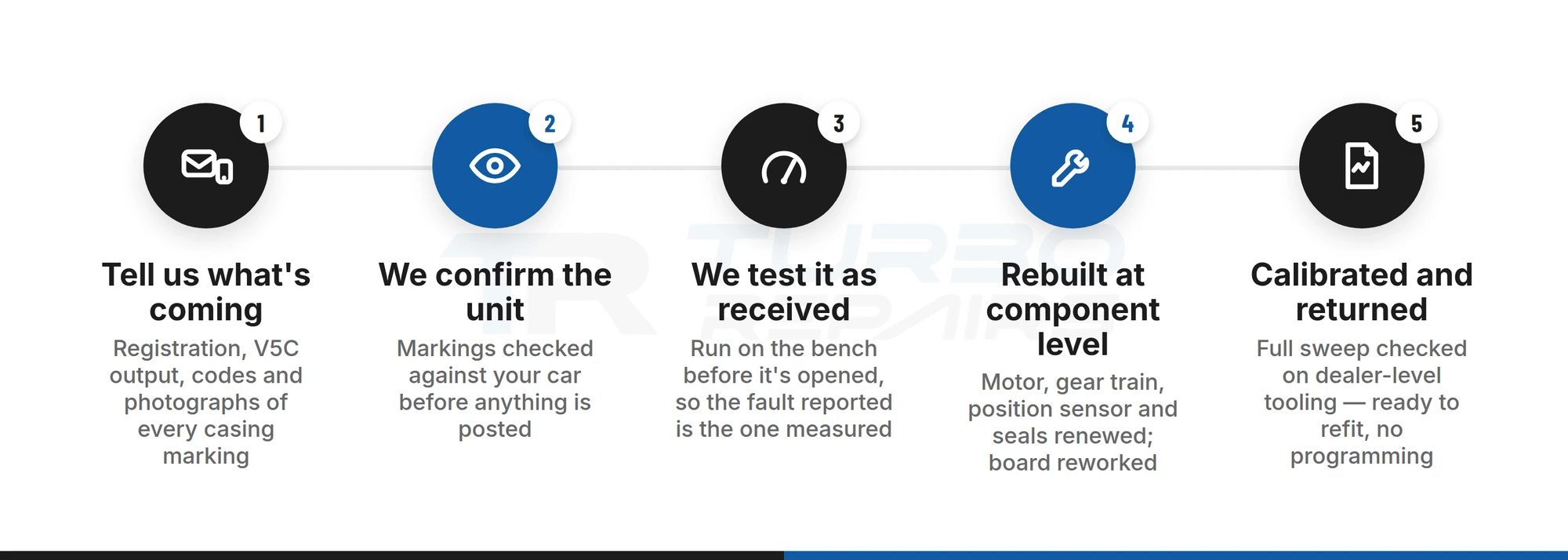
You, or the garage that looks after the car, remove the actuator and send it to our workshop at Unit 102 Reaver House, 12 East Street, Epsom, Surrey, KT17 1HX, United Kingdom. There it is rebuilt by our team of turbo specialists and electronic engineers. The work runs in this order.
- Tell us what is coming. On the online Repair Form, give the registration, the output from your V5C, the engine code if you have it, the stored fault codes, photographs of every marking on the casing, and what you found when you moved the lever by hand.
- We confirm the unit. The markings are checked against your car before anything is posted. If what you have is a vacuum can or a control valve rather than an electronic actuator, we say so at this stage.
- We test it as received. The actuator is run on the bench before it is opened, so the fault we report is the one we measured rather than the one we expected.
- We rebuild it at component level. The motor, gear train, position sensor and seals are renewed as needed and the circuit board is reworked. Any component with a known weakness in the original design is replaced with an uprated part rather than put back as it was, so the unit meets or exceeds original specification.
- We calibrate it and send it back. Its travel and position feedback are checked across the full sweep on dealer-level diagnostic and calibration tooling, and it returns ready to refit with no programming. Clear the stored codes once it is back on the car.
Repairs start from £100 + VAT, and the exact price is confirmed once the unit has been identified and tested, before any work goes ahead. Turnaround is typically one to two working days from arrival, plus postage each way, and every rebuild carries a lifetime, unlimited-mileage warranty with no time limit. Packing and postage are covered on our FAQs page, and independent garages send Insignia actuators in for their customers’ cars the same way.
The other cars whose actuators we rebuild are on our electronic turbo actuator repairs page.
Vauxhall Insignia Turbo Actuator Repair FAQ
Does the Vauxhall Insignia 2.0 CDTI have an electronic turbo actuator?
The listings we reviewed put an electronic actuator on the 160 hp car (118 kW, engine code A20DTH) and on the 170 hp car (125 kW) of both generations. They do not state the type for the other outputs. Look at the unit on your turbocharger: an electrical connector plugged into a moulded housing means it is electronic.
Can I replace just the actuator without replacing the turbo?
Yes. The actuator is a separate part bolted to the turbocharger, and it can be removed, rebuilt and refitted on its own. Check first that the turbocharger’s control lever moves freely by hand with the engine cold. If it drags or sticks, the turbocharger needs the work rather than the actuator.
What does 786137 mean on an Insignia actuator listing?
It is the Garrett turbocharger number for the 160 hp car, and the listings use it to identify the actuator fitted to that turbocharger. It is printed on the turbocharger’s label, not the actuator’s. If you are having your own actuator rebuilt, the number does not need matching at all.
Is the Insignia actuator the same as the Cascada or Antara one?
On the 170 hp cars, one listing puts the same electric actuator on the Insignia, the Cascada 2.0 CDTI and the Antara 2.0 CDTI, all at 125 kW. That listing gives no reference number to check it against, so compare the markings on your own casing rather than rely on the model name.
Will a rebuilt actuator need programming on my Insignia?
No. Your own unit is calibrated and tested on our bench and comes back ready to refit without programming. Clear the stored fault codes with a diagnostic tool once it is fitted.
How much does an Insignia turbo actuator repair cost, and how long does it take?
Repairs start from £100 + VAT, with the exact price confirmed once the unit has been identified and tested. Turnaround is typically one to two working days from arrival, plus postage each way, and every rebuild carries a lifetime, unlimited-mileage warranty.
Final Thoughts
The Insignia 2.0 CDTI actuator is a part the trade mostly describes through something else: the turbocharger’s number on the 160 hp car, a list of vehicles on the 170 hp car, and silence on the other outputs. That is why the evidence worth gathering sits in three places, on the V5C, on the turbocharger’s label and on the actuator’s own casing, and why the connector on the housing is the first thing to look at.
Once you know the part is electronic, the order of work is short. Check the connector and the intake, move the lever by hand with the engine cold, and photograph every marking. If the lever is free, the actuator already fitted to your turbocharger is the one unit that needs no matching, and it is the one to rebuild.
Turbo Repairs · Epsom workshop
Your Insignia’s own actuator, rebuilt for the turbo it came off
Complete the Repair Form with your output, codes and casing photographs, and we confirm the unit before you post it. It is tested, rebuilt at component level, calibrated and returned ready to bolt on, with no programming needed.
Lifetime, unlimited-mileage warranty · Mail-in from the UK and internationally · Bench-tested and calibrated before it ships