

Summary A turbocharger whistles because its compressor wheel is spinning up and moving air, so a smooth whistle that rises as the turbo comes on boost is normal on most turbocharged engines. What matters is change. A whistle that is new, louder or sharper under boost usually means pressurised air escaping from a hose, clamp or intercooler. A siren-like whine that climbs with revs points inside the turbocharger itself. Below is how to tell the noises apart, what you can check yourself, and when to stop driving.
The most common cause of a new whistle under boost is not the turbocharger at all — it is charge air escaping from the pipework between the turbo and the engine.
Most turbo whistles are the sound of a turbocharger doing its job. The ones worth worrying about give themselves away differently: they change. This guide is about telling the two apart from the driver’s seat, before anybody condemns a turbocharger that may be perfectly healthy.
Is a Turbo Supposed to Whistle?
Yes, within limits. Forcing air through a compressor spinning at very high speed makes noise, and the whistle you hear as you accelerate is the compressor wheel spooling up as the turbocharger starts to build boost. On most cars it sits in the background. Some owners never notice it; others hear it on every pull away.
A healthy whistle has a recognisable character. It is smooth, it arrives with throttle and load rather than with engine speed alone, and it fades as you ease off. Above all, it sounds the same this month as it did last month.
That last point is the useful one. You are the person who knows what your car normally sounds like, and a change in the noise is better evidence than the noise itself. A whistle that has grown louder, sharper or more noticeable is worth investigating even if it still sounds like “just a whistle”.
What is missing from that description is anything harsh, anything metallic, or anything you would compare to a siren or a dentist’s drill. Those belong to a different conversation, covered below. For everything else a failing turbocharger can do — smoke, oil in the charge pipes, lost boost — our guide to turbo failure symptoms maps each one to where in the unit it starts.
Match the Noise: Whistle, Siren, Whine or Hiss
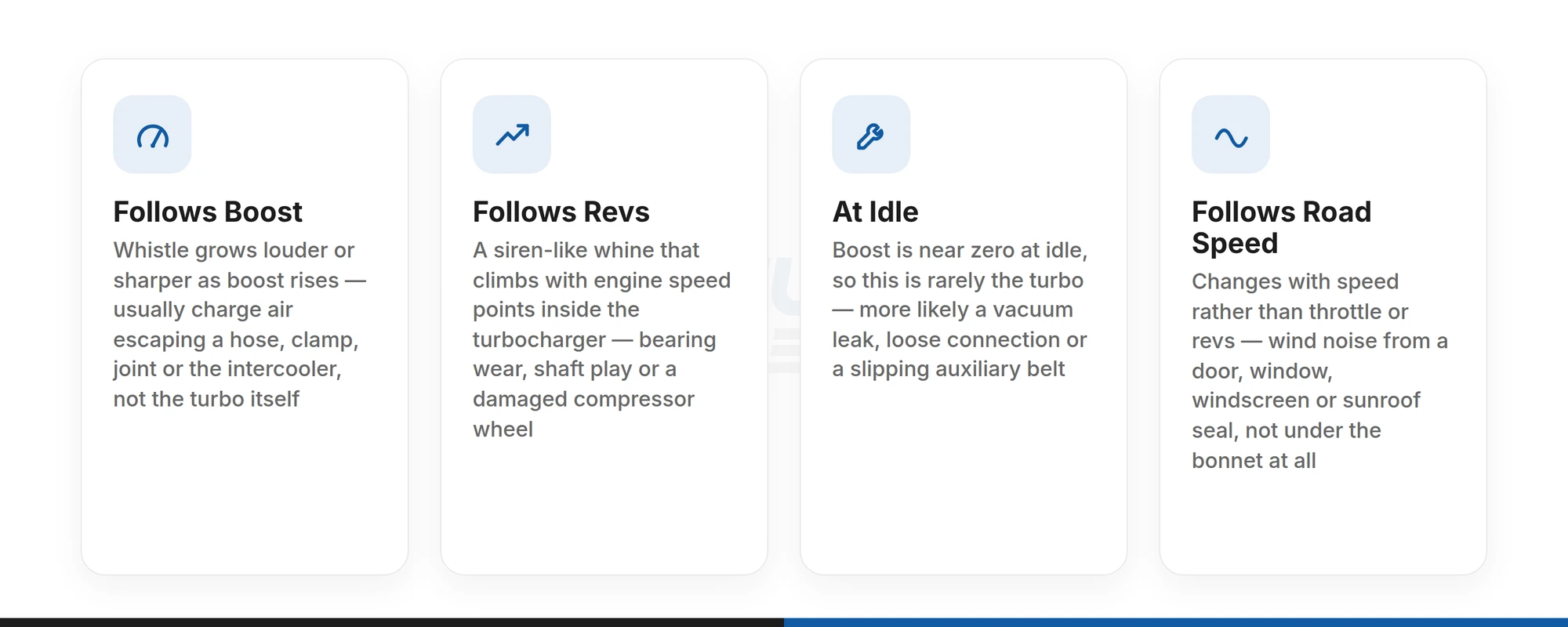
Owners describe turbo noise in a handful of words, and they are not interchangeable. Pin down which one you have and, just as importantly, what makes it come and go.
| What you hear | When it happens | Most likely source | First check |
|---|---|---|---|
| A smooth whistle that has always been there | Rises as the turbo comes on boost, fades as you lift | Normal compressor noise | None — just notice if it changes |
| A whistle that is new, louder or sharper | Under boost, loudest when accelerating firmly | Charge air escaping from a hose, clamp, joint or the intercooler | Hoses, clamps and intercooler joints; then a boost-leak test |
| A hiss or rushing sound | Under boost, often with slower pick-up and less power | A larger boost leak or a split hose | As above — a split hose is often visible |
| A siren-like whine, or a “dentist’s drill” | Climbs with revs; may change as the engine warms | The rotating assembly: bearing wear, shaft play or compressor wheel damage | Specialist inspection — do not wait for the next service |
| Scraping, grinding, or a rattle as it spools down | Under load or on lift-off | A wheel touching its housing, or material loose inside | Stop driving |
| A whistle at idle or very low revs | Parked, or barely moving | Usually not the turbo: an intake or vacuum leak, a loose connection, a slipping belt | Vacuum lines, intake connections, auxiliary belt |
| A whistle that follows road speed | Changes with speed, not with throttle | Wind noise from a door, window, windscreen or sunroof seal | Not under the bonnet at all |
Two of those rows are the car doing nothing wrong, and two more are not the turbocharger. That is why the most useful question about any whistle is not how it sounds but what it follows: boost, engine speed, road speed, or nothing at all.
Whistle Under Boost That Wasn’t There Before: Boost Leaks
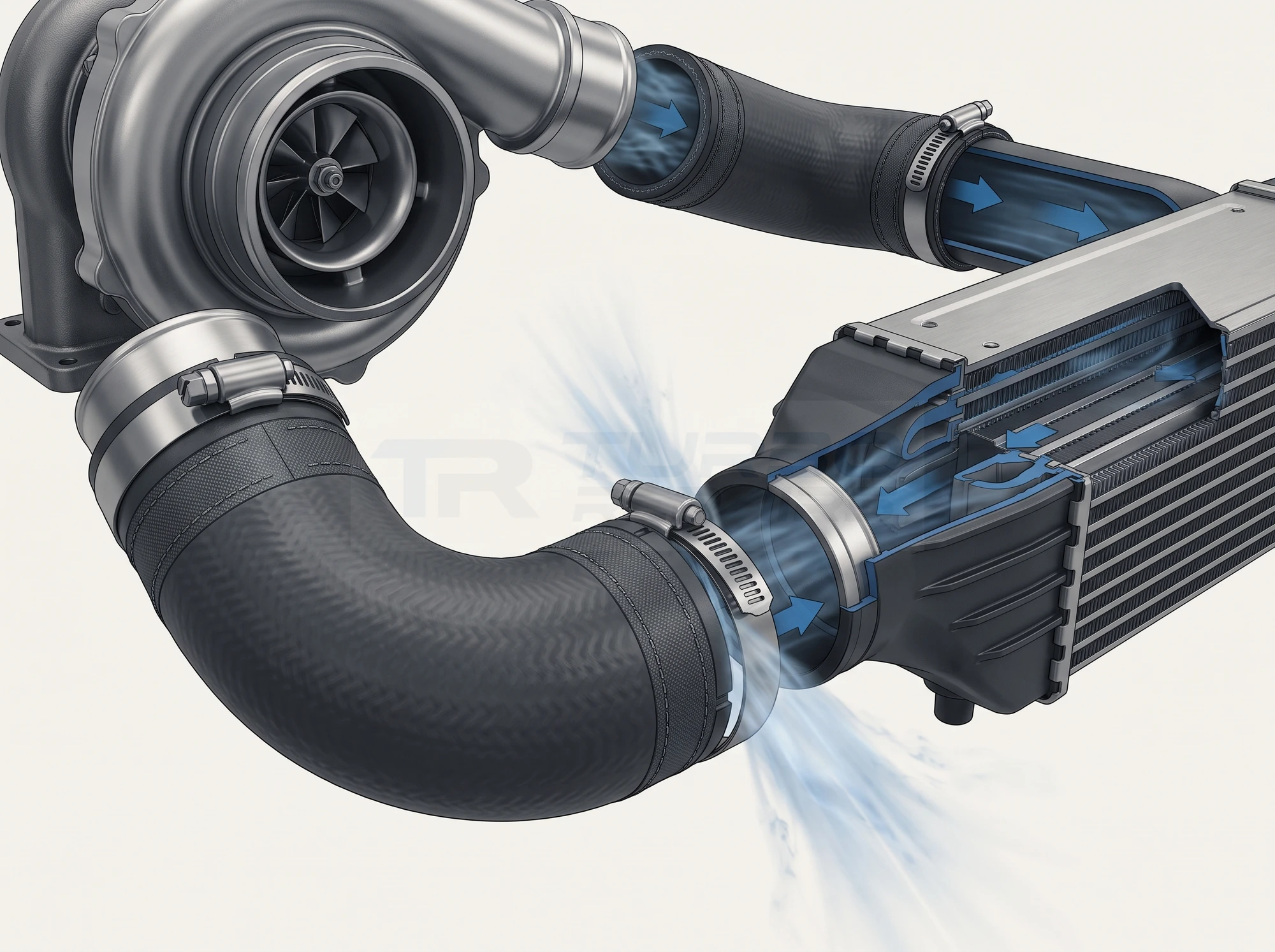
A turbocharger compresses air and pushes it to the engine through a run of pipework: hoses, joints, clamps and an intercooler. Every joint in that run is holding pressure whenever the turbo is on boost. When one opens up, even slightly, air forces its way out through the gap — and air escaping under pressure whistles. It is the most common cause of a turbo whistle, and the first thing to rule out.
The places it happens are predictable. A hose that has split or perished, a clamp that has worked loose, a joint that was not refitted properly, a cracked pipe, or a leaking intercooler. It is also why a whistle often grows as a car ages: the whistle from a healthy turbo gets louder as the intake joints age, long before anything inside the turbocharger is wrong.
A boost leak rarely stops at noise. Air lost from the pressurised side is air the engine never receives, so the leak that whistles tends to bring slower pick-up and reduced power as well. A large enough leak leaves the engine short of the boost it asked for and can store an underboost code; our guide to overboost and underboost explains what that code tells you and, just as usefully, what it does not.
Two things make boost leaks easy to miss. An intercooler or coupler that leaks only under full load can pass a static inspection and a gentle test drive. And the leak that whistles is not always one you can see. The reliable answer is a boost-leak test — pressurising the intake side and finding where it will not hold — which a garage can carry out with the turbocharger still on the car.
On engines whose wastegate or turbine vanes are worked by vacuum, a leaking vacuum line produces its own whistle and can upset boost control at the same time. The turbocharger is fine and the boost is still wrong. The good news about this whole family of faults is that it sits outside the turbo: a hose, a clamp, a vacuum line or an intercooler, with no turbocharger work required.
A Whine That Climbs With Revs: Bearing Wear and Shaft Play
This is the noise to take seriously. Where a boost leak sounds like air escaping, a failing turbocharger tends to sound like machinery: a sharper, higher-pitched whine, or a siren that climbs with engine speed and may change character as the unit warms up. Owners reach for the same comparisons — a police siren, a dentist’s drill — and they are right to be concerned.
The noise comes from the rotating assembly. The turbine and compressor wheels share one shaft, which spins in a bearing system fed with engine oil. As the bearings wear and the clearance opens beyond what the unit was built with, the shaft can wobble, the assembly runs out of balance and the wheels sit closer to their housings than the design intended. You hear that before anything touches.
A damaged compressor wheel whistles for a related reason. Chipped or bent blades — usually the mark of something that got past the air filter — mean the wheel no longer moves air cleanly, and at the speeds it turns, the damage is audible.
This kind of noise rarely stays on its own for long. If a whine arrives with blue, grey or black smoke, a noticeable loss of power, or oil consumption you cannot account for, the cause is likely to be internal — shaft play, worn bearings or wheel damage — and it needs diagnosing straight away rather than at the next service.
How much shaft play is too much depends on the bearing system, and the answer for a journal-bearing diesel turbo is the opposite of the answer for a ball-bearing cartridge. Our turbo failure symptoms guide covers that split, and why feeling the shaft by hand screens a unit rather than measuring it.
What no check on the car can do is cure it. Bearings, seals and the shaft and wheel assembly are serviceable, but only once the turbocharger is off the car and stripped. And a turbo that has worn its bearings has usually been living with something else — interrupted oil supply, contaminated oil, debris or overspeed — that stays on the car when the unit comes off. Our guide to replacing a turbocharger sets out what to look for while it is out.
Turbo Repairs · Epsom workshop
A whine the pipework does not explain
If the hoses, clamps and intercooler check out and the whine is still there, the answer is inside the turbocharger. Remove it, pack it and post it to our Epsom workshop, where it is stripped to component level and the bearings, shaft and wheels are measured before anything is quoted.
Lifetime, unlimited-mileage warranty · Mail-in from the UK and internationally · Bench-tested and calibrated before it ships
Whistle on Lift-Off or at Idle
Turbo-related whistles become more pronounced under load, as boost pressure rises. So a noise that shows up when the turbocharger is barely working is, more often than not, pointing somewhere else.
At idle. A whistle at idle or very low revs is usually not the turbocharger. With the engine ticking over, the turbo is making little or no boost, and the more likely sources are a small intake leak, a loose connection, a vacuum leak or a slipping auxiliary belt. An exhaust gasket that has begun to leak, or exhaust parts vibrating against each other, can also produce a whistle or buzz that is easy to mistake for the turbo.
On lift-off. When you lift off, boost pressure falls away, so a whistle heard only on the overrun does not fit the boost-leak pattern described above. The lift-off noise that matters most is not a whistle at all: a rattle, scrape or grind as the turbo spools down is metallic, and metallic noise from a turbocharger is never normal. It is covered under stopping, below.
Cold or warm. Note whether the noise is there from a cold start or only once the engine is warm, and whether it changes as the car warms up. A whine that changes character with temperature is one of the signs that points at the turbocharger itself — and it is exactly the kind of detail that is worth writing down before you describe the noise to anyone.
A tick rather than a whistle. If what you hear from the turbo area is a tick or a click, particularly alongside limp mode or a boost fault, the electronic actuator on the outside of the turbo is the more likely source. Our guide to turbo actuator symptoms covers that part and how its faults show up.
Checks You Can Do Before Anyone Condemns the Turbo
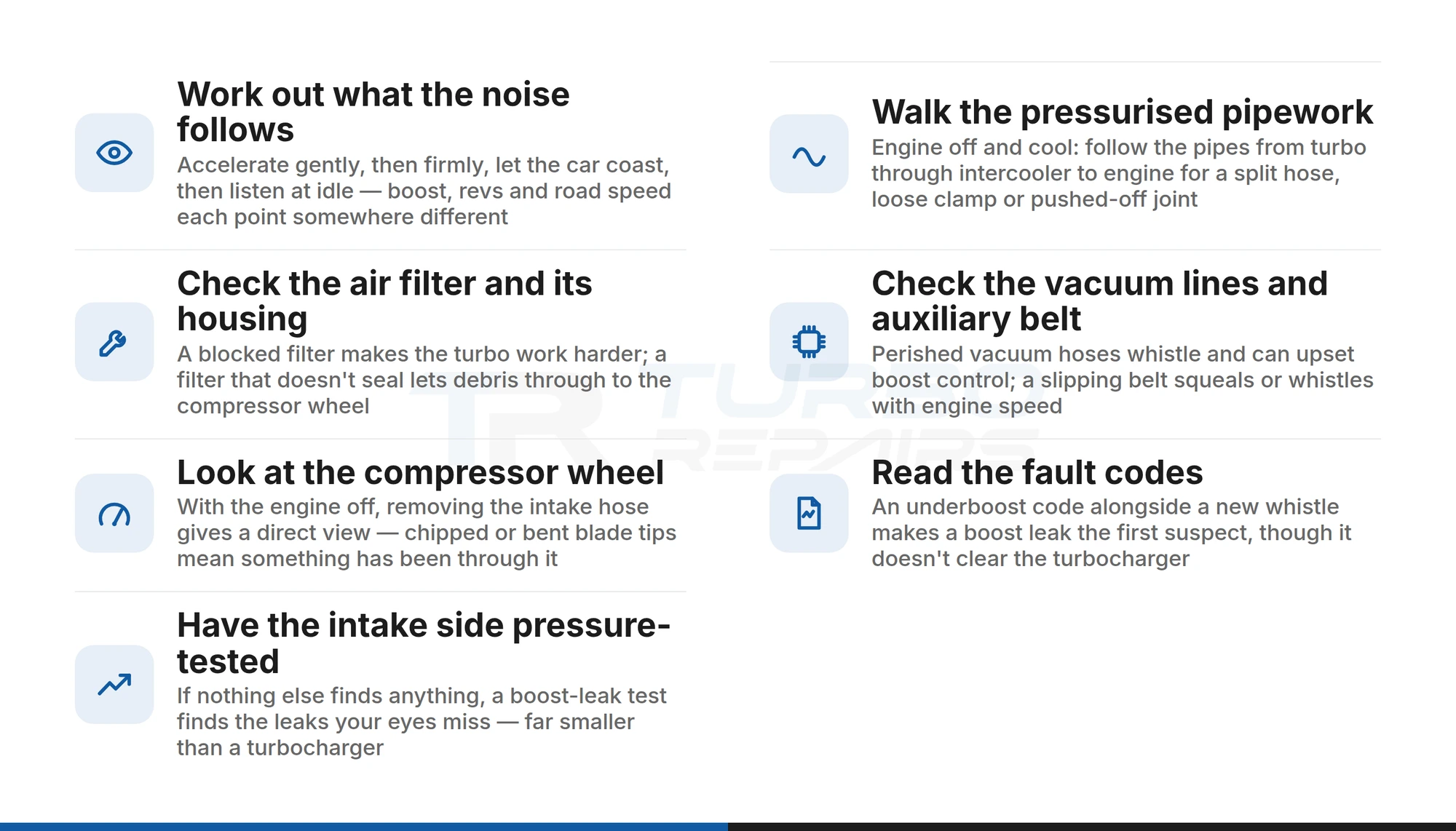
None of these needs special tools, and between them they rule out most of the cheaper causes of a whistle.
- Work out what the noise follows. In the same gear, accelerate gently and then more firmly; let the car coast; then listen with it parked at idle. A noise that grows with boost, one that is there at idle, and one that changes with road speed are three different faults.
- Walk the pressurised pipework. With the engine off and cool, follow the pipes from the turbocharger through the intercooler to the engine. You are looking for a split or perished hose, a loose or missing clamp, or a pipe that has pushed partly off its joint.
- Check the air filter and its housing. A blocked filter makes the turbo work harder for the same result, and a filter that does not seal lets debris through to the compressor wheel.
- Check the vacuum lines and the auxiliary belt. Perished vacuum hoses whistle and can upset boost control. A slipping belt squeals or whistles with engine speed, whether or not the turbo is on boost.
- Look at the compressor wheel. With the engine off, removing the intake hose from the turbocharger gives a direct view of the wheel. Chipped or bent blade tips mean something has been through it. Never start the engine with the hose disconnected; the turbo failure symptoms guide sets out what else to look for while you are there.
- Read the fault codes. An underboost code alongside a new whistle makes a boost leak the first suspect, though it does not clear the turbocharger. A whistle with no codes, no power loss and no smoke is the least urgent version of this problem.
- Have the intake side pressure-tested. If none of the above finds anything, a boost-leak test finds the leaks your eyes miss — and it is a far smaller step than a turbocharger.
If all of that comes back clean and the whine is still there, the evidence has moved inside the turbocharger. That is the point at which the unit itself, rather than the car around it, needs examining.
When to Stop Driving
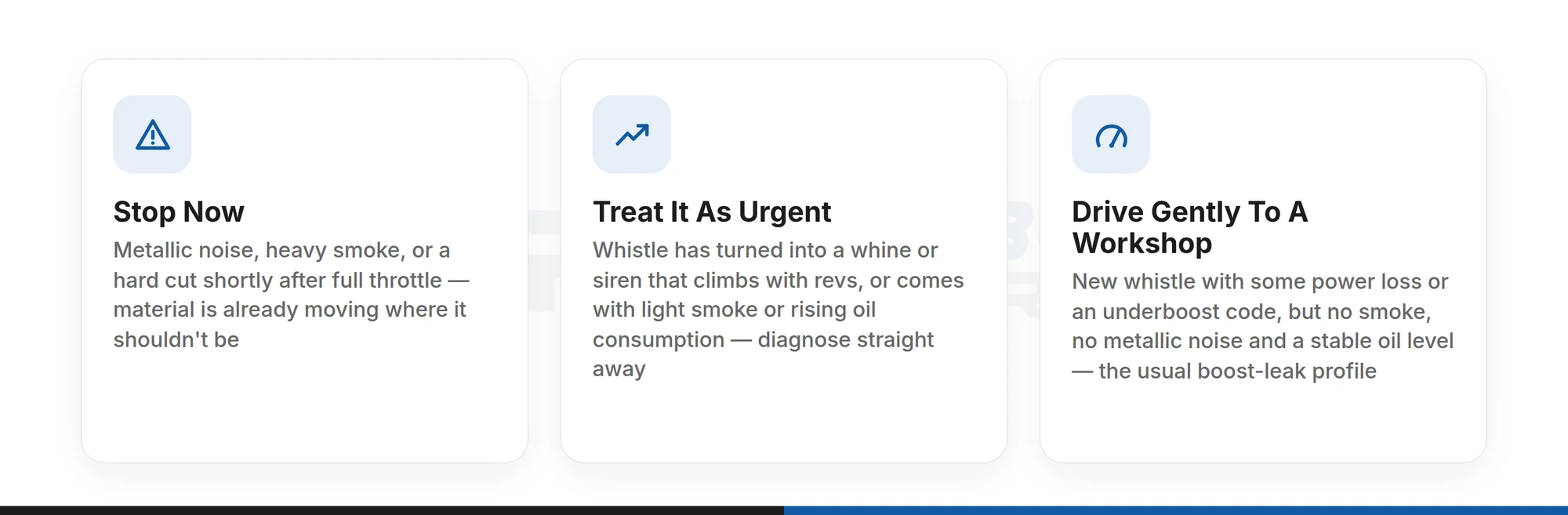
Stop now for metallic noise, heavy smoke, or a hard cut shortly after full throttle. Metallic noise — scraping, grinding, a rattle as the turbo spools down — means material is already moving where it should not be, and a turbocharger in that state can send debris towards the intercooler and charge pipework in one direction and the exhaust in the other. A whistle that arrives with heavy smoke belongs in the same category.
Treat it as urgent if the whistle has turned into a whine or siren that climbs with revs, or if it comes with light smoke or rising oil consumption. That is the pattern of internal wear, and it does not improve on its own. Have it diagnosed straight away, keep journeys to a minimum, and stop if the smoke becomes heavy.
Drive gently to a workshop if the car has a new whistle with some loss of power or an underboost code, but no smoke, no metallic noise and a stable oil level — the usual profile of a boost leak. Light throttle, short journey, no motorway run to see whether it clears.
A smooth whistle that has not changed needs nothing but your attention. The reason for caution with the others is less the turbocharger than what it takes with it: debris from a damaged wheel does not stay in the turbo, and oil passed by a failing one ends up in the intake and the exhaust.
Turbo Whistle FAQ
Is a turbo whistle normal?
Yes. A smooth whistle that rises as the turbo comes on boost and fades as you lift off is the compressor wheel spooling up, and most turbocharged engines make one. The thing to watch for is change: a whistle that becomes louder, sharper or different in character is worth investigating.
Can I drive with a whistling turbo?
If the whistle is mild and has not changed, usually yes. If it has become louder or comes with power loss, have it diagnosed soon. If there is any metallic noise, heavy smoke, or a hard cut shortly after full throttle, stop driving.
Does a whistle mean my turbo is broken?
Not usually. The most common cause of a new whistle under boost is a boost leak — a split hose, a loose clamp or a leaking intercooler — with the turbocharger itself in good order. A siren-like whine that climbs with revs is the version that points inside the turbo.
How do I fix a turbo whistle?
Fix the source rather than the noise. A boost leak is cured by replacing the split hose, refitting or renewing the clamp, or repairing the intercooler; a whistle at idle is often a vacuum line or a belt. A whine caused by bearing wear, shaft play or a damaged compressor wheel cannot be fixed on the car — it needs the turbocharger removed and rebuilt.
Can a whistling turbocharger be rebuilt?
Worn bearings, shaft play and compressor wheel damage are exactly what a turbo rebuild addresses, but whether a particular unit can be rebuilt is decided on the bench after it has been stripped, not before. The service is mail-in: you remove the turbocharger, pack it and post it to our workshop, and it comes back rebuilt, bench-tested and ready to refit. Rebuilds are typically one to three working days from arrival, plus postage each way, under a lifetime, unlimited-mileage warranty. Our price guide sets out what a turbo rebuild costs.
Is a turbo whistle the same as an exhaust whistle?
No. An exhaust whistle is an aftermarket gadget fitted in the tailpipe to imitate the sound of a turbocharger. It tells you nothing about a turbo’s condition, and it is not something we supply.
Final Thoughts
A turbo whistle is one of the few symptoms where the car is usually fine. Most of the time it is air: either the turbocharger doing its job, or charge air escaping from a hose or clamp that is simple to put right. The trouble starts when every whistle is treated the same way — either ignored until it becomes a grind, or blamed on the turbo when the pipework was the problem all along.
The way through is to listen to what the noise follows before worrying about how it sounds. A whistle that comes with boost sends you to the pressurised pipework. One at idle sends you to vacuum lines, belts and the exhaust. A whine that climbs with revs, especially with smoke or oil loss, sends you to the turbocharger itself — and a metallic noise sends you to the side of the road.
Turbo Repairs · Epsom workshop
When the whine is the turbo, have it rebuilt properly
Once the pipework is ruled out, remove the turbocharger and post it in with your registration and a note of what the noise does and when. We strip it to component level, measure it against specification, rebuild it on genuine OE or OEM-grade parts, balance it and bench-test it before it comes back to you.
Lifetime, unlimited-mileage warranty · Mail-in from the UK and internationally · Bench-tested and calibrated before it ships