

Summary We rebuild the turbocharger from the VW Transporter T5 and T6 diesel: the T5 1.9 TDI, the 2.0 TDI in both generations, and the twin-turbo BiTDI. You or your garage send the unit to our Epsom workshop, where it is stripped to component level, measured, rebuilt on genuine OE or OEM-grade parts, balanced and bench-tested, then returned ready to refit. Rebuilds start from £185 + VAT, bench time is typically one to three working days, and every rebuild carries a lifetime, unlimited-mileage warranty.
The checks you can make with the turbo still on the van clear the pipes, sensors and actuator around it, not the turbocharger itself. On the BiTDI, one of the two stages stays out of sight even after the unit is off, so a clean result from the outside is a reason to open the unit, not to rule it out.
The twin-turbo 2.0 BiTDI appears in both generations: catalogued at 177 to 180 bhp on the T5 with a KP35 and K04 pair, and at 201 to 204 bhp on the T6 with a B01 and B03 pair.
This page is for Transporter owners, and the garages that keep their vans running, when a T5 or T6 has lost its pull, dropped into limp mode with a boost code stored, or started to smoke or whistle. It sets out which turbocharger your van carries, what fails on each type, how to narrow the fault down before anything is unbolted, and how we rebuild the unit. Caravelle, Multivan and California models share the Transporter’s engines and are covered here too.
- Vans covered: VW Transporter T5 1.9 TDI and 2.0 TDI, Transporter T6 2.0 TDI, and the twin-turbo 2.0 BiTDI in both generations. The 2.5 TDI has its own page
- Turbochargers catalogued: a BorgWarner KP39 on the T5 1.9; Garrett variable-nozzle units on the single-turbo 2.0 (792290 on the T5, 830323 and 830324 on the T6); a further T6 unit under VW 04L253022B; a two-stage assembly on the BiTDI
- What decides it: the engine code first, then the label on the turbocharger. The generation badge and the registration year are not enough on their own
- Codes that point at boost: P0299 (underboost) and P0234 (overboost). Neither names the part
- Choose by year and power: our VW Transporter 2.0 TDI turbocharger rebuild listing
- Our service: your own turbo rebuilt from £185 + VAT, typically one to three working days on the bench, lifetime unlimited-mileage warranty
1.9, 2.0 or 2.5 TDI? Which Transporter Engine You Have
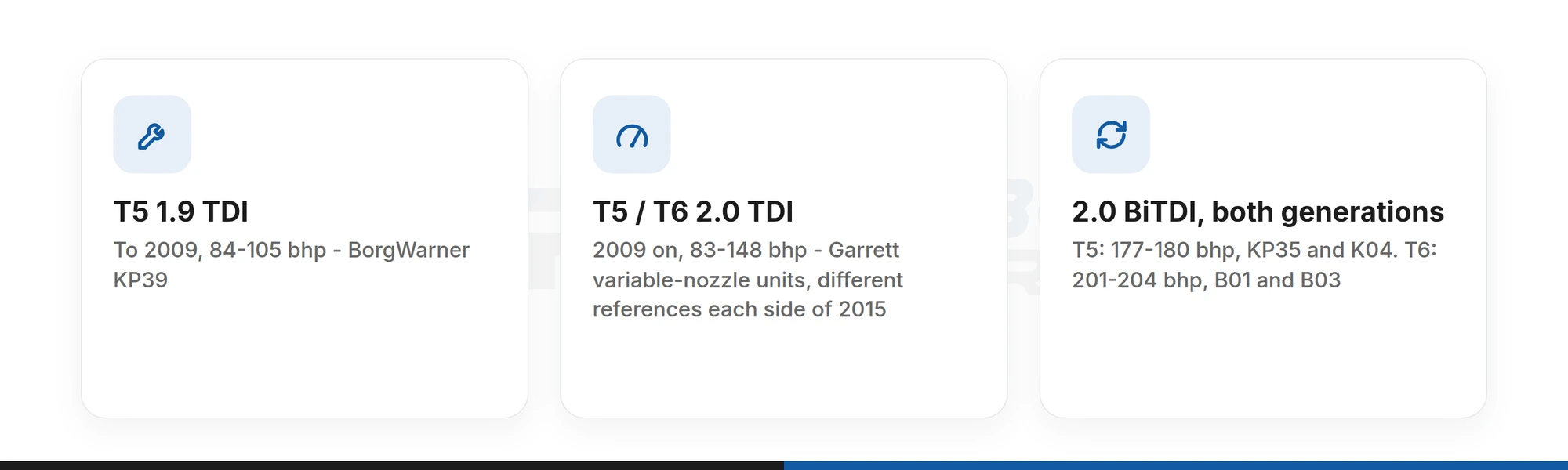
The diesel Transporter was built with three different engines across the T5 and T6, and each one carries a different turbocharger. The badge on the tailgate does not tell you which. Three pieces of information do, and you can gather all of them before a single bolt is undone.
- Cylinder capacity. Printed on your V5C at section P.1, it separates the 1.9, the 2.0 and the five-cylinder 2.5, which is catalogued at 2461 cc.
- Power output. Section P.2 of the V5C gives it in kW. On the 2.0 the catalogued outputs run from 83 bhp to 204 bhp, and the twin-turbo BiTDI sits at the top of each generation.
- Engine code. A three- or four-letter code such as AXB, CAAC or CXFA. A VW dealer or a parts supplier can look it up from your registration or VIN, and it is the most reliable guide of the three.
In the catalogue data we work from, every T6 is a 2.0 TDI. The 1.9 belongs to the earlier T5 and is catalogued up to 2009, when the 2.0 took over.
If your van turns out to be a 2.5 TDI, the turbocharger is a different family altogether, and our page on the 2.5 TDI Garrett GT2052V covers it. The rest of this page deals with the 1.9 and the 2.0.
The Turbochargers on the 1.9 and 2.0 TDI, Including BiTDI
The table sets out what the fitment data and the specialist listings catalogue for each engine. Treat it as a way to narrow the field, not a final answer. Where two units are listed for the same engine code, the label on the turbocharger decides.
| Engine as listed | Engine codes | Catalogued years and output | Turbocharger as catalogued | References as listed |
|---|---|---|---|---|
| T5 1.9 TDI | AXB, AXC, BRR, BRS | To 2009; 84 to 105 bhp | BorgWarner KP39 | 5439-970-0058 and 5439-970-0020; VW 03G253010D, 03G253016G |
| T5 2.0 TDI | CAAA, CAAB, CAAC, CAAD, CAAE, CCHA, CCHB | 2009 to 2015; 83 to 138 bhp | Garrett GTB1446VZ | 792290-0002 and 792290-0003; VW 03L253016M |
| T5 2.0 BiTDI | CFCA | 2009 to 2012; 177 to 180 bhp | Two-stage assembly, catalogued as R2S with a KP35 and a K04 | 1000-970-0027, 0053, 0064, 0098 and 0099; VW 03L145715 family, 03L145701G, 03L145873 |
| T6 2.0 TDI, lower outputs | CXGA, CXGB | From 2015; 83 to 101 bhp | Garrett GTD1244VZM | 830324-0002 and 830324-0004; VW 04L253016S, 04L253020G |
| T6 2.0 TDI, middle outputs | CXFA, CXHA, CXHB | 2015 to 2016; 113 to 148 bhp | Garrett GTD1446VZM | 830323-0003 and 830323-0006; VW 04L253014C |
| T6 2.0 TDI, middle outputs | CXFA, CXHA, DNAA | From 2015; 109 to 148 bhp | BM196, no maker named in the data | VW 04L253022B |
| T6 2.0 BiTDI | CXEB, CJKB, DMZA | From 2015; 201 to 204 bhp | Two-stage assembly, catalogued as R2S with a B01 or B01V and a B03 | 1000-970-0379, 0432 and 0442; VW 03N145721, 03N145703 family |
The 2015 changeover
The year 2015 appears on both sides of the table. The T5’s 792290 is catalogued up to 2015 on the CAA and CCH engine codes, and the T6 units start in 2015 on the CX codes. A van registered that year could carry either, so the engine code is what separates them, not the date on the V5C.
Two units against one engine code
On the T6, the CXFA and CXHA engines are catalogued against two different turbochargers: the Garrett 830323 and a unit listed as BM196 under VW 04L253022B, with no maker given. Another specialist lists a third reference, 873767, for the same engine codes. A listing cannot choose between them for you. The part number on your own unit can.
Variable-nozzle units on the single-turbo 2.0
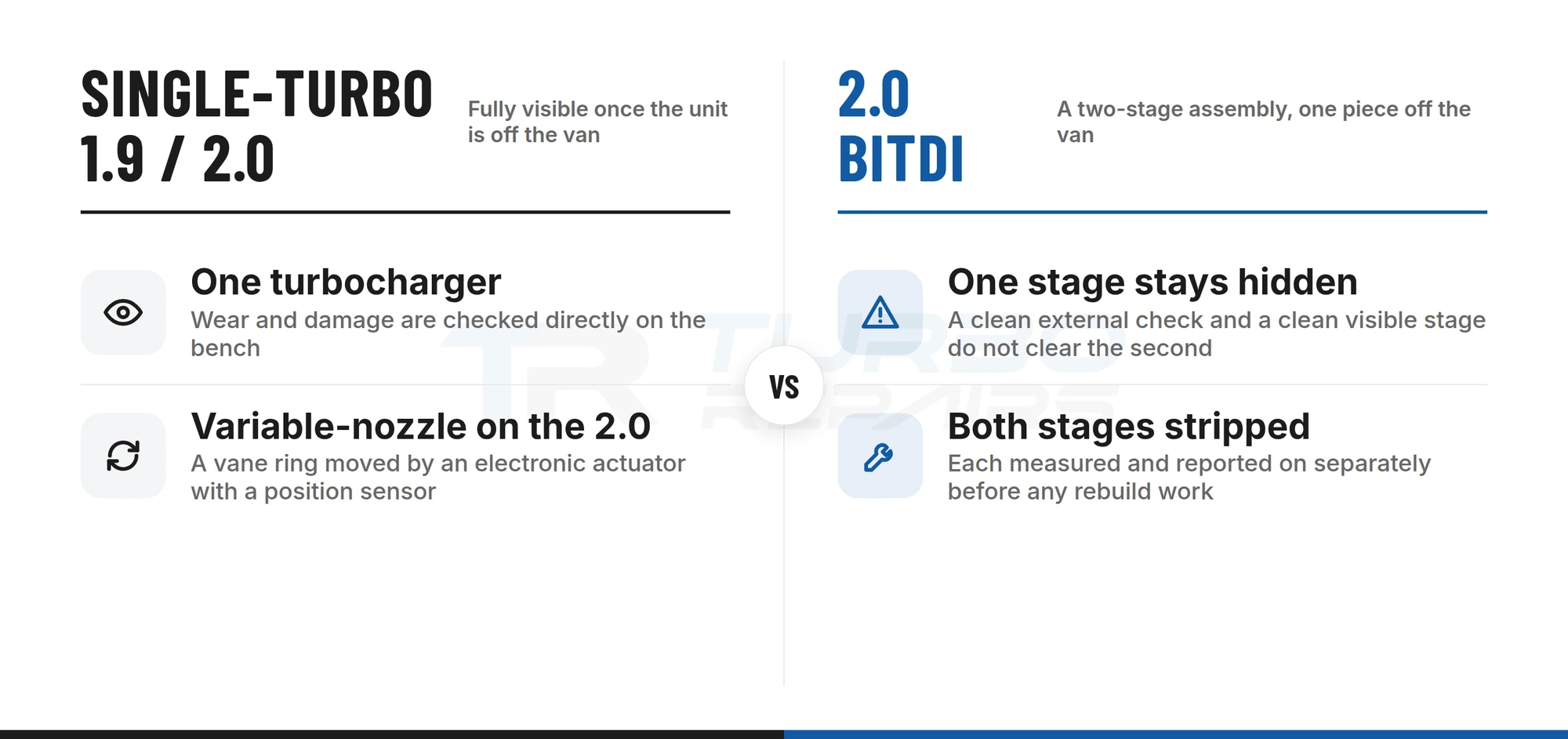
Every single-turbo 2.0 unit in the table carries a V in its Garrett designation, which marks a variable-nozzle turbocharger. A ring of vanes around the turbine wheel is moved to control boost. On the T5 2.0 those vanes are positioned by an electronic actuator with a position sensor, and that detail matters later when you are deciding whether the fault is in the turbo or in the part bolted to it.
The BiTDI: two turbochargers, one assembly
The BiTDI puts two turbochargers of different designations into a single two-stage assembly that comes off the van as one piece. The T5 pair is listed as a KP35 and a K04; the T6 pair as a B01 or B01V and a B03. Individual stages are also catalogued on their own, which is useful when only one has failed, but it means a listing can describe half the assembly or all of it. Check which you are looking at before comparing prices.
What Fails on a Transporter Turbo
A Transporter turbocharger fails for the same reasons as any other diesel turbo, and nearly all of them start outside it. Oil that arrives late, dirty or not at all wears the bearings. Debris drawn in through the intake chips the compressor wheel. Deposits build up in the variable-nozzle mechanism on the 2.0 units until the vanes drag or stick. Our guide to removing and refitting a turbocharger explains why the cause has to be found on the van before any turbo, rebuilt or new, goes back on.
On the single-turbo 1.9 and 2.0
Worn bearings let the shaft move further than it should. That shows as oil past the seals, into the intercooler pipework or out of the exhaust as blue-grey smoke, and eventually as a wheel touching its housing. On the variable-nozzle 2.0, a vane mechanism tightened by deposits cannot reach the position the engine management asks for, which sets a boost code and limp mode long before anything inside the turbo is actually worn out.
The electronic actuator on the 2.0 can also fail on its own while the turbocharger is sound. That is a different, cheaper repair, and our page on Transporter and Crafter turbo actuator repairs shows how to tell the two apart with the turbo still fitted.
On the BiTDI: the stage you cannot see
The twin-turbo assembly has a problem of its own, and one independent VW workshop’s published account of a T5 BiTDI shows it clearly. The van was in limp mode with the engine warning light on. Their dealer-level diagnostic tool found an underboost fault, so they worked outwards from the turbocharger: vacuum pipes and actuators, then the boost pressure sensors, then a smoke test of the intake path from the air filter through the intercooler to the turbo. Everything passed.
With the unit off the van, the compressor wheel they could see showed no damage and no play. But only one of the two turbochargers was visible, and checking the other meant stripping the assembly with tooling the workshop did not have. When a specialist opened it, the turbine wheel inside had sheared. Every check made on the van, and the first check made off it, had come back clean on a broken turbocharger.
The lesson is not that the external checks were wasted. They ruled out a leak, a sensor and the actuator, which is exactly what they are for. What they cannot do is clear the inside of the assembly, and on the BiTDI that includes a whole stage. That is why we strip both stages of every BiTDI unit we receive, and report on each, rather than judging the assembly by the half that can be seen.
Symptoms on a Working Van
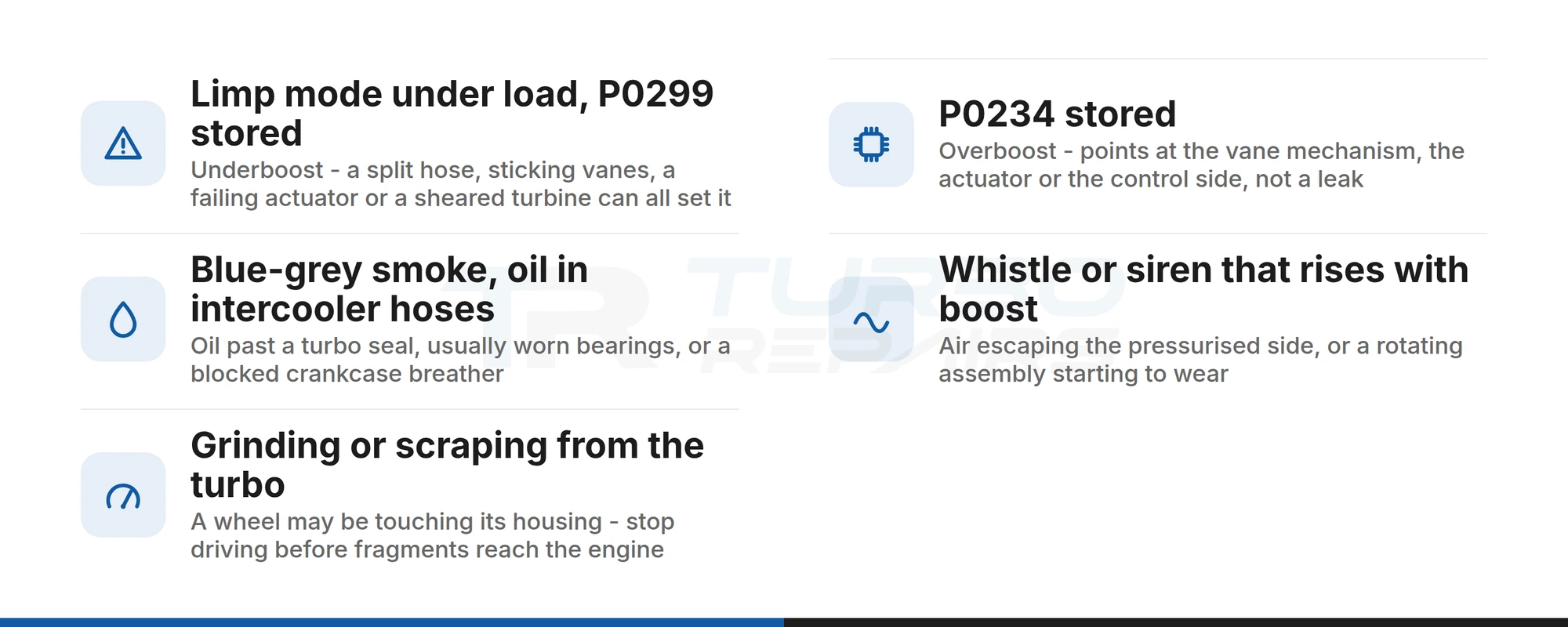
A turbo fault on a Transporter usually shows up when the van is loaded, towing or climbing, because that is when the engine asks the turbocharger for most boost. These are the signs, and what each one does and does not tell you:
- Limp mode under load, with P0299 stored. Underboost: the engine asked for more pressure than it got. A split hose, a sticking vane mechanism, a failing actuator and a turbine wheel that has sheared can all set it.
- P0234 stored. Overboost: more pressure than requested. A leak cannot cause that, so it points at the vane mechanism, the actuator or the control side. Our guide to overboost and underboost codes explains what each direction rules out.
- Blue-grey smoke and oil in the intercooler hoses. Oil is getting past a turbo seal, usually because the bearings have worn, although a blocked crankcase breather can push oil through too.
- A whistle or siren that rises with boost. Air escaping from the pressurised side, or a rotating assembly that has started to wear. Our guide to diagnosing a turbo whistle sorts the noise by what it follows.
- A grinding or scraping noise from the turbo. A wheel may be touching its housing. Do not keep driving the van on it, because fragments can reach the engine.
For the cheaper faults that imitate turbo failure, see our guide to common turbocharger problems.
Narrow it down in this order
- Read the codes and the freeze-frame data with a tool that can talk to VW engine management, and write everything down before anything is cleared.
- Inspect the boost pipework and intercooler hoses for splits, oil and slipped clamps, and check the vacuum pipes where the van has them.
- Check the actuator and its connector. On the 2.0, disconnect the link and move the vane lever by hand: if it drags, the turbocharger needs the work, not the actuator.
- Compare the boost pressure sensor reading with the requested value on a live-data run.
- Smoke-test the intake path from the air filter through the intercooler to the turbocharger.
- If everything passes, remove the turbocharger and have it opened. On the BiTDI that means stripping both stages.
Rebuild or Replace on a High-Mileage Van?
Once the turbocharger is confirmed as the fault, there are three ways to get the van working again. You can buy a new unit outright. You can buy a reconditioned exchange unit, which is usually sold against your old one coming back, with a surcharge held until it does. Or you can have your own unit rebuilt.
High mileage is not an argument against rebuilding. What wears in a turbocharger is the rotating assembly: the shaft, bearings, seals, wheels and, on the 2.0, the vane mechanism. Those are the parts a rebuild renews. One supplier describes its own remanufactured units as all new parts with only the casing re-used, and that is the real difference between the routes. An exchange unit is somebody else’s casing with new internals. A rebuild is your casing, already matched to your van’s engine code, with new internals.
There are cases where replacement is the right call: a cracked turbine housing, or a casing damaged by a failure beyond repair. We find that out when the unit is stripped, and we tell you before any work goes ahead. On the BiTDI, we assess each stage separately, so an assembly with one failed stage is not treated as two failed turbochargers.
Downtime matters on a van that earns its keep. One retailer lists a new turbocharger for the T5 1.9 on BRR and BRS engines as a special order with around 14 days’ lead time. A rebuild of your own unit typically takes one to three working days on the bench, plus postage each way. Rebuilds start from £185 + VAT, and the exact price is confirmed once the unit has been stripped and measured. Our guide to van turbo repair prices sets out what drives the figure.
Turbo Repairs · Epsom workshop
Every outside check passed and it still will not boost?
Send us the turbocharger with your engine code, the codes you read and the checks you have already made. We strip it to component level, both stages on a BiTDI, and tell you what failed before any rebuild work starts.
Lifetime, unlimited-mileage warranty · Mail-in from the UK and internationally · Bench-tested and calibrated before it ships
Our VW Transporter Turbo Rebuild
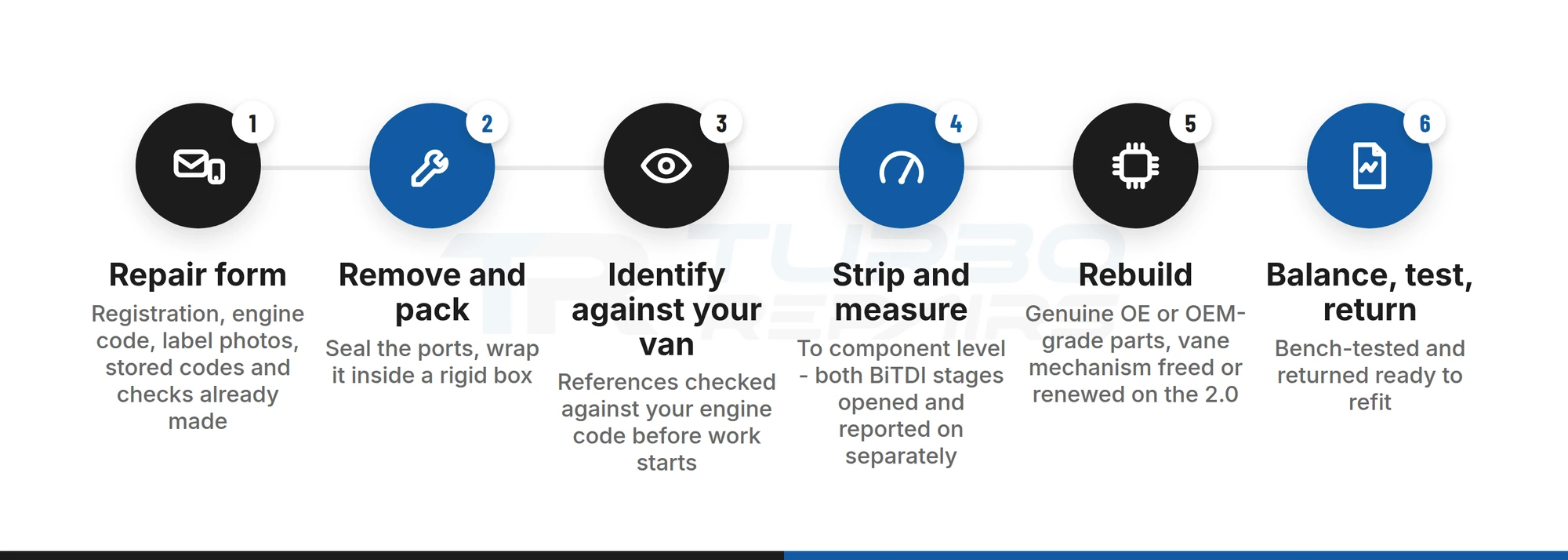
You or your garage remove the turbocharger and send it to our workshop at Unit 102 Reaver House, 12 East Street, Epsom, Surrey, KT17 1HX, United Kingdom. Our team of turbo specialists handles every stage of the rebuild in-house, and your own unit comes back to you.
- Complete the repair form. Give us the registration, the engine code, photographs of the label on the turbocharger, the stored codes, and a note of which checks you have already made and what they showed.
- Remove and pack the unit. Seal the oil and air openings, wrap it in foam or bubble wrap inside a rigid box, and put your repair reference on a note inside. Our FAQs page covers packing and postage.
- We identify it against your van. The references on the unit are checked against your engine code. If anything does not match, we contact you before work starts.
- We strip it and measure it. Every unit is taken down to component level and measured against specification. On a BiTDI, both stages are opened and assessed separately, and you get a report on each.
- We rebuild it. Worn parts are renewed with genuine OE or OEM-grade components, or uprated ones where the original design has a known weakness, so the unit meets or exceeds its original specification. On the variable-nozzle 2.0, the vane mechanism is stripped, freed and renewed where it is worn.
- We balance and bench-test it. The rotating assembly is balanced, the unit is tested on the bench, and it is returned ready to refit.
Before refitting, fix whatever caused the failure. That usually means a new oil feed pipe and fresh oil and filter, then priming the oil supply as our refit guide describes. Every rebuild carries a lifetime, unlimited-mileage warranty, with no mileage cap and no time limit. Garages and trade workshops use the same service for their customers’ vans. For the other engines we cover, see our turbocharger rebuild service.
VW Transporter Turbo FAQ
Is the T5 turbo the same as the T6 turbo?
Mostly not. The T5 2.0 on the CAA and CCH engine codes is catalogued with the Garrett 792290, while the T6 on the CX codes is catalogued with the 830323, the 830324 or a unit under VW 04L253022B. One specialist lists the 792290 under both T5 and T6, so on a van from around 2015 the label on the turbocharger is the thing to check.
Will a 2.0 TDI turbo fit a T5 1.9?
No. The 1.9 is a different engine and is catalogued with a BorgWarner KP39, while the 2.0 carries Garrett variable-nozzle units or, on the BiTDI, a two-stage assembly. Match the turbocharger to your engine code, not to the Transporter name.
Can you rebuild the BiTDI twin-turbo assembly?
Yes. We strip both stages, measure each one against specification and report on both before the rebuild. If only one stage has failed, we tell you, because the price depends on what the assembly actually needs.
How much does a VW T5 turbo replacement cost?
Rebuilding your own turbocharger starts from £185 + VAT. The exact price is confirmed once the unit has been stripped and measured, because it depends on how many parts are still within specification. Removal and refitting are not included, and a BiTDI assembly needs more work than a single-turbo unit.
How do I know it is the turbo and not the actuator?
On the 2.0, disconnect the actuator’s link and move the vane lever by hand with the engine cold. If it moves freely from end to end, the actuator is the stronger suspect, and repairs to it start from £100 + VAT. If it drags or stops short, the turbocharger needs the work. Our Transporter actuator page covers the full check.
How long will my van be off the road?
Bench time is typically one to three working days from the day the unit arrives, plus postage each way and the time taken to remove and refit it. The rebuilt unit comes back ready to fit, with a lifetime, unlimited-mileage warranty.
Do you rebuild the 2.5 TDI Transporter turbo?
Yes. The five-cylinder 2.5 TDI carries a different Garrett family, and it has its own page under the GT2052V designation, where you can identify your unit from the compressor housing plate.
Final Thoughts
The Transporter name covers three engines and several turbochargers, and the engine code, not the T5 or T6 badge, is what sorts them. Once you know which unit you have, the harder question is whether it has actually failed. Pipes, sensors and the actuator can all be tested on the van, and they should be, because each one is cheaper than a turbocharger.
What those checks cannot do is see inside the turbo. On a single-turbo van, taking the unit off answers most of it. On the BiTDI, one stage stays hidden even then, and the only reliable answer is to strip the assembly and measure both halves. That is where our rebuild starts.
Turbo Repairs · Epsom workshop
Have your Transporter turbo opened up, not guessed at
1.9, 2.0 or BiTDI, send us the unit with its label photographs and your engine code. It is stripped, measured stage by stage, rebuilt on OE or OEM-grade parts, balanced and bench-tested, then returned ready to refit.
Lifetime, unlimited-mileage warranty · Mail-in from the UK and internationally · Bench-tested and calibrated before it ships