

Summary Your Renault or Dacia 1.5 dCi turbocharger can be rebuilt rather than replaced. Take it off, post it to our workshop, and it is stripped to component level, measured, renewed on genuine OE or OEM-grade parts, balanced and bench-tested before it comes back ready to refit. Rebuilds start from £185, the bench work typically takes one to three working days, and the warranty is lifetime with no mileage cap.
The 1.5 dCi, Renault’s K9K diesel, was built with two different kinds of turbocharger: a fixed-geometry BorgWarner KP35 on the lower-output engines and a variable-vane BorgWarner BV39 on the more powerful ones. Which of the two is on your car decides what can fail, what each symptom means, and what a rebuild has to put right.
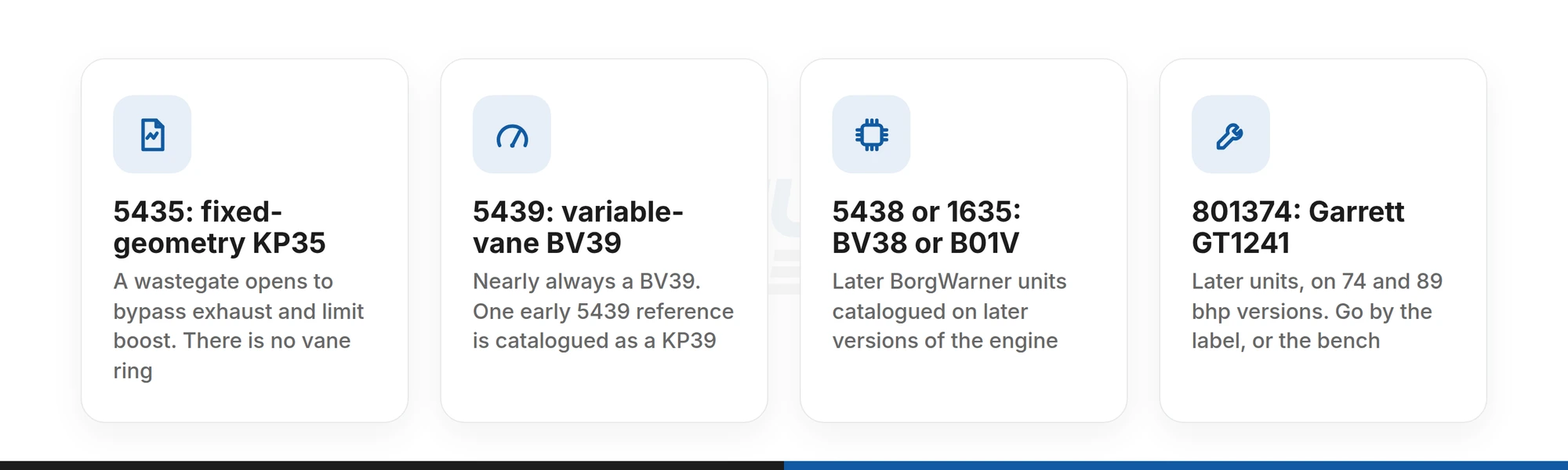
A 1.5 dCi turbo whose label starts 5435 is a fixed-geometry KP35: it has no vane ring, so a sticking-vane diagnosis can never be the answer for that unit.
- Engine: the Renault 1.5 dCi (K9K) diesel, in Renault and Dacia cars and small vans
- Two turbo types: a fixed-geometry BorgWarner KP35 on the lower outputs, a variable-vane BorgWarner BV39 on the higher ones; later versions are also catalogued with BV38, B01V and Garrett GT1241 units
- The quick tell: a label reference beginning 5435 is a KP35; one beginning 5439 is a BV39 on nearly every application
- Not covered here: the 1.6 dCi, the 2.3 dCi and the petrol TCe engines, which carry different turbochargers
- Price: rebuilds from £185; replacement units from £450; your price is confirmed once the unit has been inspected
- Order by model: each model in the table below links to its own rebuild listing
- Turnaround: typically one to three working days on the bench, plus postage each way
- Warranty: lifetime and unlimited mileage
- Getting started: the online Repair Form
Which Renault and Dacia Models Run the 1.5 dCi
The 1.5 dCi is a 1461 cc four-cylinder diesel that the parts trade catalogues under Renault’s K9K engine code, with a long run of suffixes (K9K 702, K9K 732, K9K 834, K9K 646 and many more) marking its versions. Renault fitted it across its small and mid-size range, from the Twingo and Clio to the Megane, Scenic, Laguna and Kangoo, and Dacia used it in the Duster, Logan, Sandero, Dokker and Lodgy.
The table shows which turbo types the trade catalogue lists against each model. It is a list of references, not a build record: where a model shows more than one type, the label on your own turbocharger decides which one you have. The per-year part numbers, and the rebuild price for your year and power output, sit on each model’s rebuild listing.
| Model | Fixed-geometry KP35 catalogued | Variable-vane BV39 catalogued | Later units catalogued |
|---|---|---|---|
| Renault Clio 1.5 | Yes | Yes | Garrett GT1241, B01V |
| Renault Megane 1.5 | Yes | Yes | BV38, B01V |
| Renault Scenic 1.5 | Yes | Yes | BV38, B01V |
| Renault Grand Scenic 1.5 | Yes | Yes | BV38, B01V |
| Renault Kangoo 1.5 | Yes | Yes | Garrett GT1241, BV38, B01V |
| Renault Modus 1.5 | Yes | Yes | — |
| Renault Fluence 1.5 | Yes | Yes | B01V |
| Renault Laguna 1.5 | — | Yes | — |
| Renault Captur 1.5 | — (one catalogue row, dated before the Captur existed) | — | Garrett GT1241, B01V |
| Renault Kadjar 1.5 | — | — | B01V |
| Renault Twingo 1.5 | Yes | — | — |
| Renault Symbol 1.5 | Yes | — | — |
| Dacia Duster 1.5 | Yes | Yes | B01V |
| Dacia Logan 1.5 | Yes | — | Garrett GT1241 |
| Dacia Sandero 1.5 | Yes | — | Garrett GT1241 |
| Dacia Dokker 1.5 | Yes | — | Garrett GT1241 |
| Dacia Lodgy 1.5 | Yes | Yes | Garrett GT1241 |
Two patterns stand out. The Twingo and Symbol are catalogued with the fixed-geometry KP35 alone, and the Laguna with the variable-vane BV39 alone. Almost everything else spans both, which is why a model name on its own never settles which turbo is fitted.
The same engine went into Nissan and Mercedes-Benz models as well. Nissan’s version has its own page, our Nissan Qashqai 1.5 dCi turbo repair; this page covers the Renault and Dacia cars.
Not every small Renault diesel is a 1.5 dCi. The 1.6 dCi found in the Trafic and in later Megane and Scenic models carries different turbochargers, covered on our Renault Trafic and Vauxhall Vivaro turbo repair page, as does the 2.3 dCi in the Renault Master and Vauxhall Movano. The petrol TCe engines have their own turbochargers too, and nothing on this page applies to them.
Fixed-Geometry or Variable-Vane: The Two Turbo Types on the K9K
Both turbos do the same basic job. Exhaust gas spins a turbine wheel, the turbine drives a compressor wheel on the same shaft, and the compressor pushes air into the engine. Both also have to stop boost climbing past its limit. They do that in two quite different ways, and the difference runs through everything else on this page.
The KP35 is fixed-geometry. The passage that feeds exhaust into its turbine never changes shape. To hold boost down, a wastegate valve opens and lets part of the exhaust bypass the turbine altogether. An actuator on a rod opens that valve, and the rod’s setting decides the point at which it starts to open. Our page on wastegate actuator repair explains why that setting matters as much as the part.
The BV39 is variable-vane. A ring of small pivoting vanes surrounds the turbine wheel. Closed down, the vanes speed up the exhaust at low revs so the turbo builds boost early; opened out, they let the flow through at high revs. An actuator moves the whole ring through a lever, and there is no wastegate: the vanes do the controlling. Our guide to VNT turbos covers the vane mechanism in detail.
Telling the two apart
The quickest check is the first four digits of the reference on the turbo’s label. In the trade catalogue, every 1.5 dCi reference beginning 5435 is a KP35, and nearly every one beginning 5439 is a BV39. The exception is one early 5439 reference catalogued as a KP39, on 100 to 106 bhp versions of the Clio, Megane, Scenic and Grand Scenic. On an early higher-output car, then, a 5439 label narrows the choice to two rather than one.
Both turbo types are covered in detail on our BorgWarner KP35 and BV39 page.
Power output is the second clue. The KP35 references sit mostly against the lower outputs, up to about 90 bhp, and the BV39 references mostly against versions of around 100 to 110 bhp. There are exceptions in both directions, so treat the output as a pointer and the label as the answer.
Later cars moved on
Later versions of the engine are catalogued with three further units: BorgWarner BV38 and B01V references, with labels beginning 5438 and 1635, and a Garrett GT1241, with labels beginning 801374. The Garrett appears on 74 and 89 bhp versions of the Clio, Captur and Kangoo and across the Dacia range, which is the output band where the KP35 used to sit.
At least one trade listing for that Garrett unit describes a variable-vane mechanism. So the rule that a lower-output 1.5 dCi has no vanes belongs to the KP35 cars only. On a later car, go by the label, and if the label has gone, the bench settles it.
What Fails on a 1.5 dCi Turbo
Whichever type your car has, most failures start in the part the two share: the rotating assembly. Where they differ is boost control, and that is where a wrong assumption about the type costs money.
Faults both types share
The shaft runs in bearings fed with engine oil, with a seal at each end keeping that oil inside the centre housing. Oil that is short, overdue or dirty wears the bearings first. Once the shaft has room to move, the seals stop sealing, and oil reaches the intake on one side and the exhaust on the other.
Left running, a wheel eventually touches its housing, and a compressor wheel that has rubbed can shed metal into the intake. Anything that gets past the air filter, such as a fragment of a split hose, can chip the compressor blades on its way in.
The earlier the unit comes off, the more of it can be reused. A turbo removed at the first change in its note usually needs consumables only; one driven until it smokes often needs a wheel, the shaft or a housing as well.
Faults only a KP35 can have
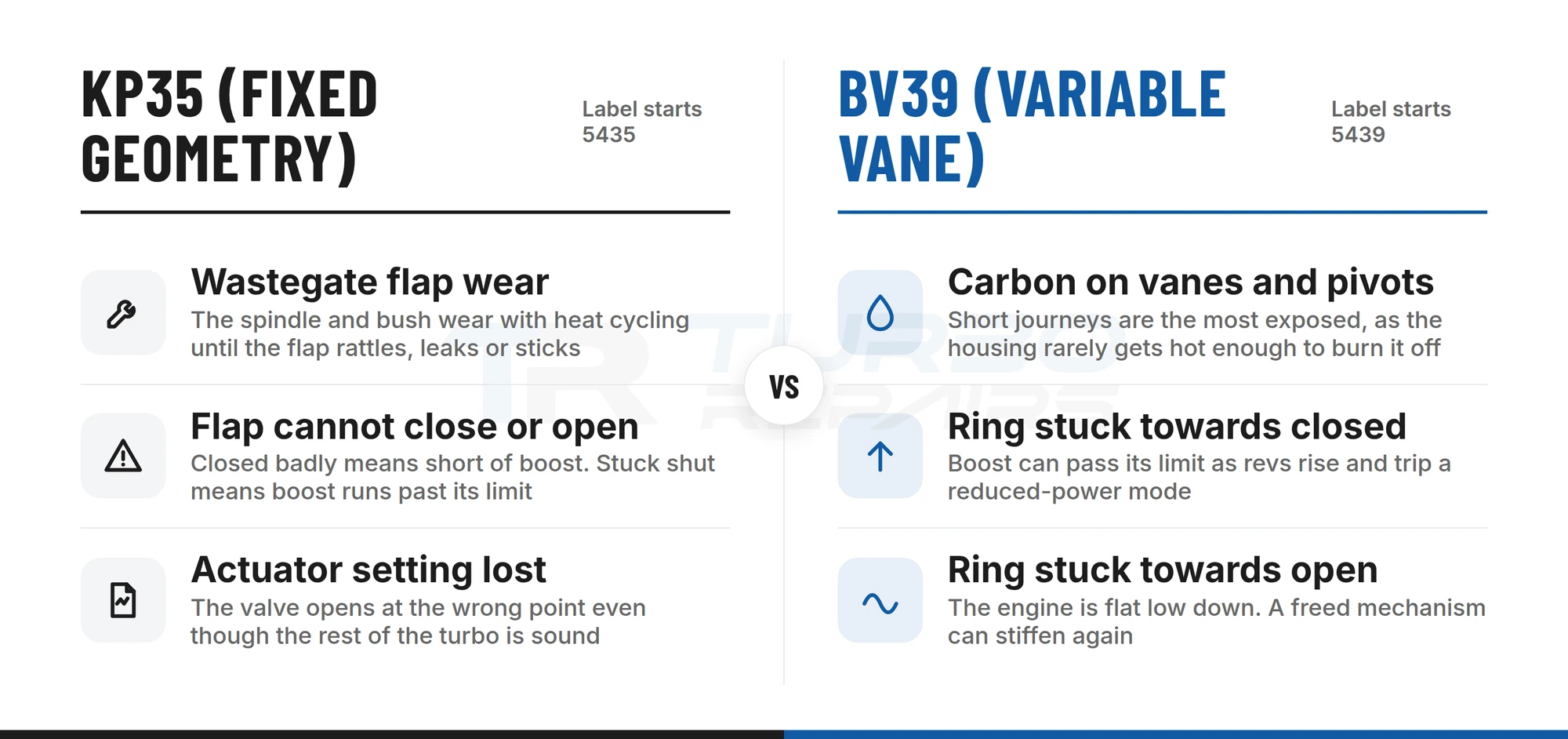
On the fixed-geometry turbo, boost control comes down to a flap and a pivot. The wastegate flap seats against the turbine housing and swings on a spindle running through a bush, and heat cycling wears that spindle and bush until the flap rattles, leaks or sticks.
A flap that cannot close properly leaves the turbo short of boost. One that cannot open lets boost run past its limit. The actuator can also lose its setting or its seal, so the valve opens at the wrong point even though the rest of the turbo is sound.
None of these faults involves vanes. If a turbo with a 5435 label has been diagnosed with sticking vanes, the diagnosis is describing a different turbocharger.
Faults only a BV39 can have
On the variable-vane turbo, the vane ring sits in the hottest part of the unit, and carbon from the exhaust builds up on the vanes and their pivots. Cars that mostly do short journeys are the most exposed, because the turbine housing rarely gets hot enough to burn the deposit off.
A ring stuck towards closed can push boost past its limit as the revs rise and trip a reduced-power mode. Stuck towards open, it leaves the engine flat low down. The vanes, their pivots and the ring itself also wear, so a mechanism that has been freed can stiffen again.
What the Car Does When the Turbo Is Failing
A failing 1.5 dCi turbo produces the same symptoms whether it sits in a Clio or a Duster. What changes is what those symptoms point to, and that depends on the turbo type.
One published workshop account of a 2013 Megane 1.5 dCi is typical. The car whistled, lacked power and dropped into limp mode when the throttle was pushed harder. The workshop traced it to a seized turbocharger, and put the seizure down to old oil.
Signs the rotating assembly is wearing (either type)
- A whine or siren that rises and falls with the revs. A metallic note that follows engine speed points inside the turbo rather than at the pipework.
- Blue or grey smoke, with oil use between services. Oil is getting past a seal, although an engine burning oil through its own wear gives the same sign.
- Oil in the intercooler pipework downstream of the turbo. A pointer to wear on the compressor side.
- Play at the compressor nut, or rub marks in the compressor housing. Both are visible with the intake pipe off, and either means the turbo has to come off.
Signs of a boost-control fault, read by type
Lost power with a warning light and a reduced-power mode is where the two types part company. On a KP35 car the suspects are the wastegate flap, its actuator and the pipes and hoses in its control circuit, alongside the intake pipework. On a BV39 car the vane ring joins that list, and a fault that shows up after a run of short journeys points towards it.
A stored underboost (P0299) or overboost (P0234) code records which way the boost was wrong, not which part made it so. Our guide to turbo overboost and underboost explains how far those codes can be trusted.
Before any of this points at the turbo, rule out the cheaper faults that imitate it: a split intercooler hose, a loose clip, a failing sensor. Our guide to turbo failure symptoms lists them, sorted by where in the unit each symptom starts.
The Oil Supply on a High-Mileage 1.5 dCi
The oil that lubricates a 1.5 dCi’s crankshaft also carries the turbo’s shaft, so the turbo is only ever as healthy as the engine’s oil. When a turbo has failed on neglected oil, the unit is only half the job. The other half is what gets done on the car before the rebuilt turbo goes back on.
In the Megane account above, the workshop drained the old oil, flushed the engine, and fitted a new oil filter and air filter before the turbo went back on. That is the right order for any 1.5 dCi with a patchy history:
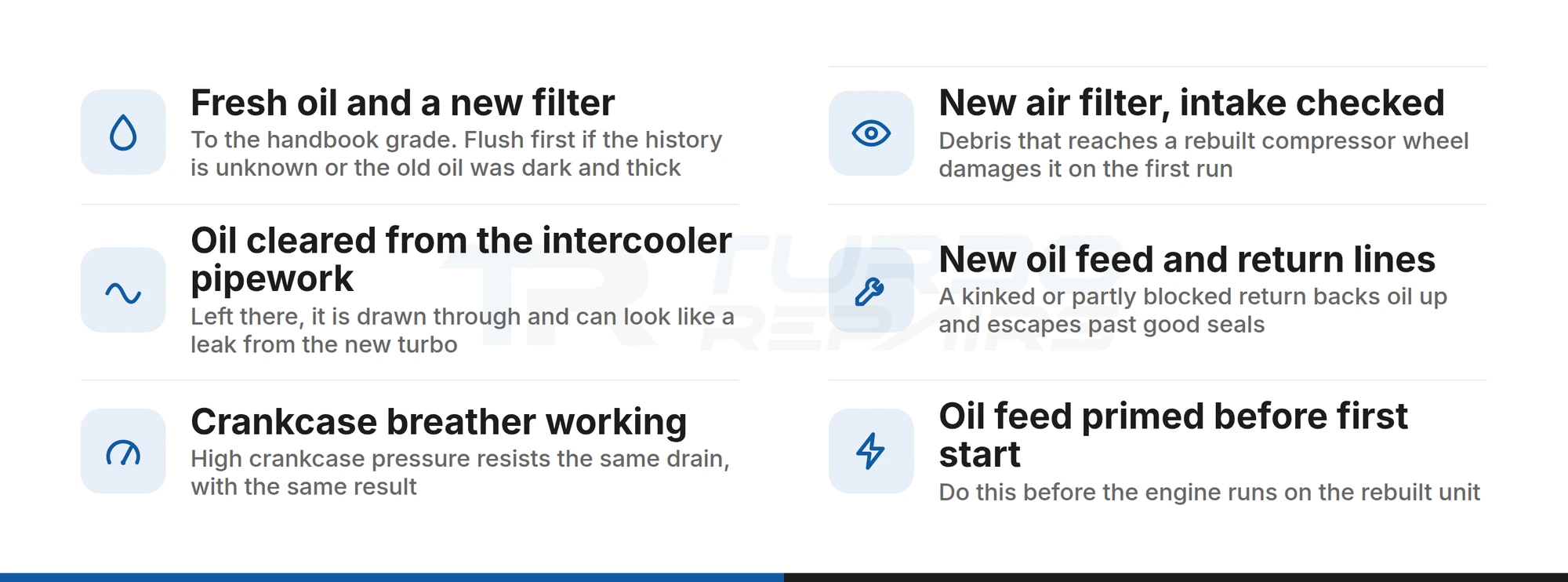
- Fresh oil and a new filter, to the grade in the handbook. Where the history is unknown, or the old oil came out dark and thick, flush first.
- A new air filter, and a look along the intake for anything loose. Debris that reaches a newly rebuilt compressor wheel damages it on the first run.
- Oil cleared from the intercooler and its pipework. Oil left there by the old turbo will be drawn through on the first drive and can look exactly like a leak from the new one.
- New oil feed and return lines rather than the old ones. The return line drains the turbo’s oil back to the sump by gravity; if it is kinked or partly blocked, oil backs up in the centre housing and escapes past seals that are in perfect order.
- A crankcase breather that works. High pressure in the crankcase resists that same drain, with the same result.
- The oil feed primed before the first start. Our guide to refitting and priming a turbocharger sets out the method.
Some later versions are catalogued with a particulate filter. If yours has one and it has been regenerating often or struggling, sort it out before the turbo goes on; our guide to whether a blocked DPF can cause turbo failure explains why the two are connected.
Rebuild or Replace on a 1.5 dCi
The work on the car is identical either way: the turbo comes off, a unit goes on, and the oil feed is primed. So the decision is only about which unit that is, and it can wait until the old one is off and on the bench.
A replacement has to be the right reference, not just the right car. The catalogue lists several references against most of these models, across more than one turbo type. A KP35 and a BV39 control boost in different ways, so one cannot stand in for the other, and even within one type the references differ by output and emissions version. Ordering by model name alone is how the wrong unit arrives.
A rebuild has nothing to match. The unit that goes back on is the one that came off, so its type, its reference and its boost-control setting are already your car’s. On a BV39 that includes the vane mechanism, set up on the bench for that turbo; on a KP35, the wastegate and its actuator setting.
When replacement is the better value. If a wheel, the shaft and a housing have all failed on top of the bearings and seals, little of the original unit is left to rebuild. The inspection shows that, and when a unit is not worth rebuilding we tell you and recommend a replacement instead.
What it costs. Our published prices start at £185 for a rebuild of your own turbocharger and £450 for a replacement unit from us, with removal and refitting charged separately by whoever does the work. Our price guide sets rebuild ranges by vehicle class, with small cars at £185 to £285 and mid-size cars at £185 to £350. The Clio, Twingo, Modus and Sandero sit nearest the first row, and the Megane, Scenic, Fluence and Duster nearest the second. Where a rebuild lands depends on what survived inside. The full table is in our guide to turbo repair and replacement prices, and the rebuild listing for your model, linked in the table above, prices it by year and power output.
Turbo Repairs · Epsom workshop
Find out which turbo your 1.5 dCi carries, and what it needs
Post your turbocharger in and it is identified from its label or on the bench, then stripped and measured part by part before anything is priced. If a rebuild is the right route, the KP35 or BV39 that comes back is your own, with its boost-control setting intact.
Lifetime, unlimited-mileage warranty · Mail-in from the UK and internationally · Bench-tested and calibrated before it ships
Our Renault and Dacia 1.5 dCi Turbo Rebuild
You, or the garage doing the work, remove the turbocharger and post it to us. From there, the turbocharger rebuild service runs in this order:
- Repair Form first. Complete the online Repair Form with the registration, mileage, symptoms, any stored codes and, if it is readable, the reference from the label. The first four digits alone tell us a great deal.
- Packing and posting. Send the turbo complete, with its actuator attached and every port plugged or taped, to Unit 102 Reaver House, 12 East Street, Epsom, Surrey, KT17 1HX, United Kingdom. Our FAQs page covers packing and postage.
- Identification and strip. The unit is identified from its label or, where the label has burned away, on the bench, then stripped to component level.
- Measurement. The shaft, wheels, bearing bores and housings are cleaned and measured against the original specification. Bearings, seals and thrust parts are renewed as standard with genuine OE or OEM-grade components, uprated where the original has a known weakness, and a wheel, shaft or housing that fails inspection is replaced.
- Boost control, by type. On a KP35 the wastegate flap, spindle and bush are checked for wear and renewed where worn, and the actuator’s setting is checked. On a BV39 the vane ring is stripped, cleaned of carbon, freed or renewed, and its travel set.
- Balance and bench test. The rotating assembly is balanced, then the finished unit is set up and run on the bench with dealer-level diagnostic and calibration tooling before it is boxed and posted back, ready to refit.
Bench time is typically one to three working days from arrival, plus postage each way, and the rebuild carries a lifetime, unlimited-mileage warranty. Independent garages and dealers send units in on behalf of their customers in exactly the same way as owners do.
If you already know your model, year and power output, the rebuild listing for your car in the table above lets you order directly. The unit is still identified on the bench before any work starts.
Renault and Dacia 1.5 dCi Turbo FAQ
Which turbo does my Renault 1.5 dCi have?
Look at the first four digits of the reference on the turbo’s label. On the 1.5 dCi, 5435 means a fixed-geometry BorgWarner KP35 and 5439 almost always means a variable-vane BV39, while 5438, 1635 and 801374 belong to the later BV38, B01V and Garrett units. If the label is unreadable, send the turbo and it is identified on the bench.
Does the Dacia Duster 1.5 dCi use the same turbo as a Renault?
It has the same engine, and the catalogue lists it with the same kinds of turbo: KP35 on the lower-output versions, BV39 on the higher-output ones, and later B01V references. Several of its references are shared with Renault models. Our Dacia Duster 1.5 diesel rebuild listing narrows it by year and power output.
How much does a Renault 1.5 dCi turbo rebuild cost?
Rebuilds start from £185, and our price guide puts small cars at £185 to £285 and mid-size cars at £185 to £350, depending on what has survived inside the unit. A replacement unit from us starts from £450. Removal and refitting are not included, and your exact price is confirmed after inspection.
Can a 1.5 dCi turbo have sticking vanes?
Only if it has vanes. The BV39 does, and at least one trade listing describes the later Garrett as variable-vane too. The KP35 has none, so on a turbo with a 5435 label a boost fault points to the wastegate, its actuator or the pipework instead.
Is the Renault 1.5 dCi turbo the same as the Nissan one?
Nissan used the same K9K engine family, so the turbo types overlap, but each reference is matched to a particular version of the engine rather than to a badge. Whichever car you have, the label on your own unit is what counts.
Should I send the actuator with the turbo?
Yes. Send the complete turbocharger as it came off the engine, actuator attached. On a BV39 the actuator and vane ring are set up together, and on a KP35 the actuator’s setting decides when the wastegate opens, so both are checked with the turbo.
How long does a rebuild take, and what is the warranty?
Typically one to three working days on the bench from arrival, plus postage each way. Every rebuild carries a lifetime, unlimited-mileage warranty.
Final Thoughts
It is easy to talk about “the 1.5 dCi turbo” as though it were one part. It is at least two, and the difference is not a detail: a KP35 controls boost with a wastegate and a BV39 with a ring of vanes, so the same warning light sends you to different parts on different cars.
Read the label before anything is ordered or condemned. Then put the oil, the lines and the intake right on the car, because the turbo shares all three with the engine. Rebuilding the unit you already have takes the matching question off the table altogether.
Turbo Repairs · Epsom workshop
Get your own KP35 or BV39 back, rebuilt
Complete the Repair Form with your car’s details and the label reference, then post the turbocharger in complete. It is identified, stripped, measured, rebuilt, balanced and bench-tested, and comes back ready to go on.
Lifetime, unlimited-mileage warranty · Mail-in from the UK and internationally · Bench-tested and calibrated before it ships