

Summary We rebuild Mitsubishi Heavy Industries (MHI) turbochargers from UK diesels, including the TF035, TD025, TD02, TD03 and TD04 families, to their original specification. This page starts from the Mitsubishi name and works back to the engine, the reference on the label and the page on this site that covers your car, then explains what wears out on these small units and how each family controls boost.
Rebuilds of your own turbo start from £185, bench time is typically one to three working days, and every rebuild carries a lifetime, unlimited-mileage warranty.
The Mitsubishi turbochargers in our vehicle listings sit on BMW, Citroen, Peugeot, Ford, Volvo, Mazda and Vauxhall diesels, and not one of those cars wears a Mitsubishi badge.
A search for a Mitsubishi turbo mostly returns Mitsubishi’s own vehicles, from L200 pick-ups to Lancer Evolutions, alongside the corporate sites of the turbocharger business itself. That business supplies other vehicle manufacturers as well as its own group, and in the catalogue our rebuild listings are built from, every MHI reference sits on another maker’s car. This page is the route from the name on the turbo to the car it is bolted to.
- Families covered: TF035HL6, TD025 (S2 and M versions), TD02 (H2 and L11 versions), TD03L4 and TD04
- Where they are fitted: BMW 2.0 diesels; the 1.6 HDi and TDCi in Citroen, Peugeot, Ford, Volvo and Mazda cars; Vauxhall’s 1.7 diesel; the earlier Ford Transit 2.4 TDCi
- How to identify yours: the reference on the turbo’s label, written as 49, three more digits, a dash and five digits
- Boost control: variable geometry on the TF035HL6 and TD03L4 references; a pneumatic actuator and wastegate on the TD025S2 and TD02 references
- Price: rebuilds from £185; replacement units from £450; electronic actuator repairs from £100 + VAT
- Turnaround: typically one to three working days on the bench, plus postage each way
- Warranty: lifetime and unlimited mileage, with no time limit
- Not covered: upgrade or hybrid Mitsubishi turbos; every rebuild returns the unit to its original specification
Which Mitsubishi Turbo Is on Your Engine? Applications by Family
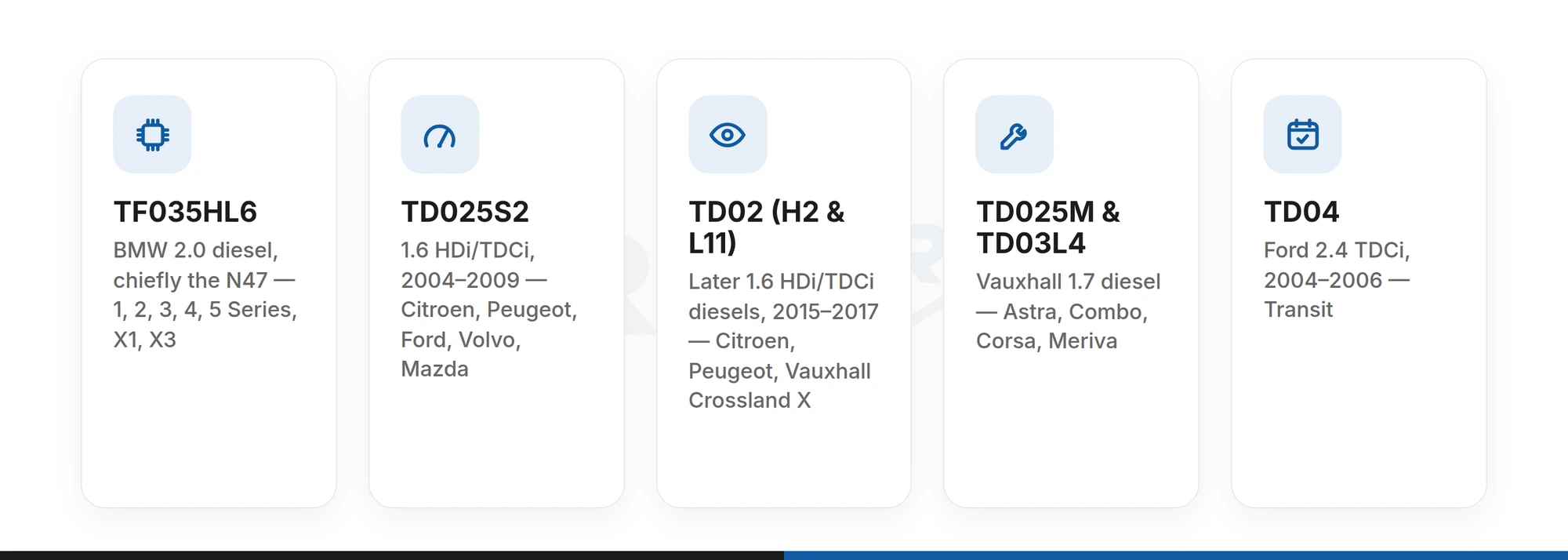
Start with the car, not the turbo. The table below lists each MHI family as the trade catalogue files it, the engines and vehicles it is listed against, and the page on this site that covers that engine in depth. The references are shown as series rather than single numbers, because each family runs to several builds.
| MHI family | Reference series | Engine | Vehicles listed | Read next |
|---|---|---|---|---|
| TF035HL6 | 49135-05… and 49335-00… | BMW 2.0 diesel, chiefly the N47 | 1, 2, 3, 4 and 5 Series, X1, X3; 134 to 197 bhp | BMW N47 turbo repair |
| TD025S2 | 49173-075… | 1.6 HDi and TDCi (DV6), mostly 2004 to 2009 | Citroen C3, C4, Berlingo; Peugeot 207, 308, Partner, Expert; Ford Fiesta, Focus, C-Max; Volvo S40, V50; Mazda 3 | the 1.6 HDi TD025 |
| TD02H2 | 49373-020… | 1.6 HDi and TDCi at 74 to 95 bhp | Citroen C3, C4, DS3, Berlingo; Peugeot 207, 208, 308, Partner, Expert; Ford Fiesta, Focus, C-Max, B-Max | Peugeot 308 1.6 listing |
| TD02L11 | 49172-03000 | Later DV6F-series 1.6 diesel, 2015 to 2017 | Citroen and Peugeot 1.6 diesels including the 208, 308, 3008 and 5008; Vauxhall Crossland X | Citroen C3 1.6 listing |
| TD025M | 49173-065… and 49173-066… | Vauxhall 1.7 diesel, Y17DT and Z17DTL | Astra, Combo, Corsa, Meriva; 64 to 80 bhp | Vauxhall Astra 1.7 listing |
| TD03L4 | 49131-060… | Vauxhall 1.7 diesel, Z17DTH, 2003 to 2005 | Astra, Combo, Corsa, Meriva; 99 to 101 bhp | Vauxhall Astra 1.7 listing |
| TD04 | 49377-00510 | Ford 2.4 TDCi, H9FA engine, 2004 to 2006 | Transit | Ford Transit turbo repair |
Use the table to find the right page, not to choose a part. A family name narrows the search; the full reference on your unit finishes it, and the next section shows how to read one.
One engine, several Mitsubishi families
The 1.6 HDi and TDCi shows why the family alone is not enough. Across its life the catalogue lists three different MHI designs against it, a TD025S2, a TD02H2 and, on the later DV6F engines, a TD02L11, and the higher-output versions of the same engine carry a Garrett unit instead. The Citroen 1.6 HDi page sorts the Mitsubishi and Garrett cars by output, and the Ford Focus 1.6 TDCi page covers the Ford side of the same engine.
Vauxhall’s 1.7 diesel splits the same way. The catalogue lists TD025M units against the Y17DT and Z17DTL engines and variable-geometry TD03L4 units against the Z17DTH, and the same model listings also carry Garrett references for other 1.7 versions. The engine code separates them, and the label settles it.
Mitsubishi’s own vehicles
Mitsubishi’s own diesels run MHI turbochargers too. UK trade listings put 49335- and 49135- references on the L200, ASX, Outlander and Pajero diesels, and 49378- units on Lancer Evolution petrols. We have no model listings for these vehicles, so send the details through the Repair Form with the reference from the label, and we confirm whether the unit is a candidate for a rebuild before you post anything.
The same applies to any MHI unit not in the table. If the reference begins 49 and the car is not listed here, the Repair Form is the starting point.
Reading an MHI Reference: 49xxx Numbers
The reference is on the label or plate on the turbocharger’s housing. On an MHI unit it takes one consistent shape: 49, three more digits, a dash and five digits, as in 49173-07508 or 49335-00500. The carmaker’s own part number often sits nearby, and it is worth photographing the whole label rather than copying one number from it.
The first block points to the family
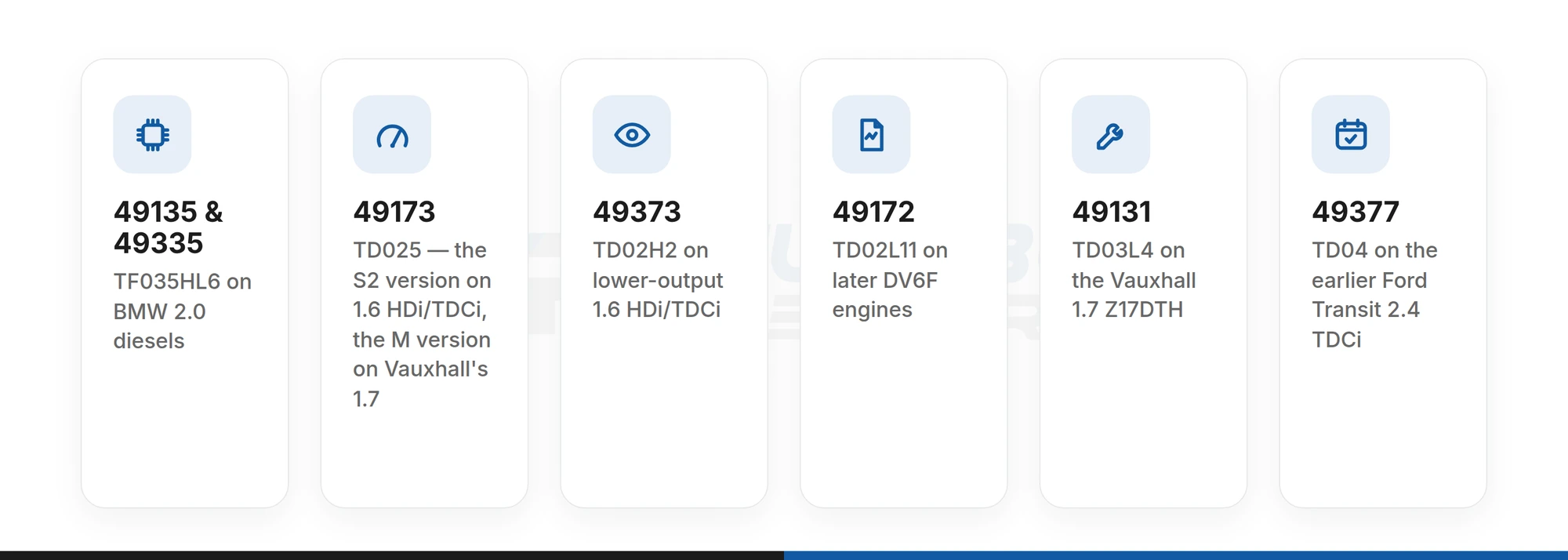
Across the listings on this site, the first five digits line up with the family:
- 49135 and 49335: TF035HL6 on BMW 2.0 diesels, with 49135 on most of the earlier rows and 49335 on most of the later ones
- 49173: TD025, both the S2 version on the 1.6 HDi and TDCi and the M version on Vauxhall’s 1.7
- 49373: TD02H2 on the lower-output 1.6 HDi and TDCi
- 49172: TD02L11 on the later DV6F engines
- 49131: TD03L4 on the Vauxhall 1.7 Z17DTH
- 49377: the TD04 listed for the earlier Transit 2.4 TDCi
Treat that as a pointer to the right page, not a rule for every MHI unit ever built. It is what our listings show, and it is enough to tell a TD025 from a TF035 before the turbocharger is even off the car.
The second block identifies the build
The five digits after the dash identify one build within the family, and neighbouring numbers are not simply variations of one part. The TD025S2 numbers 49173-07502 and 49173-07508 are catalogued against different spreads of vehicles and years: one runs to a model year of 2014, the other adds the Volvo S40 and V50 and stops at 2009.
That is why a replacement has to be matched to the full reference, and why a rebuild does not. The unit that goes back on your engine is the one that came off it, so the reference is already correct.
When the label has gone
Labels on the exhaust side of an engine bay fade, burn and peel. If yours is unreadable, send the turbo anyway. It is identified on the bench before any work starts, and your registration on the Repair Form lets the unit be checked against the car it came from.
What Fails on Small Mitsubishi Turbochargers
Every family on this page is a small unit built around one shaft, with the turbine wheel at the exhaust end and the compressor wheel at the intake end. The shaft turns inside a bearing housing on a film of pressurised engine oil, and a seal at each end keeps that oil where it belongs. What fails first is almost always the part that depends on the oil.
- Bearings and thrust parts. Short of oil, running on old oil or carrying debris, they wear and let the shaft move further than it was built to.
- Seals. Once the shaft stops running true, oil passes the seals into the intake on one side and the exhaust on the other.
- Wheels and shaft. Left running with worn bearings, a wheel touches its housing, and a damaged shaft can bend or break. The turbine wheel and shaft are one assembly, so damage to either replaces both.
- The boost-control mechanism. On the variable-geometry units the vane ring can carbon up and stick; on the wastegated units the wastegate flap and its pivot can wear or seize. Either gives a boost fault while the rotating assembly is still sound.
How far a failure spreads depends mostly on how long the car is driven after the first sign. Taken off when it first whines, a small MHI unit is usually a bearings-and-seals rebuild; driven until it smokes, it may need a wheel, the shaft or a housing as well.
The cause is nearly always on the car rather than in the turbo: the oil supply, the oil itself, or something drawn into the intake. Our guide to removing and refitting a turbocharger sets out those causes and what to check while the unit is off. On the 1.6 HDi and TDCi, the engine-specific causes are covered on the Citroen and Ford Focus pages linked above, and symptoms are sorted by where they start in our guide to common turbocharger problems.
Boost Control on Mitsubishi Units
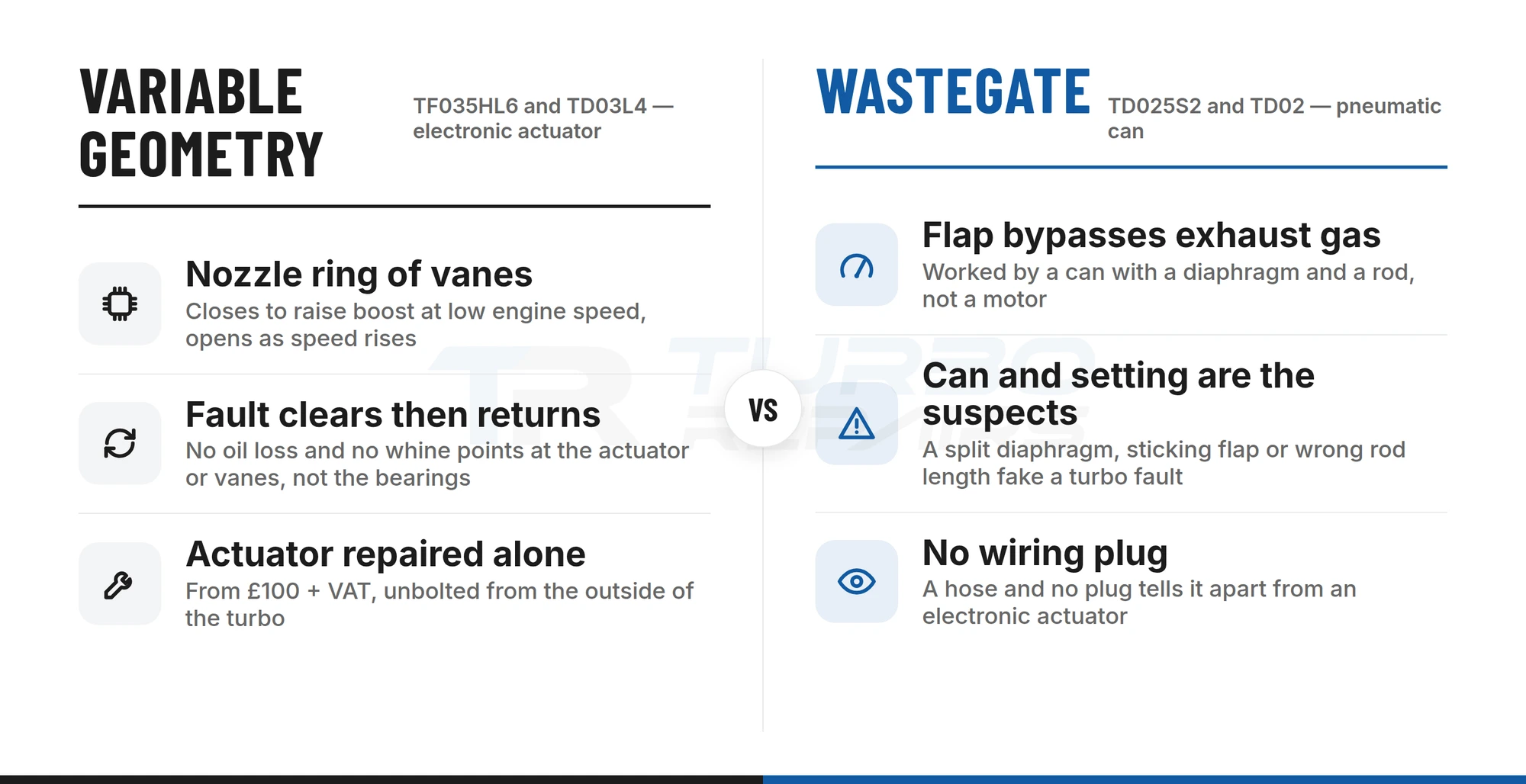
The Mitsubishi families on this page control boost in two different ways, and knowing which one yours uses tells you which part can imitate a failed turbocharger.
Variable geometry: TF035HL6 and TD03L4
The TF035HL6 and TD03L4 references are listed with a nozzle ring assembly, and nearly all of them carry a VG suffix in the catalogue. The nozzle ring is a ring of vanes around the turbine wheel that closes to raise boost at low engine speed and opens as speed rises. On the BMW 2.0 diesel an electronic actuator on the side of the turbo positions those vanes, and the 5 Series F10 and F11 520d pairs a Hella 6NW010430-04 actuator with its TF035 unit. Our guide to VNT turbos covers why vane rings stick and why a fault that clears itself is still a fault.
On these units, a boost fault that clears on a restart and returns, with no oil loss and no whine, points at the actuator or the vanes rather than the bearings. An electronic actuator is repaired on its own from £100 + VAT, and our BMW 5 Series actuator repair page shows how that unit is identified.
Wastegate: TD025S2 and TD02
The TD025S2, TD02H2 and TD02L11 references are catalogued with a pneumatic actuator and no nozzle ring. Boost is controlled by a wastegate, a flap that opens to let exhaust gas bypass the turbine wheel, worked by a can with a diaphragm and a rod rather than by a motor.
On these units the can and its setting are the suspects to rule out before the turbo itself. A split diaphragm, a sticking flap or a rod set to the wrong length all produce boost faults on a sound turbocharger. Our wastegate actuator repair page explains why the setting matters as much as the part.
A quick check tells the two apart on the car. An electronic actuator has a wiring plug; a pneumatic can has a hose and no plug.
Turbo Repairs · Epsom workshop
Found a 49 on the label? That is all we need to start
Put the reference, the registration and the symptoms on the Repair Form, then post the turbocharger in with its actuator still attached. We identify the family, strip it, and tell you whether the fault is in the rotating assembly or the boost control before anything is renewed.
Lifetime, unlimited-mileage warranty · Mail-in from the UK and internationally · Bench-tested and calibrated before it ships
Our Mitsubishi Turbo Rebuild
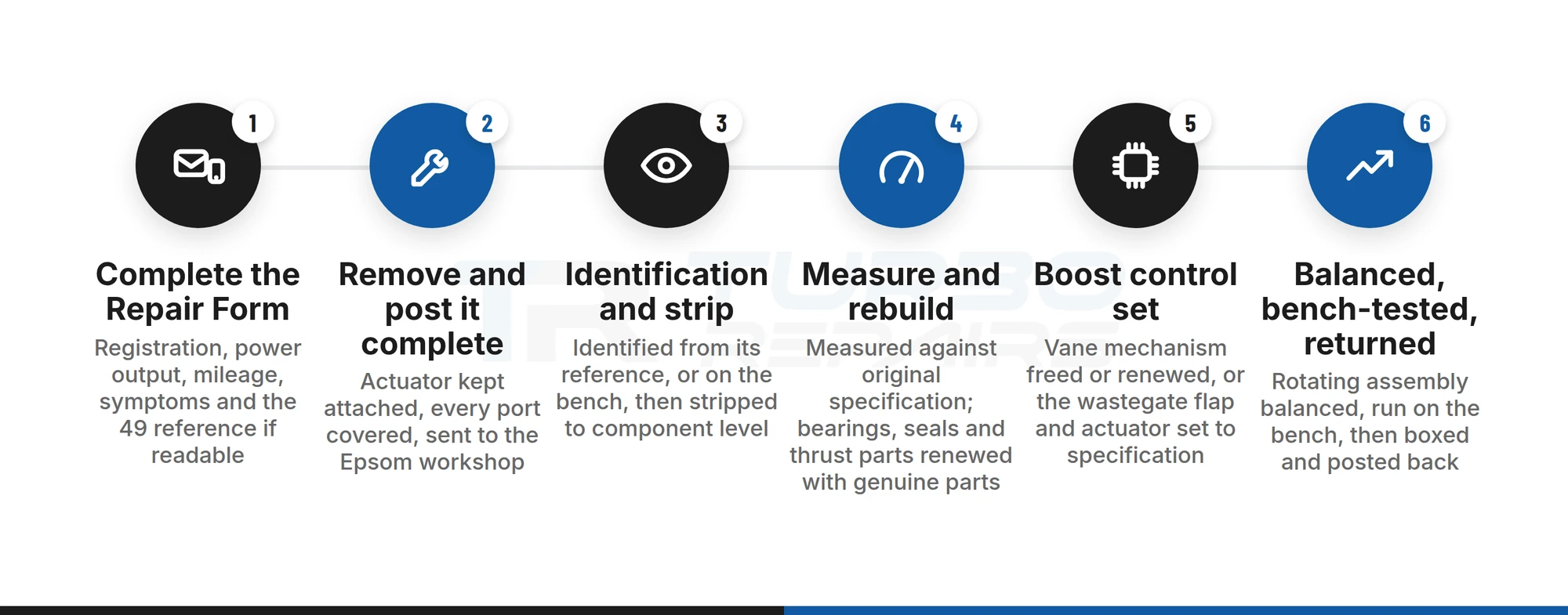
You, or the garage working on the car, remove the turbocharger and post it to us; we rebuild it and post it back ready to refit. This is how it runs:
- Complete the online Repair Form with the registration, the power output from the V5C, the mileage, the symptoms, any fault codes, and the 49 reference from the label if you can read it.
- Remove the turbo, keeping the actuator attached. Our refitting guide, linked above, covers priming the oil feed on the first start.
- Pack and post it complete, every port covered, to Unit 102 Reaver House, 12 East Street, Epsom, Surrey, KT17 1HX, United Kingdom. Packing and postage are covered on our FAQs page.
- Identification and strip. The unit is identified from its reference, or on the bench if the label is gone, then stripped to component level.
- Measurement. The shaft, wheels, bearing surfaces and housings are cleaned and measured against original specification, so what is renewed is decided by measurement rather than by a standard kit.
- Rebuild. Bearings, seals and thrust parts are renewed with genuine OE or OEM-grade components that meet or exceed the original, a part with a known design weakness is uprated rather than reinstated, and a wheel, shaft or housing that fails inspection is replaced.
- Boost control. On a variable-geometry unit the vane mechanism is freed or renewed so it sweeps its full range; on a wastegated unit the flap and pivot are checked for wear and the actuator is set to the turbocharger’s specification.
- Balanced, bench-tested and returned. The rotating assembly is balanced, the unit is set up and run on the bench, then boxed and posted back.
Bench time is typically one to three working days from arrival, with postage on top each way. The rebuild carries a lifetime, unlimited-mileage warranty, with no time limit and no mileage cap.
Rebuild or replace?
The labour on the car is the same either way, so the choice can wait until the unit is off and inspected. Rebuilding your own turbo starts from £185, and a replacement unit from us starts from £450. Our turbo repair price guide breaks rebuild prices down by vehicle class.
A rebuild is the sensible default when the housings, shaft and wheels pass inspection, because the parts that wore out are the ones designed to be renewed. When too much has gone at once for a rebuild to be good value, we say so and recommend replacement instead.
Mitsubishi Turbo Repair FAQ
Is a Mitsubishi turbo the same as an MHI turbo?
Yes. MHI stands for Mitsubishi Heavy Industries, whose turbocharger business makes the units, and it supplies other vehicle manufacturers as well as Mitsubishi’s own vehicles. That is why an MHI turbo can be on a BMW, a Citroen or a Vauxhall, and why the reference on its label begins 49 whatever the car.
How much does a Mitsubishi turbo rebuild cost?
Rebuilding your own turbo starts from £185, and a replacement unit from us starts from £450. An electronic actuator repaired on its own starts from £100 + VAT. Removal and refitting are charged by whoever does them, and your exact price is confirmed once the unit has been inspected.
Do you rebuild turbos from Mitsubishi’s own cars, such as the L200 or Outlander?
We have no model listings for Mitsubishi’s own vehicles, so start with the Repair Form and include the reference from the label. We confirm whether the unit is a candidate for a rebuild before you post it.
The label on my turbo is unreadable. Can you still identify it?
Yes. Send the unit anyway, with the registration on the Repair Form. Every turbo is identified on the bench before any work starts, whether or not its label survived.
Can you upgrade my car to a bigger Mitsubishi turbo?
No. We rebuild the turbocharger your engine was built with, to its original specification. Upgrade and hybrid turbos are a different job, and nothing on this page covers them.
Could the fault be the actuator rather than the turbo?
Often, yes. On a variable-geometry TF035 or TD03, a boost fault that clears on a restart with no oil loss points at the electronic actuator or the vanes. On a wastegated TD025 or TD02, check the pneumatic can and its rod before the turbo comes off. Oil smoke, oil in the intake pipework or a whine that rises with the revs point at the turbo itself.
Final Thoughts
“Mitsubishi” on a turbocharger names the company that made it, not the car it is bolted to, which is why a search for the name turns up pick-ups and rally cars while the unit on your drive sits under a BMW, Citroen, Ford or Vauxhall bonnet. The 49 reference on the label is the way back: its first block points to the family and the page that covers your engine, and its full number is what the bench checks.
Before the turbo comes off, find out which way it controls boost. A plug means an electronic actuator on a variable-geometry unit; a hose means a wastegate can, and either can fake a failed turbocharger. When the evidence does point at the turbo, take it off early, before worn bearings have time to take the wheels and shaft with them.
Turbo Repairs · Epsom workshop
Get your own MHI turbo back, rebuilt to its original specification
Complete the Repair Form with your registration and the 49 reference from the label, then post the turbocharger in complete. We identify it, strip, measure, rebuild, balance and bench-test it, and send it back ready to refit.
Lifetime, unlimited-mileage warranty · Mail-in from the UK and internationally · Bench-tested and calibrated before it ships