

Summary We rebuild the turbochargers from the 2.0 Ingenium four-cylinder diesel, fitted to Land Rover and Jaguar models from 2015: the Discovery Sport, the Evoque, the Velar, the Discovery 5 and the Defender, and the Jaguar XE, XF, E-Pace and F-Pace. JLR specialists report that Ingenium turbo failure often starts in the oil the turbo shares with the engine, so the engine is checked first and the turbo second, before a rebuilt or new unit goes back on.
You or your garage remove the turbo and post it to us. It is stripped to component level, measured, rebuilt on genuine OE or OEM-grade parts, balanced and bench-tested. Rebuilds start from £185 + VAT and replacement units from £450 + VAT, and every rebuild carries a lifetime, unlimited-mileage warranty.
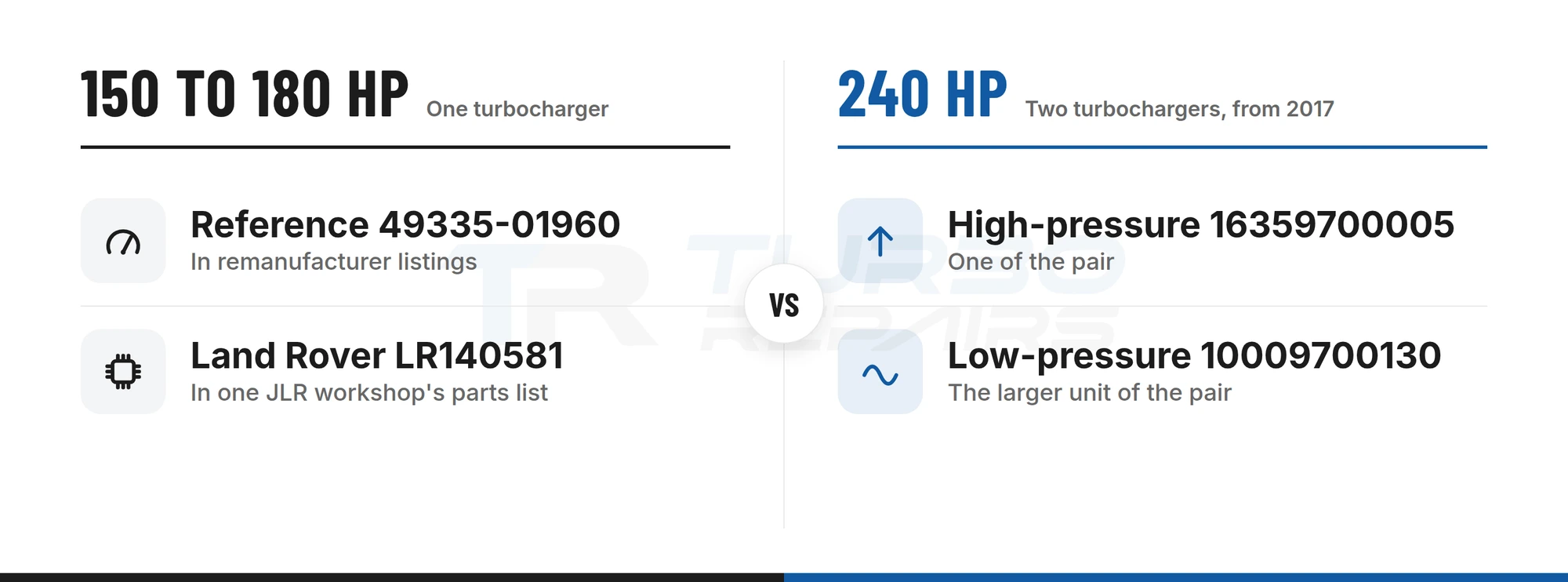
Remanufacturers list the 150 to 180 hp Ingenium diesel with one turbocharger and the 240 hp version from 2017 with two, a high-pressure unit and a low-pressure unit, even though one engine-supply guide describes every version as single-turbo.
If your Ingenium diesel is whining, smoking or falling into limp mode, this page helps you work out whether the turbocharger failed on its own or was taken out by a fault in the engine. It covers which turbo your car carries, what wears inside it, the checks to make before it comes off, and what a rebuild involves.
- Covered here: the 2.0 Ingenium four-cylinder diesel in Land Rover and Jaguar models from 2015
- Not covered here: the 2.2 diesel in earlier Evoque, Discovery Sport and Freelander 2 cars, and the petrol and six-cylinder Ingenium engines
- Engine codes in workshop and parts literature: 204DTD, 204DTA, 204D4 and AJ200D, with 205DTA on a later twin-turbo listing
- 150 to 180 hp versions: one turbocharger, reference 49335-01960 in remanufacturer listings, Land Rover number LR140581 in one JLR workshop’s parts list
- 240 hp version from 2017: two turbochargers, a high-pressure 16359700005 and a low-pressure 10009700130
- Causes JLR specialists name: fuel-diluted oil, timing-chain guide debris, a restricted oil feed pipe and a failed crankcase breather
- Our service: rebuild of your own turbo from £185 + VAT, replacement from £450 + VAT, typically 1–3 working days on the bench, lifetime unlimited-mileage warranty
Ingenium or 2.2? Check Which Engine Your Car Has
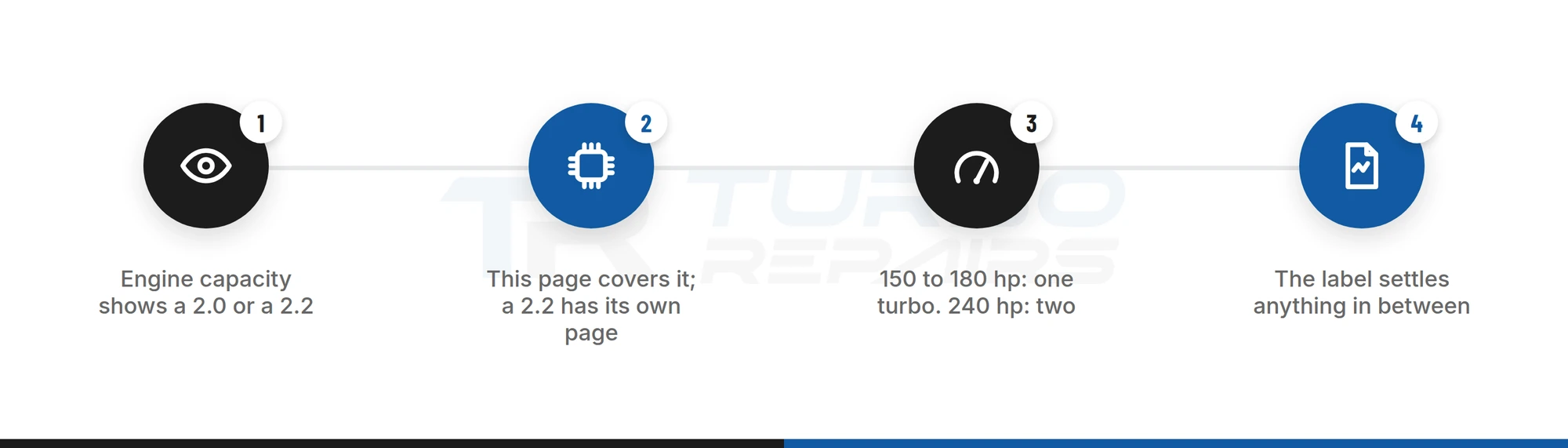
Three of the cars on this page were also sold with the older 2.2 diesel, and its turbocharger is a different part. The Evoque and the Discovery Sport carried the 2.2 before the Ingenium replaced it, and the Jaguar XF is listed with the 2.2 as well as with the Ingenium, which arrived in the X260 generation in 2015.
The listings overlap around the changeover rather than dividing cleanly. The 2.2 turbo is listed for the Discovery Sport in 2015 and 2016, while specialist lists put the Ingenium in the same car from 2015. No catalogue we have read gives a single changeover date for either car, so we do not print one.
The quickest answer is on your V5C: the engine capacity shows a 2.0 or a 2.2. The badge on the tailgate does not settle it. If your car has the 2.2, our page on the 2.2 diesel covers its turbocharger, and nothing about the 2.2 below applies to an Ingenium.
The Ingenium Diesel Models and Their Turbochargers
The 2.0 Ingenium diesel runs across most of the Jaguar Land Rover range. The years below are those one JLR specialist gives for the engine in each model. Other specialists also list the Range Rover Sport, but they disagree about which generation, so it is left out of the table.
| Model | Ingenium diesel years as listed |
|---|---|
| Land Rover Discovery Sport | 2015 onwards |
| Range Rover Evoque, first generation (L538) | 2015–2018 |
| Range Rover Evoque, second generation (L551) | 2019 onwards |
| Range Rover Velar | 2017 onwards |
| Land Rover Discovery 5 | 2017 onwards |
| Land Rover Defender (L663) | 2020 onwards |
| Jaguar XE | 2015 onwards |
| Jaguar XF (X260) | 2015 onwards |
| Jaguar F-Pace | 2016 onwards |
| Jaguar E-Pace | 2017 onwards |
One turbocharger or two
In the listings, the power output decides how many turbochargers the engine carries. Remanufacturers list a single unit, reference 49335-01960, for the 150 to 180 hp versions in the F-Pace, XE, XF, Discovery Sport, Discovery 5, Evoque and Velar, against the 204DTD and AJ200D engine codes. One JLR workshop lists the Land Rover number LR140581 for the turbo on this engine, and a turbo seller lists the two numbers together.
The 240 hp version is listed from 2017 with a pair: a high-pressure turbocharger, 16359700005, and a larger low-pressure unit, 10009700130. Sellers offer them separately and as a set. A second pair, 16359700006 and 10009700131, is listed against the later 205DTA engine code.
Not every source agrees. One engine-supply guide describes the 2.0 diesel as single-turbo at every output from 150 to 250 bhp, which the twin-turbo listings contradict. The workshop literature also uses four engine codes for one engine, and the sources do not agree which output each code belongs to.
So work from the car and the unit, not the code. A 150 or 180 hp car should have one turbo, a 240 hp car should have two, and the label on the unit settles anything in between. If your output is not in either band, send us the reference from the label and we will identify it before anything is quoted.
What Fails on an Ingenium Turbo
Inside, an Ingenium turbo is a conventional unit. A turbine wheel and a compressor wheel share one shaft, which spins in oil-fed bearings inside a centre housing, with a seal at each end. One engine supplier describes the single turbo as variable-geometry, with vanes in the turbine housing moved by an actuator. What goes wrong falls into four groups.
- Bearings and seals worn by poor oil. The bearings depend on a steady supply of clean oil at the right viscosity. Thinned or contaminated oil wears them, the shaft gains play, and oil starts to pass the seals.
- A restricted oil feed. JLR workshops report blocked turbo oil feed pipes on this engine, and one reports plastic debris from worn timing-chain guides blocking the feed line. A turbo on a restricted feed is short of oil whatever the oil’s condition.
- Oil pushed past the seals. A blocked crankcase breather raises the pressure inside the engine. One specialist describes that pressure forcing oil past the turbo seals, which shows as blue smoke and oil in the intake.
- The vane mechanism. Carbon builds up around the variable-geometry vanes until they stick, and actuator wear is reported on this engine too. Either can cause hesitant or erratic boost. Our guide to VNT turbochargers explains how the vanes work and why they seize.
The symptoms JLR specialists list for this engine are the usual ones: a whine or siren rising with engine speed, blue or black smoke, lag or lost power, limp mode, boost-related fault codes, oil in the intercooler pipework and high oil consumption. Our guide to turbo failure symptoms explains where in the unit each one starts and which cheaper faults imitate them.
When the Engine, Not the Turbo, Started It
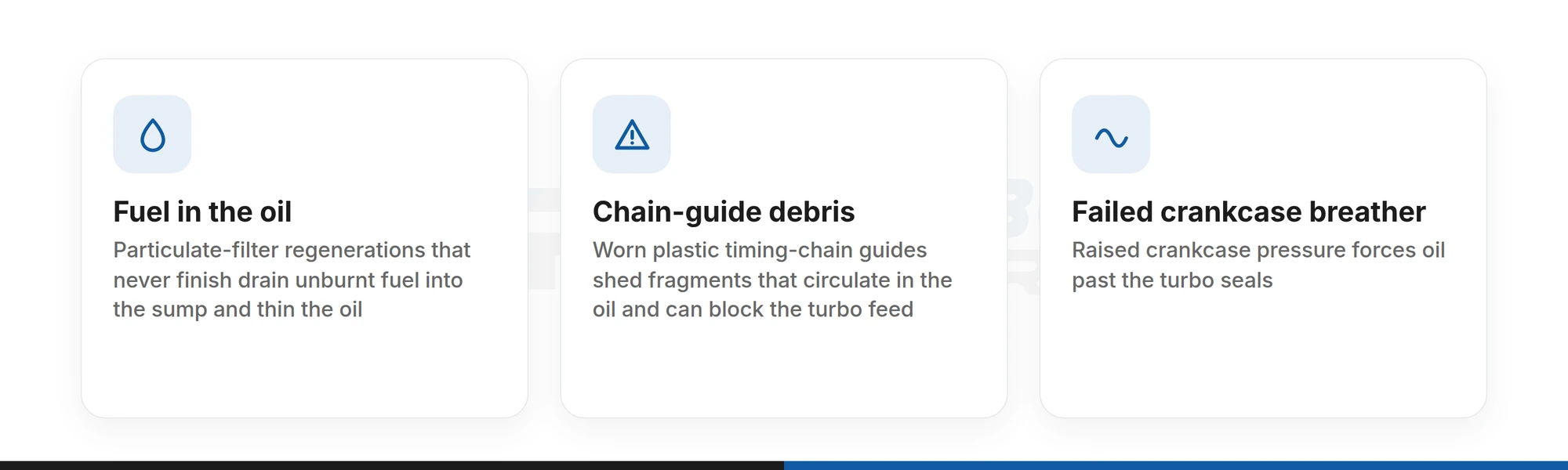
The garages ranking for Ingenium turbo failure are mostly engine specialists, and they agree on one point. On this engine the turbocharger is often not where the failure started. They name three routes by which the engine takes the turbo out, all through the oil the two share.
Fuel in the oil from unfinished regenerations
To clean its particulate filter, the engine injects extra fuel late in the combustion process to raise exhaust temperature. JLR specialists explain that on short journeys the regeneration starts but cannot finish, and the unburnt fuel drains into the sump. The oil thins, and the turbo bearings lose the protection they depend on.
Two specialists cite a Land Rover service notification under which the car brings its service warning forward when it detects dilution. One of them adds that on the transverse-engined models the filter sits under the car in cooler air, which makes a full regeneration harder to reach. A loading filter also raises the pressure the turbine has to discharge into. Our article on whether a blocked DPF can cause turbo failure covers that side of it.
Debris from the timing-chain guides
The Ingenium’s timing chain runs on plastic guides. Several specialists describe those guides wearing and shedding fragments that circulate in the oil, and one reports them blocking the turbo feed line. That makes a worn chain a threat to the turbo before the chain itself fails.
A failed crankcase breather
A blocked breather raises crankcase pressure, which forces oil past the turbo seals. Specialists treat it as a contributing cause rather than the whole story, but one that has to be checked, because it keeps working on whatever turbo is fitted next.
What that means for the repair
Each of these causes stays on the car when the turbocharger comes off. A rebuilt or new turbo bolted back onto diluted oil, a debris-laden sump or a blocked feed pipe runs in the same conditions that failed the first one, and one JLR workshop warns that fitting a turbo without clearing a blocked feed pipe will likely lead to the new unit failing early.
We rebuild turbochargers. The engine checks are work for your garage, and they are what decide whether a rebuilt turbo is worth fitting. If the engine shows chain debris or heavy dilution, that comes first, and a turbo can wait until the engine it bolts to is sound.
Checks Before the Turbo Comes Off
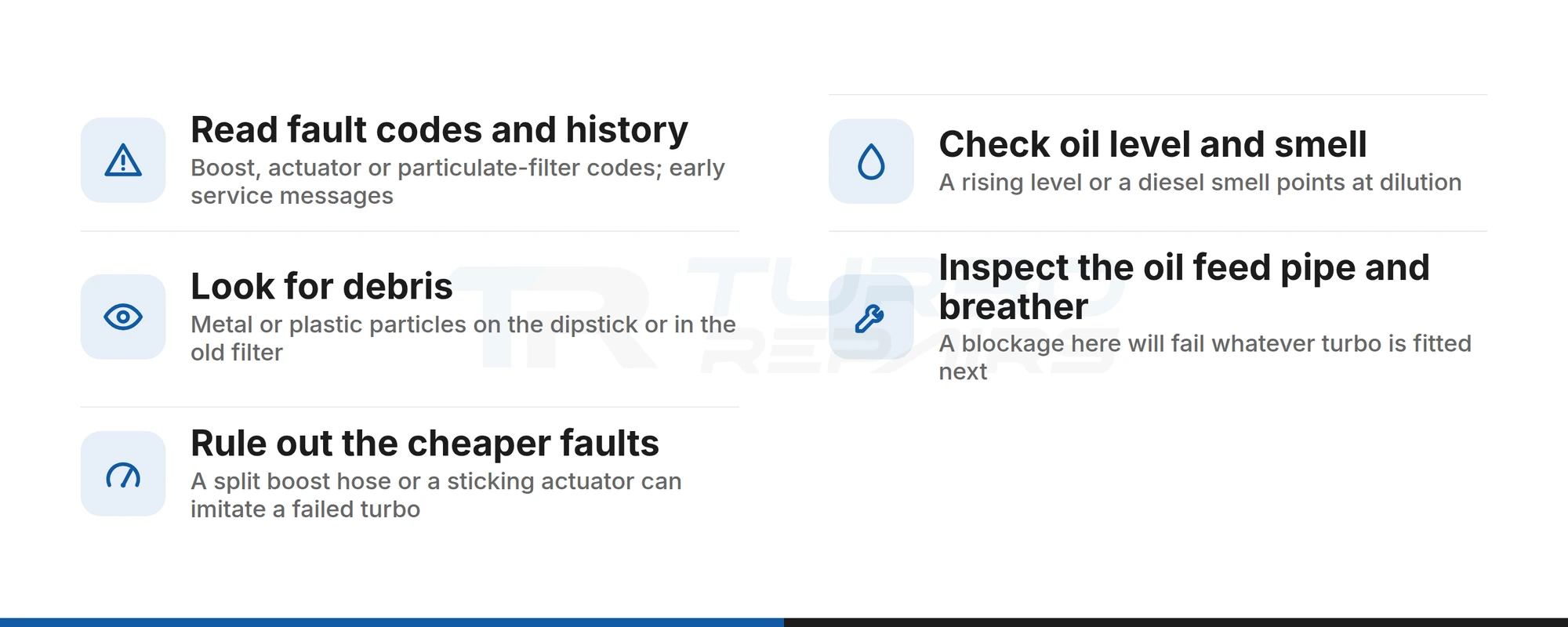
These checks are all made with the turbo still on the car, and most take minutes. They tell you whether the turbo failed on its own or the engine caused it, and what has to be put right before the turbo goes back on.
- Read the fault codes and the history. Note any boost, actuator or particulate-filter codes, and whether the car has shown repeated filter warnings or an early service message.
- Check the oil level and smell. A level that has risen between services, oil that looks thin or oil that smells of diesel all point at dilution.
- Look for debris. Metal or plastic particles on the dipstick, in the drained oil or in the old filter point at the timing-chain guides. Specialists also describe a metallic rattle for a few seconds after a cold start as an early sign of guide wear.
- Inspect the intake and intercooler. Oil in the pipework after the turbo means oil has been passing the seals. If it has reached the intercooler, one JLR workshop recommends replacing it rather than flushing it, because oil left inside can damage a new turbo straight away.
- Check the oil feed pipe and banjo fittings. A blocked feed pipe has to be found now. Replace the pipe and its banjo fittings if any contamination is suspected.
- Check the crankcase breather. A blocked breather keeps forcing oil past the seals of whatever turbo is fitted.
- Rule out the cheaper faults. A split boost hose, a leaking clamp or a sticking actuator can all imitate a failed turbo. The symptoms guide linked above lists them.
If the checks come back clean and the turbo is still whining or passing oil, the fault is most likely inside the unit, and it is a rebuild.
Rebuild Your Own Turbo or Fit a Replacement?
Most failed turbochargers can be rebuilt, because the parts that have usually gone are the ones designed to wear: bearings, seals and thrust components. A rebuild keeps your housings, wheels and shaft wherever they pass measurement and replaces what does not. Only when so many major parts are damaged that little of the original would be kept do we recommend a replacement unit, and we tell you so before any work goes ahead.
On this engine a rebuild also avoids a matching problem. The listings disagree about how many turbos the engine carries, and they use four engine codes for one engine, so ordering a unit from a description can go wrong. A rebuild returns the unit that came off your engine, whether it is the single turbo or one half of the pair.
What it costs
- Rebuild of your own turbocharger: from £185 + VAT.
- Replacement turbocharger: from £450 + VAT, a reconditioned or new exchange unit for when your own is not worth rebuilding.
- Electronic actuator repair on its own: from £100 + VAT, where the actuator is the only part that failed.
The exact price is confirmed after the strip-down, because it depends on what the unit needs. On the twin-turbo engine it also depends on whether one unit or both need work. Our turbo repair and replacement prices guide sets out the full range.
None of these figures includes taking the turbo off or refitting it. That labour varies by car: one JLR workshop notes that the turbo sits on the back of the engine on longitudinally mounted models and on the side on transverse ones, and that access is tight either way. Budget too for the parts the checks above call for: gaskets, oil and a filter, a feed pipe, and an intercooler if oil has reached it.
Turbo Repairs · Epsom workshop
Engine cleared? Send us the Ingenium turbo
Once your garage has ruled out dilution, chain debris and a blocked feed, post the turbocharger in with your registration, the car’s output and the reference from its label. We identify it, strip and measure it, and tell you what we found before any rebuild goes ahead.
Lifetime, unlimited-mileage warranty · Mail-in from the UK and internationally · Bench-tested and calibrated before it ships
Our Ingenium Turbo Rebuild
The work is carried out at our workshop at Unit 102 Reaver House, 12 East Street, Epsom, Surrey, KT17 1HX, United Kingdom, by a team of turbo specialists and engineers.
- Complete the repair form. Give us the registration, the model, the power output, any stored fault codes, what the car did when it failed, what the engine checks found, and the reference from the turbo’s label if you can read it.
- Remove the turbo and post it. Plug the oil and air openings, pack it in foam or bubble wrap inside a rigid box, and send it to us. Our FAQs page covers packing and postage.
- We identify it. The reference is checked against your registration and output, so the single turbo, the high-pressure unit or the low-pressure unit is settled before work starts.
- We strip and measure it. Every part is measured against original specification. We report what we found, including the state of the bearings and oil passages, and recommend a rebuild or a replacement before going ahead. That report gives your garage one more piece of evidence about what the oil has been doing.
- We rebuild it. Bearings, seals and thrust components are renewed, damaged parts are replaced with genuine OE or OEM-grade components, or uprated parts where the original has a known weakness, and the vane mechanism is cleaned and freed or renewed.
- We balance and test it. The rotating assembly is balanced and the unit is bench-tested before it is boxed and returned, ready to refit.
Bench time is typically one to three working days from the unit reaching us, plus postage each way. Every rebuild carries a lifetime, unlimited-mileage warranty, with no mileage cap and no time limit, and we accept units from anywhere in the UK and from overseas.
At refit
Fit the turbo to an engine that is ready for it. Clean the mating faces, flush the oil lines, fit new gaskets and sealing washers, and renew the oil and filter. Replace the intercooler if oil has reached it. Prime the oil supply before the engine runs. Our guide to refitting and priming a turbocharger sets out the procedure step by step.
After refit, the same JLR workshop recommends shorter oil-change intervals than the manufacturer’s schedule, an approved low-SAPS oil made for diesels with a particulate filter, and around 30 seconds of idle after a cold start and before switching off after a drive. Our guide on how long turbos last explains why those habits matter.
Ingenium Turbo FAQ
Why do Ingenium diesel turbos fail?
JLR specialists most often trace it to the oil supply: fuel dilution from particulate-filter regenerations that never finish, debris from worn timing-chain guides, a blocked oil feed pipe, or a crankcase breather fault forcing oil past the seals. Bearing and seal wear inside the turbo, and carbon sticking the vanes, also occur on their own.
Is my Ingenium diesel single-turbo or twin-turbo?
Remanufacturers list the 150 to 180 hp versions with one turbocharger and the 240 hp version from 2017 with two, a high-pressure and a low-pressure unit. Your V5C and the label on the unit confirm which you have.
Can I keep driving with a failing turbo?
No. One JLR workshop warns that driving on a failing turbo can cause further engine damage, including engine runaway, especially if oil is leaking internally or reaching the intercooler. If the car has gone into limp mode, have it checked before driving it further.
Do I need a new intercooler as well?
If the old turbo has passed oil into the intercooler, one JLR workshop recommends replacing it rather than flushing it, because oil left inside can damage the next turbo almost immediately. If the intake pipework is dry, it is less likely to be needed.
How much does an Ingenium turbo rebuild cost?
Rebuilding your own turbo starts from £185 + VAT, and a replacement unit from £450 + VAT. The exact price is confirmed once the unit has been stripped. Removal, refitting and any parts the engine checks call for are charged separately by your garage.
My Evoque or Discovery Sport has the 2.2 diesel. Is that covered here?
No. The 2.2 carries a different turbocharger and has its own page, linked in the first section above. Check the engine capacity on your V5C if you are not sure which engine you have.
How long does a rebuild take, and what is the warranty?
Bench time is typically one to three working days from arrival, plus postage each way. Every rebuild carries a lifetime, unlimited-mileage warranty with no time limit.
Final Thoughts
An Ingenium turbo that has failed is a question about the engine as much as the turbo. The JLR specialists writing about this engine agree that the oil the two share is where the trouble most often starts, and a turbo, rebuilt or new, is only as good as the oil it is fed.
So the order matters. Settle whether the car is a 2.0 or a 2.2 and whether it runs one turbo or two, clear the engine of dilution, debris and blocked oil feeds, and then send us the unit. The turbo that comes back is the one your engine was already running, rebuilt and tested, going onto an engine that is ready for it.
Turbo Repairs · Epsom workshop
Put a rebuilt turbo back on a sound Ingenium engine
Single turbo or one of the pair, send us the unit with your registration, output and label reference. It is stripped, measured and rebuilt on OE-grade parts, then balanced, bench-tested and returned ready to refit.
Lifetime, unlimited-mileage warranty · Mail-in from the UK and internationally · Bench-tested and calibrated before it ships