

Summary The Vauxhall Astra turbo replacement cost starts from £185 + VAT when your own turbocharger is rebuilt, and from £450 when a replacement unit is supplied instead. Removing and refitting it is charged separately by whoever does that work. The same starting prices apply to the Zafira, Meriva, Combo and Corsa with the 1.6, 1.7 or 1.9 CDTi.
Those three engines share a badge and very little else. Which one your car has decides which turbocharger it carries and what a symptom points to, but not what a rebuild costs. Every rebuild is bench-tested before it is returned, typically within one to three working days of arrival, and carries a lifetime, unlimited-mileage warranty.
Our fitment data files the 1.9 CDTi under Fiat’s JTD engine names and lists the 1.7’s engine on several rows simply as Isuzu.
This page is for owners of a Vauxhall Astra, Zafira or Meriva with the 1.6, 1.7 or 1.9 CDTi, and for the garages that look after them, when the car has lost boost, gone into limp mode, started smoking or begun to whistle, and the next question is what putting it right will cost. The Combo, Corsa, Mokka, Vectra and Signum appear wherever they share one of these engines. The 2.0 CDTi carries different turbochargers and is covered on our Vauxhall Insignia turbo repair page; the 1.3 CDTi has its own page.
- Engines covered: the 1.6, 1.7 and 1.9 CDTi, three separate engine lineages under one name
- Petrol, not diesel? The 1.4 Turbo petrol has its own page: Vauxhall 1.4 Turbo petrol turbo rebuild
- Cars covered: Astra, Zafira and Meriva, plus the Combo, the Corsa 1.7, the Mokka 1.6 and 1.7, and the Vectra and Signum 1.9
- Turbocharger makers in our fitment data: Mitsubishi and Garrett on the 1.7, Garrett on the 1.9 (a Garrett GT1749V / GTA1749MV), BorgWarner and Garrett on the 1.6
- Price: rebuilding your own turbocharger from £185 + VAT; a replacement turbocharger from £450; electronic actuator repairs from £100 + VAT where that proves to be the fault
- Know your year and power output? Each model has its own rebuild listing, linked in the table below, which shows the price for your car before you order
- Turnaround: typically one to three working days on the bench, plus postage each way
- Warranty: lifetime and unlimited mileage, with no time limit
Three CDTi Engines, Three Different Origins: 1.6, 1.7 and 1.9
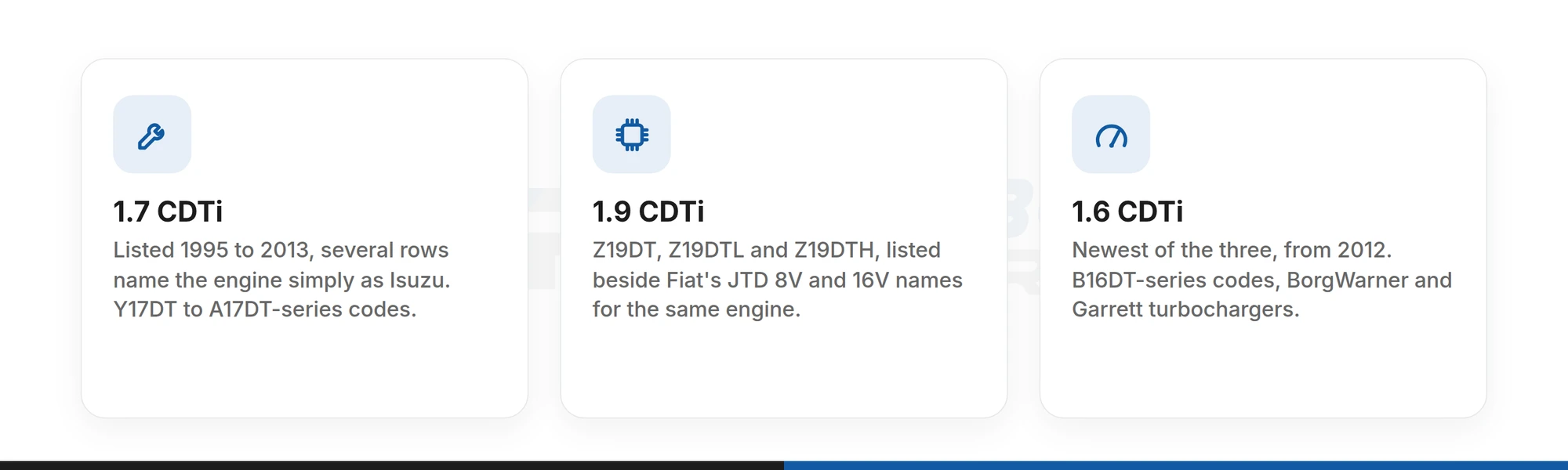
Vauxhall put the CDTi name on every small diesel in this range, but the name is where the family resemblance stops. The fitment data behind our rebuild listings shows three separate engine lineages under it, each with its own engine codes and its own turbochargers, and not one turbocharger reference in common between them.
The 1.7 CDTi: listed as Isuzu
The 1.7 is the longest-running of the three. Our Astra 1.7 listing catalogues it from 1995 to 2013 at outputs between 67 and 129 bhp, and on several of its rows the fitment data gives no Vauxhall engine code at all: it names the engine as Isuzu. The same entry appears on our Corsa, Meriva and Combo 1.7 listings.
Where Vauxhall codes do appear, they fall into three generations: the Y17DT and Z17DTL, then the Z17DTH, then the Z17DTJ, Z17DTR and A17DT-series codes such as the A17DTR and A17DTS. Each generation is catalogued with a different family of turbocharger, which is why a 1.7 Astra from one end of that span has so little in common with one from the other.
The 1.9 CDTi: the JTD engine shared with Fiat
The 1.9 is catalogued on the Astra, Zafira, Vectra and Signum. Its Vauxhall codes, Z19DT, Z19DTL and Z19DTH, are listed side by side with Fiat’s own names for the same engine, 1.9 JTD 16V and JTD 8V. Trade listings sell one of its turbochargers for the Fiat Bravo and Croma and the Suzuki SX4 as well as for the Astra, Vectra and Zafira.
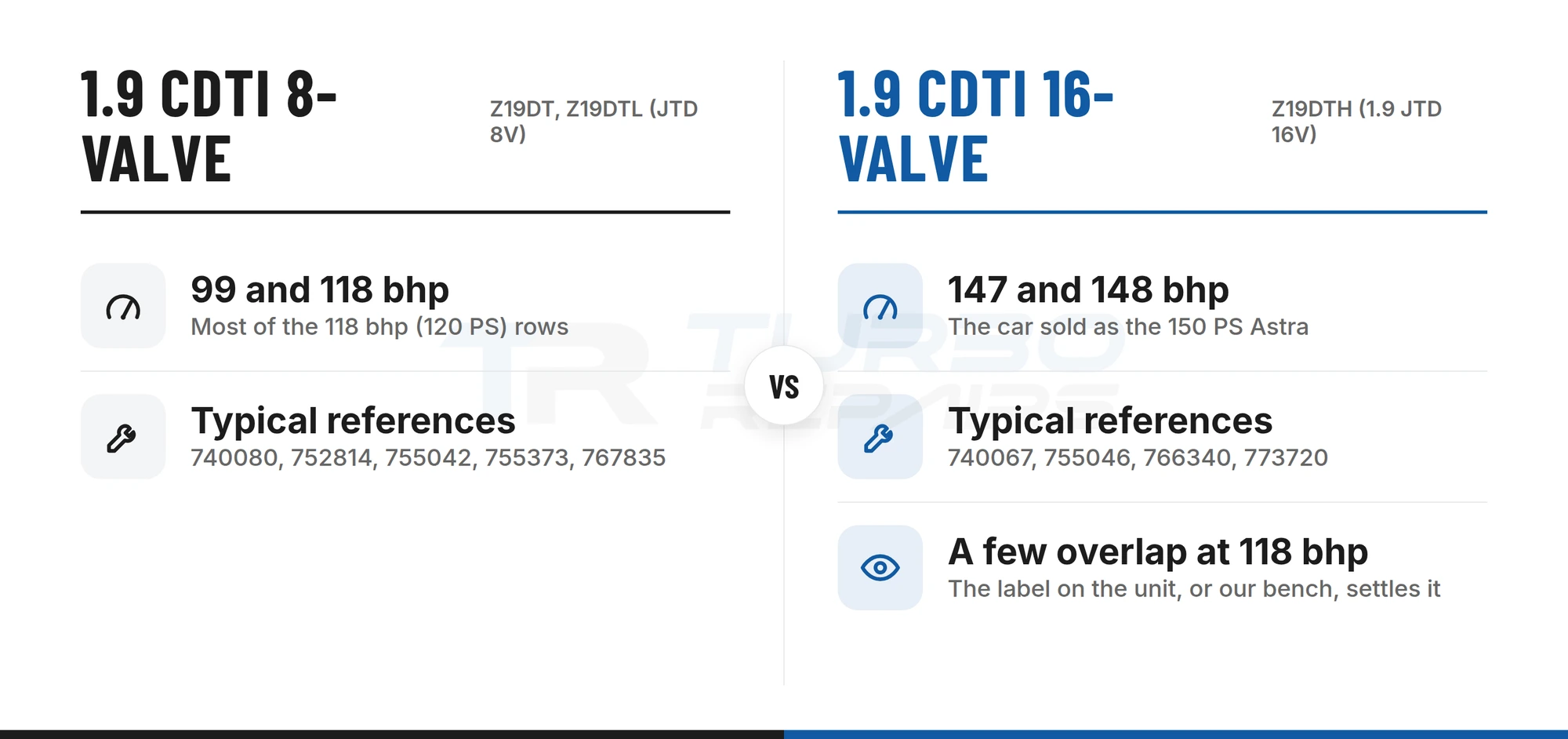
The catalogued outputs are 99, 118, 147 and 148 bhp. Because 150 PS is about 148 bhp, the car sold as the Astra 1.9 CDTi 150 is the one catalogued at 147 to 148 bhp, where the Z19DTH engine code appears. Most of the 99 and 118 bhp rows are the 8-valve engine, listed as Z19DT, Z19DTL or JTD 8V, although a few 16-valve references are catalogued at 118 bhp as well.
The 1.6 CDTi: the newest of the three
The 1.6 arrives in our listings from 2012 on the Astra, Zafira and Mokka and from 2013 on the Meriva, under B16DT-series engine codes, with the A16DTH also listed on the Mokka. Neither Isuzu nor JTD appears anywhere in its data. Its turbochargers come from two makers, BorgWarner and Garrett, and the 158 bhp B16DTR on the Astra is a twin-turbo engine, sold in the trade as a BiTurbo assembly.
The Combo 1.6 CDTi needs watching. Its listing shows A16FDH and 940C-series engine codes rather than B16DT, which makes it a different engine from the Astra 1.6 despite the matching badge and displacement, with turbochargers of its own.
The practical result is that the displacement tells you more than the model name does. A 1.7 Astra and a 1.7 Meriva share engine codes and turbocharger references; a 1.7 Astra and a 1.9 Astra share neither.
Which Turbocharger Your CDTi Carries
The table groups the turbochargers in our fitment data by engine generation rather than by car. The years on each listing are the years a unit is catalogued against, not the production dates of the car, and the part numbers year by year sit on the listing itself.
| Engine | Engine codes | Catalogued outputs | Turbocharger | Our rebuild listings |
|---|---|---|---|---|
| 1.7, early | Y17DT, Z17DTL | 64 to 80 bhp | Mitsubishi TD025M, references beginning 49173 | Astra 1.7, Corsa 1.7, Meriva 1.7, Combo 1.7 |
| 1.7, middle | Z17DTH | 99 to 101 bhp | Mitsubishi TD03L4, variable geometry, references beginning 49131 | |
| 1.7, later | Z17DTJ, Z17DTR, A17DT-series | 99 to 129 bhp | Garrett references in the 779591 and 789533 series; one unit listed only under the code VIFC | Astra 1.7, Zafira 1.7, Meriva 1.7, Mokka 1.7 |
| 1.9, 8-valve | Z19DT, Z19DTL (JTD 8V) | 99, 118 bhp | 740080, 752814, 755042, 755373, 767835 | Astra 1.9, Zafira 1.9, Vectra 1.9, Signum 1.9 |
| 1.9, 16-valve | Z19DTH, M741 DTH (1.9 JTD 16V) | 147, 148 bhp; some references also at 118 | 740067, 755046, 766340, 773720 | |
| 1.6 | B16DT-series; A16DTH on the Mokka | 94 to 136 bhp | BorgWarner references beginning 5438-970, one of which the trade sells as the BV38; Garrett 814698, the GT1241SZ | Astra 1.6, Zafira 1.6, Meriva 1.6, Mokka 1.6 |
| 1.6 BiTurbo | B16DTR | 158 bhp | Twin-turbo assembly, references 823540 and 823559 | Astra 1.6 |
| Combo 1.6 | A16FDH, 940C-series | 89 to 118 bhp | BorgWarner and Garrett units of its own | Combo 1.6 |
To use it, start from the displacement, then the engine code if you know it, then the power output. Your V5C logbook gives the output in kilowatts at section P.2, and one kilowatt is about 1.34 bhp. If your car falls in a row with several references, or the label on the unit is unreadable, you do not have to settle it before ordering: every unit is identified on the bench before any work starts.
The references beginning 49 on the 1.7 are Mitsubishi numbers. Our Mitsubishi MHI turbo repair page explains what the first block of those numbers tells you.
What Fails on a CDTi Turbo
Whatever the lineage, every turbocharger in that table is built the same way at its core. A turbine wheel in the exhaust and a compressor wheel in the intake share one shaft, which spins in bearings fed by engine oil inside a centre housing, with a seal at each end. That shared layout is why the faults recorded against all three engines on our listings read so alike.
- Worn bearings and shaft play. Oil that arrives late, thin or dirty wears the bearings first. The shaft then moves further than it should, and a wheel that touches its housing chips its blades.
- Failed seals. Once the shaft wanders, the seals stop keeping oil inside the centre housing. It leaves as blue or grey exhaust smoke, or collects in the intercooler pipes.
- Compressor damage. Grit that gets past a split intake hose or a badly seated air filter strikes the compressor blades at full speed.
- Boost control faults. Sticking vanes on a variable-geometry unit, or a sticking wastegate, make boost arrive late, drop out or spike, often with P0299 (underboost) or P0234 (overboost) stored.
Nearly all of these begin outside the turbocharger. A carboned oil feed pipe, a slow-draining return line, stretched oil-change intervals or an intake leak will wear a rebuilt or new unit exactly as they wore the old one, so the cause has to be found and put right on the car before the turbocharger goes back on. Our guide to turbo failure symptoms sorts each sign by where in the unit it starts.
Why the Same Symptom Means Different Things on Each Engine
A symptom tells you which system has a problem. Which parts in that system are suspects depends on the engine, because the three lineages do not carry the same hardware. Three symptoms show how far apart they sit.
Boost that comes and goes
On the 1.7 Z17DTH, the catalogued TD03L4 is a variable-geometry unit, so a boost fault that clears after a restart points first to its vane mechanism stiffening with carbon rather than to a worn rotating assembly. Our guide to variable-vane turbos explains why a fault that keeps clearing is progressing rather than recovering. On the 158 bhp 1.6 BiTurbo the same complaint has twice the suspects: either of two turbochargers, and the hardware that joins them.
For the other engines our listings do not state the boost-control type, so we do not guess at it here. It is established on the bench from the unit itself. In the meantime, our guide to overboost and underboost codes explains what a stored code can and cannot tell you.
A turbocharger that has clearly failed
When the shaft has visible play or oil is running into the intercooler, the question moves from diagnosis to replacement, and here the engines part company. A later 1.7 at 109 or 123 bhp is catalogued with several Garrett references across the same years. A 1.9 at 118 bhp can carry an 8-valve or a 16-valve reference. A 1.6 at 94, 109 or 134 bhp is listed with a BorgWarner unit and a Garrett unit for the same years.
None of that affects a rebuild, because the unit that goes back is the one that came off. It matters a great deal to anyone buying a replacement, since the right part is the one on your label, not the one most often sold for the model.
A whistle that rises with boost
This is the one symptom that reads the same on every engine here. It points to air escaping from the pressurised side through a split hose or a loose joint, or to bearing wear letting a wheel run out of true, and a loaded road test separates the two better than a look under the bonnet. Our guide to diagnosing a turbo whistle sorts the noises by what they follow.
What a Vauxhall Astra Turbo Replacement Costs
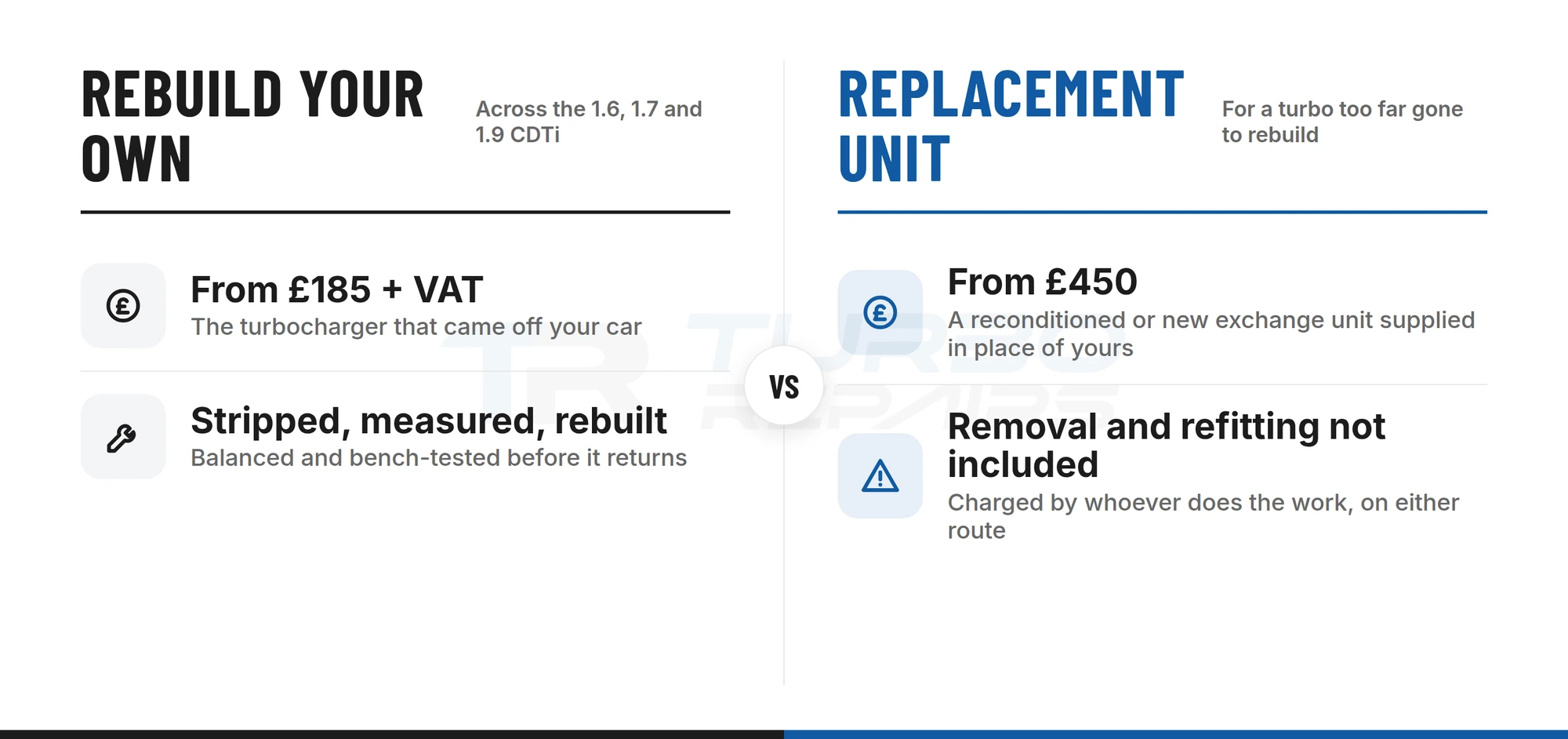
For the turbocharger itself, the answer is the same across all three CDTi engines and every car on this page.
| Route | Price with us | What it covers |
|---|---|---|
| Rebuild of your own turbocharger | From £185 + VAT | The unit that came off your car, stripped, measured, rebuilt, balanced and bench-tested |
| Replacement turbocharger | From £450 | A reconditioned or new exchange unit supplied in place of yours, for a turbo too far gone to rebuild |
| Electronic actuator repair | From £100 + VAT | Only where the fault proves to be an electronic actuator rather than the turbocharger |
| Removal and refitting | Not included | Charged by whoever does the work on the car, and the same job whichever route you choose |
Our guide to turbo repair and replacement prices sets rebuild prices by vehicle class: £185 to £285 for small cars such as the Fiesta and Polo, and £185 to £350 for mid-size cars such as the 3 Series and A3, excluding VAT. A Corsa sits with the first group, an Astra or Zafira with the second. Where your car has a rebuild listing, that listing shows the price for your year and power output before you order.
What moves a rebuild up its range
Bearings, thrust parts and seals are renewed on every rebuild, and those alone are what the starting price covers. A compressor wheel chipped by debris, a shaft scored by a failing bearing or a housing that no longer measures true adds to the work. The price is confirmed once the unit has been stripped and measured, before anything further is done, and if so little survives that a rebuild stops making sense, we tell you so and a replacement becomes the better buy.
Why the quotes you see vary so widely
Figures published for a Vauxhall turbo replacement rarely price the same thing. Some are for a turbocharger alone, some include a garage’s labour to fit it, and some are averages taken across every Vauxhall engine rather than the one in your car. A quote that bundles a new unit with fitting will always sit well above one for the turbocharger alone, even when the fitting labour behind both is identical.
Two costs belong in every comparison and rarely appear in the headline figure. The first is the labour to take the unit off and put it back, which is the same job whichever route you choose. The second is putting right whatever wore the old turbocharger out: at the least, new oil feed and return lines and fresh oil and filter, which a rebuilt unit and a new one need alike.
Turbo Repairs · Epsom workshop
1.6, 1.7 or 1.9 CDTi, the rebuild starts at the same price
Send the turbocharger that came off your Astra, Zafira or Meriva and it is identified, stripped and measured before any price above the starting figure is confirmed. You hear whether it is worth rebuilding before any work is done.
Lifetime, unlimited-mileage warranty · Mail-in from the UK and internationally · Bench-tested and calibrated before it ships
Our Vauxhall CDTi Turbo Rebuild
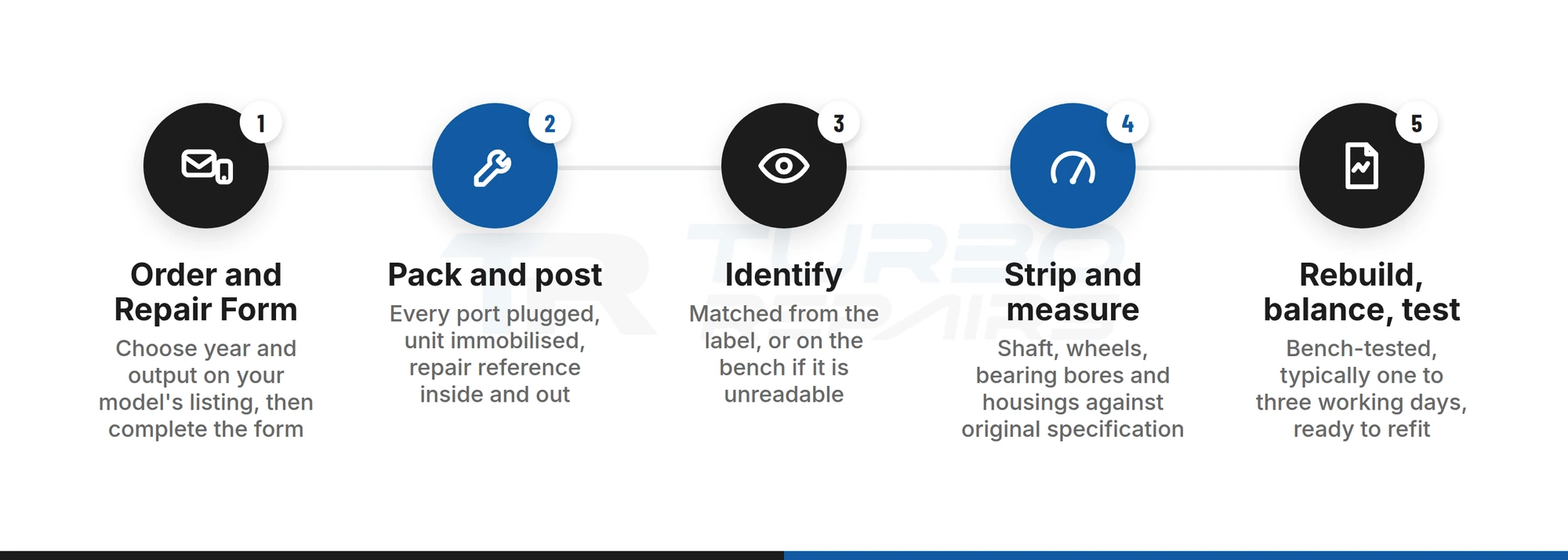
You, or the garage that looks after the car, take the turbocharger off and send it to us at Unit 102 Reaver House, 12 East Street, Epsom, Surrey, KT17 1HX, United Kingdom. Independent garages send units in for their customers’ cars the same way. From there, our turbocharger rebuild service runs in this order.
- Order from your model’s listing, then complete the Repair Form. On the listing, choose your year and power output and the price follows; choose “Not sure” if you do not know the output. Then complete the online Repair Form with the registration, the engine code if you have it, the mileage, the symptoms, any stored fault codes and every number on the turbocharger’s label.
- Pack and post it. Plug or tape every port, pack the unit so it cannot move, and write your repair reference inside and outside the box. Our FAQs page covers packing and postage, and our guide to refitting and priming a turbocharger covers the work on the car.
- Identified before it is opened. The unit is matched to its reference from the label, or on the bench where the label is unreadable, so a 1.9 at 118 bhp or a 1.6 with two possible makers is settled on the unit itself.
- Stripped and measured. Turbo specialists strip it to component level and measure the shaft, wheels, bearing bores and housings against original specification.
- Rebuilt. Bearings, thrust parts and seals are renewed with genuine OE or OEM-grade components that meet or exceed the original, and a part with a known design weakness is uprated rather than put back. On a variable-geometry unit, the vane mechanism is cleaned and freed where it is sound and renewed where it is worn.
- Balanced and bench-tested. The rotating assembly is balanced, and the unit is run on the bench before it is boxed and returned, ready to refit.
Bench time is typically one to three working days from arrival, with postage each way on top, and every rebuild carries a lifetime, unlimited-mileage warranty. On refitting, renew the oil feed and return lines rather than reusing them, and prime the oil supply before the engine runs as our refitting guide sets out, so the new bearings never turn dry.
Vauxhall CDTi Turbo FAQ
Is the Vauxhall 1.9 CDTi a Fiat engine?
Our fitment data lists its Vauxhall codes, Z19DT, Z19DTL and Z19DTH, alongside Fiat’s JTD names for the same engine, and trade listings sell one of its turbochargers for the Fiat Bravo and Croma as well as the Astra, Vectra and Zafira. The Vivaro 1.9 is the exception: its listing carries F9Q engine codes, a different engine altogether, which is covered on our Trafic and Vivaro turbo repair page.
Does the Astra 1.9 CDTi 150 use the same turbo as the 120?
Usually not. 150 PS is about 148 bhp and 120 PS about 118 bhp. The 147 to 148 bhp cars are catalogued with 16-valve references such as 755046, 766340 and 773720, while most 118 bhp cars carry 8-valve references such as 740080 and 767835. A few 16-valve references are listed at 118 bhp too, so the label on your unit, or our bench, settles it. The Astra 1.9 CDTi listing takes your year and output.
How much does a Vauxhall Zafira turbo replacement cost?
The same as the Astra: rebuilding your own turbocharger from £185 + VAT, or a replacement turbocharger from £450, with removal and refitting charged separately. The Zafira 1.7, Zafira 1.9 and Zafira 1.6 CDTi listings show the rebuild price for your year and power output.
Which turbo is on my Astra 1.7 CDTi?
It depends on the engine generation. The Y17DT and Z17DTL are catalogued with the Mitsubishi TD025M, the Z17DTH with the variable-geometry Mitsubishi TD03L4, and the later Z17DTJ, Z17DTR and A17DT-series engines with Garrett references. Our Astra 1.7 CDTi listing covers 22 different part numbers, so choose your year and output there and we confirm the unit when it arrives.
Do you rebuild the 1.3 and 2.0 CDTi turbos?
Yes, although they carry different turbochargers and are not covered on this page. The 2.0 CDTi is covered on our Vauxhall Insignia turbo repair page. For the 1.3, or any other Vauxhall diesel, complete the Repair Form with the numbers from the label and we identify the unit when it arrives.
How long will my car be off the road?
Bench time is typically one to three working days from the day the unit arrives, plus postage in each direction and the time it takes to remove and refit it. The rebuilt turbocharger comes back ready to refit, with a lifetime, unlimited-mileage warranty.
Final Thoughts
The CDTi badge on an Astra, Zafira or Meriva covers three engines that were never one family: a 1.7 the fitment data lists as Isuzu, a 1.9 filed under Fiat’s JTD names, and a newer 1.6 with turbochargers from two makers. Knowing which one you have tells you what to suspect when boost goes missing, and which part number a replacement would have to match.
It does not change what the turbocharger costs to put right. A rebuild starts from £185 + VAT on all three, and because the unit that goes back on is the one that came off, the question of which reference you own is answered on the bench rather than bought on trust. Find what wore the old one out first, and the rebuilt unit starts its second life on equal terms.
Turbo Repairs · Epsom workshop
Three CDTi engines, one route to the right turbo
Choose your model’s listing or complete the Repair Form, then send the turbocharger in as it came off the car. It is identified, rebuilt, balanced and bench-tested, then returned ready to refit.
Lifetime, unlimited-mileage warranty · Mail-in from the UK and internationally · Bench-tested and calibrated before it ships