

Summary We rebuild the turbochargers from the Peugeot Boxer, Citroën Relay and Fiat Ducato built from 2006 onwards, on their 2.0, 2.2, 2.3 and 3.0 diesels, whether the vehicle works as a van, a minibus or a motorhome. You send the unit in; it is stripped to component level, rebuilt on genuine OE or OEM-grade parts, balanced and bench-tested, then posted back ready to refit. Rebuilds start from £185 plus VAT and replacement units from £450 plus VAT, bench time is typically one to three working days, and every rebuild carries a lifetime, unlimited-mileage warranty.
The three badges share one body but not one vocabulary. Each applies its own maker’s name to the engine, so the reliable way to identify the turbocharger is the label on the unit rather than the name on the tailgate.
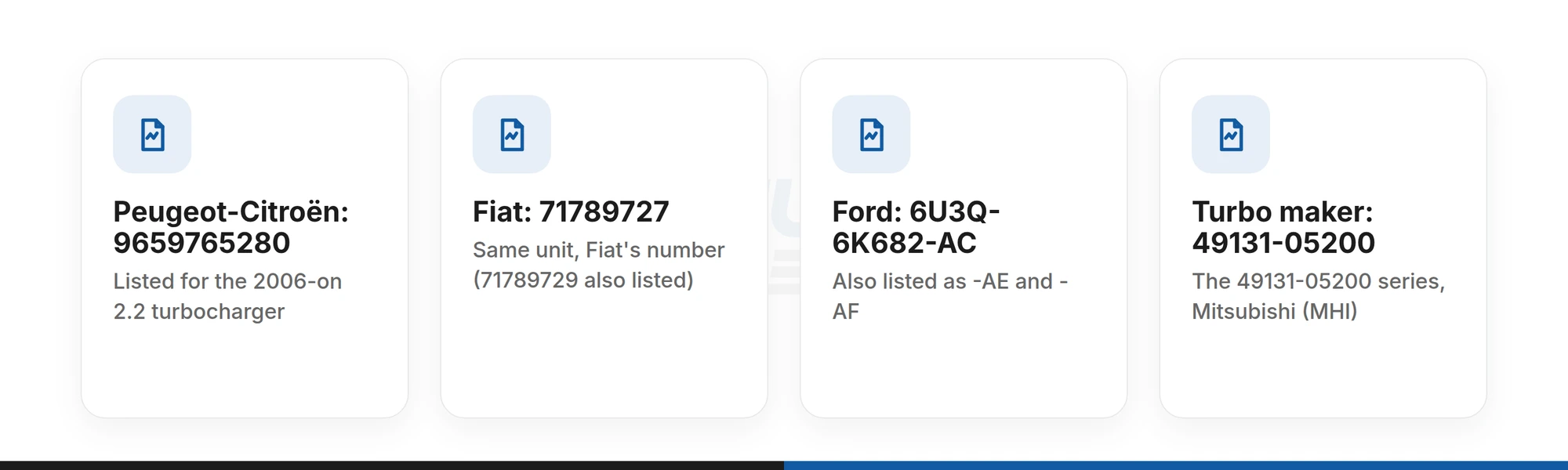
One parts listing for the 2006-on 2.2 turbocharger cross-references it to a Peugeot-Citroën number (9659765280), a Fiat number (71789727) and a Ford number (6U3Q-6K682-AC): three carmakers’ part numbers for a single turbo.
This page is for owners, fleet operators and garages with a Boxer, Relay or Ducato built from 2006 onwards, and for anyone whose motorhome is built on one. It covers which engine you have, which turbochargers are listed against it, what a motorhome asks of its turbo that a van does not, and what a rebuild or a replacement costs.
- Vehicles covered: the Peugeot Boxer, Citroën Relay (listed as the Jumper outside the UK) and Fiat Ducato from 2006, as vans, buses, platform cabs and chassis cabs, including the motorhomes built on them
- Engines: the 2.2 (HDi in the Boxer and Relay, Multijet in the Ducato), the later 2.0 and 2.2 in the Boxer and Relay, the 2.3 Multijet and the 3.0
- Identify it by: the reference on the turbocharger’s own label, which may be in Peugeot-Citroën, Fiat, Ford or turbo-maker numbering
- Price: rebuilds from £185 plus VAT; replacement units from £450 plus VAT; actuator-only repairs from £100 plus VAT
- Turnaround: typically one to three working days on the bench, plus postage each way
- Warranty: lifetime and unlimited mileage, with no time limit
- Relay or Boxer built before 2006: a different generation, covered with the older Relay and Jumper engines
Which Engine Is in Your Boxer, Relay or Ducato?
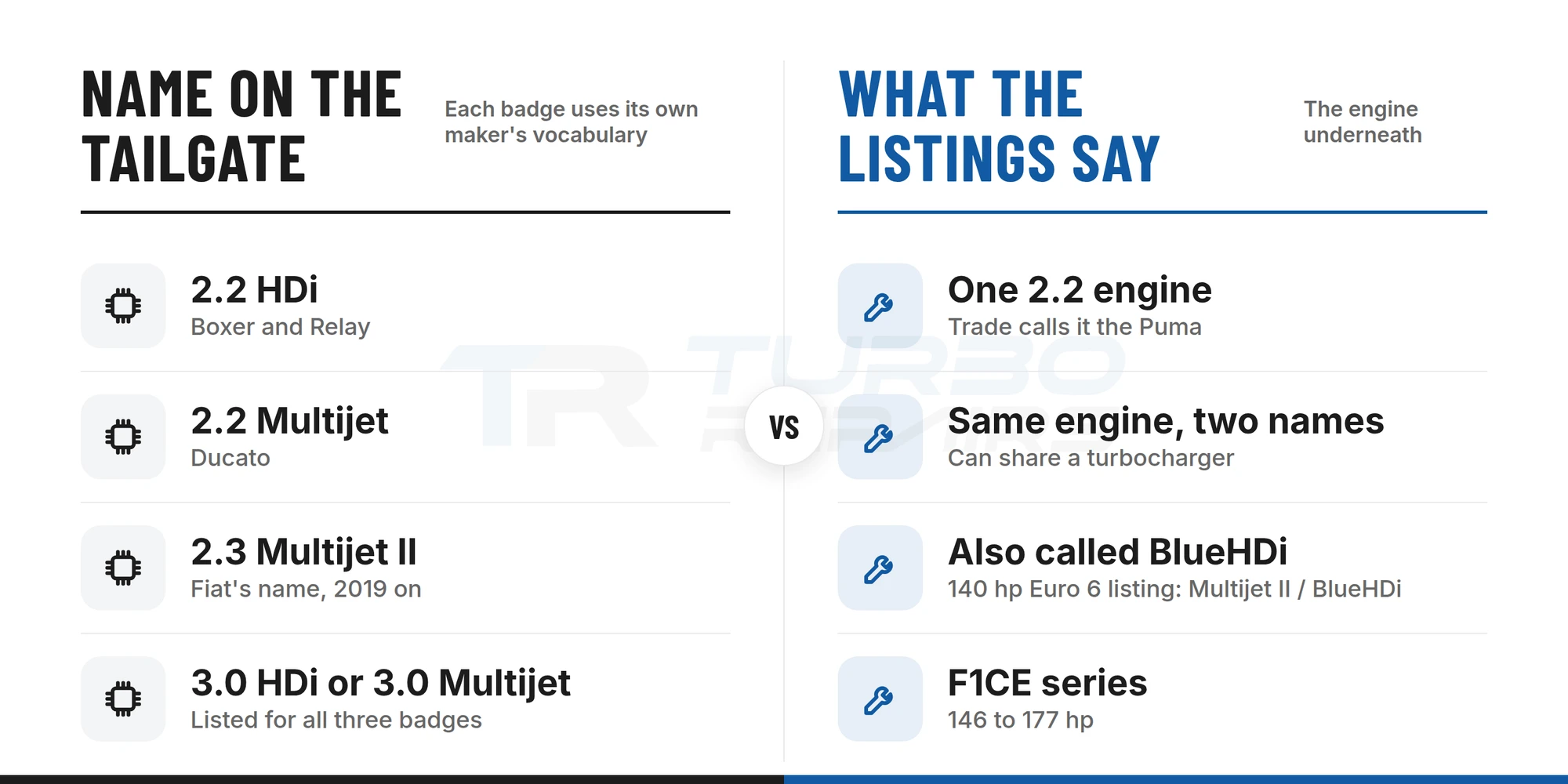
From 2006 the Boxer, Relay and Ducato are one vehicle wearing three badges, and the turbocharger trade lists them side by side, often with the Relay under its continental name, Jumper. What the trade does not do is give the engines a single name. Each badge carries its own maker’s engine vocabulary, whoever designed the engine underneath.
- The 2.2. Sold as the 2.2 HDi in the Boxer and Relay and as the 2.2 Multijet in the Ducato, this is one engine, which the parts trade calls the Puma. It is the Ford-family 2.2 also fitted to the Transit, and one listing gives it to the Ducato from 2006 to 2014 and to the Boxer and Relay from 2006 onwards.
- The later 2.0 and 2.2. From 2014, the Boxer and Relay listings add Peugeot-Citroën’s own DW10 and DW12 engines in Euro 6 form. The Ducato is not listed against them.
- The 2.3. Multijet is Fiat’s name, and the 2.3 Multijet is listed across Ducato vans, buses and platform or chassis cabs. It is listed in the Boxer and Relay too, and one listing for the 140 hp Euro 6 version from 2019 calls it “Multijet II / BlueHDi”: a Fiat name and a Peugeot-Citroën name for the same engine.
- The 3.0. Listed for all three badges as the 3.0 HDi or 3.0 Multijet, at 146 to 177 hp, on the F1CE-series engine.
So the engine name on the tailgate tells you who sold the vehicle, not who made the engine. A Ducato 2.2 Multijet and a Boxer 2.2 HDi can share a turbocharger, while a Boxer on the later 2.0 and a Boxer on the 2.3 do not. Start from the cylinder capacity and power output on the V5C, then let the label on the turbocharger settle it. If your van is the 2.2, our Ford Transit turbo rebuild page covers the Transit’s version of the related Puma engine.
On a motorhome
A coachbuilt motorhome carries two names: the base vehicle’s badge on the cab and the converter’s name on the habitation body. Only the base vehicle’s engine matters to the turbocharger, so tell us both. If you are not sure which engine it has, the cylinder capacity and power on the V5C and a photograph of the turbo’s label are enough to start.
Earlier vans
A Relay or Boxer built before 2006, on the 2.0 or 2.8 HDi, is an earlier generation with different turbochargers, and our Citroën page covers those older Relay and Jumper engines. Earlier Ducatos come in through the same Repair Form; everything below concerns the 2006-on vehicle.
The Turbochargers by Engine: 2.2 HDi, 2.3 Multijet and 3.0
These are the references listed against the 2006-on vehicle in the parts listings we have read. Every engine carries more than one, changing with output and year, and one listing for the 2.2 warns that more than one option can be fitted to these vehicles.
| Engine | Badges listed | Output listed | Turbocharger references listed |
|---|---|---|---|
| 2.2 HDi / 2.2 Multijet (Puma), 2006 on | Boxer and Relay; Ducato 2006 to 2014 | Ducato listed as the 2.2 100 Multijet | 49131-05200, 49131-05210, 49131-05211, 49131-05212 |
| 2.2 HDi | Ducato, Boxer, Jumper | 110 to 150 hp | 798128 (-0002, -0004, -5002S, -5004S, -5006S), with OE numbers 9802446680 and 9676934380 |
| 2.0 and 2.2 HDi (DW10, DW12), Euro 6, 2014 on | Boxer, Jumper | 110 to 165 hp | 53039700521 |
| 2.3 Multijet | Ducato van, bus and platform or chassis cab; selected Boxer and Jumper 2.3 | 160 to 177 hp | 879542 (879542-0004) |
| 2.3 Multijet II / BlueHDi, Euro 6, 2019 on | Boxer, Jumper, Ducato | 140 hp | 877674 (877674-0003) |
| 3.0 HDi / Multijet (F1CE series) | Boxer, Relay, Ducato, including bus, van and platform-chassis versions | 146 to 177 hp | 796122 (-0001, -0005, -0007, -0010) |
One turbo, four kinds of number
Because three carmakers sell this vehicle and a fourth company builds the turbocharger, the same unit can be quoted under very different numbers. The listing for the 2006-on 2.2 cross-references its turbo to Peugeot-Citroën 9659765280, Fiat 71789727 and 71789729, Ford 6U3Q-6K682-AC, -AE and -AF, and to the turbo maker’s 49131-05200 series, all at once.
Two practical consequences follow. A quote in Fiat numbering and a label in Peugeot-Citroën numbering are not, on their own, a mismatch. And two suppliers quoting different numbers may be offering the same unit or two different ones, because the 2.2 is listed with more than one option. The reference on your own unit is the one number that is certainly right for your vehicle.
References beginning 49 belong to Mitsubishi (MHI) turbochargers, and our page on Mitsubishi MHI turbochargers explains how those labels read. On the 2.3, notice the word “selected” in the table: the 879542 listing is written first for the Ducato 250 range, with cross-fitment confirmed only for selected Boxer and Jumper 2.3 applications. That is a reason to check the label, not to assume a match.
Photograph the label before the unit is cleaned or packed, and put every number on it onto the Repair Form, whichever maker’s system it is in. If the label has burned off or cannot be read, send the turbo anyway: it is identified on the bench before any work starts.
Motorhome Duty: Heavy Loads, Low Mileage and Long Lay-Ups
This vehicle is built as a platform cab and a chassis cab as well as a van, and the turbo listings name those versions alongside the van and bus. Those cabs are what a coachbuilder turns into a motorhome. The turbocharger cannot tell the difference, but the way a motorhome is used changes what it goes through, in three ways a working van rarely combines.
A load that never comes off
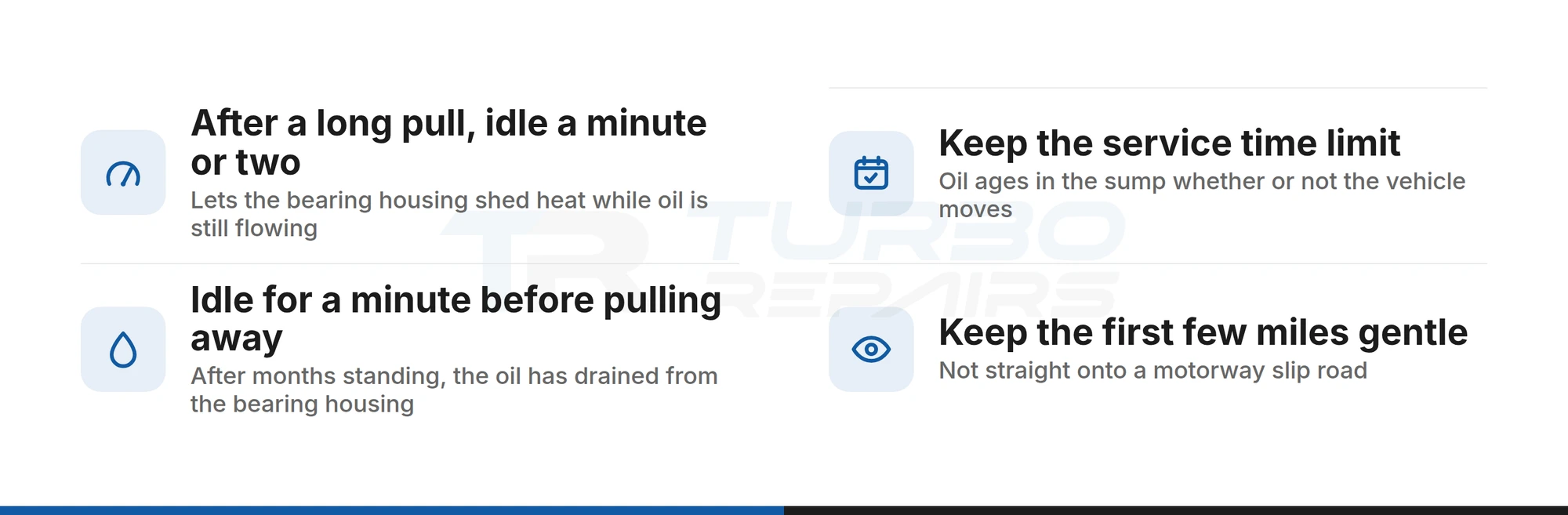
A van runs empty on some journeys. A coachbuilt motorhome carries its habitation body, water, gas and belongings on every one of them, so the engine meets every gradient close to its plated weight and the turbocharger spends long stretches at high boost with the exhaust at its hottest. After a long pull up to a site or over a pass, give the engine a minute or two at idle before switching off, so the bearing housing sheds heat while oil is still flowing through it.
Few miles, ageing oil
If your motorhome covers a small annual mileage, the time limit in its service schedule will fall due before the mileage limit does, and it is the one to keep. Oil ages in the sump whether or not the vehicle moves, and the turbocharger’s bearings run on whatever oil the engine holds. A low odometer reading on a motorhome describes how far it has travelled, not how long its oil has been in the engine.
Months standing still
While the vehicle stands, oil drains out of the turbo’s bearing housing and back to the sump, so the first start of the season turns the shaft on the thinnest oil film it will see all year. Let the engine idle for a minute before you pull away, and keep the first few miles gentle rather than heading straight for a motorway slip road.
A season made up of short hops, from the site to the shop and back, rarely brings the exhaust side up to full heat. On a turbocharger with variable vanes, that is the pattern that lets carbon build on the vane mechanism, which our guide to why variable-vane turbos stick explains. The general factors that decide how long any turbo lasts are set out in our guide to turbo life.
If the turbo fails on a trip, the vehicle itself does not need to reach us. Once a garage near you has removed the unit, it can be posted from wherever you are, in the UK or abroad, and we post it back rebuilt and ready to refit. Tell us on the Repair Form how long the motorhome had stood before the fault appeared, because it helps us read what the strip shows.
What Fails on These Van Turbos
Whichever engine is fitted, the turbocharger is a shaft carrying two wheels, turning on engine oil inside a sealed bearing housing, with a mechanism that controls boost. The faults we see on these vehicles follow from that design, and usually in this order:
- The oil film fails. Starved or contaminated oil wears the bearings first, and nearly everything else follows from that wear.
- Oil passes the seals. Once the shaft has play, oil escapes into the intercooler pipework on one side and the exhaust on the other, showing as oily boost hoses or blue smoke.
- A wheel touches its housing. With enough play, the compressor or turbine blades rub, producing a rising whine or siren, and fragments can travel into the intercooler or the exhaust.
- Boost control stops following commands. Carbon on the boost-control mechanism, or a fault in whatever drives it, shows as lost power, limp mode and boost fault codes.
Several cheaper faults can imitate a failing turbocharger, split boost hoses among them. Our guide to turbo failure symptoms sorts each symptom by where in the unit it starts and lists the imitators to rule out first.
Turbo or actuator?
If your turbocharger carries an electronic actuator and the mechanism it drives moves through its full travel with the actuator detached, the actuator alone may be at fault. That is a separate repair, from £100 plus VAT, and the turbo can stay on the vehicle; our electronic turbo actuator repairs section explains how it works. A stiff or seized mechanism means the turbocharger itself needs rebuilding.
What to put right on the vehicle
Several of those failures leave something behind on the vehicle, and a rebuilt turbo fitted without dealing with it inherits the problem. Before any unit goes back on, the oil feed and drain lines should be checked or renewed, the intercooler and boost pipes cleaned of oil and any fragments, the air filter and intake checked, and the oil and filter changed.
On the 2.2, the fitting instruction reported to UK workshops for the Transit’s version of this engine asks for more than that, and our Ford Transit turbo page sets out what it contains. We have not found an equivalent instruction published for the Boxer, Relay or Ducato, so treat it as a guide to a related engine rather than the instruction for your vehicle. Our guide to refitting and priming a turbocharger covers the first start on any engine.
What a Boxer or Relay Turbo Replacement Costs
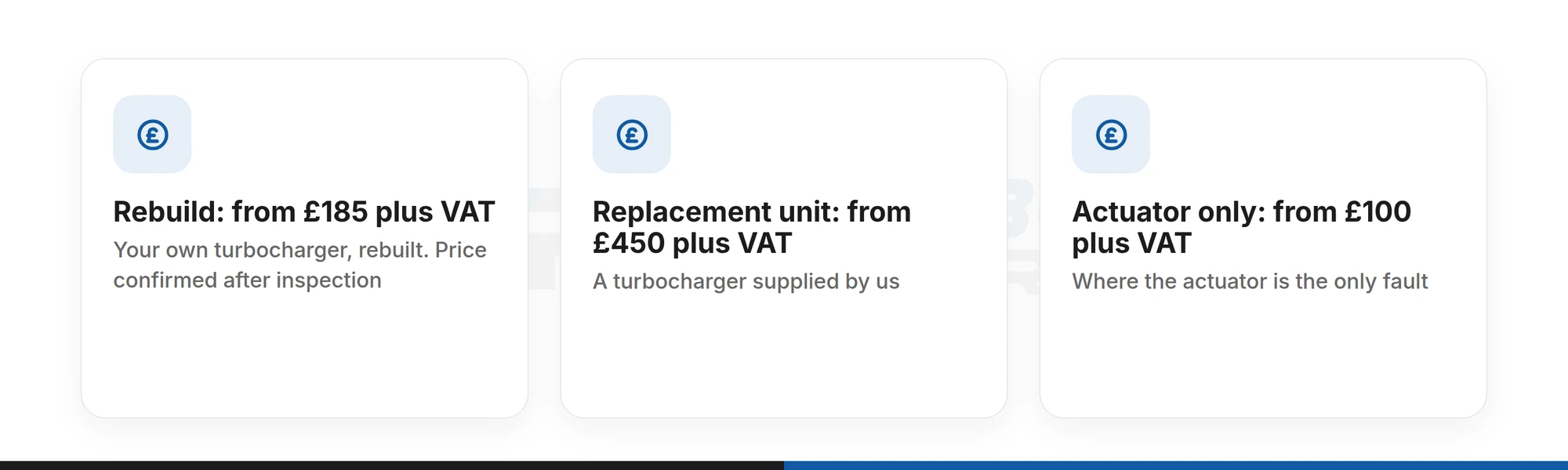
For the Boxer, Relay and Ducato, our prices start from these figures:
- Rebuild of your own turbocharger: from £185 plus VAT.
- Replacement turbocharger from us: from £450 plus VAT.
- Electronic actuator alone, where that is the only fault: from £100 plus VAT.
Where a rebuild lands above £185 depends on what survived inside. A unit that needs only bearings, seals and thrust parts sits near the floor, and each wheel, shaft or housing that fails inspection adds to it. Your price is confirmed once the unit has been inspected, before the rebuild goes ahead.
A garage’s figure for a Peugeot Boxer turbo replacement covers more than the turbocharger. It usually bundles the unit, the labour to remove and refit it, gaskets, a new oil feed pipe where one is fitted, oil and filter, and on some exchange units a charge that depends on your old unit being returned. The labour is the same whichever unit goes back on, so compare quotes line by line rather than on the total.
Unit prices for “a Boxer turbo” vary widely for a simple reason: they are often not the same turbo. Each engine is listed with several references, sold under several numbering systems, and a cheaper unit may simply be a different one. A rebuild prices the unit already on your vehicle, so there is nothing to match. The full breakdown by vehicle class is in our guide to turbo repair and replacement prices.
Turbo Repairs · Epsom workshop
Price the turbo you already have, not the one in a listing
Post in the turbocharger from your Boxer, Relay or Ducato and we will strip it, measure every part and confirm the price before any work starts. Whatever numbering is on the label, the unit that comes back is the one your engine was built with.
Lifetime, unlimited-mileage warranty · Mail-in from the UK and internationally · Bench-tested and calibrated before it ships
Our Boxer, Relay and Ducato Turbo Rebuild
You, or the garage looking after the vehicle, take the turbocharger off and send it in, and we rebuild it and post it back. Independent garages, workshops and main dealers send units in the same way owners do. The job runs in this order:
- Complete the online Repair Form with the badge, engine size, year, power output, mileage and any fault codes. Add every number from the turbo’s label, whichever maker’s system it uses. For a motorhome, include the converter’s name and how long it had stood before the fault appeared.
- Remove the unit complete, with its actuator or boost-control hardware still attached exactly as it came off.
- Pack and post it with every port sealed, to Unit 102 Reaver House, 12 East Street, Epsom, Surrey, KT17 1HX, United Kingdom. Packing and postage are covered on our FAQs page.
- Identification. The unit is matched to its reference from the label, or identified on the bench where the label has gone, so it does not matter which numbering you started from.
- Strip and measurement. Specialists whose core work is turbochargers and turbo actuators take it down to component level and measure the shaft, wheels, bearing surfaces and housings against original specification.
- Rebuild. Bearings, seals and thrust parts are renewed with genuine OE or OEM-grade components that meet or exceed the original, and a part with a known design weakness is uprated rather than reinstated. A wheel, shaft or housing that fails inspection is replaced, and the boost-control mechanism is freed where sound and renewed where worn.
- Balance, test and return. The rotating assembly is balanced, boost control is set up, and the unit is run on the bench before it is boxed and posted back ready to refit.
Bench time is typically one to three working days from arrival, with postage on top each way. You get your own turbocharger back rather than an exchange unit, with a lifetime, unlimited-mileage warranty that carries no time limit and no mileage cap.
Boxer, Relay and Ducato Turbo FAQ
How much does a Peugeot Boxer turbo replacement cost?
With us, a replacement turbocharger starts from £450 plus VAT, and rebuilding your own unit starts from £185 plus VAT. Neither figure includes removing and refitting it, which is charged by whoever does that work. A rebuild price is confirmed once the unit has been inspected.
Is the Boxer turbo the same as the Relay and Ducato turbo?
Engine for engine, often yes: the listings put the same references against all three badges on the 2.2 and the 3.0. The later 2.0 and 2.2 are listed for the Boxer and Relay only, and some 2.3 units are confirmed only for selected Boxer and Jumper applications. Match the reference on your own unit, not the badge.
My quote shows a Fiat number but my turbo’s label has a Peugeot number. Is it the wrong part?
Not necessarily. One listing for the 2.2 cross-references the same turbo to Peugeot-Citroën, Fiat and Ford numbers as well as the turbo maker’s own. Ask the supplier to confirm the turbo maker’s reference against your label, or send your unit in for a rebuild and avoid the question entirely.
Is the Boxer 2.2 HDi turbo the same as the Ford Transit 2.2’s?
The engines are related, and one listing for the Boxer, Relay and Ducato 2.2 turbo carries Ford numbers alongside the others. But each engine is listed with more than one turbocharger depending on output and year, so a family resemblance is not a fitment. Go by the reference on your own unit.
Can you rebuild the turbo from my motorhome?
Yes. The turbocharger belongs to the base vehicle, so a motorhome built on a Boxer, Relay or Ducato is rebuilt exactly as the van would be. Tell us the base vehicle, its engine and the converter on the Repair Form, and send the turbo in once it has been removed.
My motorhome has covered very few miles. Why has the turbo failed?
Mileage is only one of the things a turbocharger wears on. Oil that has aged in the sump, dry starts after months standing and heavy climbs at full weight all load the bearings without adding many miles. The strip usually shows which of them was at work, and we report what we find.
How long does a rebuild take, and what is the warranty?
Bench time is typically one to three working days from arrival, plus postage each way. Every rebuild carries a lifetime, unlimited-mileage warranty with no time limit.
Final Thoughts
Most of what makes a Boxer, Relay or Ducato turbo confusing has nothing to do with the turbocharger. Three carmakers sell the vehicle, each names the engine in its own language, and the same unit can be quoted under four different numbers. None of that changes what is bolted to your engine, which carries its own reference on its own label.
On a motorhome, the rest of the job is about how the vehicle is kept rather than how far it goes: oil changed on the calendar, a gentle first start after a lay-up, and a minute at idle after a long climb. Send the unit in with its label photographed and its history noted, put right what it left behind on the vehicle, and the rebuilt turbo goes back on to the conditions it was built for.
Turbo Repairs · Epsom workshop
Rebuild the turbo your van or motorhome already carries
Complete the Repair Form with the badge, engine and every number on the label, then post the turbocharger in complete. We identify it, strip it, rebuild it, balance it and bench-test it, and send it back ready to refit.
Lifetime, unlimited-mileage warranty · Mail-in from the UK and internationally · Bench-tested and calibrated before it ships