

Summary Our Ford pages are divided by engine, and this page sends you to the one written for yours. Two separate decisions get you there: the engine decides which turbo page applies, and the part that failed decides whether you need that page or an actuator page instead. Electronic actuator repairs start from £100 + VAT, and every repair carries a lifetime, unlimited-mileage warranty.
The decisions are separate because Ford’s engines and models cross rather than line up. A Focus can belong on any of three of our turbo pages, while one page covers the 2.0 TDCi in eight different Fords. Find the row where your model meets your engine, then let the turbo-or-actuator section pick the page.
An EcoBlue badge can lead to three different pages here: the 2.0 TDCi page on a Focus, Kuga, Mondeo, S-Max or Galaxy, the Transit pages on a van, and the Ranger page on the pickup.
- Turbo pages: the 1.0 EcoBoost petrol, the 1.6 TDCi, the 2.0 TDCi (EcoBlue-badged cars included), the Transit and the Ranger
- Actuator pages: the Transit 2.2 TDCi and 2.0 EcoBlue, the Mondeo 1.8, 2.0 and 2.2 TDCi, the S-Max 2.2 TDCi, and the Ranger
- What finds your page: the model, plus the fuel type and engine capacity on your V5C
- What confirms it: the reference on the unit’s label, or the unit itself on our bench
- Actuator repairs: from £100 + VAT, typically one to two working days, no programming on refit
- Turbo rebuilds: typically one to three working days, with the price for your own unit confirmed after inspection
- Warranty: lifetime and unlimited mileage, on every repair
Which Ford Engine Do You Have?
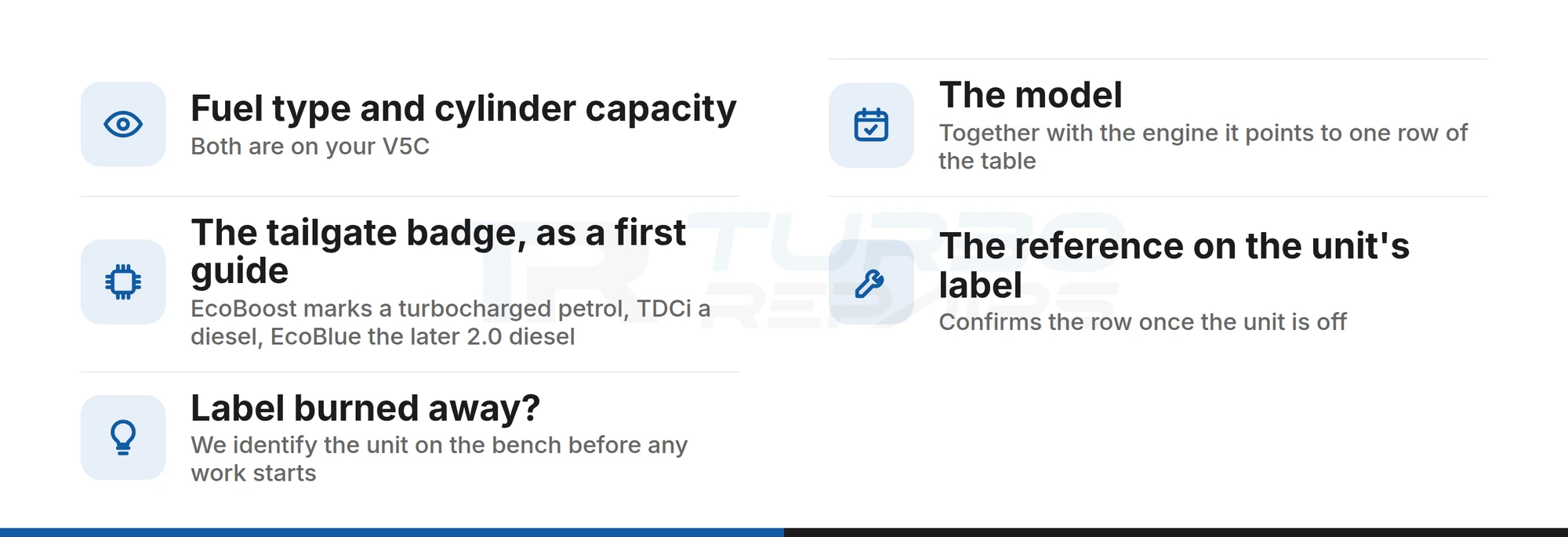
Start with the paperwork rather than the bonnet. Your V5C gives the fuel type and the cylinder capacity, and together with the model they point to one row of the table below. The tailgate badge is a useful first guide: on these Fords, EcoBoost marks a turbocharged petrol, TDCi a diesel and EcoBlue the later 2.0 diesel.
Once the unit is off, the reference on its label confirms the row. If the label has burned away, we identify the unit on the bench before any work starts.
| Engine | Fords it is listed in | Turbocharger page | Electronic actuator |
|---|---|---|---|
| 1.0 EcoBoost (petrol) | Fiesta, Focus, C-Max, Grand C-Max, B-Max, EcoSport, Mondeo, Puma | 1.0 EcoBoost turbo | No actuator page |
| 1.6 TDCi | Focus; also listed for the Fiesta, C-Max, Grand C-Max and B-Max | 1.6 TDCi turbo | Sent with the turbo |
| 2.0 TDCi, including EcoBlue-badged cars | Focus, C-Max, Grand C-Max, Kuga, S-Max, Galaxy, Mondeo, Edge | 2.0 TDCi turbo | Mondeo TDCi actuator, where electronic |
| 1.8 TDCi | Mondeo, Focus, C-Max, S-Max | Repair Form | Mondeo TDCi actuator (Mondeo unit) |
| 2.2 TDCi (cars) | S-Max, Galaxy, Mondeo | Repair Form | S-Max 2.2 TDCi actuator |
| Transit diesels: 2.0, 2.2, 2.4, 3.2 and 2.0 EcoBlue | Transit, Transit Custom | Transit turbo | Transit actuator (2.2 TDCi, 2.0 EcoBlue); 3.2 on the Ranger page |
| Ranger diesels: 2.2, 3.2 and 2.0 EcoBlue | Ranger, 2011 to 2022 | Ranger turbo and actuator | On the Ranger page |
Each row is drawn from our vehicle listings and the trade catalogues behind the page it links to. Some Ford engines have no page of their own, among them the 1.4 and 1.5 TDCi and the EcoBoost petrols larger than 1.0. Send the label reference and your registration through the Repair Form, and we tell you what the unit is and whether it can be rebuilt before you post it.
The Ford Focus: Three Engines, Three Turbos
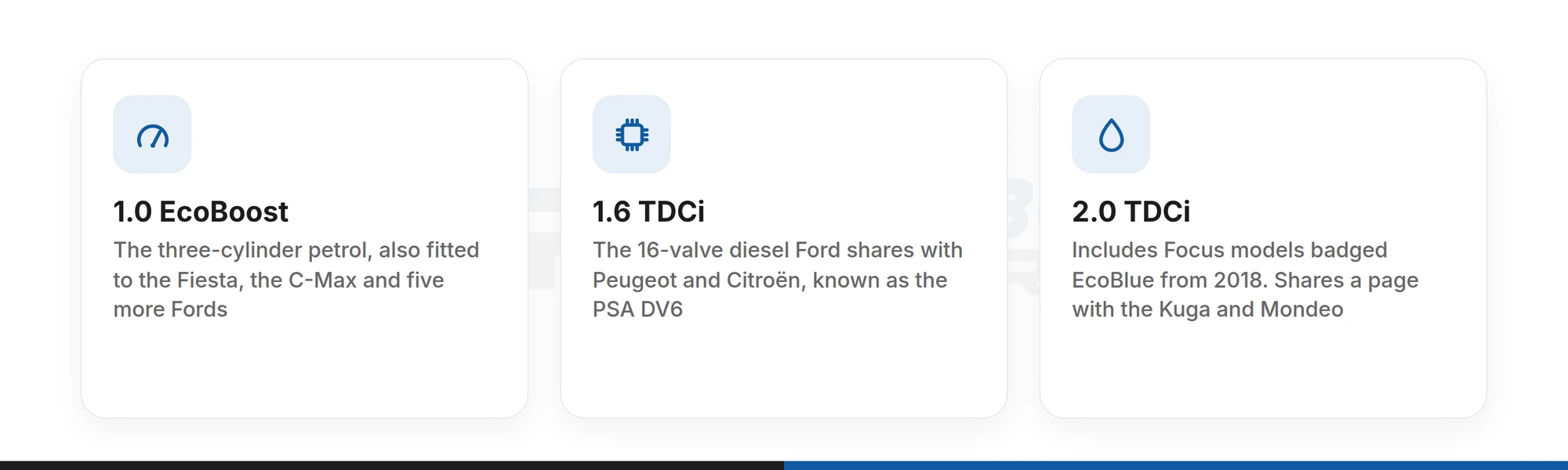
A search for a Focus turbo mixes engines that have nothing in common under the bonnet. Three of them have pages of their own, and each carries a different turbocharger:
- 1.0 EcoBoost. The three-cylinder petrol, also fitted to the Fiesta, the C-Max and five more Fords. It is covered on our Ford 1.0 EcoBoost turbo repair page, with the Focus 1.0 EcoBoost rebuild listing alongside.
- 1.6 TDCi. The 16-valve diesel Ford shares with Peugeot and Citroën, known as the PSA DV6. Our Focus 1.6 TDCi turbo page is written for it, and the Focus 1.6 TDCi rebuild listing carries its references.
- 2.0 TDCi. Including the Focus models badged EcoBlue from 2018. It shares our Ford 2.0 TDCi turbo page with the Kuga, Mondeo and the rest of the family, and has its own Focus 2.0 TDCi rebuild listing.
The fuel separates the petrol from the two diesels, and the capacity separates the diesels from each other. The Focus was also listed with engines we have no page for, including the 1.5 and 1.8 TDCi and the 1.5 EcoBoost, and the Repair Form is the route for those.
Transit and Ranger: The Van and Pickup Diesels
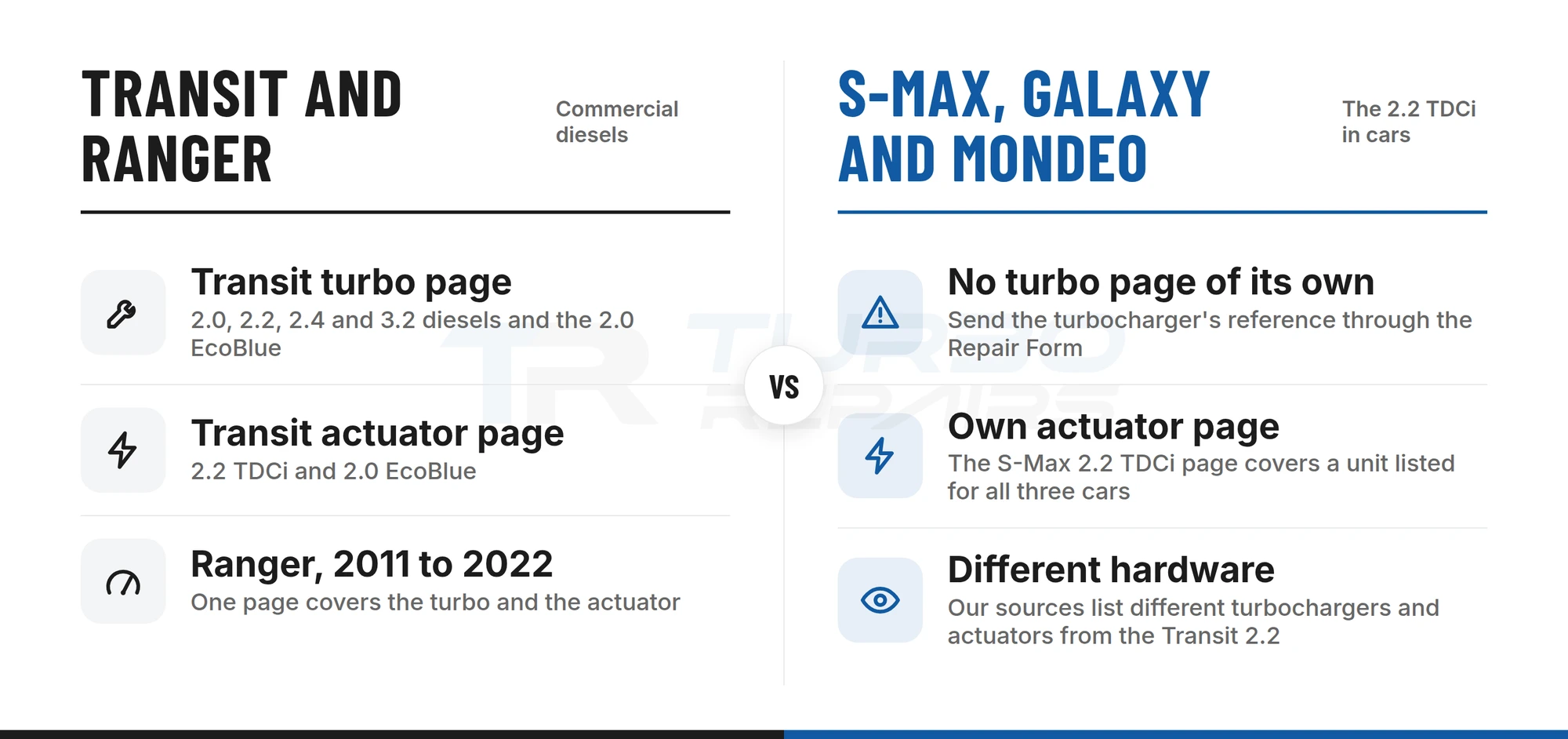
Ford’s commercial diesels have pages of their own, even where an engine name matches a car’s. The 2.2 TDCi is the clearest case: our sources list the Transit’s 2.2 with different turbochargers and different actuators from the 2.2 in the S-Max, Galaxy and Mondeo.
- Transit and Transit Custom turbochargers on the 2.0, 2.2, 2.4 and 3.2 diesels and the 2.0 EcoBlue are on our Ford Transit turbo repair page.
- Transit actuators on the 2.2 TDCi, the Custom and Tourneo included, and on the 2.0 EcoBlue are on our Ford Transit turbo actuator repair page. None of our sources lists an electronic actuator reference for the 2.4 or the early 2.0, so on those vans the turbo page comes first.
- The Ranger, 2011 to 2022, on the 2.2 TDCi, the 3.2 five-cylinder and the 2.0 EcoBlue in single-turbo and bi-turbo form, has one Ford Ranger turbo and actuator page for both parts. The actuator from a Transit 3.2 is covered there too. The 3.0 V6 Ranger from 2022 is not.
The Transit Connect and Transit Courier run smaller diesels that Ford also fits to its cars, and none of the Transit references applies to them. Send their label reference through the Repair Form.
Kuga, Mondeo, S-Max and Galaxy: The 2.0 and 2.2 TDCi
Our Ford 2.0 TDCi turbo page covers the four-cylinder 2.0 diesel in the Kuga, Focus, C-Max, Grand C-Max, S-Max, Galaxy, Mondeo and Edge, plus the 2015 Tourneo, and keeps the EcoBlue-badged cars from 2018 on the same page. Each model’s rebuild listing is linked from there.
On these cars, check the actuator before paying for an actuator repair. Suppliers catalogue a vacuum-operated actuator for the earlier 2.0 TDCi turbochargers, and our Ford Mondeo TDCi actuator page shows how to tell one from an electronic unit.
The 2.2 TDCi in the S-Max, Galaxy and Mondeo has no turbo page of its own, so send its turbocharger’s reference through the Repair Form. Its electronic actuator does have one: our Ford S-Max 2.2 TDCi actuator page, which covers a unit listed for all three cars. A Mondeo can also carry the 1.0 EcoBoost or the 1.8 TDCi, and the table above routes both.
Electronic Turbo Actuators on Ford Diesels
On a variable-geometry turbocharger, an actuator bolted to the outside sets the vanes inside. Where that actuator is electronic, with a motor, a gear train and a position sensor in one housing, it comes off on its own and we rebuild it separately, from £100 + VAT and typically in one to two working days. It goes back on without programming.
- Transit 2.2 TDCi and 2.0 EcoBlue: the Transit actuator page.
- Ranger: the electronic actuator on the later 3.2 turbocharger, covered alongside the turbo on the Ranger page.
- Mondeo 1.8, 2.0 and 2.2 TDCi: the Mondeo actuator page, which also covers the vacuum can some Mondeos carry instead.
- S-Max, Galaxy and Mondeo 2.2 TDCi: the S-Max actuator page.
The 1.6 TDCi has no actuator page; send its turbocharger complete, with the boost-control hardware attached as it came off. Every electronic actuator we rebuild, across all makes, is listed on our electronic turbo actuator repairs page, and our Hella actuator index finds one by its part number.
Turbo Repairs · Epsom workshop
Ford in limp mode? Find out which part to post first
Give us the model, the engine and every stored code on the Repair Form, and we advise whether the actuator or the turbocharger should come to us before anything is unbolted. An electronic actuator travels on its own, while a turbocharger comes complete with its actuator in place.
Lifetime, unlimited-mileage warranty · Mail-in from the UK and internationally · Bench-tested and calibrated before it ships
Turbo or Actuator? Which Page You Need
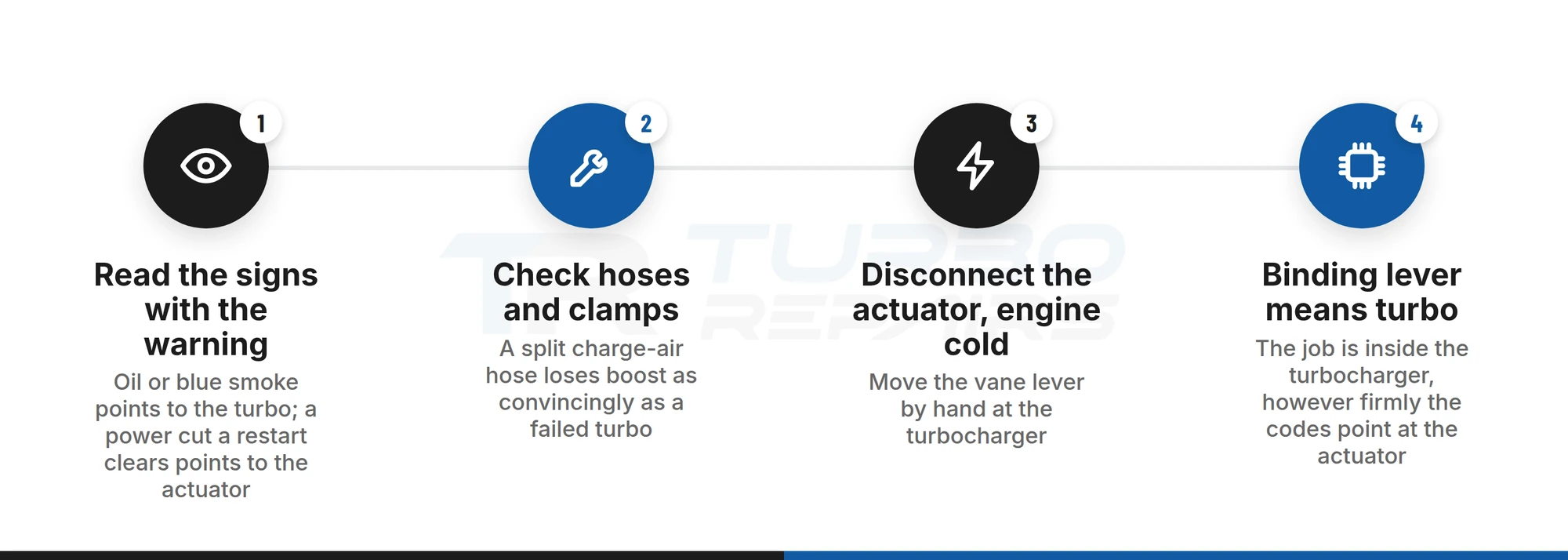
A Ford that loses boost shows the same warning lights and the same limp mode whichever part has failed, so the warning alone will not choose the page. What comes with it usually does.
- Oil where it should not be, blue smoke, or a siren that climbs with engine speed. These start in the turbocharger’s bearings and seals. Read the turbo page for your engine.
- A power cut that a restart puts right for a while, with boost-control codes stored. Suspect the control side first: the actuator, its plug and its wiring. Read the actuator page.
- Lost power with neither. Check the charge-air hoses and clamps before either part comes off, because a split hose loses boost as convincingly as a failed turbo.
The deciding check is made by hand at the turbocharger, with the actuator disconnected and the engine cold, and each actuator page describes it for its own engine. A vane lever that binds puts the job inside the turbocharger, however firmly the codes point at the actuator. For the wider picture, see our guides to turbo failure symptoms and turbo actuator symptoms.
Getting the unit to us
Complete the online Repair Form with the registration, the engine, any fault codes and a photograph of the label. Then seal every port, pack the unit in a rigid box and post it to Unit 102 Reaver House, 12 East Street, Epsom, Surrey, KT17 1HX, United Kingdom. Garages send units in the same way owners do, and our FAQs cover packing and postage.
Ford Turbo Repair FAQ
How much does a Ford turbo or actuator repair cost?
An electronic actuator repair starts from £100 + VAT. A turbocharger rebuild is priced on the unit itself, and the page or vehicle listing for your engine is the place to start; the price for your own turbo is confirmed once it has been inspected, before the rebuild goes ahead. Removal and refitting are charged by whoever does that work, and our guide to turbo repair prices explains what moves the figure.
Which page do I need for a Ford Focus turbo?
It depends on the engine. The 1.0 EcoBoost petrol, the 1.6 TDCi and the 2.0 TDCi each have their own page and their own Focus listing, and the fuel type and capacity on your V5C tell you which is yours.
Is the Focus 1.6 TDCi the same engine as the Peugeot and Citroën 1.6?
Yes. The 1.6 TDCi is the PSA DV6 diesel that Peugeot and Citroën sell as the 1.6 HDi, and trade catalogues list some of the same turbochargers across Ford, Peugeot and Citroën. The reference on your own unit’s label confirms which one you have.
My Ford’s engine is not on this page. Can you still help?
Usually. Engines such as the 1.4 and 1.5 TDCi and the larger EcoBoost petrols have no page of their own, and nor do the Transit Connect and Courier. Send the label reference and your registration through the Repair Form, and we tell you what the unit is and whether it can be rebuilt before you post it.
How long will my Ford be off the road?
Bench time is typically one to two working days for an electronic actuator and one to three for a turbocharger, counted from the day the unit arrives. Add postage each way and the time it takes to remove and refit it.
Final Thoughts
A Ford turbo search starts wide because Ford’s engines and models cross: one engine under many badges, and one badge over several engines. Put the model and the engine together and the table narrows to a single row, which the label on the unit then confirms.
The second question is which part to send, and it costs nothing to answer while everything is still on the car. Let the signs point you to a page, let the hand check on that page confirm it, and unbolt only the part that failed.
Turbo Repairs · Epsom workshop
From the right page to a rebuilt unit on your Ford
Put the model, engine and registration on the Repair Form with a photograph of the label, then post the unit in. It is matched to your engine, tested, stripped and rebuilt at component level, then bench-tested and returned ready to refit.
Lifetime, unlimited-mileage warranty · Mail-in from the UK and internationally · Bench-tested and calibrated before it ships