

Summary A Ford Kuga 2.0 TDCi turbocharger costs from £185 plus VAT to rebuild, or from £450 plus VAT for a replacement unit when the original is not worth saving. Removing and refitting it is charged separately by whoever does that work. The same answer holds for the Focus, C-Max, Grand C-Max, S-Max, Galaxy, Mondeo and Edge 2.0 TDCi, because across those cars the turbochargers are shared, one engine generation at a time.
This page shows which generation your car has, the one check that separates a turbo job from an actuator job, what fails, and which of our vehicle listings fixes the rebuild price for your year and power output.
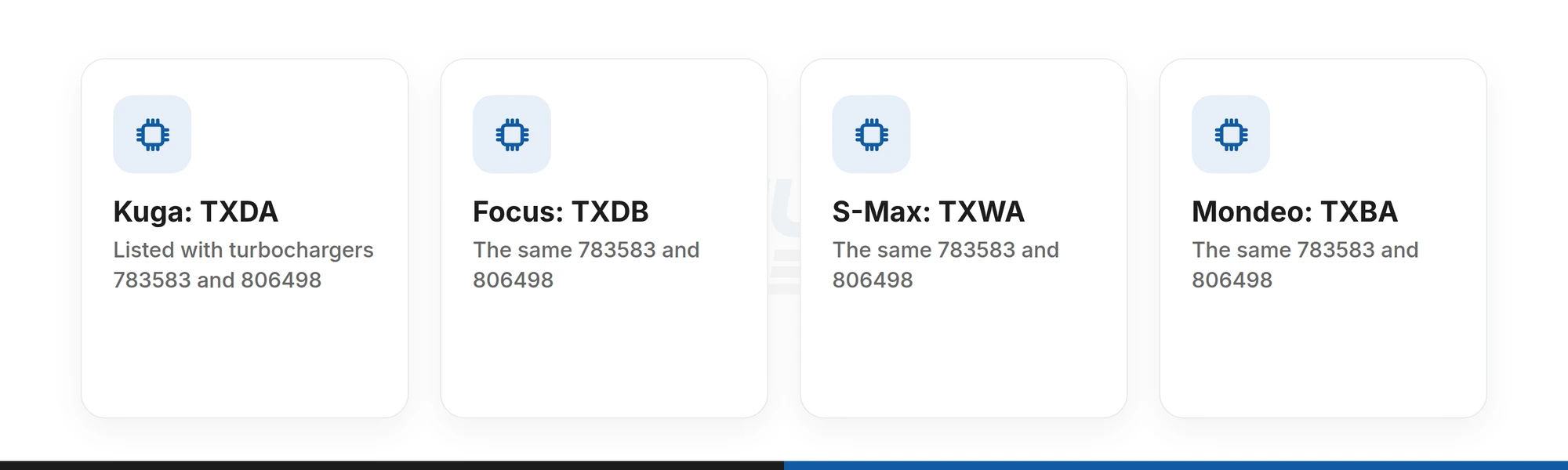
A Kuga’s TXDA, a Focus’s TXDB, an S-Max’s TXWA and a Mondeo’s TXBA are four Ford engine codes with the same two turbochargers, 783583 and 806498, listed against every one of them.
- Cars covered: Ford 2.0 TDCi in the Kuga, Focus, C-Max, Grand C-Max, S-Max, Galaxy, Mondeo and Edge, plus the 2015 Tourneo. The Transit has its own page.
- Turbochargers: shared across the family by engine generation. 728768, 753847 and 760774 on the earlier DW10B engine (Garrett GT1749V-family units); 783583 and 806498 on the DW10C; BorgWarner 5303-970-0394 listed from 2014; 852072-0002 on the Panther-coded engine from 2018.
- The exceptions: the Mondeo also carries Ford’s earlier Duratorq 2.0, with turbochargers none of the other cars on this page share; and one Kuga turbocharger, 765993, is listed in our catalogue for no other Ford.
- Actuator: a supplier catalogues a vacuum-operated actuator for the 728768, 753847 and 760774 turbochargers. Check for a pipe or a plug before buying an actuator repair.
- Cost: rebuild from £185, replacement from £450, electronic actuator repair from £100, all plus VAT. Fitting is not included.
- Turnaround and cover: turbo rebuilds typically take 1 to 3 working days; lifetime, unlimited-mileage warranty.
Search for a Kuga turbo price and you will mostly find prices for a Kuga turbocharger. On the 2.0 TDCi, that part barely exists. Every turbocharger catalogued for the diesel Kuga except one is also catalogued for at least four other Fords, so what sets the price is which generation of the engine you have, not which body it sits in.
That is also why this is one page rather than eight. The cars differ; the turbochargers, generation by generation, largely do not.
Which Ford 2.0 TDCi Is This Page For?
This page covers the four-cylinder 2.0 diesel badged TDCi in Ford’s cars and people carriers: the Kuga, Focus, C-Max, Grand C-Max, S-Max, Galaxy, Mondeo and Edge, plus the 2015 Tourneo listed under the same badge. The latest rows in our listings, from 2018, carry engine codes marked Panther, and specialist catalogues sell that turbocharger as a 2.0 EcoBlue part. If your car wears an EcoBlue badge, it is still on this page.
Some Fords that look as though they belong here do not:
- Ford Transit 2.0. Van duty cycles change how a turbo is worked and how the job is finished; see our Ford Transit turbo rebuild page.
- Ford Ranger 2.0. Covered with the rest of the Ranger range on our Ford Ranger turbo and actuator page.
- 1.6 TDCi. A different engine with a different failure pattern; see our Ford Focus 1.6 TDCi page.
- 2.2 TDCi. Its electronic actuator has its own page: Ford S-Max 2.2 TDCi actuator.
- Petrol EcoBoost. The 1.0 is on our Ford 1.0 EcoBoost turbo repair page. The larger EcoBoost petrols are not covered here.
The Turbochargers on the 2.0 TDCi, by Model Family
Our vehicle listings catalogue the 2.0 TDCi turbochargers model by model, and laid side by side they fall into a handful of generations. Within each generation the same references recur across almost every model. The table groups them at that level; the listing for your own car carries the year-by-year detail.
| Engine generation (codes as listed) | Turbocharger references | Catalogued for |
|---|---|---|
| Earlier Duratorq 2.0 (Duratorq DI, Puma) | 704226, 708618, 714467, 728680, 802419 | Mondeo only, of the cars on this page |
| DW10B (DW10BTED4, DW10 BTED 4S) | 728768, 753847, 760774 | Focus, C-Max, Kuga, S-Max, Galaxy, Mondeo |
| DW10B, Kuga only | 765993-0004 | Kuga, listed at 134 bhp |
| DW10C | 783583, 806498 | Focus, C-Max, Grand C-Max, Kuga, S-Max, Galaxy, Mondeo |
| Listed from 2014 (T7 and T8 codes) | BorgWarner 5303-970-0394 | Focus, C-Max, Grand C-Max, Kuga, S-Max, Galaxy, Mondeo, Edge |
| Panther-coded, listed from 2018 | 852072-0002 | Focus, Kuga, S-Max, Galaxy, Mondeo, Edge |
| Outside the shared car list | 5304-970-0201 (Edge, 207 bhp); 838417 (Tourneo, a reference also catalogued for the Transit Custom) | Edge; Tourneo |
The shared references are not limited to Ford. Specialist catalogues list the 760774 family against Volvo 2.0 diesels such as the C30, S40 and V50 as well as the Fords, and the 2014 BorgWarner reference is sold against Citroen, Peugeot, DS and Vauxhall 2.0 diesels too. The part belongs to an engine family, not to a model.
Why Ford’s engine code will not pick the turbocharger for you
On most cars the engine code is the shortcut to the right turbo. On the 2.0 TDCi it points somewhere else. In our listings the same 753847 turbocharger sits behind G6D codes in a Focus, C-Max or Kuga, behind QXW and AZW codes in an S-Max or Galaxy, and behind QXB and AZB codes in a Mondeo.
The later engine repeats the pattern: TXDA in a Kuga, TXDB in a Focus or C-Max, TXWA in an S-Max or Galaxy and TXBA in a Mondeo, all listed with the same 783583 and 806498 turbochargers. Ford’s own code varies with the car the engine went into. The DW10-series code that appears alongside it, DW10BTED4 on the earlier engine and DW10C on the later one, broadly tracks the turbocharger instead.
So if a supplier asks for your engine code and you read it off a Kuga, do not be surprised to find it missing from a catalogue built around the Mondeo. Give them the year and power output, and the reference on the turbo’s own label if you can reach it.
Your model’s listing
Each listing below gives the fixed rebuild price for your year and power output, and its Affected Part Numbers tab lists every reference catalogued for that car. Choose the one that matches your car, not the one that matches the turbo:
- Ford Kuga 2.0 TDCi turbocharger rebuild
- Ford Focus 2.0 TDCi turbocharger rebuild
- Ford C-Max 2.0 TDCi turbocharger rebuild
- Ford Grand C-Max 2.0 TDCi turbocharger rebuild
- Ford S-Max 2.0 TDCi turbocharger rebuild
- Ford Galaxy 2.0 TDCi turbocharger rebuild
- Ford Mondeo 2.0 TDCi turbocharger rebuild
- Ford Edge 2.0 TDCi turbocharger rebuild
- Ford Tourneo 2.0 TDCi turbocharger rebuild
Turbo or Actuator? One Check, Then the Right Page
Before anything is priced, look at the small unit bracketed to the outside of the turbocharger, linked by a rod or arm to a lever on the housing. That is the actuator, and what is connected to it decides which job you are pricing.
A thin rubber pipe into a shallow metal can means a vacuum-operated actuator. A multi-pin electrical plug into a moulded body means an electronic one. On the DW10B turbochargers, 728768, 753847 and 760774, a supplier catalogues the actuator for the C-Max, Focus, Galaxy, Kuga, Mondeo and S-Max as a vacuum unit. On the Mondeo’s older 728680 turbocharger, the actuator catalogued is a Hella electronic unit under G-149. Our sources do not state the type for the later generations, so on those cars the check is the only reliable answer.
The distinction matters for cost. An electronic actuator that has failed on its own can be repaired separately, from £100 plus VAT, with the turbocharger left on the car. A vacuum can has no motor, gears or sensor to rebuild; its faults sit in the diaphragm, the pipe, the vacuum supply or the solenoid that meters it. Our Ford Mondeo 2.0 TDCi actuator page explains how to tell a vacuum can from an electronic actuator and how each one fails.
One more check while you are there. With the actuator rod disconnected, the lever on the turbo should move through its travel by hand. If it binds, the problem is inside the turbocharger, and a new actuator of either type would only be straining against it.
What Fails Inside a 2.0 TDCi Turbocharger
A turbocharger is a turbine wheel and a compressor wheel on one shaft, with the shaft running in oil-fed bearings inside a centre housing sealed at each end. Exhaust spins the turbine; the compressor pushes air into the engine. On the 2.0 TDCi, as on most diesels, the wear shows up in a predictable order.
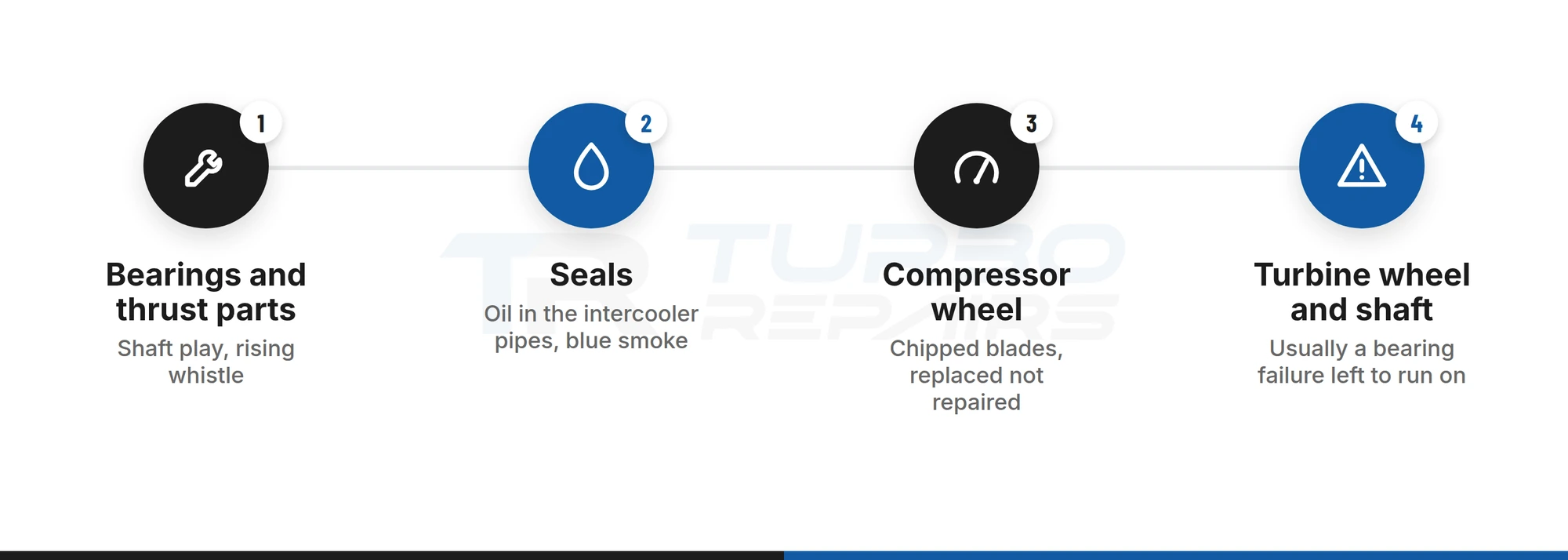
- Bearings and thrust components. The wear parts. As they go, the shaft gains play, and the first sign is often a rising whistle or a rougher note under boost.
- Seals. Worn seals let oil past into the intake or exhaust side: oil in the intercooler pipes, blue smoke, oil consumption with no visible leak.
- Compressor wheel. Debris drawn into the intake chips the blades, or a worn shaft lets the wheel touch its housing. A damaged wheel is replaced, not repaired.
- Turbine wheel and shaft. Usually the result of a bearing failure left to run on. Damage to either means replacing both, as they come as one assembly.
- Boost-control mechanism. Carbon builds up on the moving parts that control boost until they stick, so boost comes in late, drops out or spikes. Our guide to variable-vane turbos explains why a mechanism that frees itself is still getting worse.
The order matters because it is also the order of cost. A turbo taken off while only the bearings and seals have gone is the cheapest kind of rebuild. The same unit driven until the wheels have touched their housings needs more parts, and can reach the point where replacement is the better value. Which symptoms mean you should stop driving is covered in our guide to turbo failure symptoms.
What Kills 2.0 TDCi Turbos: Oil Supply and Short Journeys
A turbocharger rarely wears out on its own. The shaft spins on a film of engine oil, and anything that thins, starves or contaminates that film shortens its life. That is why the cause of a failure is almost always outside the turbo, and why a rebuilt or new unit fitted without finding it goes the same way.
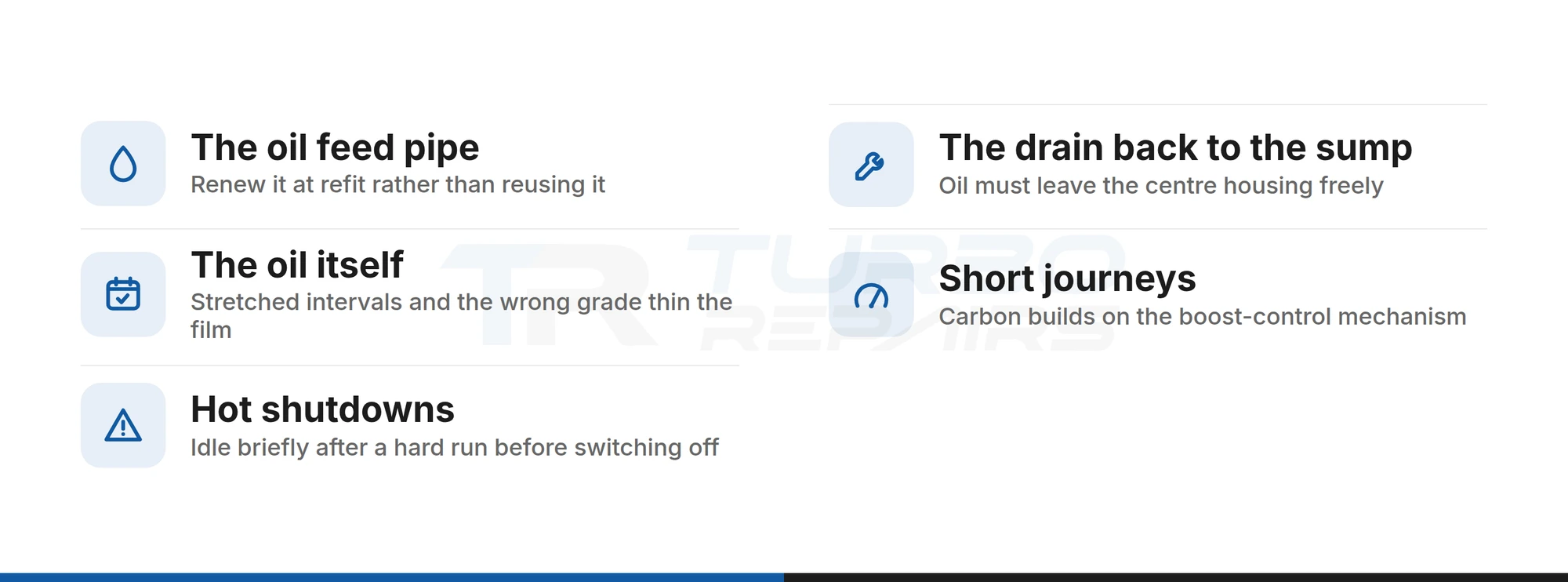
The oil feed. The small-bore pipe that feeds oil to the turbo can partly block over time, and it cannot be judged from the outside. Renew it at refit rather than reusing it. The drain back to the sump matters as much: if oil cannot get out of the centre housing freely, it pushes past the seals.
The oil itself. Stretched service intervals and the wrong grade of oil leave the bearings on a thinner, dirtier film. A turbo has no service schedule of its own. The oil change is its service.
Short journeys. An engine that rarely reaches full temperature builds carbon on the boost-control mechanism, and on cars with a particulate filter it may never finish a regeneration. Our guide on whether a blocked DPF can cause turbo failure covers how the two affect each other, and what to put right before a turbo goes back on.
Hot shutdowns. Switching off straight after a hard run leaves the bearing housing at its hottest with no oil moving through it. A short spell of idling after a motorway run or a steep climb lets the temperature come down first.
Turbo Repairs · Epsom workshop
Found your fault? Have your own 2.0 TDCi turbo rebuilt
Tell us the model, year and power output with any fault codes, and post the turbocharger in. It is stripped, measured, rebuilt on new wear parts, balanced and bench-tested, and the unit that comes back is the one you sent.
Lifetime, unlimited-mileage warranty · Mail-in from the UK and internationally · Bench-tested and calibrated before it ships
What a Ford 2.0 TDCi Turbo Replacement Costs
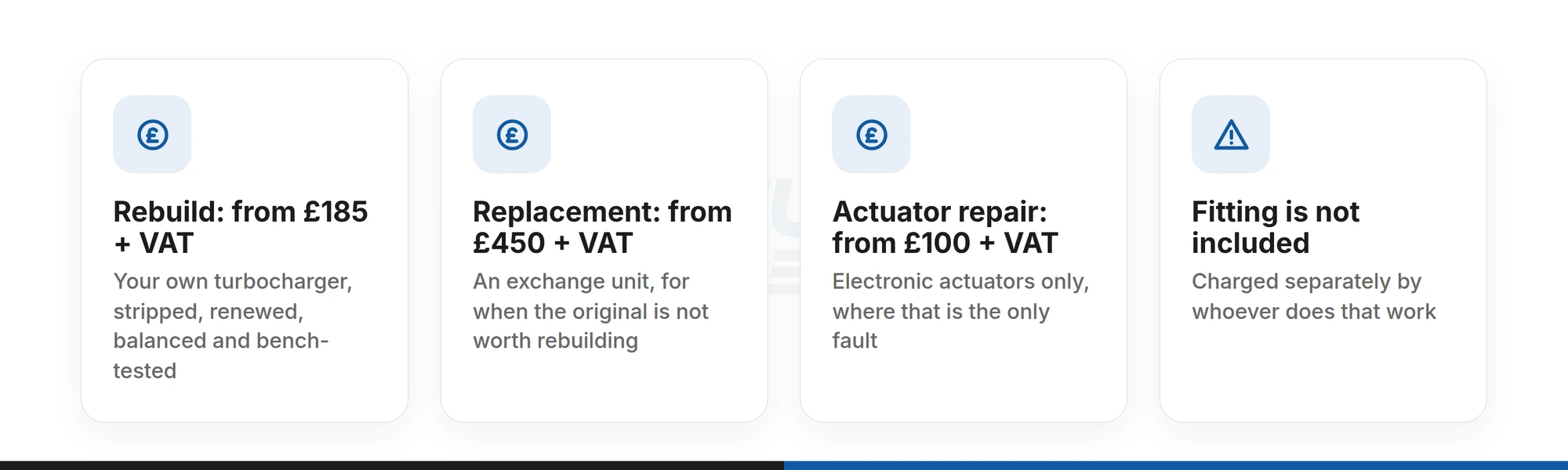
The Ford Kuga turbo replacement cost depends on which of three jobs your car actually needs. The same three apply to every 2.0 TDCi on this page:
- Rebuilding your own turbocharger: from £185 plus VAT. Stripped to component level, the wear parts renewed, any damaged part replaced, balanced and bench-tested. Your model’s listing gives the fixed rebuild price for your year and power output.
- A replacement turbocharger: from £450 plus VAT. A reconditioned or new exchange unit supplied in place of yours, for when the original is not worth rebuilding.
- An electronic actuator repair: from £100 plus VAT. Only where your turbo carries an electronic actuator and that is the only fault. It does not apply to a vacuum can.
For comparison, our turbo repair and replacement prices guide puts the typical market price of a new turbocharger at £900 to £1,300 for a mid-size car and £1,200 to £1,800 for large cars and SUVs. Those are prices for the unit alone.
What the model name changes, and what it does not
Because the turbochargers are shared, our rebuild price follows the turbocharger reference rather than the model. The same reference is priced the same whether it came off a Kuga, a Focus or an S-Max. What does change with the car is the job around the turbo: access, the time it takes to remove and refit, and the labour rate of whoever does it.
The shared parts cut the other way for a replacement unit. An exchange turbo has to match the reference on your engine, and on this family neither the model name nor Ford’s engine code is enough to guarantee that, for the reasons above. If you buy a replacement from anyone, match it on the turbocharger’s own label.
What no turbo price includes
None of these figures covers removal and refitting, new gaskets, a new oil feed pipe, fresh oil and filter, or finding whatever caused the failure. That work is charged by your garage, or is your own time if you do it yourself, and it is the same job whichever route you choose. Only the price of the unit changes between a rebuild and a replacement.
Our Ford 2.0 TDCi Turbo Rebuild
Your turbocharger comes off the car and is posted to our workshop at Unit 102 Reaver House, 12 East Street, Epsom, Surrey, KT17 1HX, United Kingdom. Units are accepted from anywhere in the UK and internationally. Complete the Repair Form first, and put the reference it gives you inside the box and on the outside.
On arrival the unit is identified from its label and bench-tested before it is opened, so what we report is what actually failed. It is then stripped to component level and each part measured against original specification. Bearings, seals and thrust components are renewed as standard; any wheel, shaft or housing that fails inspection is replaced with genuine OE or OEM-grade parts, or uprated where the original design has a known weakness. The rotating assembly is balanced, the boost-control mechanism freed or renewed and set up, and the finished unit tested again before it is packed.
If the inspection shows your turbo is too far gone to rebuild sensibly, we say so and recommend a replacement instead, before any work goes ahead. Rebuilds typically take one to three working days from the unit reaching us, plus postage each way, and every rebuild carries a lifetime, unlimited-mileage warranty.
Send these with it:
- The model, year and power output. Your V5C gives the power in kilowatts at section P.2.
- The reference on the turbocharger’s label, or a clear photograph of it.
- Any fault codes stored, and whether the fault was constant or came and went.
- What you found at the actuator: a pipe or a plug, and whether the lever moved freely by hand.
On refit, renew the oil feed pipe and gaskets, change the oil and filter, and prime the oil feed before the engine first runs. Our guide to replacing a turbocharger sets out the refit and first start step by step.
Ford 2.0 TDCi Turbo FAQ
How much does a Ford Kuga turbo replacement cost?
Rebuilding your own 2.0 TDCi turbocharger starts from £185 plus VAT, and a replacement turbocharger from £450 plus VAT. The fixed rebuild price for your year and power output is on our Kuga 2.0 TDCi listing. Removal and refitting are charged separately by whoever does the work.
Is the Kuga 2.0 TDCi turbo the same as the Focus, Mondeo or S-Max one?
In most generations, yes. The same turbocharger references are catalogued across the Kuga, Focus, C-Max, S-Max, Galaxy and Mondeo, generation by generation. The exceptions are the Mondeo’s earlier Duratorq 2.0, whose turbochargers none of the other cars on this page share, and one Kuga turbocharger, 765993, listed for the Kuga alone.
Can I use my engine code to find the right turbo?
Not on its own. Ford gives the same engine a different code depending on the car it went into, so a Kuga, a Focus, an S-Max and a Mondeo can carry the same turbocharger under four different codes. The year, the power output and the reference on the turbo’s label are more reliable.
Does my 2.0 TDCi have a vacuum or an electronic turbo actuator?
Look at the unit on the outside of the turbocharger. A rubber pipe into a metal can is vacuum-operated; a multi-pin plug into a moulded body is electronic. A supplier catalogues a vacuum actuator for the 728768, 753847 and 760774 turbochargers. On later cars, the check is the answer.
Is it cheaper to rebuild or replace a 2.0 TDCi turbo?
Usually cheaper to rebuild, because a rebuild re-uses the housings, wheels and shaft where they are sound and renews only what has worn. Replacement becomes the better value when so many major parts are damaged that little of the original would be re-used, and we tell you that after inspection.
How long does a 2.0 TDCi turbo rebuild take?
Typically one to three working days from the unit reaching our workshop, plus postage each way.
What warranty comes with the rebuild?
A lifetime, unlimited-mileage warranty, with no mileage cap and no time limit.
Final Thoughts
The Ford 2.0 TDCi has been sold under enough badges that the badge has stopped saying much about the turbocharger. A Kuga, a Focus, an S-Max and a Mondeo of the same generation share their turbos. Ford’s own engine codes change with the body, and the one number that identifies the part is the one on the turbo itself.
That makes the cost question simpler than it first looks. Find the generation, check whether the actuator takes a pipe or a plug, and the rest follows: a rebuild from £185, a replacement from £450 where the original is past saving, and an electronic actuator on its own from £100 where that is all that failed.
Whatever you choose, find what killed the first turbo before the next one goes on. It is rarely the largest line on the bill, and it is the one that decides whether you pay for a turbo twice.
Turbo Repairs · Epsom workshop
Have your Ford 2.0 TDCi turbocharger rebuilt, not replaced
Complete the Repair Form with your model, year and output, then post the turbo in. We identify it, test it, strip it and rebuild it to specification, and if it is beyond saving we tell you before any work starts.
Lifetime, unlimited-mileage warranty · Mail-in from the UK and internationally · Bench-tested and calibrated before it ships