

Summary A reconditioned exchange turbocharger is a ready-built unit supplied in place of yours, so the vehicle can go back on the road without waiting for its own turbo to be rebuilt. We hold a selection of exchange units for some of the most commonly failing turbos, from £450 + VAT, and when the one you need is in stock we can typically dispatch it the same day.
An exchange unit carries the same lifetime, unlimited-mileage warranty as a rebuild. If your turbo is not one we stock, or you would rather keep your own unit, we rebuild it instead, from £185 + VAT.
An exchange turbo saves the wait, not the diagnosis: the reason the old unit failed is still on the car, so the checks a strip-down would have made have to be made on the engine instead.
- What it is: a reconditioned turbocharger supplied in place of yours, with your old unit sent back to us
- Availability: a selection of exchange units for some of the most commonly failing turbos, not every turbo
- Dispatch: typically the same day when the unit is in stock; never guaranteed, and transit time comes on top
- Price: from £450 + VAT
- Surcharge: may apply, and is refunded when your old unit is returned
- Warranty: lifetime and unlimited mileage, the same as a rebuild
- Matched by: the part number on your turbo’s own label, not the model name
- Not in stock? Your own turbo rebuilt from £185 + VAT, typically one to three working days on the bench
Exchange or Rebuild: Which One Your Turbo Needs
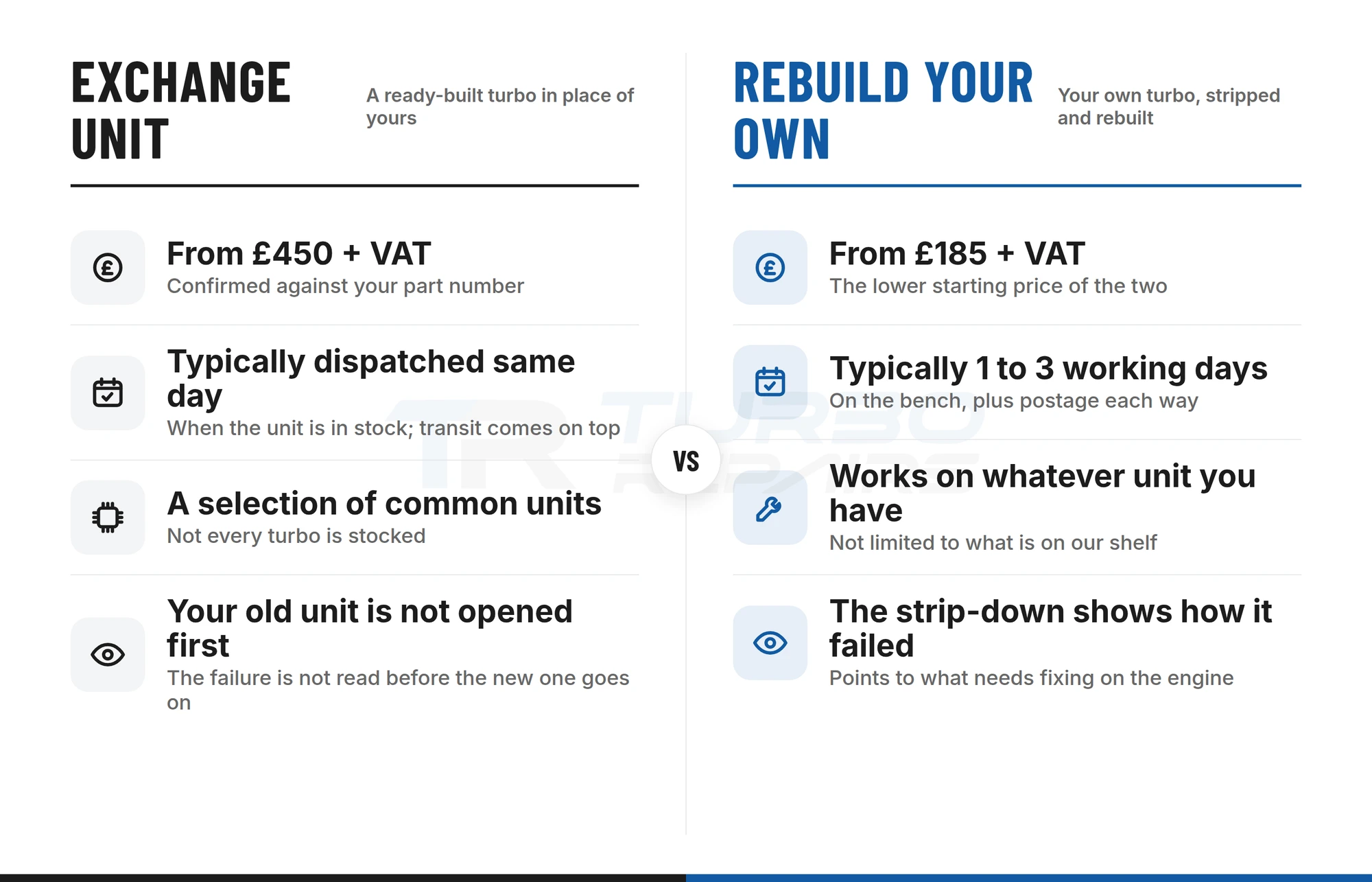
Two things decide it: how long the vehicle can be off the road, and whether your own turbocharger is still worth rebuilding. Price rarely tips it towards an exchange, because a rebuild of your own unit starts lower, from £185 + VAT against £450 + VAT.
When an exchange unit is the better choice
- The vehicle cannot wait. A rebuild means posting the turbo to us, one to three working days on the bench and the journey back. A stocked exchange unit takes the postage and bench time out of the job, which matters when the car or van is needed sooner than that.
- Your turbo is past rebuilding. A cracked turbine housing, or a bearing housing bore worn beyond its limits, is where a rebuild stops making sense unless the casting can be replaced economically. So is a unit that needs new wheels, a new shaft and a new housing on top of its bearings and seals, because very little of the original would be left.
When a rebuild is the better choice
- Your turbo is not one we stock. Our exchange units cover a selection of the most commonly failing turbos, not every turbocharger on the road. A rebuild works on whatever unit is on your engine.
- You want the failure read. When your own turbo is stripped, the wear on its bearings, seals and wheels shows how it failed, and that points at what needs fixing on the car. An exchange unit arrives before anyone has opened yours.
- The fault is the actuator, not the turbo. On many variable-geometry diesels a boost fault comes from the electronic actuator while the turbo core is healthy. Replacing the whole turbocharger for that is the expensive route; our electronic turbo actuator repairs start from £100 + VAT.
If you cannot yet tell which applies, the turbo has to come off either way, and removing and refitting it is the same work for both routes. You can make the choice once the unit is in your hands.
What a Reconditioned Exchange Turbocharger Is
An exchange turbocharger is a unit already rebuilt from a used core and supplied in place of yours. “Exchange” describes the transaction rather than the build: you receive a ready unit and send your old one back, which is why the trade calls the returned unit the core.
The words around it are used loosely. Reconditioned, remanufactured and refurbished are not protected terms in this trade, and our turbo rebuild page sets out what reconditioned should mean on the bench, so we will not repeat it here.
What separates a reconditioned exchange unit from a used turbo is the work done before it is supplied. A used turbo comes off another vehicle with its wear intact and a history nobody can tell you. A reconditioned unit has been rebuilt before it reaches you, and ours carries the same warranty as a rebuild of your own.
It is still a different turbocharger from the one on your car, and that has two practical consequences. It has to be matched to your engine by part number, and it may arrive with its housings set at a different angle from the one you removed. Both are covered below.
How the Exchange Works: Your Old Unit and the Surcharge
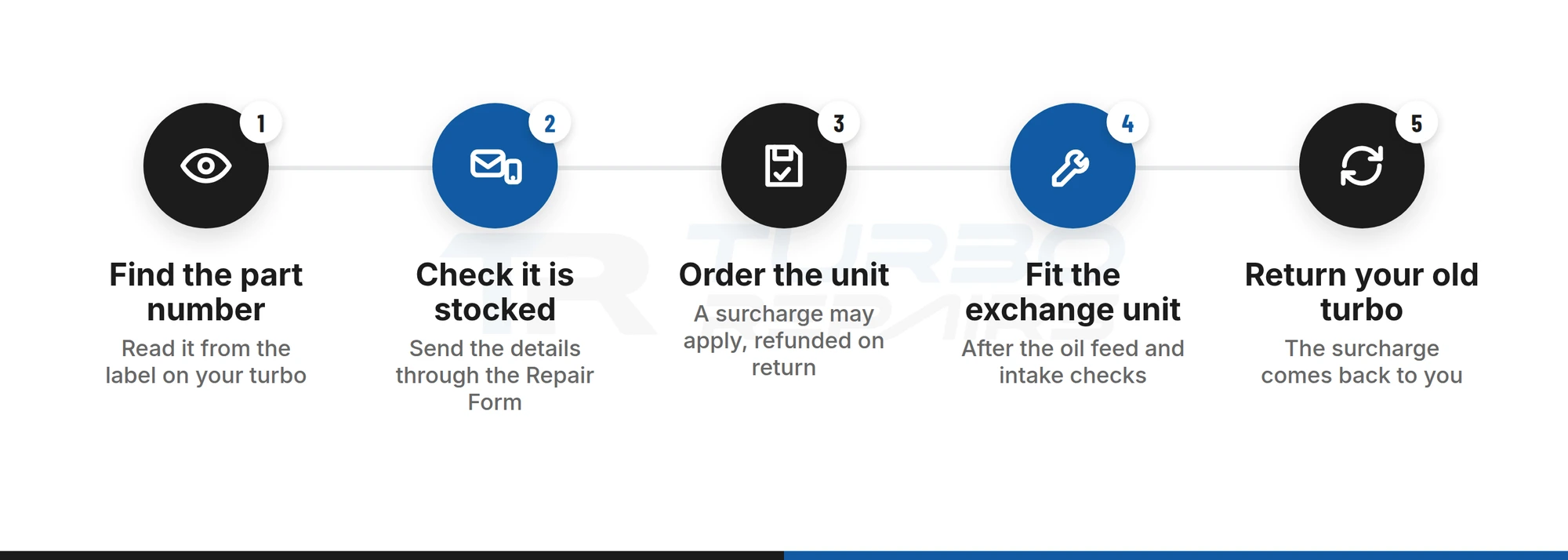
- Find the part number. Read it from the label on the turbocharger itself, as described in the matching section below.
- Check it is stocked. Send us your vehicle details and the part number through the online Repair Form and say you are asking about an exchange unit. If it is one we hold, we can typically dispatch it the same day. If it is not, the route open to you is a rebuild of your own.
- Order the unit. A surcharge may apply alongside the price of the unit. It is refunded when your old turbo is returned.
- Fit it. The exchange unit goes on in place of the old one, after the checks in the pre-fitting section below.
- Return the old unit. Send your old turbo back to us, and the surcharge comes back to you.
Keep the old turbo
It is tempting to scrap a failed turbo the moment it is off the car. On an exchange it is part of the deal, because the surcharge is refunded when it comes back to us. Pack it as carefully as you would a unit for rebuild: ports blanked, wrapped, and boxed with padding around both ends.
Same-day dispatch is not same-day fitting
When the unit is on the shelf, same-day dispatch is typical, but it is not a promise, and transit time comes on top of it. If a garage is fitting the turbo, book the refit once the unit has been dispatched rather than when it is ordered.
Turbo Repairs · Epsom workshop
Need the vehicle back sooner than a rebuild allows?
Send us your vehicle details and the part number from your turbo’s label, and we will check it against the exchange units we hold. If yours is not one of them, we can rebuild your own turbo instead, typically within one to three working days of it reaching the bench.
Lifetime, unlimited-mileage warranty · Same-day dispatch typical on stocked units
Exchange Turbocharger Prices: What From £450 + VAT Means
Exchange turbochargers start from £450 + VAT. That is where the common units we stock begin, not a fixed price for every turbo: the unit your engine takes decides where yours lands, which is why the price is confirmed against its part number.
A surcharge may apply on top. It is refunded when your old unit is returned, so it works as money held until the core comes back rather than as a cost.
Against a rebuild of your own turbo, from £185 + VAT, an exchange costs more. What the difference buys is time: the unit is ready before yours would have reached our bench. Against a brand-new turbocharger the comparison usually runs the other way, and our guide to rebuild versus replacement prices sets the figures side by side.
The turbo is also only one line of the bill. The oil feed pipe, gaskets, oil, filter and fitting labour cost the same whichever unit goes on, and they are the lines that decide whether the new turbo lasts.
Matching the Exchange Unit to Your Vehicle
Because an exchange unit is a different turbocharger from yours, it has to be the same specification as yours. That is decided by the part number, not by the vehicle.
Why the model name is not enough
One model name can hide more than one turbo. A 2008 Golf 2.0 TDI at 138 or 140 bhp can carry either of two engines, the earlier Pumpe-Düse unit or the common-rail engine that replaced it, and they take different turbochargers. As our Golf TDI turbo page explains, a unit chosen by make, model and year can be the wrong one with every detail of the car correct.
Where the right number comes from
The reliable source is the label or plate on the turbocharger itself. It can carry the turbo maker’s number, the carmaker’s number or a serial number, and they are not interchangeable; our guide to finding your turbo’s part number shows how to tell them apart by their format.
Give us the number exactly as it appears on the label. If the label is missing or cannot be read, tell us that on the form, together with the vehicle details and the engine code from your logbook, and we will work through the identification with you before anything is ordered.
When it arrives
An exchange unit can arrive with its compressor and turbine housings set at a different orientation from the one that came off, because the same turbo fits several applications in different positions. The housings have to be turned to match your installation before the unit goes on, and our guide to fitting a replacement turbo explains how. Do not alter the actuator or its rod setting to make anything fit; that setting controls the boost.
Warranty on an Exchange Unit
An exchange unit carries the same warranty as a rebuild of your own turbo: lifetime, with unlimited mileage. There is no shorter term for exchange units and no mileage cap, where turbo warranties elsewhere in this trade commonly run 12 to 24 months.
The conditions are set out in our Terms of Service and are the same for both routes. What no warranty can do is remove a cause that is still on the engine, which is why the next section matters as much on an exchange as on a rebuild.
Before It Goes On: The Oil Feed and Intake Checks
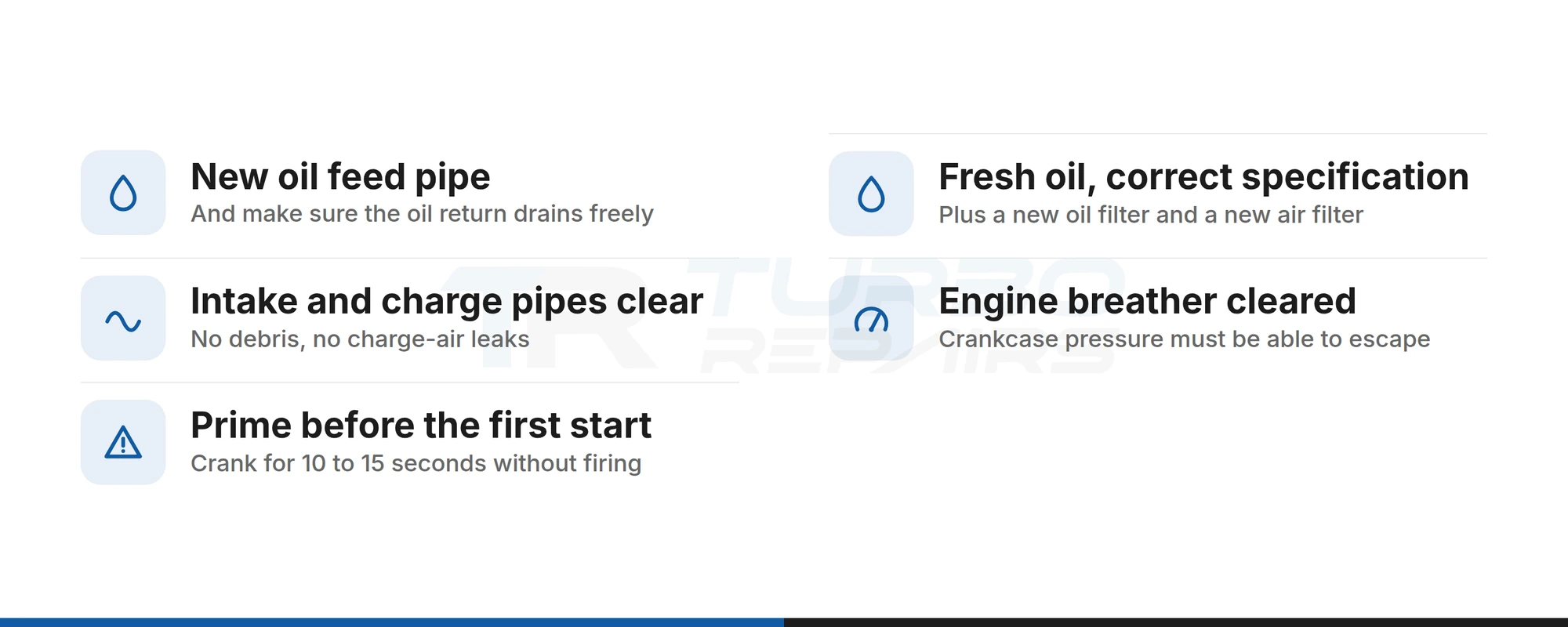
All four recognised causes of turbo failure (interrupted lubrication, contaminated oil, foreign objects and overspeed) start outside the turbocharger. When your own unit is rebuilt, its strip-down points at which one it was. With an exchange, nobody strips the old unit before the new one goes on, so the checks have to be made on the car:
- Oil feed and return. Fit a new oil feed pipe, since a collapsed or coked pipe cannot be judged from outside, and make sure the return drains freely.
- Oil and filters. Fresh oil of the correct specification, a new oil filter and a new air filter.
- Intake and intercooler. Clear any debris, including fragments of a failed wheel, from the intake and charge pipes, and check the charge-air system for leaks.
- Engine breather. Clear it. Crankcase pressure that cannot escape finds the turbo’s seals instead.
- Priming. Before the first start, crank the engine for ten to fifteen seconds without letting it fire, so oil reaches the bearings before the shaft spins.
The full removal, refit and first-start sequence is in our guide to replacing your turbocharger, and our guide to what decides how long a turbo lasts covers the habits that look after it once it is on.
Exchange Turbocharger FAQ
Do you have an exchange turbo for every vehicle?
No. We hold a selection of exchange units for some of the most commonly failing turbos. Send us the part number from your turbo’s label and we will tell you whether it is one of them. If it is not, we can rebuild your own unit instead.
Will an exchange turbo arrive the same day?
When the unit is in stock we can typically dispatch it the same day, but that is not guaranteed, and the time in transit comes on top. A unit we do not hold cannot be dispatched as an exchange at all.
What is the surcharge on an exchange turbo?
A surcharge may apply when you order an exchange unit. It is refunded when your old turbo is returned to us, so keep the old unit rather than scrapping it.
Is an exchange turbo cheaper than a rebuild?
Usually not. Exchange units start from £450 + VAT and a rebuild of your own turbo from £185 + VAT. The exchange is the route for when the vehicle cannot wait, or when your own turbo is past rebuilding.
Does an exchange unit have a shorter warranty?
No. An exchange unit carries the same lifetime, unlimited-mileage warranty as a rebuild of your own turbo.
Can I order an exchange turbo by my registration alone?
The vehicle details help, but the part number on the turbo’s own label is what identifies the unit, because one model name can cover more than one turbocharger. If the label cannot be read, tell us and we will work through the identification with you before anything is ordered.
Final Thoughts
An exchange turbo is a trade of money for time. It costs more than rebuilding the unit you already own, and in return the vehicle does not wait for postage and bench time. When your turbo is past rebuilding, it is also the route that leaves you with a sound unit at all.
What it does not do is find out why the old one failed. That job moves from our bench to the engine, and done properly, with a new oil feed, clean oil, a clear intake and a primed first start, it is what lets the exchange unit earn its lifetime warranty rather than test it.
Turbo Repairs · Epsom workshop
Exchange unit or your own turbo rebuilt: start with the part number
Complete the Repair Form with your vehicle and the number from the turbo’s label, and tell us how soon it has to be back on the road. We will tell you whether an exchange unit is in stock or whether a rebuild of your own is the better route.
Lifetime, unlimited-mileage warranty · Same-day dispatch typical on stocked units