

Summary The usual blown turbo symptoms are a loss of power, slow or late pick-up, a whine or siren under boost, blue or grey exhaust smoke, rising oil use, and the engine management light with a boost code such as P0299 or P0234. One sign on its own proves little. Two or three together usually mean a fault somewhere in the turbo system, though split hoses, the actuator and a loaded particulate filter can all mimic it.
Whether you can keep driving depends less on how bad the car feels than on what kind of sign you have. A turbo that is losing output can usually be driven gently to a garage. A turbo that is losing oil or shedding metal should not be driven unless it is unavoidable. If the turbo has failed, a rebuild of your own unit is an alternative to a replacement that would carry the same design weaknesses.
Limp mode can stop a turbo making boost; it cannot stop one losing oil.
The Signs of Turbo Failure
A turbocharger is an exhaust-driven air pump. Exhaust gas spins a turbine wheel, the turbine turns a shaft at well over 100,000 rpm, and a compressor wheel on the other end of that shaft pushes extra air into the engine. The shaft does not run in contact with its housing; it floats on a film of engine oil, and seals at each end keep that oil inside the centre housing. Our guide to how a turbo works takes the unit apart piece by piece.
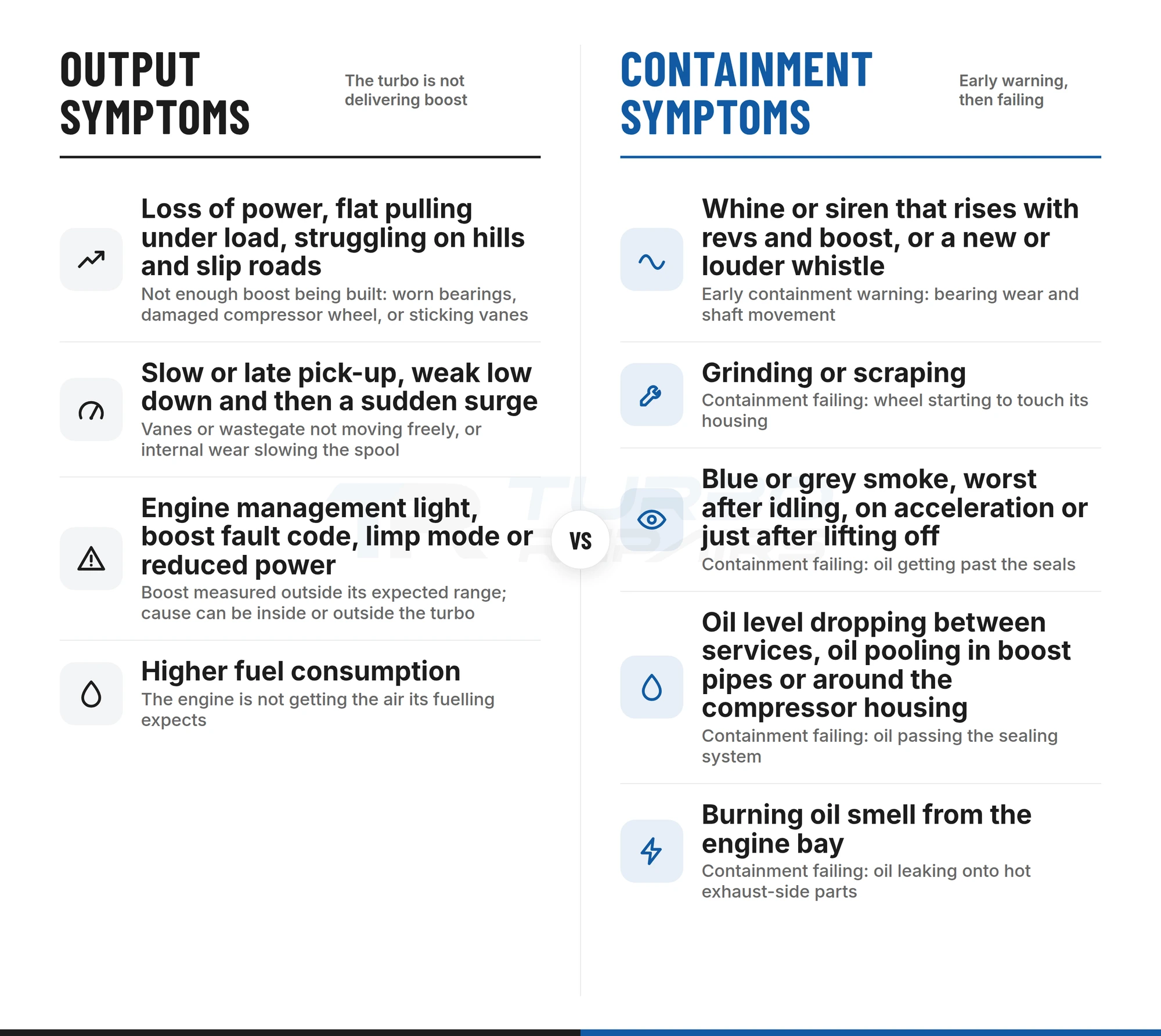
That layout explains why the signs of turbo failure fall into two groups. Some mean the turbo is losing output: it is no longer building or controlling the boost the engine expects. Others mean it is losing containment: oil is getting past the seals, or the spinning parts are no longer where they should be. The engine management can see the first group and limit the damage. It cannot see much of the second, and it can do nothing to stop it.
| Symptom | Where in the turbo it usually starts | Output or containment? |
|---|---|---|
| Loss of power, flat pulling under load, struggling on hills and slip roads | Not enough boost being built: worn bearings and shaft play, a damaged compressor wheel, or sticking vanes or boost control. Boost leaks outside the turbo do the same | Output |
| Slow or late pick-up, weak low down and then a sudden surge | Boost control: vanes or wastegate not moving freely, or internal wear slowing the spool | Output |
| Engine management light, boost fault code, limp mode or reduced power | The control system has measured boost outside its expected range. The cause can be inside or outside the turbo | Output |
| Higher fuel consumption | The engine is not getting the air its fuelling expects | Output |
| Whine or siren that rises with revs and boost, or a whistle that is new or louder | Bearing wear and shaft movement, letting the rotating assembly run out of balance | Early containment warning |
| Grinding or scraping | Excessive shaft play, with a compressor or turbine wheel starting to touch its housing | Containment failing |
| Blue or grey smoke, worst after idling, on acceleration or just after lifting off | Oil getting past the seals into the intake or exhaust side | Containment failing |
| Oil level dropping between services, oil pooling in boost pipes or around the compressor housing | Oil passing the sealing system | Containment failing |
| Burning oil smell from the engine bay | Oil leaking onto hot exhaust-side parts | Containment failing |
Two practical points follow. A whine or a slight whistle is the earliest sign many turbos give, and it often arrives before any power loss, so it is worth acting on while the car still drives normally. And none of the containment signs comes with a dashboard warning of its own. A car can be burning oil through its turbo and still pull well.
Blown Turbo Symptoms on a Diesel
A diesel turbo shows the same two groups of symptom as any other, with a few differences worth knowing.
Variable vanes. Most modern diesels control boost with a ring of adjustable vanes inside the turbine housing, moved by an actuator, rather than with a simple wastegate. Carbon from the exhaust can stiffen those vanes, so a diesel often shows control symptoms — lag, an uneven surge, intermittent limp mode — before anything inside the turbo is worn. Our guide to the VNT turbo explains how the vane mechanism works and why it sticks.
Smoke colour. Blue or grey smoke means oil is being burned, which on a turbo engine often points to oil getting past the turbo seals. Black smoke on acceleration is different. It is unburned fuel, and on a diesel it is a common sign of too little air for the fuel being injected, which an underboosting turbo or a boost leak will cause.
Some oil in the intake is normal. A light oil mist inside the intake pipework can be normal on a higher-mileage diesel. A small amount of wetness can also appear if a car has been standing. What is not normal is oil pooling in the intercooler pipes, or a level that keeps falling between services.
The particulate filter. A loaded diesel particulate filter restricts the exhaust behind the turbine and can make a healthy turbo feel tired. It works the other way too: oil passing a worn turbo ends up in the exhaust and the filter. Our article on whether a blocked DPF can cause turbo failure covers how the two interact.
Oil running the engine. Diesels are the engines at risk of running away on their own oil if a turbo seal fails badly. It is rare, and it is covered in the section on driving on below, because it is the one turbo symptom that is a safety issue in its own right.
Quick Checks Before You Blame the Turbo
Several cheaper faults produce the same symptoms as a failing turbo, and fitting a turbo to cure one of them is an expensive way to find out. These are the checks worth making first, roughly in order of how easy they are.
- Boost pipes and clamps. With the engine off and cool, follow the pipework from the turbo outlet through the intercooler to the inlet. Look for splits, especially on rubber bends, loose or missing clamps, and oily residue around a joint, which marks a leak. A split hose alone can cause power loss, a whistle and an underboost code.
- The intercooler. Check its end tanks and joints for cracks and oil. Oil sitting inside it also tells you something: a light film is one thing, pooling is a reason to look at the turbo seals.
- Vacuum lines. On engines that control the turbo with vacuum, a perished or disconnected vacuum hose leaves the turbo without control. These are small, cheap and easy to miss.
- The actuator. An electronic actuator that has failed or lost its calibration gives power loss and limp mode with a turbo that is mechanically sound. A wastegate actuator that is stuck or wrongly set does the same. The section below on telling the two apart covers this in more detail.
- The particulate filter. On a diesel, ask whether DPF warnings have been appearing and have the filter reading checked. A loaded filter can make the car feel exactly like it has a worn turbo.
- Air filter and intake. A badly blocked air filter starves the compressor. With the intake pipe off the turbo, you can also see the compressor wheel. Its blades should be clean-edged, with no chips, bent tips or rub marks, and the wheel should never touch the housing when turned by hand. A damaged compressor wheel is often visible this way.
- Fault codes and live data. A code reader shows what the engine management has recorded. Live data, comparing the boost requested with the boost measured on a road test, shows what the turbo is actually doing. A code tells you a condition was present; it does not name the failed part.
With the intake off, slight side-to-side shaft movement is normal on journal-bearing turbos; in-and-out movement is not.
Overboost and Underboost: What P0234 and P0299 Mean
These are the two fault codes most often found on a car with a turbo complaint. P0234 is the generic code for an overboost condition. P0299 is the generic code for an underboost condition. Both are recorded when the boost pressure measured in the intake stays too far from the value the engine management is aiming for, for long enough that it decides the fault is real. The usual response to either is the engine management light and a cut in power, often called limp mode, which holds boost down while the fault is stored.
P0299: underboost
P0299 means the engine has been getting less boost than it should. It is the more common of the two, because so many faults reduce boost. The likely causes, starting with the cheapest to check:
- a boost leak: a split hose, a loose clamp or a leaking intercooler, so pressure the turbo makes never reaches the engine
- a vacuum fault on a vacuum-controlled turbo
- a restricted exhaust, most often a loaded particulate filter on a diesel
- variable vanes stiff with carbon, or a wastegate that will not close properly
- an actuator that is not moving the vanes or wastegate to the position asked of it
- a fault in the boost pressure sensor or its wiring, so the reading is wrong rather than the boost
- a worn turbo: bearing wear, shaft play or a damaged wheel that stops it building pressure
A worn turbo is the last item on that list for a reason. It is a real cause of P0299, but it is rarely the only sign: a turbo worn enough to underboost usually also whines, smokes or uses oil. An underboost code with none of those signs points more strongly at the boost path or the control side.
P0234: overboost
P0234 means boost has risen above what the engine management wants. Something has stopped the turbo being held back. The usual candidates:
- variable vanes stuck in the position that builds boost, commonly from carbon in the vane mechanism
- a wastegate stuck shut, or a wastegate actuator that is seized, disconnected or set wrongly
- an electronic actuator that has lost its calibration or is not following its commands
- a boost pressure sensor reading high
Overboost puts extra pressure into the engine, which is why the engine management reacts to it by cutting power. An overboost code is a control fault more often than a worn-turbo fault, because a turbo wearing out tends to make less boost, not more.
Reading and clearing the codes
Write the code down before anyone clears it, along with any other codes stored beside it and what the car was doing when the light came on. Clearing a boost code switches the light off; it does not repair anything, and the code returns when the same conditions do. If the code reader also lists actuator position or circuit codes, our guide to turbo actuator fault codes explains those.
Can You Drive With a Blown Turbo? What Carrying On Costs
A car with a failing turbo will often still drive, and that is what makes the question dangerous: the fact that it moves is not evidence that the damage has stopped. The honest answer depends on which group your symptoms belong to.
If the turbo is losing output
Power loss, late pick-up, a boost code or limp mode with no smoke, no new noise and a steady oil level is the situation where the car can usually be driven, gently and for a short distance, to wherever it is going to be looked at. Keep the revs and load down, check the oil level before you set off, and stop if any containment sign appears. What carrying on costs here is mostly the chance of the fault developing: a leak or a sticking mechanism makes the rest of the system work harder than it should.
If the turbo is losing containment
Heavy smoke, a grinding or scraping noise, a rapidly falling oil level, or oil pouring from the turbo area mean the car should not be driven unless it is unavoidable. Arrange recovery instead. What carrying on costs here is the engine and the exhaust, not just the turbo:
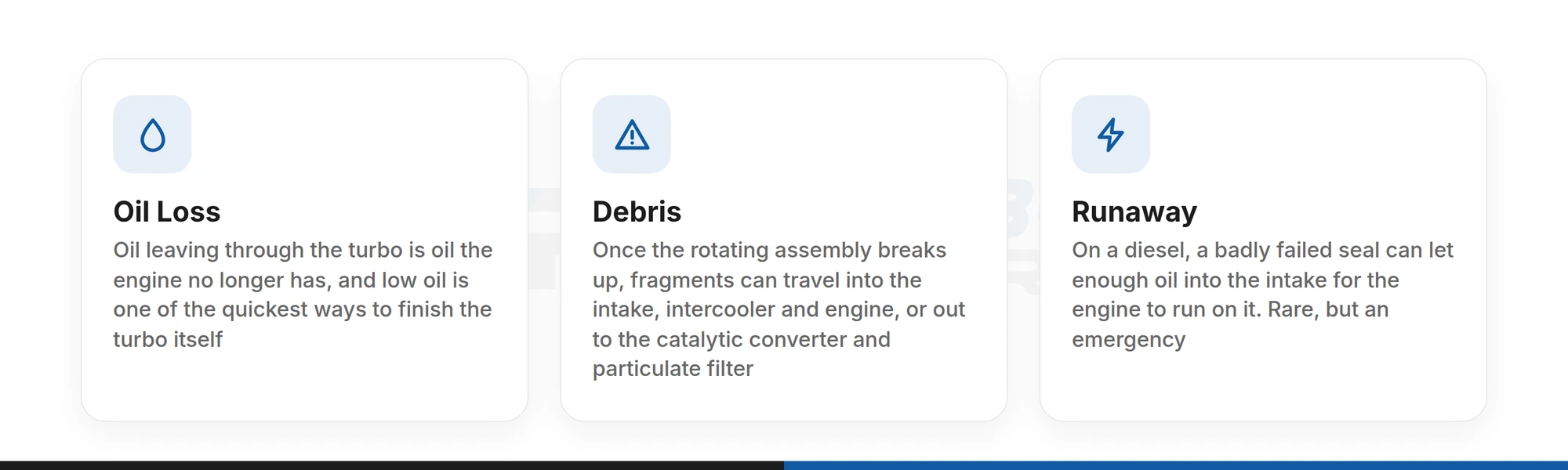
- Oil loss. Oil leaving through the turbo is oil the engine no longer has. A low oil level is also one of the quickest ways to finish the turbo itself, because its bearings depend on a steady supply.
- Debris. Once parts of the rotating assembly start to break up, fragments can travel into the intake, the intercooler and the engine, or out into the exhaust, the catalytic converter and the particulate filter.
- Runaway. On a diesel, a badly failed seal can let enough oil into the intake for the engine to run on it, revving up on its own and no longer answering the throttle. It is rare, but it can continue until the oil is used up and the engine seizes.
If a diesel starts revving on its own and does not respond when you lift off, treat it as an emergency. Get the car stopped safely, away from traffic and people, and keep clear of it.
You will find advice elsewhere giving a mileage you can safely cover on a blown turbo, or describing how to wire a wastegate open to limp home. We do not give a figure. How far a failing turbo will go depends entirely on how it is failing, and there is no way to see that from the driver’s seat. If in doubt, have it recovered.
Turbo Repairs · Epsom workshop
Turbo off the car? Send it in before you buy another
A failed turbo does not have to mean a new one. Post your unit in and it is stripped to component level, rebuilt on genuine OE or OEM-grade parts, bench-tested and returned ready to refit, typically within one to three working days on the bench.
Lifetime, unlimited-mileage warranty · Mail-in from the UK and internationally · Bench-tested and calibrated before it ships
What Happens to the Engine When a Turbo Fails
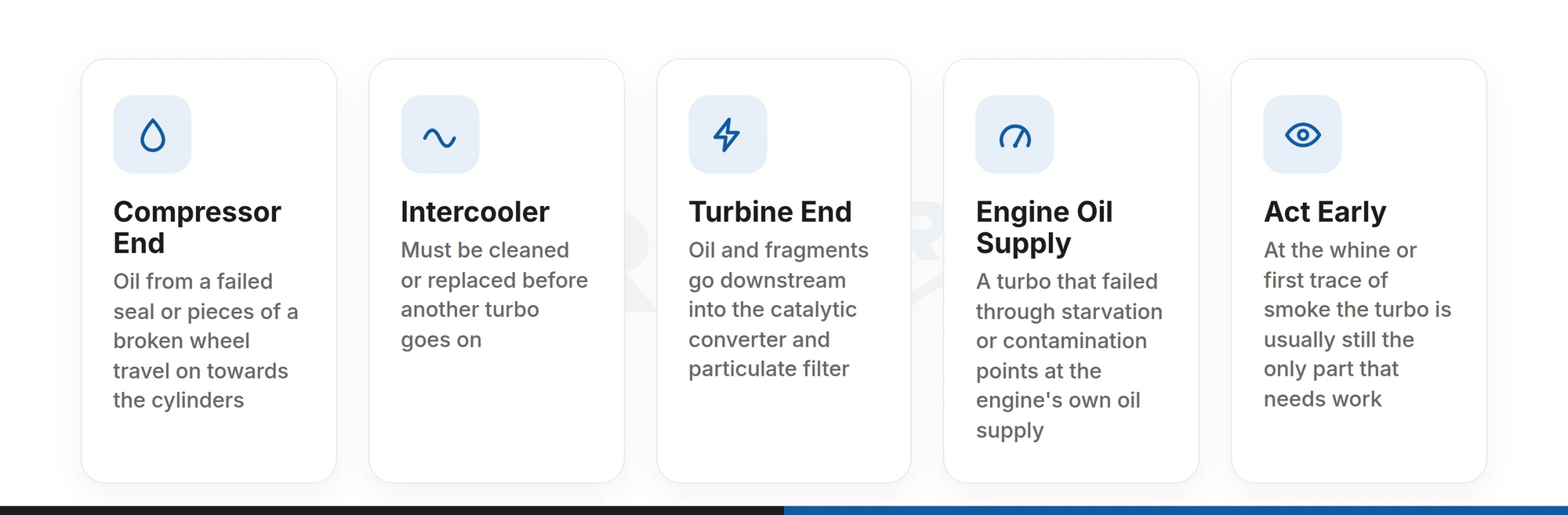
A turbo failure rarely stays inside the turbo. At the compressor end, oil from a failed seal or pieces of a broken wheel travel through the intercooler towards the cylinders, so the intercooler needs cleaning or replacing before another turbo goes on. At the turbine end, oil and fragments go downstream into the catalytic converter and particulate filter.
A turbo that failed through oil starvation or contamination also points at the engine’s oil supply, which feeds the engine’s own bearings. Act at the whine or the first trace of smoke, while the turbo is usually still the only part that needs work.
Actuator Fault or Failing Turbo?
On most modern diesels the turbo is controlled by an electronic actuator, a small motor-and-gear unit with a position sensor that sets the vanes. When it fails, the car loses power, goes into limp mode and stores a boost or actuator code. That looks like a turbo failure from the driver’s seat, but the turbocharger itself may be fine. Our article on what a turbo actuator does explains the job it is doing all the time the engine runs.
The two groups of symptom help here. An actuator fault typically brings power loss, limp mode, boost and actuator codes, and sometimes a tick or click from the actuator as it hunts. A control fault shows first as output symptoms; if smoke, oil loss or grinding appear, the turbo has to be checked whatever the actuator is doing.
The opposite is not as clean. A stuck vane ring can strain an actuator until it fails, so a failed actuator on a car with carbon-bound vanes can be a casualty rather than the cause. Our full guide to turbo actuator symptoms sets out how to tell the actuator, the turbo and the wiring apart before anything is removed.
Turbo Failure Symptoms by Model
The symptoms of turbo failure do not change much from one car to the next. What changes is the type of turbo fitted, the way the engine management reports it, and the faults that commonly sit around it.
The turbo type matters more than the badge. Most diesels use variable vanes with an electronic or vacuum actuator, so control faults and carbon are common. Many petrol engines use a wastegate turbo, where a sticking wastegate or a badly set actuator rod gives overboost or underboost. Your turbo’s part number, usually on a plate or label on the unit, tells you which you have; our guide to finding your turbo part number shows where to look.
Warning messages differ by maker. On Jaguar and Land Rover models, a turbo problem often first shows as a sharp loss of power with a Restricted Performance message on the dash, rather than a simple engine light.
We cover specific engines on our make and model pages, listed on the turbo repairs hub. Freelander 2 owners will find their answer in the FAQ below.
What to Do Next: Rebuild, Replace or Repair the Actuator
Once the checks above point at the turbo system, there are three routes, and which one is right depends on what has actually failed.
Rebuild your own turbo. If the turbocharger has failed mechanically — bearings, seals, shaft or wheels — it can be rebuilt rather than replaced. You or your garage remove the unit and post it to our workshop from anywhere in the UK or internationally. It is stripped to component level, rebuilt with genuine OE or OEM-grade or uprated parts that meet or exceed the original specification, with known design weaknesses dealt with rather than reinstalled, then bench-tested and sent back ready to refit. Turbo rebuilds are typically completed in one to three working days, and every rebuild carries a lifetime, unlimited-mileage warranty. Start from our turbocharger rebuild service, or read our guide to turbo repair costs first.
Fit a reconditioned exchange unit. If you would rather fit a ready-built unit, see our reconditioned exchange turbochargers.
Repair the actuator. If the turbo is mechanically sound and the fault is in the electronic actuator, the actuator can be repaired on its own. Our electronic turbo actuator repairs are typically completed in one to two working days, and a repaired actuator needs no programming when it is refitted.
Whichever route you take, the reason the turbo failed has to be found and put right on the car before the unit goes back on. A rebuilt or new turbo fitted to a blocked oil feed, a contaminated intercooler or a choked particulate filter is exposed to the same conditions as the one it replaced. Our guide to how long turbos last covers the habits and servicing that decide how long the next one lives.
Blown Turbo FAQ
What are the first signs of turbo failure?
Often a whine or siren under acceleration that was not there before, or a whistle that has become louder. A gradual loss of power, slower pick-up and a slow rise in oil use usually come with it or soon after. Smoke and grinding tend to be later signs. Our guide to turbo whistle explains which noises point at the turbo and which do not.
Can you drive with a blown turbo?
Sometimes, briefly, but it depends on the symptoms. With power loss or limp mode and no smoke, noise or oil loss, the car can usually be driven gently to a garage. With heavy smoke, grinding or a falling oil level, it should not be driven unless it is unavoidable — have it recovered.
How far can I drive on a failing turbo?
There is no safe figure. A turbo with a sticking vane mechanism and one that is passing oil can feel the same from the driver’s seat and have very different consequences. Check the oil level before every journey and stop at the first sign of smoke or a new noise.
Can a blown turbo damage the engine?
Yes. Oil lost through the turbo lowers the engine’s oil level, fragments of a broken wheel can travel into the intake and engine or into the exhaust and particulate filter, and on a diesel a badly failed seal can let the engine run away on its own oil.
Does a blown turbo always smoke?
No. A turbo can lose boost through wear or a control fault without passing any oil, so there is no smoke at all. Smoke means oil is getting past the seals, which is one of the more serious signs, but its absence does not clear the turbo.
Is it the turbo or the actuator?
If the only symptoms are power loss, limp mode and boost or actuator codes, the actuator is a strong suspect. If there is smoke, oil loss, a rising whine or grinding, the turbo has to be checked as well. Our turbo actuator symptoms guide goes through the checks.
What are the turbo failure symptoms on a Land Rover Freelander 2?
The same two groups as any diesel: power loss, a Restricted Performance message and boost codes when the turbo is losing output, and whine, smoke or oil use when it is losing containment. The 2.2 diesel turbo used in the Freelander 2, Evoque and Discovery Sport is covered on our Freelander 2, Evoque and Discovery Sport turbo repair page.
Final Thoughts
Most lists of blown turbo symptoms treat every sign as equal, and from the driver’s seat they can feel that way. The more useful split is between a turbo that is losing output and one that is losing containment. The first is a fault the engine management can see and protect itself from. The second is a fault it cannot see and cannot stop, and that is the one that turns a turbo repair into an engine repair.
So act on the whine, the first trace of blue smoke and the oil level that will not stay put, even while the car still pulls. Rule out the cheap imitators first, keep the codes, and if the turbo itself has failed, get it off the car while it is still the only part that needs work.
Turbo Repairs · Epsom workshop
Turbo or actuator, rebuilt and back on the car
Send in the failed turbocharger or electronic actuator with your registration and engine details. It is stripped, rebuilt with genuine OE or OEM-grade components and bench-tested before it comes back ready to refit.
Lifetime, unlimited-mileage warranty · Mail-in from the UK and internationally · Bench-tested and calibrated before it ships