

Summary There is no single SsangYong turbo actuator. The parts trade lists a Hella electronic actuator on a Garrett turbocharger for the Korando, a BorgWarner electronic actuator on the BV40 turbocharger of the Rexton 2.0, and a separately referenced electronic unit on the 2.2 diesel that runs through the later Rexton, Musso, Actyon Sports and Rodius. We rebuild Hella and BorgWarner electronic actuators alike. Your own unit is tested as it arrives, renewed at component level, calibrated and returned ready to refit, from £100 + VAT, with a lifetime, unlimited-mileage warranty.
This page sorts the range by engine and turbocharger, shows which of the numbers attached to a SsangYong actuator actually belongs to the actuator, and sets out the checks that separate an actuator fault from a turbocharger fault before anything is posted.
5440-970-0014, printed in the title of a Rexton 2.0 actuator listing, is the BV40 turbocharger’s own number; the actuator itself is listed as 59001107605 and 59001107161.
- Cars covered: SsangYong Korando, Kyron, Rexton 2.0 and 2.2, Actyon Sports, Musso from 2018 and Rodius II, wherever the actuator on the turbocharger is electronic
- Actuator makers in the listings: Hella on the Korando’s Garrett turbocharger; BorgWarner on the BV40 turbocharger of the Rexton 2.0, Actyon Sport 2.0 and Stavic 2.0
- References in the listings: Rexton 2.0 actuator 59001107605, 59001107161 and 6719920295; 2.2 XDi and e-XDi actuator listed with 6720900080
- Not on this page: the 2.9 TD Musso, whose actuator is sold as a vacuum unit, and any other vacuum-operated actuator
- Fault codes: what each one reports on is set out in our turbo actuator fault code guide
- Our service: your own actuator rebuilt from £100 + VAT, typically 1–2 working days on the bench, actuators require no programming, lifetime unlimited-mileage warranty
Which SsangYong, Which Engine, Which Turbocharger
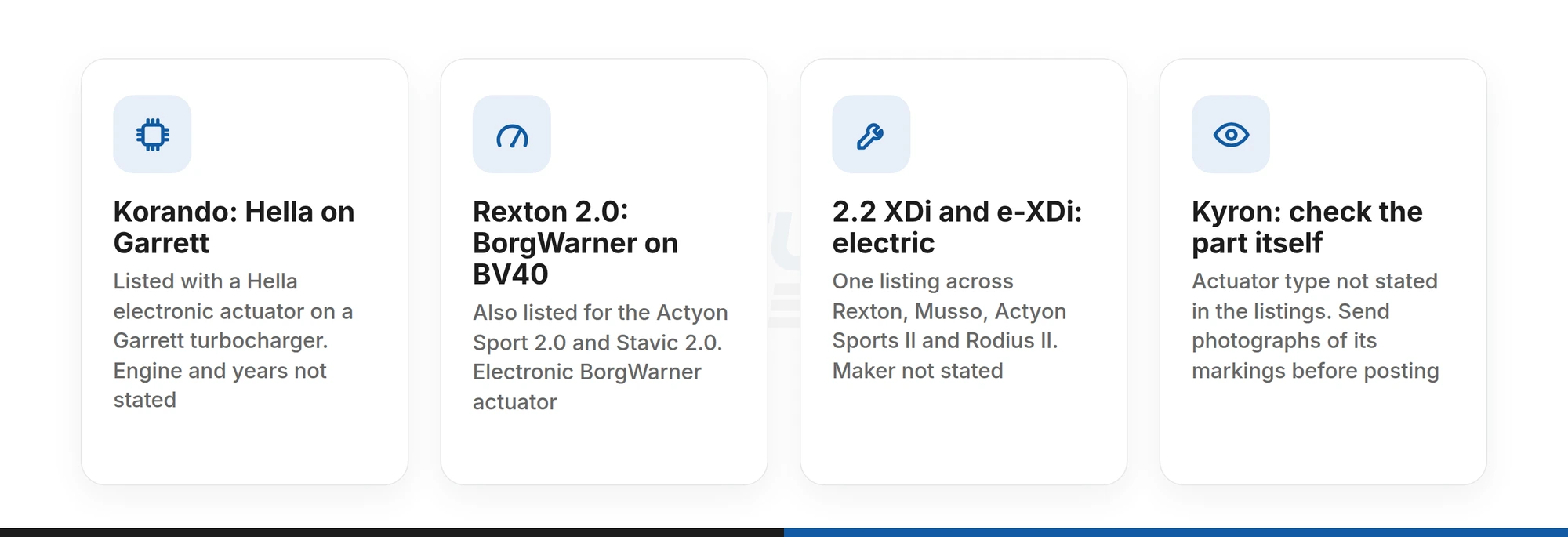
A SsangYong model name is a weak guide to the part bolted to its turbocharger. The same name has been carried by quite different vehicles: the Musso name covers a 2.9 TD sold until 2007 and, from 2018, a 2.2 e-XDi pick-up that is also sold as the Rexton Sports. The two share a badge and nothing under the bonnet.
So the useful starting point is the engine and the turbocharger, not the name. The table sets out what the listings we reviewed say about each car. Years are the ranges sellers catalogue each car against, not a production record, and “not stated” means the listing does not say.
| Car as listed | Engine | Output | Years listed | Turbocharger as listed | Actuator as listed |
|---|---|---|---|---|---|
| Korando | Not stated | Not stated | Not stated | Garrett | Hella, electronic |
| Rexton III 2.0, Actyon Sport 2.0, Stavic 2.0 | 2.0 diesel | Not stated | Not stated | BV40, 5440-970-0014 | BorgWarner, electronic: 59001107605, 59001107161, 6719920295 |
| Rexton W 2.2 XDi, including the van | 2.2 XDi / e-XDi | 131 kW | 2015 to 2017; the van to 2025 | Not stated | Electric, listed with 6720900080 |
| Rexton Y400 / Y450 2.2 XDi, including the van | 2.2 XDi / e-XDi | 133 kW | 2017 to 2025 | Not stated | Electric, same listing |
| Actyon Sports II 2.2 XDi | 2.2 XDi | 131 kW | 2015 to 2025 | Not stated | Electric, same listing |
| Musso (QK) / Rexton Sports and Musso Grand / Rexton Sports XL | 2.2 e-XDi, D22DTR | 133 kW | From 2018; Musso Grand from 2019 | Not stated | Electric, same listing |
| Rodius II 2.2 XDi | 2.2 XDi | 131 kW | 2015 to 2025 | Not stated | Electric, same listing |
| Kyron | Not stated | Not stated | Not stated | Not stated | Named on one actuator listing with the Rodius, Stavic and Actyon; type not stated |
| Musso (FJ) 2.9 TD and Musso Sports 2.9 D | OM 662 LA | 88 kW and 108 kW | 1998 to 2007; Musso Sports from 2004 | Not stated | Sold as a vacuum actuator. Not covered by this service |
The Korando: a Hella actuator on a Garrett turbocharger
The UK repair listing we reviewed for the Korando describes its actuator as a Hella unit on a Garrett turbocharger. It names neither the engine nor the years, so it tells you which two companies made the parts rather than which Korando they came from. If your Korando’s actuator carries a wiring connector and a Hella label, it is the unit this row describes, and the label gives you its reference.
The Rexton 2.0: BorgWarner’s own actuator on a BV40
The 2.0 diesel is listed with a BV40 turbocharger and an electronic actuator sold for three names: the Rexton III, the Actyon Sport and the Stavic. Neither listing gives years or outputs for the 2.0, so the badge alone will not tell you whether a given Rexton has it. The engine size on the car and the label on the turbocharger will.
The 2.2 XDi and e-XDi: one listing across six names
The 2.2 diesel is where the model names multiply. One listing sells a single electric actuator, referenced 6720900080, for the Actyon Sports II, the Musso and Musso Grand, the Rexton W, the Rexton Y400 and Y450 including the vans, and the Rodius II. It covers both the 131 kW and the 133 kW versions, so on this engine the output does not separate one actuator from another. The listing does not say who made the turbocharger or the actuator, and we do not guess. The label on your own unit settles it.
The Kyron: a gap in the listings
None of the listings we reviewed ties the Kyron to an engine, a turbocharger or an actuator reference. One names it alongside the Rodius, Stavic and Actyon for a turbo actuator without saying whether that part is electronic. So on a Kyron, look at the part itself. A housing with a wiring connector and no vacuum pipe is an electronic actuator and is in scope; send us photographs of its markings and we will confirm it before you post anything.
Not on this page: the 2.9 TD Musso
The earlier Musso and the Musso Sports are listed with a 2.9-litre diesel under the engine code OM 662 LA, and the actuator sold for them is a vacuum unit. That is a can, a diaphragm and a rod worked by vacuum, not a motorised actuator with a circuit board, and this service does not cover it. Everything below concerns the electronic units.
Hella or BorgWarner: Two Actuator Types Under One Badge
The two SsangYong actuators whose makers are on record differ in a way that matters when you come to identify one. On the Korando, the actuator and the turbocharger come from different companies: Hella made the actuator, Garrett the turbocharger. On the Rexton 2.0, both come from one maker, because the BV40 is a BorgWarner turbocharger and the electronic actuator listed for it is BorgWarner’s own unit.
That has two consequences for you as the owner.
- The turbocharger’s label does not name the actuator’s maker. On the Korando a Garrett label sits under a Hella actuator. Read the actuator’s own casing before you describe the part to anyone, including us.
- The numbers take different forms. A Hella actuator is identified by a Hella number and a G-code, and the same Hella number can be set up differently for different turbochargers, which is why one Hella number can be several parts. Our Hella reference lookup lists the vehicles each Hella number appears on. The Rexton 2.0’s actuator references are eleven-digit numbers beginning 5900110, which do not follow the spaced 5304 970 form shown in the reference table on our actuator hub. Do not expect them to.
What does not change with the maker is whether the unit can be rebuilt. We rebuild BorgWarner electronic actuators, and we rebuild Hella electronic actuators. The maker decides which parts go inside and which reference the bench set-up follows; it does not decide whether your SsangYong’s actuator is worth sending.
Reading the References Off Your Actuator
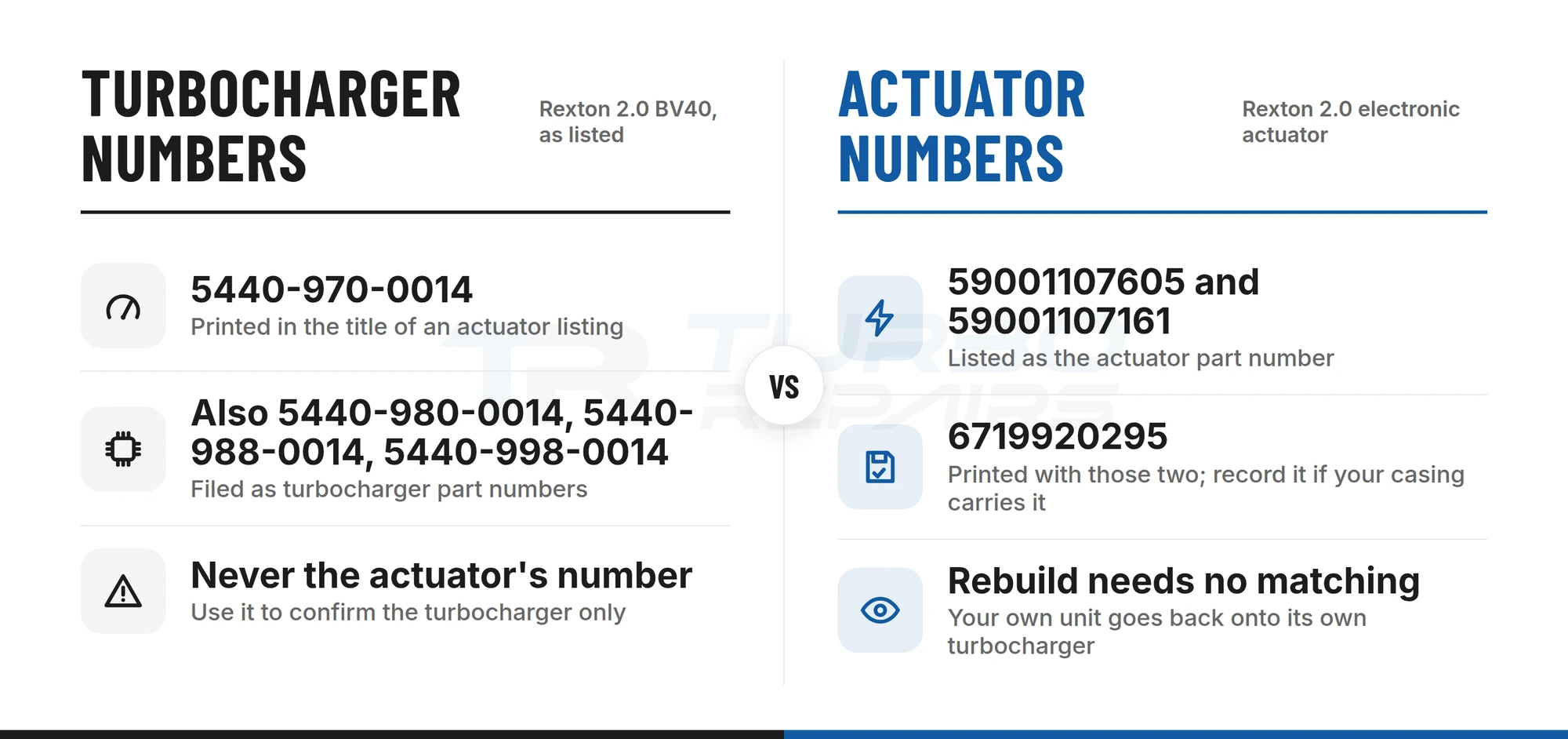
A SsangYong actuator listing usually prints several numbers at once, and they do not all name the actuator. The clearest case is the Rexton 2.0: one listing puts the turbocharger’s number in its title, and both listings we reviewed file that number under turbocharger part numbers, with the actuator’s own numbers given separately. Here is what each number names.
| Number | What it names | What to do with it |
|---|---|---|
| 59001107605 and 59001107161 | The Rexton 2.0 electronic actuator, listed as the actuator part number | Match these if you are buying a replacement for a Rexton 2.0 |
| 6719920295 | A third number printed with those two on both Rexton 2.0 listings | Record it if your casing carries it; it is listed with the actuator, not the turbocharger |
| 5440-970-0014, also 5440-980-0014, 5440-988-0014 and 5440-998-0014 | The BV40 turbocharger, listed as turbocharger part numbers | Use it to confirm the turbocharger, never as the actuator’s number |
| 6720900080 | The reference one listing attaches to the 2.2 XDi and e-XDi electric actuator | The listing does not say whether it is printed on the actuator or the turbocharger; check your casing |
| A Hella number with a G-code | The Korando’s actuator, per the listing that names Hella | Record both; the G-code marks the set-up for a particular turbocharger |
One of the Rexton 2.0 listings tells buyers, in capitals, to match from the part number rather than the turbocharger’s frame size. That is sound advice for a purchase, and it is the reason a wrong number costs money: a new unit bought against 5440-970-0014 alone has been bought against the turbocharger, not the actuator.
A rebuild asks nothing of the numbers. The unit you send goes back onto the turbocharger it came off, so nothing has to be matched to a listing. The numbers still help us: photographs of the actuator’s casing, its connector and the turbocharger’s label, sent with the Repair Form, let us confirm which unit is coming before you post it.
What a Failing SsangYong Actuator Does
An electronic actuator is sent a position by the engine management, moves the turbocharger’s boost-control mechanism to it with a small motor and gear train, and reports back where it ended up through a position sensor. When any part of that chain wears, the engine gets the wrong boost. On a Rexton, or on a Musso pick-up with a load on board, the loss is most obvious pulling away and on hills.
The usual picture is a warning lamp, a sudden drop in power and the engine management holding the car in a reduced-power mode to protect the engine. The codes it stores are normally generic ones that describe the boost, not the part: P0299 when boost is lower than requested, P0234 when it is higher, and P2263 when the boost system’s performance falls outside what the engine management expects. A split charge hose or a stiff mechanism inside the turbocharger can set the same codes as a worn actuator.
What leans towards the actuator
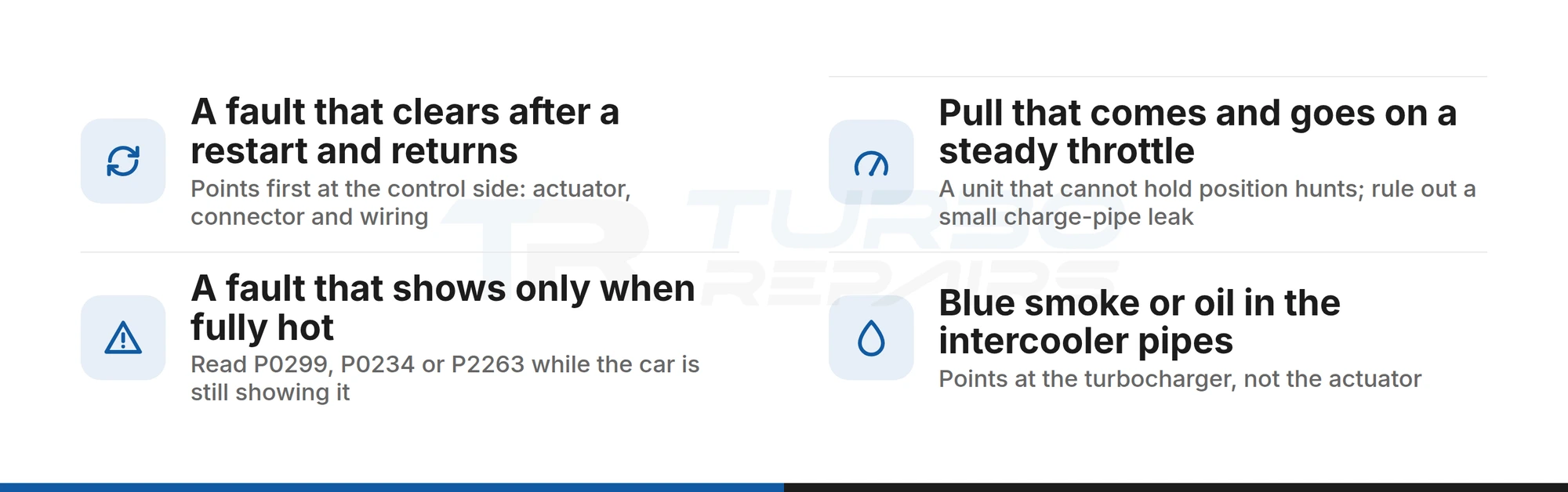
- A fault that clears after a restart and comes back. Intermittent loss of boost points first at the control side: the actuator, its connector and the wiring to it.
- Pull that comes and goes on a steady throttle. A unit that can no longer hold its commanded position hunts around it. A small leak in the charge pipes can feel similar, so it needs ruling out.
- A fault that shows only when the engine is fully hot. Heat is hard on the motor and circuit board inside the housing. Read the codes while the car is still showing it.
- A ticking or buzzing from the turbocharger with the engine running. This can be the actuator’s motor working against a worn gear train.
Blue smoke, oil in the intercooler pipes or a whine that rises with engine speed point at the turbocharger instead, because an actuator cannot move oil anywhere. Our guide to the symptoms of a failing turbo actuator goes through each pattern in more depth, and whether you have a vacuum or electronic actuator is explained alongside what the part does.
Actuator or Turbocharger? Check the Vanes First
An electronic actuator on a variable-geometry turbocharger moves a ring of vanes inside the turbine housing. If carbon has stiffened that ring, the actuator strains against it, and a garage reading the codes will quite reasonably blame the actuator. A rebuilt or new actuator fitted to a stiff vane ring meets the same resistance from its first drive, so the vanes are the thing to check before any actuator is removed.
Work through these checks in this order. None needs special tools.
- Move the vane mechanism by hand, with the engine stone cold. The turbine housing gets hot enough to burn, so leave it until it has cooled completely. Where the actuator connects to the turbocharger through an external link, have the link detached and move the turbocharger’s lever gently through its full travel. Smooth, even movement clears the vanes. Dragging, catching or stopping short means the turbocharger needs the work. Our guide to how a vane ring sticks explains why that fault tends to return.
- Inspect the connector and the loom. With the ignition off, unplug the actuator and check both halves for corrosion, water and pushed-back pins, then follow the wiring back for chafing. A poor connection throws the same codes as a failed motor.
- Pressure-test the intake. A charge hose or intercooler joint that only opens under boost reads as a boost-control fault and is far cheaper to put right than either the actuator or the turbocharger.
- Read the codes with the fault present. Plug in while the car is showing the fault, before anything is cleared, and keep the freeze-frame data. Send it with the unit; it tells the bench what to look for.
Do not drive with the actuator unplugged to see what changes. If the vanes are stiff, start with our turbocharger repairs, and mention on the form that the actuator has been working against a stiff mechanism so that we test it as well.
Turbo Repairs · Epsom workshop
Hella or BorgWarner, the rebuild starts with a photograph of the casing
Fill in the Repair Form with the model, the engine size and the stored codes, and attach photographs of every number on the actuator and on the turbocharger’s label. We confirm which unit you have before you post it, and the price is agreed before any work begins.
Lifetime, unlimited-mileage warranty · Mail-in from the UK and internationally · Bench-tested and calibrated before it ships
Our SsangYong Actuator Rebuild
We rebuild BorgWarner electronic actuators, and we rebuild the Hella units fitted to Garrett turbochargers. Whichever your SsangYong carries, you or your garage remove the actuator and send it to our workshop at Unit 102 Reaver House, 12 East Street, Epsom, Surrey, KT17 1HX, United Kingdom, where our team of turbo specialists and electronic engineers works through the same sequence on every unit.
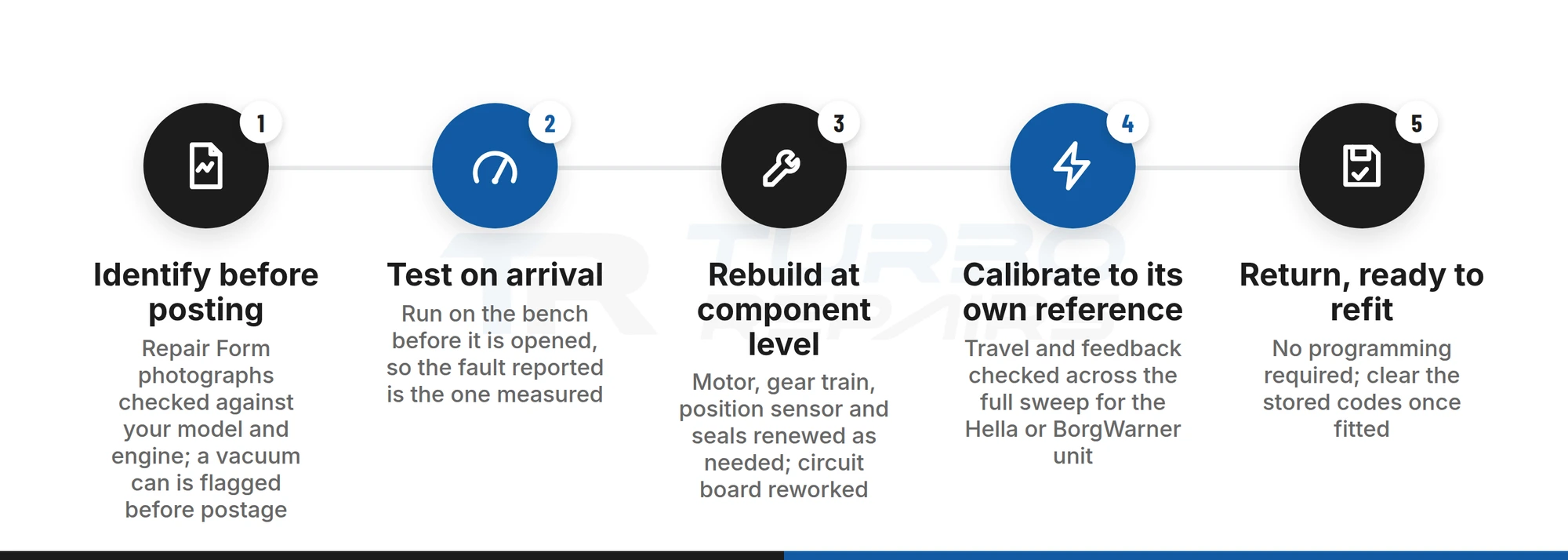
- Identification before posting. Your Repair Form photographs are checked against the model and engine you give us. If they show a vacuum can rather than an electronic actuator, you hear it from us at this stage, before any postage is spent.
- A test on arrival. The actuator is run on the bench before it is opened (see how the actuator is tested), so the fault we report is the one we measured, and a unit that proves sound is reported as sound.
- A component-level rebuild. The motor, gear train, position sensor and seals are renewed as needed and the circuit board is reworked. Parts with a known weakness in the original design are replaced with uprated components rather than refitted, so the unit meets or exceeds its original specification.
- Calibration to the unit’s own reference. Travel and position feedback are checked across the full sweep on dealer-level diagnostic and calibration tooling, set up for the Hella or BorgWarner reference on your casing.
- Return, ready to refit. Actuators require no programming, so the unit goes straight back onto the turbocharger. Clear the stored codes once it is fitted.
Electronic actuator repairs start from £100 + VAT, and the exact price is confirmed once the unit has been identified and tested, before any work goes ahead. Turnaround is typically one to two working days from arrival, plus postage each way. Every rebuild carries a lifetime, unlimited-mileage warranty, with no time limit and no mileage cap.
Independent garages send SsangYong actuators in for their customers in exactly the same way, and the steps are identical whether the unit came off a Korando or a Rodius. Packing and postage are covered on our FAQs page, and the other vehicles we cover are listed under our electronic turbo actuator repairs.
SsangYong Turbo Actuator FAQ
Which turbo actuator does my SsangYong have?
It depends on the engine, not the model name. The listings put a Hella electronic actuator on the Korando’s Garrett turbocharger, a BorgWarner electronic actuator on the BV40 turbocharger of the Rexton 2.0, Actyon Sport 2.0 and Stavic 2.0, and an electric actuator referenced 6720900080 on the 2.2 XDi and e-XDi. The label on your own actuator confirms which you have.
Can you repair the BorgWarner actuator on a Rexton 2.0?
Yes. We rebuild BorgWarner electronic actuators. The unit listed for the Rexton 2.0 carries the references 59001107605, 59001107161 and 6719920295, and it is rebuilt at component level and calibrated to its own reference before it comes back.
Is 5440-970-0014 the Rexton actuator’s part number?
No. Both Rexton 2.0 listings we reviewed give 5440-970-0014 as a turbocharger part number: it identifies the BV40 turbocharger the actuator is fitted to. The actuator is listed as 59001107605 and 59001107161. If you are buying a new unit, match those; if you are sending yours for a rebuild, nothing needs matching.
My Kyron is not in the listings. Can you still rebuild its actuator?
If it is electronic, yes. Look for a wiring connector on the housing and no vacuum pipe, then send photographs of every marking through the Repair Form. We confirm the unit before you post it.
Does this service cover the actuator on the 2.9 TD Musso?
No. The earlier Musso 2.9 TD and the Musso Sports 2.9 D are listed with a vacuum actuator, a can and diaphragm worked by vacuum. That is a different component from the electronic actuators this service rebuilds.
Will the rebuilt actuator need programming or coding?
No. Actuators require no programming. Your own unit is calibrated on our bench and returned ready to refit; clear the stored fault codes with a diagnostic tool once it is back on the car.
How much does a SsangYong actuator repair cost, and how long does it take?
Electronic actuator repairs start from £100 + VAT, with the exact price confirmed after the unit has been identified and tested. Turnaround is typically one to two working days from arrival, plus postage each way, and every rebuild carries a lifetime, unlimited-mileage warranty.
Final Thoughts
SsangYong is a make where the model name does the least work. The Musso name spans two unrelated vehicles, the 2.2 diesel’s actuator is sold under six names at once, and the number in the title of a Rexton 2.0 actuator listing belongs to the turbocharger. What does the work is the engine, the turbocharger’s label and, above all, the markings on the actuator’s own casing.
Once you know which unit you are holding, the order is short: free vanes first, then a clean connector and a sealed intake, then codes read with the fault still live. If the vanes sweep freely, the actuator already set up for your turbocharger is the one to rebuild, whether Hella or BorgWarner made it.
Turbo Repairs · Epsom workshop
Korando, Kyron or Rexton: your own actuator, rebuilt and returned
Start the Repair Form with your model, engine size and stored codes, and add photographs of the actuator’s casing so we can confirm the unit before it is posted. It comes back tested, rebuilt at component level and calibrated to its own reference, ready to bolt on without programming.
Lifetime, unlimited-mileage warranty · Mail-in from the UK and internationally · Bench-tested and calibrated before it ships