

Summary We rebuild the electronic turbo actuator from the Ford Transit and Transit Custom diesel: the Hella units recorded for the MK7 and Euro 5 2.2 TDCi, the 6NW010430-22 variant, and the actuator on the 2.0 EcoBlue’s variable-geometry turbocharger. The actuator unbolts from the turbocharger, which stays on the van, and comes back from our Epsom workshop stripped, renewed and recalibrated, ready to refit without programming. Repairs start from £100 + VAT, bench time is typically one to two working days, and every repair carries a lifetime, unlimited-mileage warranty.
On a Transit the binding that wears an actuator out normally shows at the two ends of the vane lever’s travel, so a lever that feels free through the middle has not passed the check yet.This page is for the owner-driver, fleet manager or garage holding a Transit with a boost fault. It identifies the actuator from its label, reads the codes each generation logs, and separates an actuator fault from a turbocharger fault before anything is ordered.
- Vans covered: Transit MK7 2.2 TDCi; the Euro 5 2.2 TDCi in the Transit, Transit Custom and Tourneo; the 2.0 EcoBlue in the MK8 Transit and later Custom
- Actuator references recorded: Hella 6NW009206 (MK7); Hella 6NW009550, G-59, with 767649 (Euro 5 2.2); 6NW010430-22 with 797863-0073 (some 2.2 TDCi vans)
- Codes: P132A and P132B (Ford-specific), P2598 and P2599, plus P2263, P0234 and P0299
- First check: engine cold, actuator disconnected, vane lever swept by hand to both stops
- Price: from £100 + VAT, confirmed before any work goes ahead
- Bench time and warranty: typically one to two working days plus postage; lifetime, unlimited mileage
- Getting started: the online Repair Form
Which Transit Actuator Is On Your Van? MK7, Euro 5, MK8 and Custom
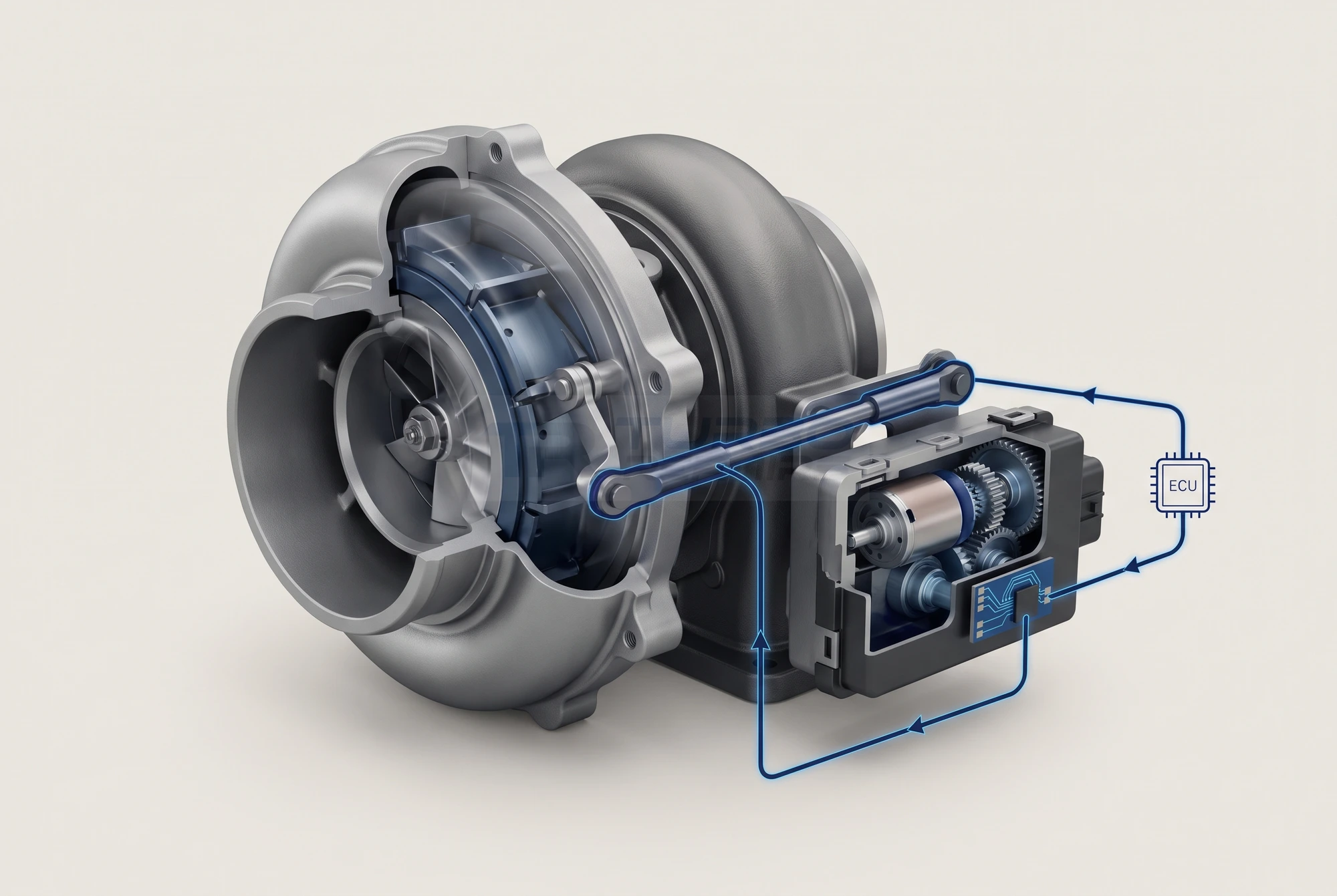
The Transit has carried an electronic actuator on its diesel turbocharger across more than one generation, and not always the same part. The actuator follows the engine and its emissions standard rather than the body shape, which is why a late MK7 and an early MK8 on the Euro 5 2.2 TDCi share a row below. The references are those recorded in the trade listings we hold and in our own records.
| Van | Engine | Actuator references recorded | Codes recorded |
|---|---|---|---|
| Transit MK7, 2006–2014 | 2.2 TDCi Duratorq, 85–140 PS | Hella 6NW009206 | P132A, P132B |
| Transit MK7 and MK8, Euro 5, 2011–2016; Transit Custom and Tourneo on the same engine | 2.2 TDCi Duratorq; listed as front-wheel drive at 114 kW (155 PS) | Hella 6NW009550, G-code G-59, actuator number 767649, on a Garrett GTB1749VK turbocharger | P132A, P2598, P2599 |
| Some 2.2 TDCi vans | 2.2 TDCi | 6NW010430-22, listed with Garrett turbocharger number 797863-0073 | Not separately recorded |
| Transit MK8, 2016 on; later Transit Custom | 2.0 EcoBlue | Electronic actuator on the Garrett variable-geometry turbocharger; no actuator reference in our sources | P2599, P0299, P0234 |
Read the table as a starting point, not a fitment list. The G-59 listings name the front-wheel-drive 2.2 at 114 kW (155 PS). The 2.2 TDCi ran at several outputs, and none of our sources ties the others to G-59 or to a different unit, so on any other 2.2 the label on your own actuator settles it.
The 2.0 EcoBlue has the least published detail: our sources record its codes and its Garrett turbochargers, but no actuator reference of its own. On an MK8 or a later Custom, the casing is the only reliable identification.
Two Transits sit outside this page. The 3.2 five-cylinder shares its engine with the Ford Ranger, covered on our Ford Ranger turbo actuator page. For the 2.4 TDCi and the early 2.0 Duratorq, none of our actuator sources lists an electronic actuator reference, so start with the turbocharger on our Transit turbo rebuild page.
Reading the Label: 6NW009206, G-59 and the Garrett-Coded 6NW010430-22
The actuator carries its own label, separate from the turbocharger’s, and that is the one that identifies it. On some vans it sits on a face you cannot see with the actuator fitted: one listing for the 6NW010430-22 places the number on the aluminium side of the casing, and notes that the actuator may have to come off before it can be read.
Photograph every face rather than copying one number down. A Transit actuator label can carry a Hella reference beginning 6NW, a G-code, and a second number that is either the actuator’s own or that of the turbocharger it was sold against. Each does a different job.
6NW009206: the MK7 2.2 TDCi
6NW009206 is the Hella reference recorded for the MK7 2.2 TDCi, and it is a shared base number. Our Hella actuator reference index also lists it against the Mondeo 1.8 TDCi and the Jaguar X-Type 2.0 and 2.2, under more than one G-code. The 6NW number gives the family; the G-code beside it narrows the unit, so record both.
6NW009550, G-59: the Euro 5 2.2
The Euro 5 2.2 actuator is listed as Hella 6NW009550 with the G-code G-59 and actuator number 767649, on a Garrett GTB1749VK. The same listings carry Ford’s turbocharger reference BK2Q-6K682-GA and Garrett 786880 references. Those belong on the turbocharger’s housing, so do not let them stand in for the actuator’s label.
The Hella number alone is not enough here. The same 6NW009550 is catalogued on BMW six-cylinder saloons under a different G-code and on a different turbocharger, so a listing that matches only the 6NW number can be selling the wrong set-up. On this actuator, G-59 is the part of the label that says Transit.
6NW010430-22: the variant sold against a Garrett number
Some 2.2 TDCi vans carry an actuator referenced 6NW010430-22, listed alongside 797863-0073. The 6NW number is in Hella’s format and the listing gives Hella as the brand; 797863-0073 is the Garrett turbocharger number it is sold against, which is why the unit is often called Garrett-coded.
Record the suffix exactly as printed. 6NW010430-04 is a different actuator, catalogued for BMW diesels, so a number without its dash and two digits is incomplete. If the label has burned off, send the actuator anyway: it is identified on the bench before any work starts.
P132A, P132B, P2598 and P2599: Which Transit Logs Which
Which code a Transit stores says something about the van as well as the fault. The two Ford-specific codes are recorded on the 2.2 TDCi, the position codes on the Euro 5 2.2 and the 2.0 EcoBlue, and the generic boost codes on any of them.
| Code | What it reports | Recorded on |
|---|---|---|
| P132A | Ford-specific. Boost control actuator “A”, circuit range or performance. Some descriptions call it a wastegate actuator, although the Transit controls boost with vanes. | MK7 and Euro 5 2.2 TDCi |
| P132B | Ford-specific. Boost control “A” performance. | MK7 2.2 TDCi |
| P2598 / P2599 | Boost control position performance: the vane position reported back has not followed the position commanded. | Euro 5 2.2 TDCi, including the front-wheel-drive van; 2.0 EcoBlue |
| P2263 | Boost system performance. | Any of the vans above |
| P0234 | Overboost. | Recorded on the Transit Custom |
| P0299 | Underboost. | Recorded on the 2.0 EcoBlue |
A basic reader can show P132A and P132B as unknown, or with a description that never mentions the turbocharger. That is a limit of the reader, not of the code. Our guide to turbo actuator fault codes explains how basic readers handle manufacturers’ codes, and our Ford Mondeo actuator page sets out where published descriptions of P132A disagree.
The position codes come closest to naming the actuator, because they compare what was commanded with what was reported. Even so, a vane ring stiff with carbon produces the same disagreement as a worn actuator. P2263, P0234 and P0299 say only that boost missed its target, and a split boost hose, a faulty boost-pressure sensor, an EGR fault or a blocked particulate filter can set them too.
Record every stored code before anything is removed, with whether it returns straight away or only once the van is hot, and whether a restart clears it. That record travels with the actuator.
Actuator or Turbo? The Lever Check Before You Order Anything
Every code above leaves one question open: is the actuator failing to move the vanes, or are the vanes refusing to be moved? The answer decides between an actuator repair with the turbocharger left in place and a turbocharger job, and you can find it on the van by hand.
Clear the cheap causes first: boost hoses, intercooler pipes and clamps for splits and oil, and the actuator’s connector for corrosion or broken tabs. Our guide to the checks you can do on the car first sets them out in order.
How to sweep the vane lever
- Engine off and cold. The turbine housing and exhaust stay hot enough to burn long after a drive.
- Disconnect the actuator from the vane lever. On most electronic units that means unbolting it from the turbocharger; a fitting note for the 6NW010430-22 describes releasing the circlip on the arm instead. Either way, the turbocharger stays where it is.
- Move the lever gently through its full travel by hand, all the way to one stop and then to the other. Do not force it.
- Note how it felt through the middle and at each end: free, notchy, tight or short of travel.
The ends are the part most people skip, and they are usually where the answer is. Vanes that are starting to stick normally tighten at one or both ends of the travel first. A lever that swings freely through the middle and then drags at a stop has not passed: it is a vane ring the actuator would push against on every movement.
| What the lever does | What it means | What to do next |
|---|---|---|
| Sweeps smoothly to both stops | The vane ring is working; the actuator is the suspect | Send the actuator, with its codes and label photographs |
| Free in the middle, tight or notchy at one or both ends | The vane ring is dragging. Count it as a vane fault, even if the van still runs | The turbocharger needs attention before any actuator goes back on |
| Stiff throughout, or will not move | Carbon is binding the vane mechanism | Turbocharger rebuild; no actuator, rebuilt or new, can move a seized ring |
When the turbocharger is the problem, oil in the boost pipes, blue smoke, a metallic whine or shaft play usually say so too. Our Ford Transit turbo repair page sorts those signs, and for a 2.0 EcoBlue van the Transit 2.0 TDCi turbocharger rebuild listing includes the EcoBlue engine codes.
A dealer route on these vans typically replaces the turbocharger and its actuator together, while a rebuilt actuator on a dragging ring fails for the reason the first one did. The lever tells you which you are facing, and our guide to what each actuator replacement route involves compares the options from there.
Turbo Repairs · Epsom workshop
Lever free at both stops? Keep the turbo and post the actuator
Complete the Repair Form with the van’s codes and the numbers off the casing, then post the actuator in on its own. It is tested as it arrives, and you hear what failed and the price before any rebuild goes ahead.
Lifetime, unlimited-mileage warranty · Mail-in from the UK and internationally · Bench-tested and calibrated before it ships
What Wears Inside a Transit Actuator
The actuator is a small electric motor and a position sensor in one sealed housing, with a circuit board between them and the van’s wiring. The motor turns a gear train, including a worm gear on the Transit units, which drives the arm on the vane lever. The sensor reports where the arm has got to, and the engine management compares that with what it asked for.
All of it works bolted to a turbocharger, in heat and vibration. On high-mileage Transit units, gear wear and position-sensor failure are the faults repairers report most:
- The gear train. Teeth wear with every movement, and a stiff vane ring raises the load until they strip, leaving the motor turning without moving the vanes.
- The motor. It works harder against a dragging ring and can burn out. A fitting note for the 6NW010430-22 warns that an actuator fitted to sticking vanes will burn out again.
- The position sensor. As it wears or drifts, the engine management stops trusting where the vanes are and limits power even when the gears and motor are sound. Freeing the mechanism without recalibrating the sensor does not hold.
- The board connections. Solder joints crack with repeated heating and cooling, giving a fault that appears hot and a unit that passes a cold test.
- Water and the connector. A tired seal or cracked connector lets water in, corrosion follows, and the feedback turns erratic, often faulting as the plug warms and flexes.
How it shows from the driver’s seat
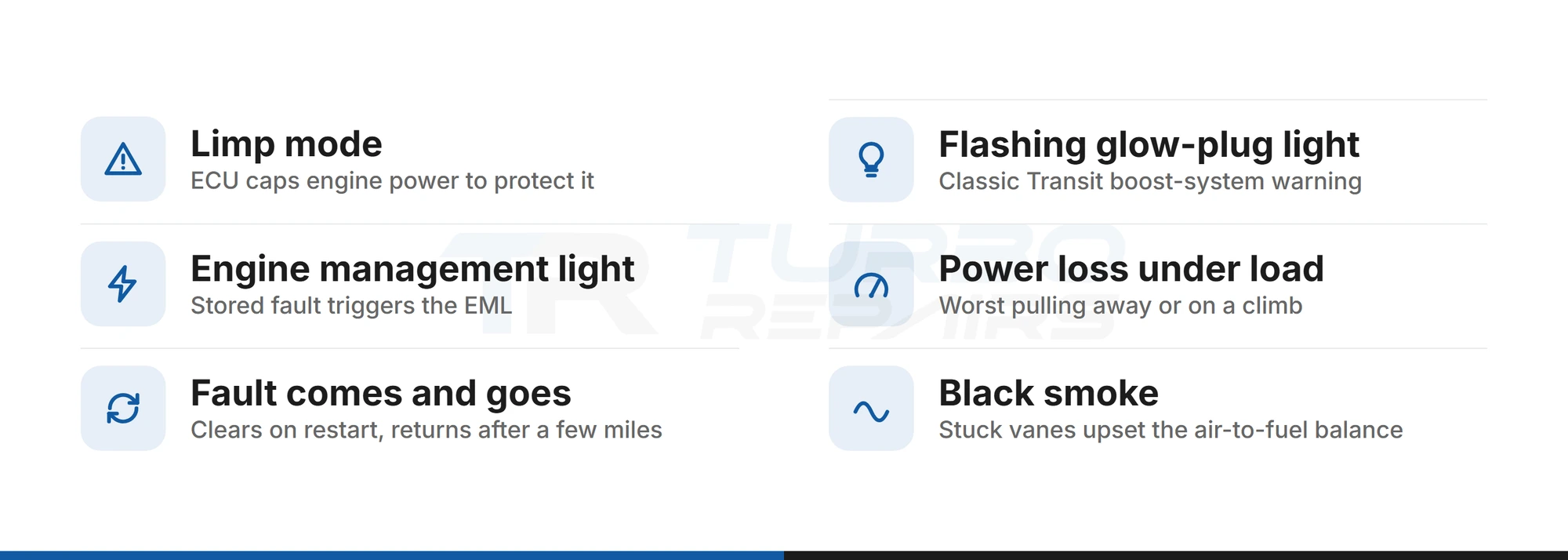
A Transit actuator rarely fails all at once. It usually starts with power cutting out under acceleration, hot or cold, with the engine-management light or, on some vans, the glow-plug light. The van falls into limp mode, a restart brings the power back, and a few miles later it goes again, until the van stays in limp mode.
Vanes that stick produce the same pattern, as our guide to the VNT turbo and its vane mechanism explains. The symptoms start the diagnosis; the lever check finishes it.
Fleet and Trade Vans: Keeping the Van Off the Road for Less Time
On a working Transit, an actuator fault is counted in days off the road, and most of them are spent away from the bench: waiting for a diagnosis, waiting for a part, refitting something that was not the fault. The repair itself is short. What shortens the rest is an order of work in which the van comes off the road once.
- Record the fault while it is live. Read the codes, and note whether it appears hot or cold and whether a restart clears it. On a shared van, ask every driver who has had it: the person who felt the fault is rarely the person removing the part.
- Clear the hoses and the connector before anything is ordered.
- Do the lever check when the actuator is removed, cold and to both stops. It decides whether you post an actuator or send the turbocharger for a rebuild.
- Photograph the label and fill in the Repair Form before the parcel goes, so the unit is logged against the van the day it arrives.
- Pack it in a padded box on a tracked service, with the connector protected.
From arrival, bench time is typically one to two working days, plus postage each way. The actuator that comes back is the one that came off, so there is nothing to match and nothing to programme.
Two things lengthen the time off the road more than anything else. One is fitting an actuator, new or rebuilt, to a vane ring that drags. The other is driving on in limp mode with vanes that may be stuck towards closed, which risks overboost damage inside the turbocharger. The lever check catches the first; parking the van until it is done avoids the second.
Independent garages, workshops and main dealers send actuators in the same way owners do, and the Repair Form gives each job its own reference for the parcel, so units from different vans in a fleet are never confused.
Our Ford Transit Actuator Rebuild
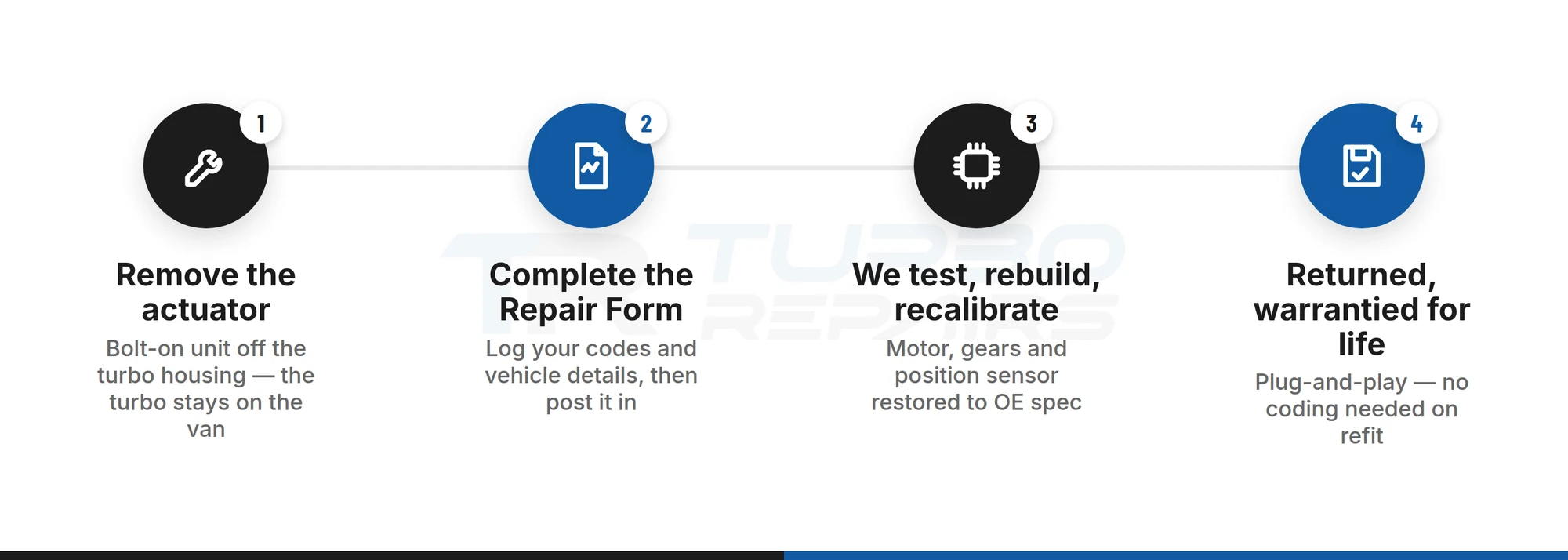
Your actuator comes to our workshop at Unit 102 Reaver House, 12 East Street, Epsom, Surrey, KT17 1HX, United Kingdom, where turbo specialists and electronic engineers who rebuild actuators as their core work take it through the same sequence every time.
- Tested as it arrives. Before it is opened, the actuator is driven through its sweep and its feedback read, so the fault is confirmed rather than assumed. If it proves healthy, we tell you and nothing is rebuilt.
- Stripped to component level. Worn parts are renewed with genuine OE or OEM-grade components that meet or exceed the original specification, and a part with a known design weakness is uprated rather than reinstalled.
- Recalibrated. The position sensor is recalibrated to the vane end-stops, so the position the actuator reports lines up again with the position commanded.
- Proven before it ships. The unit is driven through its full sweep, held at commanded positions while warm, and checked against live boost targets on dealer-level diagnostic and calibration tooling and our in-house test platforms.
You are told what failed, and the exact price, before the rebuild goes ahead; actuator repairs start from £100 + VAT. The full sequence is on our page about how actuators are tested and calibrated, and the Transit sits on our electronic turbo actuator repairs bench alongside every other unit we rebuild.
The actuator comes back ready to refit with no programming: bolt it on, reconnect the plug and clear the stored codes. Every repair carries a lifetime, unlimited-mileage warranty, with no time limit and no mileage cap.
On the online Repair Form, give us the registration, engine, mileage, every stored code, the numbers from the actuator label, and how the vane lever felt at each end of its travel. If an actuator has already been fitted and the fault came back, say so. Packing and postage are covered on our FAQs page.
Ford Transit Turbo Actuator Repair FAQ
How much does a Ford Transit turbo actuator repair cost?
Rebuilding the actuator starts from £100 + VAT, with the exact price confirmed once the unit has been tested and before any work goes ahead. Removing and refitting it is charged separately by whoever does that work.
My garage has quoted for a new turbo. Does my Transit need one?
Not if the turbocharger itself is sound. If the vane lever sweeps freely to both stops with the actuator disconnected, and there is no oil, smoke or shaft play, rebuilding the actuator alone is usually the repair and the turbo stays on the van.
Which actuator does my Transit Custom have?
It depends on the engine. The Euro 5 2.2 TDCi Custom is listed with the Hella 6NW009550, G-59 unit. Our sources give no actuator reference for the 2.0 EcoBlue Custom, so the label on the casing decides, and an unreadable unit is identified on the bench.
A new actuator did not fix my van. Why?
Usually because the vanes were the fault. If the ring drags at either end of its travel or is stiff throughout, any actuator fitted to it strains against it and the boost fault returns. Sweep the lever to both stops before another actuator goes on.
Can I keep driving the van in limp mode?
Only as far as somewhere safe to stop. Vanes stuck towards closed risk overboost and damage inside the turbocharger; stuck open, they leave little usable power. A restart may bring power back for a while, but that is not a repair.
Will the rebuilt actuator need programming?
No. It is calibrated on our bench and goes back on without coding or programming. Clear the stored codes with a diagnostic tool once it is refitted.
How long does it take, and what is the warranty?
Bench time is typically one to two working days from arrival, plus postage each way. Every actuator repair carries a lifetime, unlimited-mileage warranty, with no time limit and no mileage cap.
Can I send my actuator from outside the UK?
Yes. Contact us with your fault codes and vehicle details before you send it, so we can advise on the courier and any customs paperwork.
Final Thoughts
A Transit actuator fault tends to look bigger than it is. The code may be one a basic reader cannot name, the first quote may be for a whole turbocharger, and the van earns nothing while you find out which. Underneath sits a bolt-on unit with a label that identifies it, and a lever beside it that tells you whether it is really the fault.
So read the label before the unit is cleaned or packed, rule out the hoses and the connector, and sweep the lever cold, all the way to both stops. Free at both ends, and the actuator is the repair while the turbocharger stays on the van. Dragging at either end, and you have found the real fault before a rebuilt unit was asked to fight it.
For Transit turbochargers and the rest of the Ford range, see our Ford turbo repair page.
Turbo Repairs · Epsom workshop
One removal, one repair: have the Transit’s actuator rebuilt
Send the actuator with photographs of its label, its stored codes and a note of how the vane lever felt at each end of its travel. It comes back rebuilt, recalibrated and tested, ready to bolt on and drive.
Lifetime, unlimited-mileage warranty · Mail-in from the UK and internationally · Bench-tested and calibrated before it ships