

Summary A failing electronic turbo actuator shows itself as limp mode, persistent underboost or overboost, a stored boost-control code, and performance that changes with engine temperature — all of which the turbocharger, the vane mechanism or the wiring can produce just as easily. Below is what each symptom proves, a procedure that separates an actuator fault from turbo failure, and what to record before you book. Actuator rebuilds start from £100 +VAT, typically completed in one to two working days.
Limp mode, a boost code and power that changes with temperature all have more than one possible cause, so the procedure below matters more than the symptom itself.
- The symptom picture: limp mode, steady underboost or overboost, a stored boost-control code, and performance that changes with engine temperature. Every one of those can be produced by the turbocharger, the vane mechanism or the wiring just as easily as by the actuator.
- What points away from the actuator: a rising siren-like whine climbing with engine speed is the rotating assembly, and blue or grey smoke with oil pooling in the charge pipes is turbo seals, a restricted oil return or a pressurised crankcase. An actuator cannot cause either — and both arrive here with a new actuator already fitted.
- The restart test: if full power returns after a key cycle, the fault is on the control side. Bearings and wheels do not repair themselves at ignition-off.
- What a code actually proves: P0299 says only that the engine did not receive the boost it asked for and P0234 that it received more. P2562 and P2563 confine the fault to the boost control position sensor circuit; P0045 says a circuit is open somewhere along its length, not which end broke. The freeze-frame data stored with a code is worth more than the code — read it before anything is cleared.
- The fault a cold test cannot find: connections on the board crack with thermal cycling, and the manufacturers are explicit that it can only be detected once there is a temperature change. Fine on a ramp, limping twenty minutes into a run — so “no fault found” from a cold session is not a result.
- What to record before you book: every stored and pending code with its freeze-frame, how far into the drive the fault appears and whether it repeats there, whether a restart clears it, commanded boost against actual, noise and smoke honestly described, any recent work, and the reference on the actuator casing photographed on every face.
- When to stop driving: overboost, a hard cut shortly after full throttle, metallic noise from the turbo or heavy smoke — stop now. Limp mode or steady underboost with no smoke, no metallic noise and a stable oil level — drive gently to a workshop. Repairs start from £100 +VAT and are typically completed in one to two working days.
An electronic actuator on its way out rarely announces itself. It gives the same limp mode, the same underboost code and the same flat throttle as half a dozen other faults in the boost system. That is how an actuator ends up replaced on a hunch while the car still limps afterwards. What separates it is the pattern around the symptom: when it appears, whether a restart clears it, and what the engine management recorded at the time.
What an Electronic Turbo Actuator Does, and Why That Shapes the Symptoms
On a variable-geometry turbocharger the actuator moves the vane mechanism inside the turbine housing, changing how exhaust gas meets the turbine wheel. On a wastegate turbo it opens and closes the wastegate to cap boost. Either way, it decides how hard the turbo is driven at any moment.
A rotary electronic actuator does that with a small electric motor turning a gear train, and a position sensor reporting where the output shaft actually is. The engine management commands a position and compares it with the one achieved, which is why actuator faults present as boost faults rather than noises.
Failure then takes one of two directions. Vanes held too far closed choke exhaust flow and can drive the turbine beyond its intended speed; vanes sitting further open than requested leave the turbo slow to respond. One reads as overboost and a hard cut, the other as lag and a flat engine. The longer version of that mechanism — what a turbo actuator does, on both wastegate and variable-geometry turbos — is worth reading first if any of this is new.
First, Establish Which Actuator Your Turbo Has
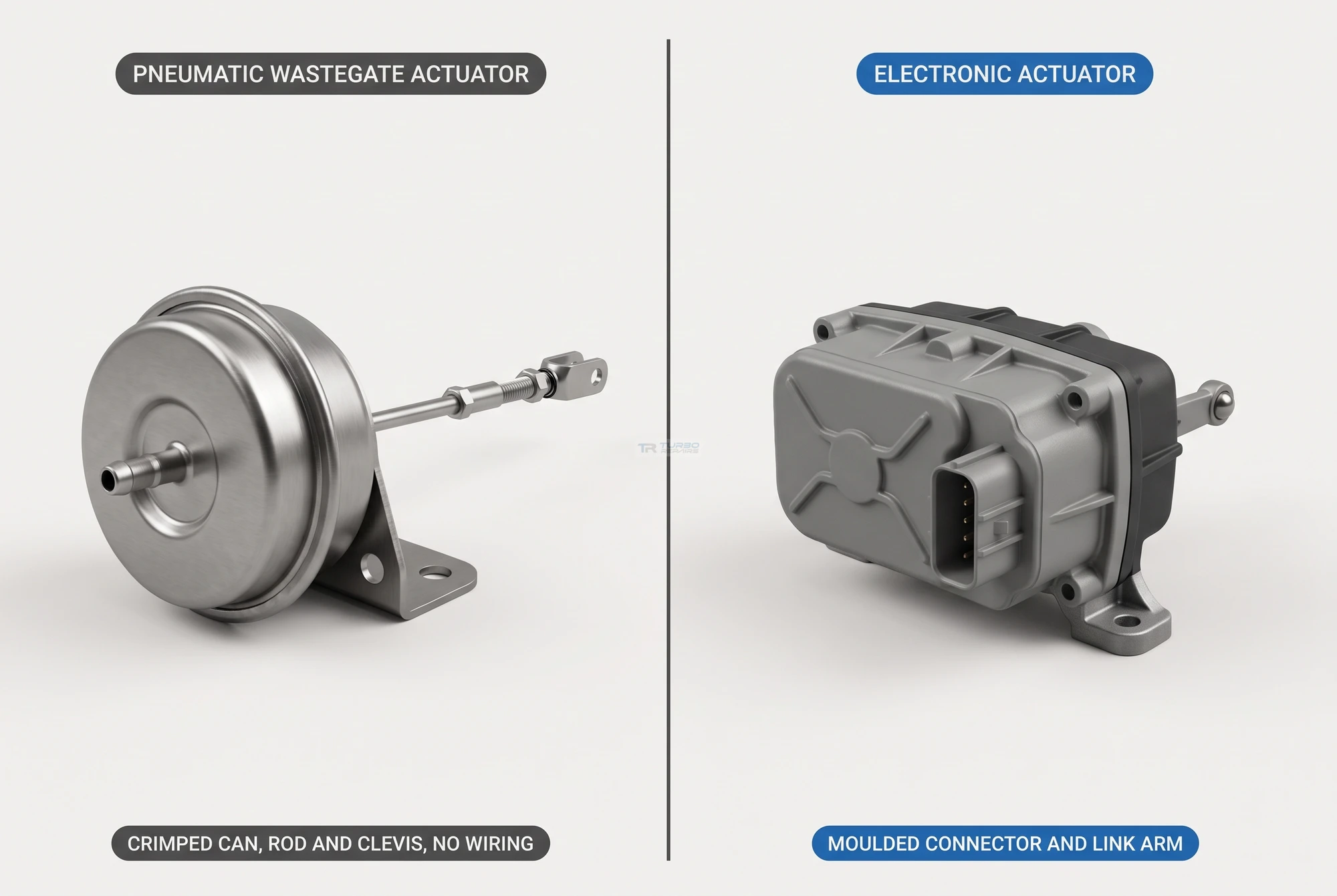
Much of the advice written about actuator symptoms is unusable because it never says which part it means. Two entirely different components are both called turbo actuators.
A vacuum or pressure actuator is a shallow metal can with a rod on one side and a rubber pipe on the other, and no wiring at all. It is worked by vacuum or boost pressure and tested with a hand vacuum pump.
An electronic actuator is a moulded body bolted to the turbo with an electrical connector on it, holding a motor, a gear train, a position sensor and a circuit board. No vacuum pump will test it, and it logs position and circuit codes a vacuum can has no way of producing.
If there is no plug on yours, nothing here about motors, position feedback or calibration applies. Some models were built with both across a production run, which is why the part is identified on the car rather than from the badge — the Ford Mondeo 2.0 TDCi is the clearest example. Electronic units carry a reference on the casing, and on Hella-built actuators that G-reference decides which unit you have, as the BMW 5 Series page shows.
Turbo Actuator Symptoms, and What Each One Actually Points At
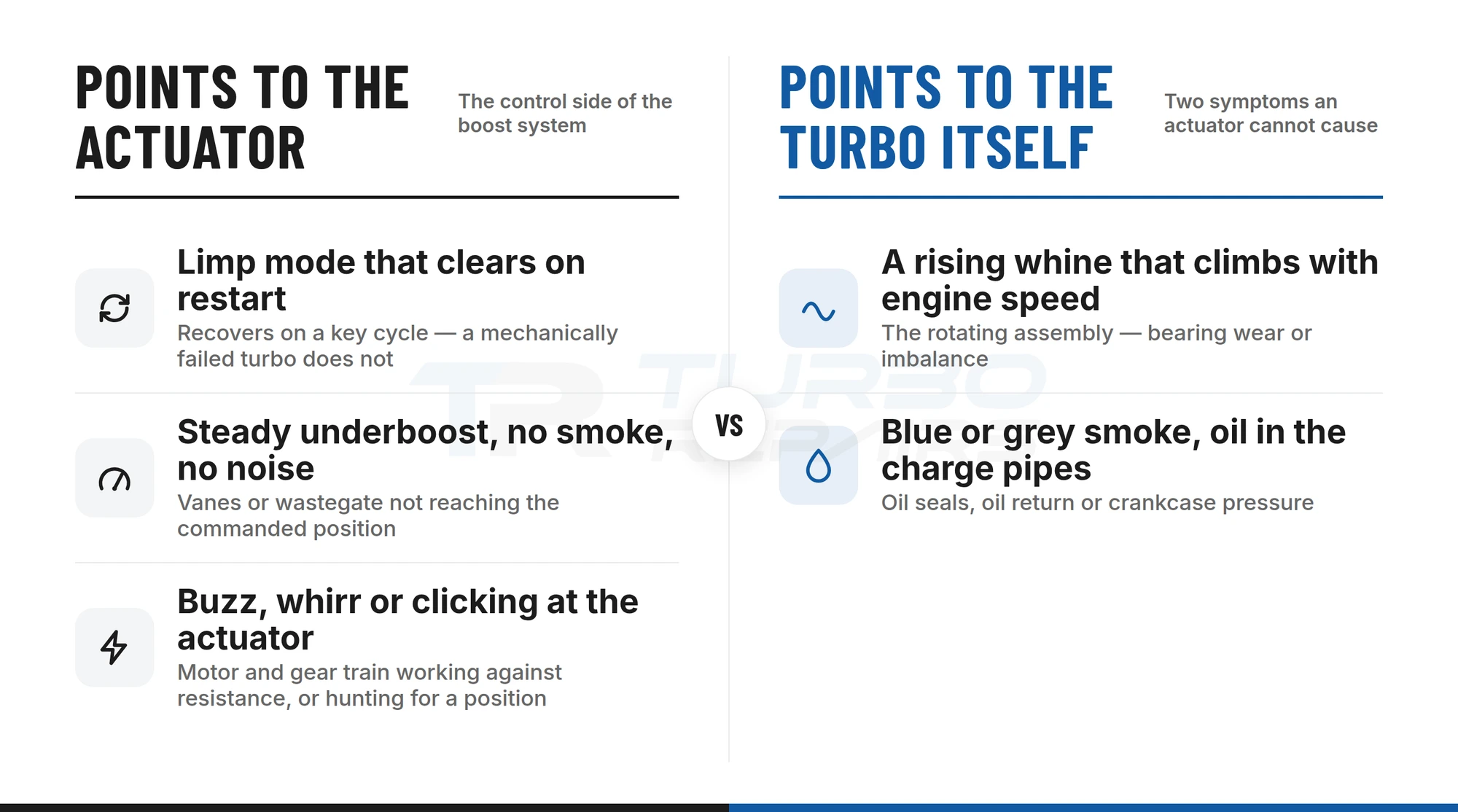
These are the complaints that bring actuator jobs to a workshop, set against the fault each genuinely implicates. Two rows point away from the actuator entirely — and both are complaints we see arrive with a new actuator already fitted.
| What the car is doing | What it points at | What to check next |
|---|---|---|
| Limp mode part-way into a run, normal again after a restart | The boost-control loop, not a broken turbo — a failed turbo does not recover on a key cycle | How far into the drive it happens, and whether it repeats at that point |
| Steady underboost under load, no noise, no smoke | Vanes or wastegate not reaching the commanded position, or air escaping before the engine | Charge pipes, clips and intercooler. Pressure-test before condemning a part |
| Overboost, or a hard cut shortly after full throttle | Vanes or wastegate not opening when commanded — a seized mechanism as often as a failed motor | Stop driving. Overboost is the symptom that damages other components |
| Sluggish at some speeds and loads, normal at others | Partial or erratic position control rather than outright failure | Whether it tracks engine temperature, or one gear and load |
| A buzz, whirr or repeated clicking at the actuator | Motor and gear train working against resistance, or hunting for a position they cannot reach | Whether the noise is at the actuator or inside the turbo |
| A rising siren-like whine that climbs with engine speed | The rotating assembly — bearing wear or imbalance. A turbo symptom, not an actuator one | Shaft play. Stop driving if there is scraping with it |
| Blue or grey smoke, oil pooling in the charge pipes | Turbo oil seals, a restricted oil return or a pressurised crankcase. An actuator cannot do this | Oil return, crankcase breather and oil feed, before fitting anything |
No row is conclusive alone. What the table does is reduce seven complaints to three questions, answered below in order: is the turbocharger mechanically intact, is the vane mechanism free, and is the control side doing what it is told?
What a Boost Fault Code Tells You, and What It Does Not
Diagnosis normally starts with a stored code, and a boost code names an outcome rather than a part.
P0299 says the engine did not receive the boost it asked for; P0234 says it received more. Neither says where the shortfall arose. Between request and result sit the control unit, the loom, the connector, the actuator motor, the gear train, the position sensor, the vane or wastegate mechanism, and every hose and clamp carrying air to the engine.
Position codes get closer: P2562 and P2563 concern the turbocharger boost control position sensor circuit, which at least confines the fault to position feedback. Circuit codes such as P0045, reporting the boost control circuit open, say a loop is broken along its length — not which end broke. An open winding inside the actuator and a wire chafed through two feet away set the same code, because the control unit watches the circuit and cannot see inside it. Our Ford S-Max 2.2 TDCi page walks that loop component by component.
Two cautions. Turbo circuits share supply and earth paths with other sensors, so a fault presented as the turbocharger’s can belong to something else on the same circuit. And the freeze-frame data stored with a code is worth more than the code itself — do not clear anything before reading it.
The Fault That Only Appears When the Engine Is Hot
One actuator failure defeats a workshop test outright, and it is how a car with a real fault gets sent away with nothing found.
Connections on the actuator’s board expand and contract with every heat cycle until a joint cracks. The manufacturers who build these units are explicit that the failure often goes undetected during repair and workshop testing, because it can only be detected once there is a temperature change. Cold on a ramp, the unit passes; twenty minutes into a run, the joint opens and the car limps.
So “no fault found” from a cold diagnostic session is not a result. If your car is fine from cold and limps part-way into a sustained drive, that timing is diagnostic information and should be recorded. The Chrysler 300C 3.0 CRD page covers the pattern in detail, because on that engine it is the normal presentation.
Actuator Fault or Failing Turbo? A Procedure That Settles It
Work through these in order; each step clears a suspect or narrows to it, and the cheap ones come first. Let the engine cool before touching anything near the turbine housing or exhaust.
- Look for oil and smoke. Blue or grey smoke, or oil pooling in the intercooler and charge pipes, means seals, bearings or crankcase pressure. A light oily film is normal on many engines; pooled oil is not. An actuator cannot cause either, so this is a turbocharger repair, not an actuator job.
- Listen. A rising siren-like whine climbing with engine speed, or any metallic scraping, is the rotating assembly. Stop driving.
- Does full power return after a restart? If it does, you are on the control side. Bearings and wheels do not repair themselves at ignition-off.
- Rule out the cheap impostors. A split charge hose, a loose clip, a leaking intercooler or a perished vacuum line all give underboost and the same code as a failed actuator. Pressure-test the boost side first.
- Watch it at ignition-on. The manufacturers’ own inspection routine has the actuator sweep briefly at switch-on and return rapidly to a safe position at switch-off. Some units do not move until the engine runs, and on some applications the arm keeps sweeping to clear the vane path — so no movement is not proof of failure.
- Check the linkage and connector cold. Engine off and cold, work the link between the actuator and the lever arm on the turbo: free movement at each end, a small amount of play, no corrosion restricting it. Then release the connector by its locking tabs rather than pulling the wiring, and look for damaged tabs, cracked walls, green corrosion on the pins and staining below the seal where water has been in.
- Compare commanded position with actual. On live data, a wide and persistent gap with the circuit electrically healthy puts the fault in the actuator or in the mechanism it is trying to move.
- If all of that is clean, look elsewhere. Free movement, sound connectors, no water ingress and correct sweep behaviour together make a turbo-side fault unlikely, and the manufacturers say as much in their own service guidance.
Step seven is where a driveway diagnosis runs out. An actuator straining against a vane mechanism seized with carbon behaves exactly like one whose motor is failing — because it is failing, as a consequence. Telling cause from casualty needs the unit tested off the car against a known load, which the Jeep Grand Cherokee 3.0 CRD page works through, and it is why a replacement actuator fitted to an untouched mechanism can fail within months.
Turbo Repairs · Epsom workshop
Not sure whether it is the actuator or the turbo?
Send the codes stored, whether the fault is hot or cold, and the reference on the actuator casing. Our engineers will tell you what that rules in and out before you buy a part.
From £100 +VAT · One to two working days · Lifetime, unlimited-mileage warranty
What Actually Fails Inside an Electronic Actuator
Based on what our engineers see on the bench, four failure modes account for most of the electronic actuators we rebuild, and which one you have changes what needs fixing on the car as well as in the unit.
The vane mechanism sticks and takes the actuator with it. Soot and oil residue build up around the mechanism until it no longer sweeps freely. The actuator keeps trying, drawing more current through its motor than the motor was designed to carry, and burns out the motor or strips a plastic gear. It has failed as the casualty rather than the cause — fit another to the same seized mechanism and it repeats.
Board connections crack with thermal cycling. The hot-only fault above, and the one that reads as no fault found when the car is cold.
Water gets in, and vibration wears it out. A damaged seal or cracked connector wall lets water reach the electronics, corrosion follows, and the unit starts reporting positions that are not real. Vibration meanwhile works on joints, gear teeth and mountings — and where the actuator sits in the vee of the engine, as on the Mercedes CLS, it does so in the hottest position available to it.
One thing to know before hunting for a cheap replacement: the calibration lives in the actuator’s own electronics and is specific to the turbocharger it was set up on, and even disturbing the retaining bolts can move a unit outside its settings. In most gear-train failures those electronics are unharmed, which is why rebuilding your own unit keeps the calibration matched to your turbo.
What to Record Before You Book Anything
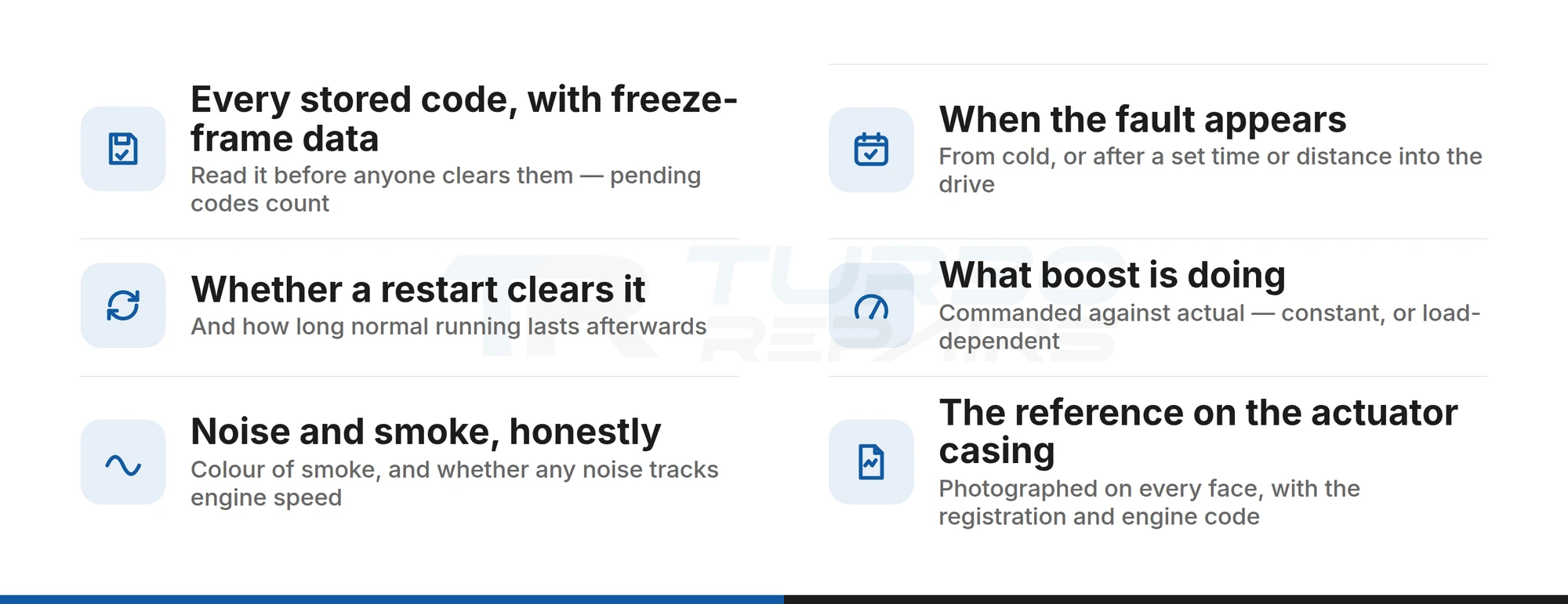
This step decides whether a repair starts from evidence or from a guess, and it costs nothing but attention on the next few drives.
- Every stored code with its freeze-frame data — read before anyone clears them. Pending codes count.
- When the fault appears. From cold, or after a set time or distance? Note how far into the drive, and whether it repeats at that point.
- Whether a restart clears it, and how long normal running lasts afterwards.
- What boost is doing, if you can see live data: commanded against actual, and whether the gap is constant or load-dependent.
- Noise and smoke, honestly. Colour of the smoke, when it appears, whether any noise tracks engine speed.
- Recent work — a hose disturbed, a sensor changed, an actuator unbolted, a remap. Each produces these symptoms with nothing having failed.
- The reference on the actuator casing, photographed on every face, with the registration and engine code.
A symptom is a shortlist, not a diagnosis. What decides whether this is the actuator, the turbocharger or the wiring between them is the pattern around the symptom — when it appears, whether a restart clears it, and what the engine management recorded at the time. Write that down before anyone opens anything, and the repair starts from evidence rather than a hunch.
What an Actuator Repair Involves, and How Long It Takes
Electronic actuator repair is a mail-in service. You remove the actuator and post it to our workshop at Unit 102 Reaver House, 12 East Street, Epsom, Surrey, KT17 1HX, United Kingdom, and it returns rebuilt, calibrated and ready to refit. The turbocharger stays on the engine, so the oil feed and return lines, the manifold studs and the gaskets are never disturbed — the point the Mercedes C-Class page makes about the scope of the job.
The unit is tested as received before it is opened, so the fault is confirmed rather than assumed, as on the BMW X3 2.0d. It is then stripped to component level — motor, drive gears, position sensor, seals and circuit board renewed where worn, uprated where the original design is the weakness, the sequence set out on the BMW 3 Series page. It is recalibrated to the travel and feedback range its own reference demands, then bench-proven against live boost targets, the way every Ford Transit actuator is signed off.
Repairs start from £100 +VAT, the exact figure confirmed once your unit has been identified and assessed. Turnaround is typically one to two working days from the unit reaching the workshop, plus postage each way. It returns plug-and-play with no programming on refit, and every repair carries a lifetime, unlimited-mileage warranty.
When to Book, and When to Stop Driving
Stop driving now with overboost or a hard cut at full throttle, metallic noise from the turbo, or heavy smoke. Vanes held closed can choke the engine and drive the turbine faster than it was meant to run, and metallic noise means material is already moving where it should not.
Drive gently to a workshop if the car is in limp mode or underboosting steadily with no smoke, no metallic noise and a stable oil level. Limp mode exists so the car can be moved somewhere useful: light throttle, short journey.
Book without panic if the fault is intermittent, hot-only and clears with a restart — and use the intervening drives to complete the record above.
In every tier, the unit is worth assessing for repair before anyone buys a replacement. Our electronic turbo actuator repair service covers units fitted across a wide range of makes, and it is the reference on your casing, not the badge on the car, that decides whether yours is one of them.
Turbo Actuator Symptoms FAQ
Questions specific to symptoms are below; postage, turnaround and warranty are covered in our full FAQs.
What are the first symptoms of a failing turbo actuator?
Drivability goes before the dashboard does: a loss of power or a flat spot, then an engine management light and intermittent limp mode. Boost that is low, erratic or occasionally too high is the pattern underneath. With no siren-like whine and no smoke, the actuator and its circuit are worth investigating first.
Can I keep driving with a faulty turbo actuator?
Briefly and gently, if the car is only underboosting or in limp mode with no smoke and no metallic noise. Do not keep driving with overboost, a hard cut at full throttle, heavy smoke or grinding — those risk damage well beyond the actuator.
How do I tell whether it is the actuator or the turbo?
Three checks separate them. Smoke and pooled oil in the charge pipes mean the turbocharger. A whine that climbs with engine speed means the rotating assembly. Power returning fully after a restart means the control side, because a mechanically failed turbo does not recover on a key cycle.
Does a P0299 underboost code mean the actuator has failed?
No. P0299 records only that the engine did not get the boost it requested, which implicates the control unit, the loom, the connector, the actuator, the vane or wastegate mechanism and every hose and clamp in between. A split charge hose sets the same code.
Why does my car only lose power once it is warm?
Because the fault is thermal. Connections inside the actuator expand and contract with every heat cycle until a joint cracks, and manufacturers note this failure can only be detected once there is a temperature change. It passes a cold test and fails part-way into a run.
Can an electronic actuator be repaired, or do I need a new one?
Repair is the usual outcome for the units that reach our bench. What fails is the motor, the drive gears, the position sensor, the seals and the board connections, and in most gear-train failures the electronics are unaffected. A second-hand unit from another car is a gamble, because the calibration is specific to the turbocharger it was set up on.
Final Thoughts
Actuator diagnosis goes wrong so often because the questions are asked in the wrong order. Whether to repair or replace the actuator is the last one. The first is whether the turbocharger is mechanically intact, the second whether the vane mechanism is free, and only the third whether the control side is doing what it is told.
Taken in that order, most cases resolve without guesswork. Smoke and oil send you to the turbo; a whine that tracks engine speed sends you to the rotating assembly; recovery after a restart, a hot-only pattern or a wide gap between commanded and actual position send you to the actuator. Spend the next few drives recording what the car actually does, and you arrive at a repair knowing what needs testing.
Turbo Repairs · Epsom workshop
Have your actuator rebuilt, not guessed at
Post the unit in with your codes, the reference from the casing and a note of when the fault appears — the repair form takes those details and books it in. It is tested as received, stripped to component level, recalibrated and bench-proven under live boost before it comes back.
From £100 +VAT · One to two working days · Returned plug-and-play · Lifetime, unlimited-mileage warranty