

Summary We rebuild the turbochargers from the 3.0 TDV6 and SDV6 diesel in the Range Rover, the Range Rover Sport and the Discovery 4. The failed unit comes off the engine and is posted to us, where it is stripped to component level, measured, rebuilt on genuine OE or OEM-grade parts, balanced and bench-tested, then returned ready to refit. Rebuilds start from £185 + VAT per turbocharger, a replacement unit from £450 + VAT, bench time is typically one to three working days, and every rebuild carries a lifetime, unlimited-mileage warranty.
Twin-turbo versions of this engine carry a primary and a secondary turbocharger under different references, and neither is a spare for the other. Which of the two has failed decides how much work it takes to identify a replacement. A rebuild of the unit you send needs no identifying at all.
One remanufacturer lists the same secondary turbocharger, 824756, in both of its 3.0 SDV6 pairs, while the primary beside it changes from 824754 or 827153 to 824755 with the engine’s output.
A 3.0 diesel Range Rover, Range Rover Sport or Discovery 4 that is smoking, whining or short of boost, with the actuator ruled out, has a turbocharger problem, and on this engine that usually means one turbocharger out of two. This page covers which engine you have, how its two turbochargers are catalogued and why they are not interchangeable, what wears inside them, how to tell which one has failed, and what a rebuild or a replacement costs.
- Covered here: the 3.0 TDV6 and SDV6 diesel in the Discovery 4, the Range Rover Sport (L320 from 2009, and L494) and the Range Rover L405. The same turbochargers are also listed for the Discovery 5 and, on the SDV6, the Jaguar XF and XJ
- Not covered here: the 2.7 TDV6, the 3.6 TDV8 and 4.4 SDV8, and the BMW-based 3.0 diesel in the earlier Range Rover L322
- Engine as catalogued: TDV6 listings name the Lion V6; SDV6 listings name the 306DT
- Two turbochargers: a primary and a secondary on twin-turbo versions, under different references; a single “primary” unit is also listed for a mono-turbo version of the later 3.0
- SDV6 pairs as listed: primary 824754 or 827153 with secondary 824756 (245–306 hp); primary 824755 with secondary 824756 (295–306 hp)
- Earlier TDV6 pair as listed: 778400-0003 and 778401-0006, sold as left and right, 211–255 hp, from 2009
- Our service: rebuild of your own turbocharger from £185 + VAT per unit, replacement from £450 + VAT, typically 1–3 working days on the bench, lifetime unlimited-mileage warranty
3.0 or 2.7? Make Sure This Is Your Engine
Land Rover sold two TDV6 diesels, and both the Discovery line and the Range Rover Sport carried each of them in turn. The 2.7 is the earlier engine: our own listings cover it in the Discovery 3 from 2004 to 2010 and in the Range Rover Sport L320 from 2005 to 2010. Turbochargers for the 3.0 are catalogued for the Discovery 4 and the Range Rover Sport from 2009, and for the Range Rover L405 and Range Rover Sport L494 that followed.
So a Range Rover Sport from around 2009 or 2010 can carry either engine, and the badge on the tailgate will not tell you which. The engine size on the registration document settles it, and so does the reference on the turbocharger’s own plate.
Getting this right matters well beyond the turbocharger. The two engines’ turbochargers are catalogued under entirely different references, and the parts around them do not carry across either: one Land Rover parts retailer sells the 2.7’s turbo oil feed pipe with a plain note that it does not fit the 3.0 TDV6.
If yours is the 2.7
The 2.7 has its own pages, and nothing below about primary and secondary units applies to it. If yours is the 2.7 TDV6 in a Range Rover Sport, our Range Rover Sport 2.7 TDV6 turbocharger rebuild covers it, and the Discovery 3 2.7 TDV6 listing covers the Discovery.
The other Range Rover diesels
A search for a Range Rover turbo also turns up engines this page does not cover. The 3.6 TDV8 and the 4.4 SDV8 are V8s with turbocharger pairs of their own, sold as left and right units on the 3.6 and as high-pressure and low-pressure units on the 4.4. The earlier Range Rover L322 was also sold with a 3.0 diesel, a BMW-based engine listed with a single turbocharger, reference 712541, which has nothing in common with the TDV6. If your turbo carries one of those references, send it through the repair form and we will tell you what it is and whether it is a candidate for a rebuild.
Two Turbochargers, Two Roles: Primary and Secondary
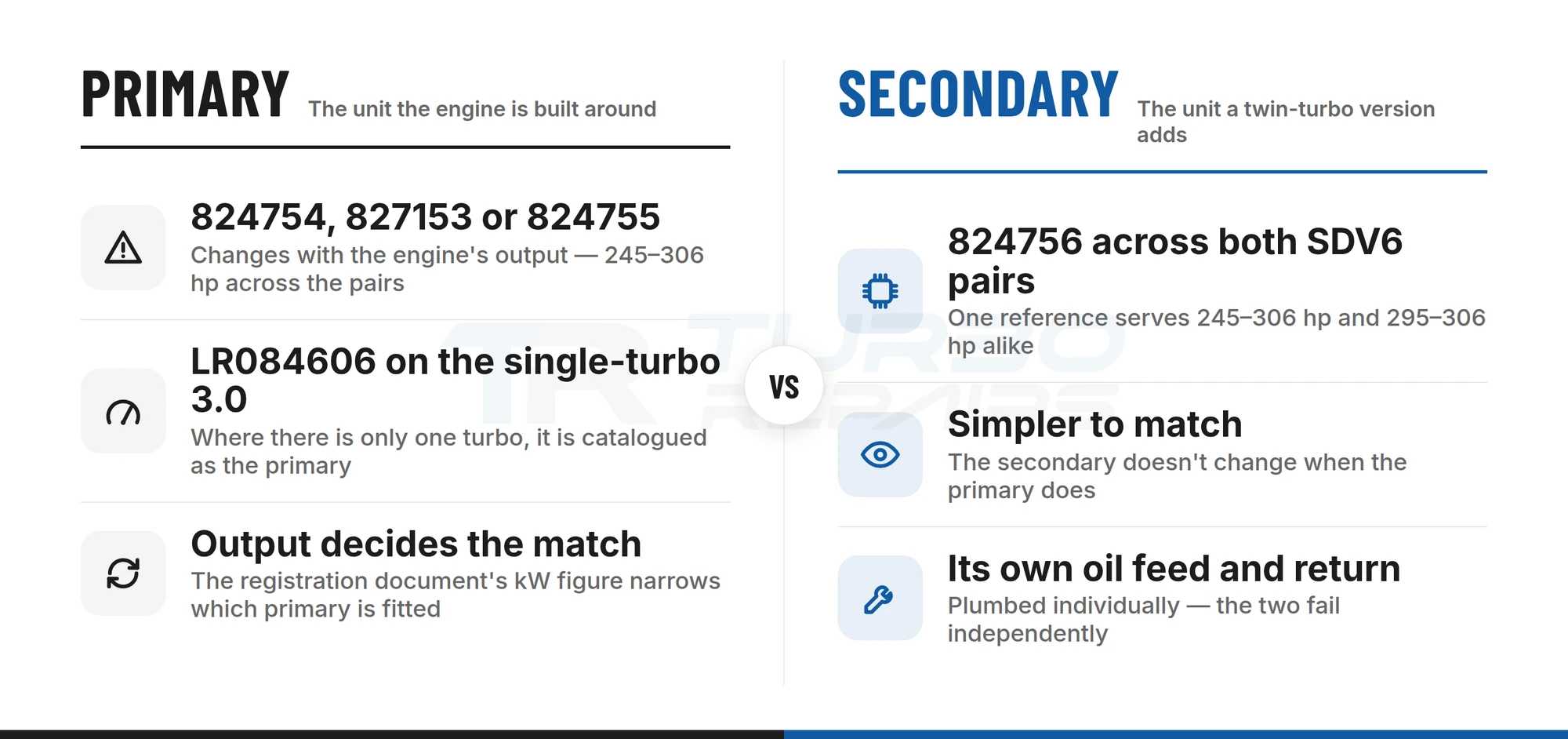
On twin-turbo versions of the 3.0, the two turbochargers are not two copies of the same part. They are catalogued as a primary and a secondary, under different references, and one cannot stand in for the other. The earlier TDV6 pair is sold as a left-side and a right-side unit, 778400-0003 and 778401-0006, while the later SDV6 pairs are sold as a primary and a secondary. The left-side unit, 778400-0003, is also listed on its own for the Jaguar XF 3.0 diesel at 211–275 hp. How the two sets of names line up is covered on our TDV6 turbo actuator repair page, so it is not repeated here.
The names themselves say which unit the engine is built around. The later 3.0 was also listed in a single-turbo version, and its one turbocharger, LR084606, is catalogued as the “Primary” turbo. A version with one turbocharger calls that one the primary, and a twin-turbo version adds a secondary to it. One Land Rover parts retailer labels a right-hand 3.0 unit, LR116631, as “Right Hand (Secondary)”.
The secondary stays the same while the primary changes
The two SDV6 pairs listed by one remanufacturer make the point concrete. The first, listed for the Discovery, Range Rover Sport, Jaguar XF and XJ at 245 to 306 hp, pairs primary 824754 or 827153 with secondary 824756. The second, listed for the Range Rover Sport, XF and XJ at 295 to 306 hp, pairs primary 824755 with the same secondary, 824756. Sold on its own, the 824755 primary is listed for 300 to 306 hp models from 2015.
Across those two listings, then, the secondary does not change and the primary does. That has a practical consequence for anyone buying a unit. If the secondary has failed, identifying its replacement is the simpler question. If the primary has failed, the output of your engine becomes part of the identification. The registration document gives output in kilowatts, and one listing puts this SDV6 at 182 to 228 kW against its 245 to 306 hp.
Two things the catalogues do not tell us, so we do not publish them here: whether each position carries a variable vane mechanism, and how the engine management divides the work between the two units. What boost-control hardware your own units carry is confirmed on the bench, not assumed from a listing.
What Fails on the 3.0 TDV6 and SDV6 Turbochargers
Each of the two is a complete turbocharger in its own right. A turbine wheel and a compressor wheel sit on one shaft, running in oil-fed bearings inside a centre housing that is sealed at each end, and each unit has its own oil feed and its own oil return. The catalogue even lists a separate return hose for the left-hand unit. The two are plumbed individually, and they fail individually.
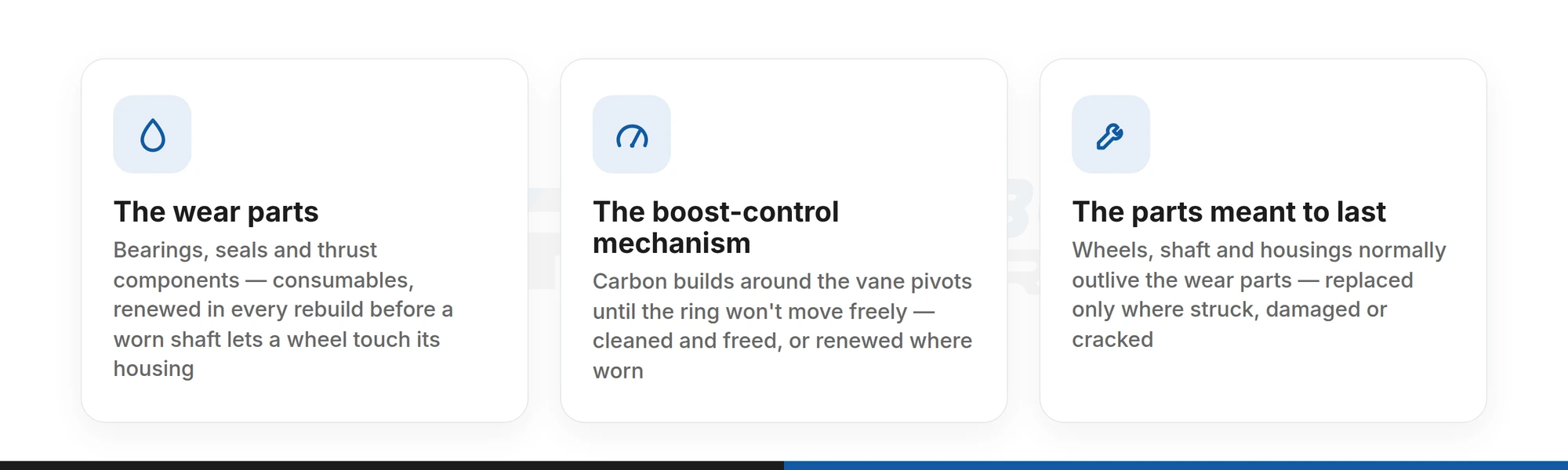
What wears inside either unit falls into three groups.
- The wear parts. Bearings, seals and thrust components are consumables, designed to wear and renewed in every rebuild. Left to run on, worn bearings let the shaft move far enough for a wheel to touch its housing, and that is when a consumables job becomes a larger one.
- The boost-control mechanism. On a variable-geometry unit, carbon builds up around the vane pivots until the ring no longer moves freely. Where the parts are sound they are cleaned and freed; where they are worn or distorted they are renewed.
- The parts meant to last. The wheels, the shaft and the housings normally outlive the wear parts. A compressor wheel struck by debris is replaced rather than repaired, the turbine wheel and shaft are supplied together as one assembly, and a cracked housing can usually be replaced as a section while the rest of the unit is rebuilt.
What stays on the engine
Some of the parts that fail alongside a turbocharger never come to us, because they belong to the engine rather than the unit. Catalogues for the 3.0 list the gasket between the turbo and the inlet manifold, the lower drain pipe gasket, a drain pipe gasket shared with the 2.7 TDV6, and the oil return hoses, each as a separate part. A weeping return hose or a failed drain gasket can put oil on the outside of a turbocharger that is perfectly sound inside, so these are worth checking before either unit is condemned, and worth renewing when one is refitted.
Symptoms, and Which Unit Each One Points At
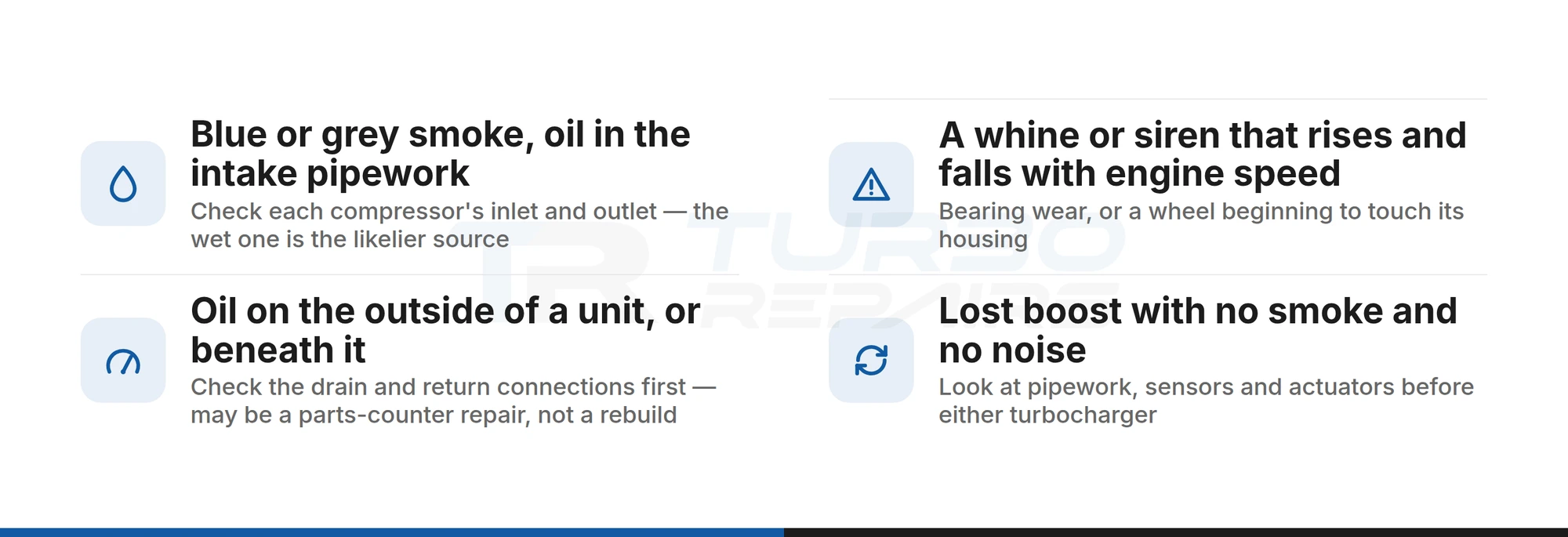
The honest answer comes first. Most symptoms on this engine point at a turbocharger, not at a position. Smoke from the tailpipe, a flat engine or a boost code is what you see of the whole system, and none of them carries a left, a right, a primary or a secondary. What narrows a fault to one unit is a physical check at the engine, made cold and with the intake pipework off.
- Blue or grey smoke, or oil inside the intake pipework. Oil is getting past a seal. To find which unit, look at each turbocharger’s compressor inlet and outlet connections: the one whose connections are wet with oil is the likelier source.
- A whine or siren that rises and falls with engine speed. Classic bearing wear, or a wheel beginning to touch its housing. With the engine off and the intake pipe removed, shaft play can be felt by hand, and comparing the two units usually shows which one has worn.
- Oil on the outside of a unit, or beneath it. Check the drain and return connections at that unit before blaming the turbocharger. A leak there is a parts-counter repair on the engine, not a rebuild.
- Lost boost with no smoke and no noise. Look at the pipework, the sensors and the actuators before either turbocharger. Actuator faults on this engine are covered on the actuator page linked above, and our guide to turbo overboost and underboost explains what a boost code does and does not rule out.
If the checks leave you between the two units, that is not a reason to guess. Tell us what you found at each one, and if both come off, the bench settles it. Our guide to common turbocharger problems sets out which warning signs mean the vehicle should not be driven further in the meantime.
Rebuild Both, or Just the One That Failed?
Usually just the one that failed, and the reason lies in how these units are sold. Turbochargers for this engine are offered singly and as bi-turbo sets, and a set replaces the working unit along with the failed one. A rebuild works the other way round. It starts from the unit that failed and renews only what inside it has worn or broken.
The exception is when both units show the fault. If shaft play or oil turns up at both turbochargers, send both, and each is stripped and assessed on its own.
Whichever units go back on, the cause of the failure is still on the engine. An oil supply fault or debris in the intake starts outside the turbocharger, and a rebuilt or new unit fitted without it being found fails the same way. Our guide to removing and refitting a turbocharger covers what to check while the unit is off.
If you are buying rather than rebuilding
For a replacement, the difference between the two positions decides how much matching there is to do. A secondary is the simpler unit to match, since one listed reference serves both SDV6 pairs. A primary has to be matched to the output of the engine as well as to the engine itself. A set means paying for a unit you may not have needed.
A rebuild of the unit you send avoids all of it. The turbocharger that goes back on is the one that came off, so its reference, its position and its fit to your engine are already settled.
Turbo Repairs · Epsom workshop
Send the unit that failed, not the pair
Tell us which side of the engine it came off and give us the reference from its plate, then post it in with your stored fault codes. It is stripped and measured before a route is recommended.
Lifetime, unlimited-mileage warranty · Mail-in from the UK and internationally · Bench-tested and calibrated before it ships
What a Range Rover or Discovery 4 Turbo Costs
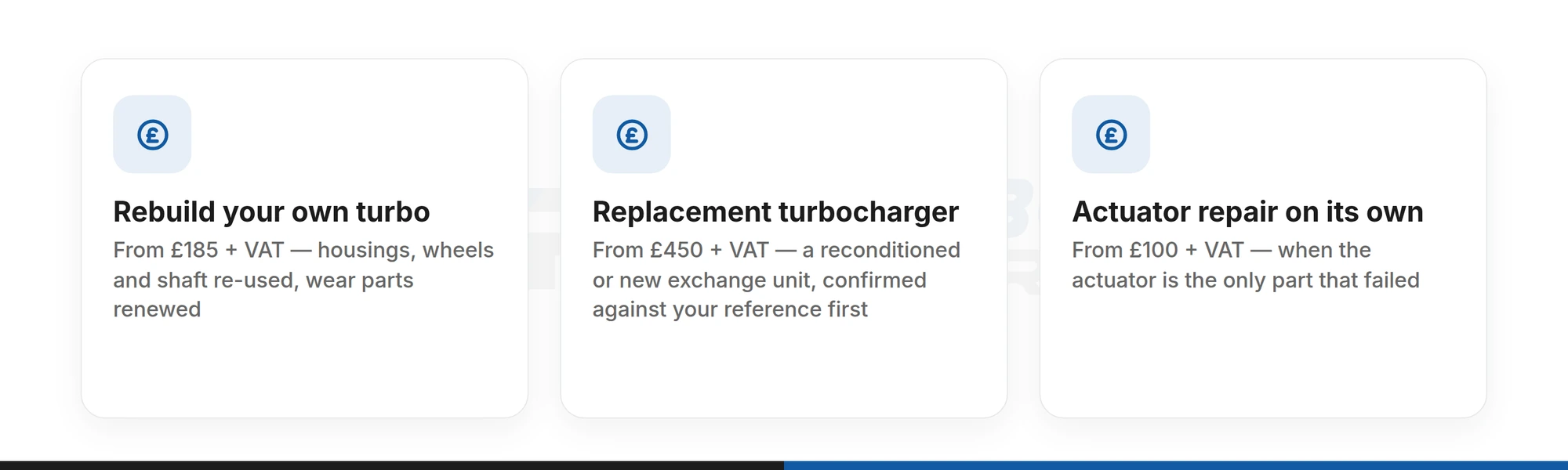
There are three routes, depending on what failed.
- Rebuild of your own turbocharger: from £185 + VAT, where the housings, wheels and shaft can be re-used and the wear parts renewed.
- Replacement turbocharger: from £450 + VAT, a reconditioned or new exchange unit for when your own is not worth rebuilding. We confirm the unit for your reference before anything is supplied.
- Electronic actuator repair on its own: from £100 + VAT, when the actuator is the only part that failed.
Our price guide names the Range Rover in its large cars and SUVs row, where rebuilds run from £210 to £450 excluding VAT, against a typical market price of £1,200 to £1,800 for a new turbocharger. Where a unit falls within the row is set by what its strip-down finds, not by whether it came off a Range Rover or a Discovery. The full breakdown is in our guide to turbo repair prices.
None of these figures covers taking a turbocharger off or putting it back, which your garage charges for and which is the same job whichever route you take. Our price guide notes that one of a twin-turbo pair, or a unit in the vee of a V6, is a different job from a turbo within easy reach on a four-cylinder engine. Expect the bill to include the gaskets and hoses listed above, an oil feed pipe, fresh oil and a filter, and the cost of finding whatever caused the failure.
Our 3.0 TDV6 and SDV6 Turbo Rebuild
You or your garage remove the failed unit and post it to us, and the vehicle stays where it is while the turbocharger travels. The work is carried out at our workshop at Unit 102 Reaver House, 12 East Street, Epsom, Surrey, KT17 1HX, United Kingdom, by a team of turbo specialists and engineers, for private owners and for garages sending units in on a customer’s behalf.
- Complete the repair form. Give us the registration, the model and the engine, any stored fault codes, what the vehicle did when it failed, the reference from the turbo’s plate if you can read it, and which side of the engine it came off. If you know whether it is the primary or the secondary, say so.
- Remove the turbo and post it. Plug the oil and air openings, pack the unit in foam or bubble wrap inside a rigid box, and mark the box with its position. Our FAQs cover packing and postage.
- We identify it. The reference and position are checked against your registration, so 2.7 or 3.0, primary or secondary, is settled before any work starts.
- We strip and measure it. Every part is measured against original specification, and we tell you what we found and recommend a rebuild or a replacement before going ahead.
- We rebuild it. Bearings, seals and thrust components are renewed, damaged parts are replaced with genuine OE or OEM-grade components, or uprated parts where the original has a known weakness, and any vane mechanism is freed or renewed.
- We balance and test it. The rotating assembly is balanced and the unit is bench-tested before it is boxed and returned ready to refit.
Bench time is typically one to three working days from the unit reaching us, plus postage each way. Every rebuild carries a lifetime, unlimited-mileage warranty, with no mileage cap and no time limit, and we accept units from anywhere in the UK and from overseas. The full range is on our turbocharger rebuild service hub.
At refit, renew the gaskets and any perished return hose, and prime the oil supply before the engine runs. Our refitting guide linked above sets out the priming procedure step by step.
Range Rover and Discovery 4 Turbo FAQ
How much does a Range Rover turbo replacement cost?
Rebuilding your own turbocharger with us starts from £185 + VAT per unit, and a replacement unit from £450 + VAT. Our price guide places the Range Rover in its large cars and SUVs row, where rebuilds run from £210 to £450 excluding VAT, against £1,200 to £1,800 for a typical new unit. Removal and refitting are extra, and your exact price is confirmed once the turbo has been stripped.
How much does a Discovery 4 turbo replacement cost?
The same as a Range Rover or Range Rover Sport with the 3.0 diesel, because the turbochargers are catalogued across all three. The price is set by the condition of the unit, not by the vehicle it came off.
What is the difference between the primary and secondary turbo?
They are two different turbochargers under different references, and neither can replace the other. The primary is the unit the engine is built around: a single-turbo version of the later 3.0 catalogues its only turbo as the primary. The secondary is the second unit a twin-turbo version adds. On the SDV6 pairs one remanufacturer lists, the secondary reference stays the same while the primary changes with output.
Do I need to replace both turbos?
Not usually. Only the failed unit needs to come to us. If both show oil or shaft play, send both.
Is the Range Rover Sport 3.0 turbo the same as the Discovery 4’s?
The 3.0 turbochargers are catalogued for both vehicles from 2009, and the earlier TDV6 pair, 778400-0003 and 778401-0006, is listed for the Discovery 4 and the Range Rover Sport alike. Match on the reference on the plate and the position of the unit, not on the vehicle name.
Could it be the actuator rather than the turbo?
Yes, and it is worth ruling out first. Oil smoke, oil in the intake pipework or a whine that follows the revs point at a turbocharger. Actuator fault codes with power that comes and goes point at the actuator, which is repaired on its own from £100 + VAT.
How long does a rebuild take, and what is the warranty?
Bench time is typically one to three working days from arrival, plus postage each way. Every rebuild carries a lifetime, unlimited-mileage warranty with no time limit.
Final Thoughts
A failed turbo on a 3.0 Range Rover, Range Rover Sport or Discovery 4 is rarely a failed pair. The engine carries a primary and a secondary under different references, each with its own oil feed and return, and a fault normally starts in one of them. Confirm the engine first, since the 2.7 and the V8s sit outside all of this, then use the checks at each unit to find which one has gone.
From there, the difference between the two positions is only a problem if you are buying. The secondary is the easier unit to match and the primary depends on the engine’s output, while a set pays for a unit that may have been fine. Take the failed turbocharger off before worn bearings reach the wheels, send it in with its position marked, and the unit that comes back is the one your engine was already built to run.
Turbo Repairs · Epsom workshop
Rebuild the 3.0 TDV6 or SDV6 turbo that failed
Primary or secondary, Range Rover, Range Rover Sport or Discovery 4, send us the unit with its plate reference, its position and your stored codes. It is identified, stripped, measured and rebuilt on OE-grade parts, then bench-tested and returned ready to refit.
Lifetime, unlimited-mileage warranty · Mail-in from the UK and internationally · Bench-tested and calibrated before it ships