

Summary When the electronic turbo actuator on a Chevrolet Captiva or Vauxhall Antara diesel fails, the car loses boost and usually drops into limp mode, yet the turbocharger it is bolted to can be perfectly sound. The actuator is a separate part, and we rebuild your own unit from £100 + VAT: tested as it arrives, renewed at component level, calibrated on the bench and returned ready to refit, typically within one to two working days, with a lifetime, unlimited-mileage warranty.
The two cars share their diesels, but the parts trade files them unevenly. This page sets out which engines the listings put an electronic actuator on, which reference belongs to which, and how to tell an actuator fault from a sticking turbocharger before anything is posted.
The only actuator reference the listings give this platform, Hella 6NW008412 under G-203, is catalogued against the Captiva 2.0 diesel, not against the 2.2 and not against the Antara by name.
On these two SUVs the electronic actuator is the motorised unit mounted on the turbocharger. It moves the turbo’s variable vanes to the position the engine management asks for, and a position sensor inside it tells the engine management where they are. Because it unbolts on its own, a failed actuator is a repair in its own right rather than a reason to replace the turbocharger.
- Cars covered: the Chevrolet Captiva and Vauxhall Antara diesels with an electronic turbo actuator. The same car is catalogued as the Opel Antara, so Opel listings apply too
- Electronic actuator listed for: the Captiva 2.0 diesel (Hella 6NW008412, G-203) and the 2016 to 2017 Antara 2.0 CDTi at 125 kW
- Check your own car: the 2.2 diesel’s actuator is sold as a separate part, but the listings do not state its type, so look for a wiring connector on the housing
- Not on this page: vacuum-operated actuators. We rebuild electronic actuators
- Fault codes: explained in our turbo actuator fault code guide
- Our service: your own actuator rebuilt from £100 + VAT, typically 1–2 working days on the bench, actuators require no programming, lifetime unlimited-mileage warranty
Captiva or Antara: One Diesel Platform, Two Badges
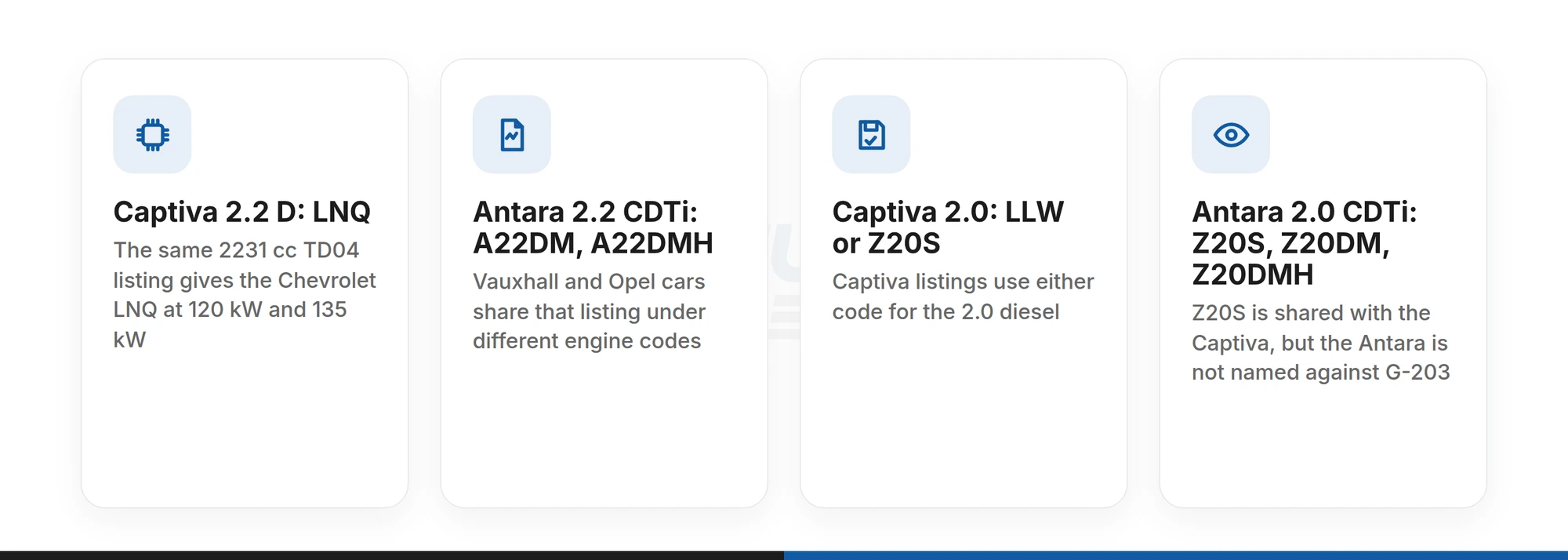
The Captiva and the Antara wear different badges, but the turbocharger catalogues treat their diesels as one family. A single TD04 turbocharger listing covers the Chevrolet Captiva 2.2 D, the Vauxhall Antara 2.2 CDTi and the Opel Antara 2.2 CDTi together, at the same 2231 cc capacity and the same two outputs, 120 kW and 135 kW.
What changes with the badge is the vocabulary. That listing gives the Chevrolet the engine code LNQ, and the Vauxhall and Opel cars A22DM and A22DMH. On the 2.0 diesel, Captiva listings use LLW or Z20S, while our own Antara listing catalogues Z20S, Z20DM and Z20DMH. An engine code copied from one badge’s paperwork can therefore fail to match a listing written for the other, even where the listings put both cars on the same turbocharger.
The actuator listings are lopsided in the same way. The one reference they give, Hella 6NW008412 under G-203, is filed under the Captiva. The one electric actuator listing that names the Antara belongs to a much later version of the car and gives no reference at all.
A 2.0 Antara can come from either end of the model’s life
On the Antara, “2.0 diesel” does not place the car in time. Our Antara 2.0 CDTi listing catalogues Z20-series engines on 2006 to 2008 cars and a B20DTH engine on a 2016 car, while the 2.2 CDTi is listed from 2010. The two ends of that span carry different Garrett turbochargers, 762463 on the early cars and 822072 on the 2016 car, and the actuator listings treat them as different vehicles.
So on this platform the date of first registration on your V5C does identifying work that neither the badge nor the engine size can do. Note it down before anything else.
Which Engines Carry the Electronic Actuator
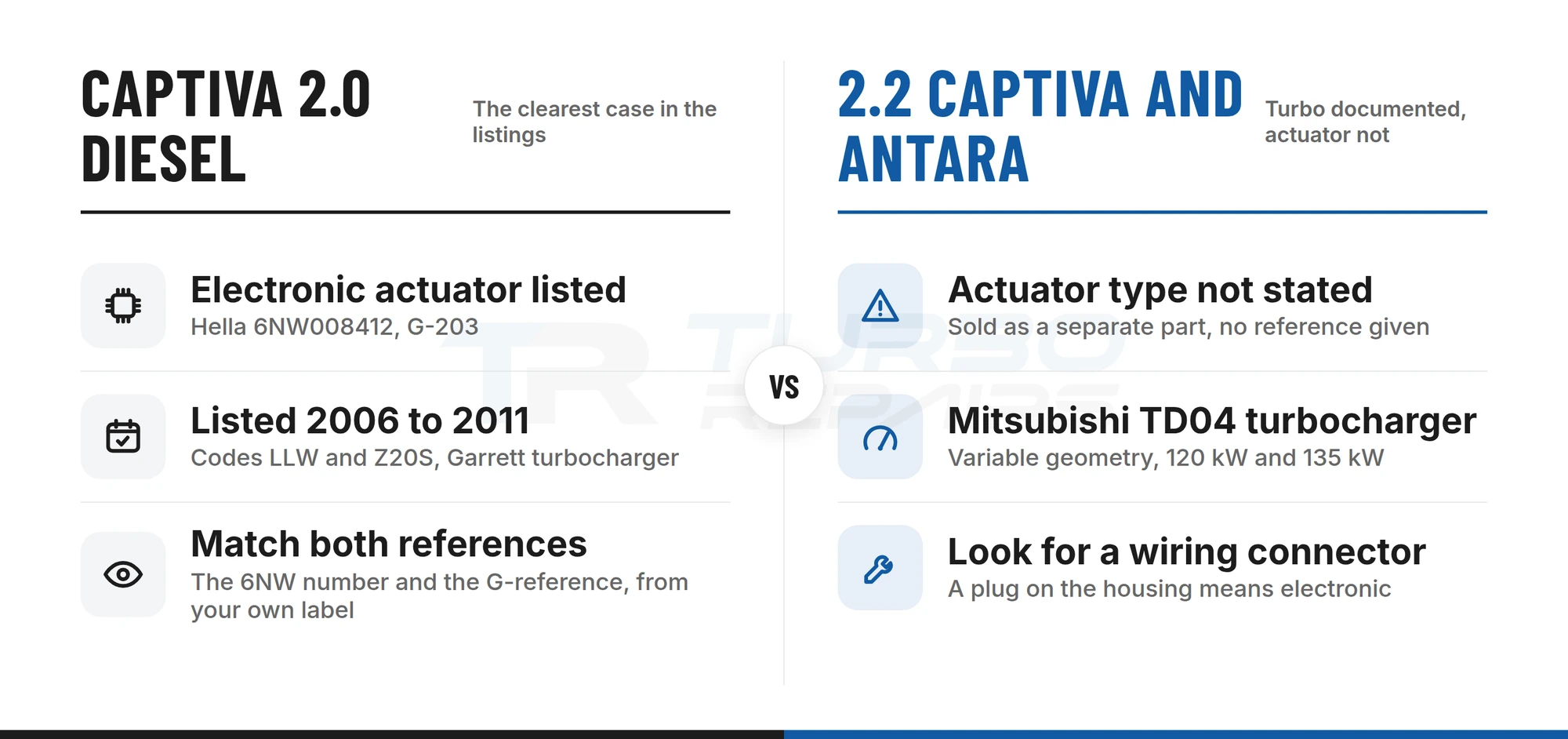
Four groups of engine sit under these two badges, and the listings we reviewed are explicit about the actuator type on only two of them. The table sets out what they say. The years are those the catalogues list each version against, not a production record.
| Engine | Codes in the listings | Output | Years listed | Turbocharger | What the listings say about the actuator |
|---|---|---|---|---|---|
| Captiva 2.0 diesel (VCDi) | LLW, Z20S | 93 kW (126 hp), 110 kW (150 hp) | 2006 to 2011 | Garrett | Electronic: Hella 6NW008412, G-203 |
| Antara 2.0 CDTi, early | Z20S, Z20DM, Z20DMH | 125, 147 or 148 bhp | 2006 to 2008 | Garrett 762463 | Not named in the actuator listings; shares the Z20S code with the Captiva |
| Captiva 2.2 D and Antara 2.2 CDTi | LNQ (Chevrolet); A22DM, A22DMH (Vauxhall and Opel) | 120 kW (163 hp), 135 kW (184 hp) | Captiva from 2011; Antara from 2010 | Mitsubishi TD04 variable geometry, 49477-01610 or 49477-01600 | Sold as a separate part; type and reference not stated |
| Antara 2.0 CDTi, late | B20DTH | 125 kW (170 hp) | 2016 to 2017 | Garrett 822072 | Electric, one listing shared with the Insignia and Cascada; no reference |
The Captiva 2.0: the clearest case
Several parts listings sell a Hella electronic actuator, 6NW008412 under the G-203 reference, for the Captiva 2.0 diesel. One names the Z20S engine at 110 kW, one describes the actuator as fitted to a Garrett turbocharger, and one specialist catalogue dates the application to 2007 to 2011.
None of them names the 93 kW (126 hp) version on its own. If your V5C shows the lower output, treat G-203 as the likely reference rather than a certainty, and let the label on your casing confirm it.
The early Antara 2.0: where the badge gap bites
The early Antara 2.0 CDTi shares the Z20S engine code with the Captiva and, like it, runs a Garrett turbocharger. But none of the actuator listings we reviewed names the Antara against G-203. A shared engine code is a strong lead, not a confirmation, and the markings on your own actuator settle it either way.
The 2.2: a documented turbocharger, an undocumented actuator
The 2.2 is the opposite case. The listings put a Mitsubishi TD04 variable-geometry turbocharger on it, and one seller offers the actuator as a separate part for that turbocharger, but none of them says whether the actuator is electronic or gives it a reference of its own. Our Mitsubishi turbocharger repair page covers the TD04 family itself.
The late Antara 2.0: the Insignia’s actuator
The 2016 to 2017 Antara 2.0 CDTi at 125 kW appears in an electric actuator listing alongside the Insignia and Cascada at the same output. That listing carries no reference number. Because the part belongs to the Vauxhall 2.0 CDTI family rather than to the Captiva platform, our Vauxhall Insignia actuator page covers it in more detail.
Where the listings are silent, the part is not
An electronic actuator is a moulded housing with a wiring connector plugged into it. A vacuum actuator is a round can with a rod and a thin rubber pipe. We rebuild electronic actuators, so if you find a vacuum pipe rather than a plug, this is not the service your car needs.
Reading the References Off Your Actuator
On a Captiva 2.0 the actuator label should carry a Hella number and a G-reference. One specialist catalogue gives the combination as OEM number 6NW 008 412 and G203, also written G-203, with 712120 listed alongside them. Other parts listings sell the same unit as 6NW008412 G-203.
Match both, not just the 6NW number. Hella used 6NW008412 on actuators for several makes, set up for different turbochargers, and our BMW 5 Series actuator page explains why one Hella number can be several parts. Our Hella reference lookup lists the other vehicles the number appears on.
What to record before anything comes off
Because the evidence on this platform is spread between the car, the turbocharger and the actuator, gather it in one go.
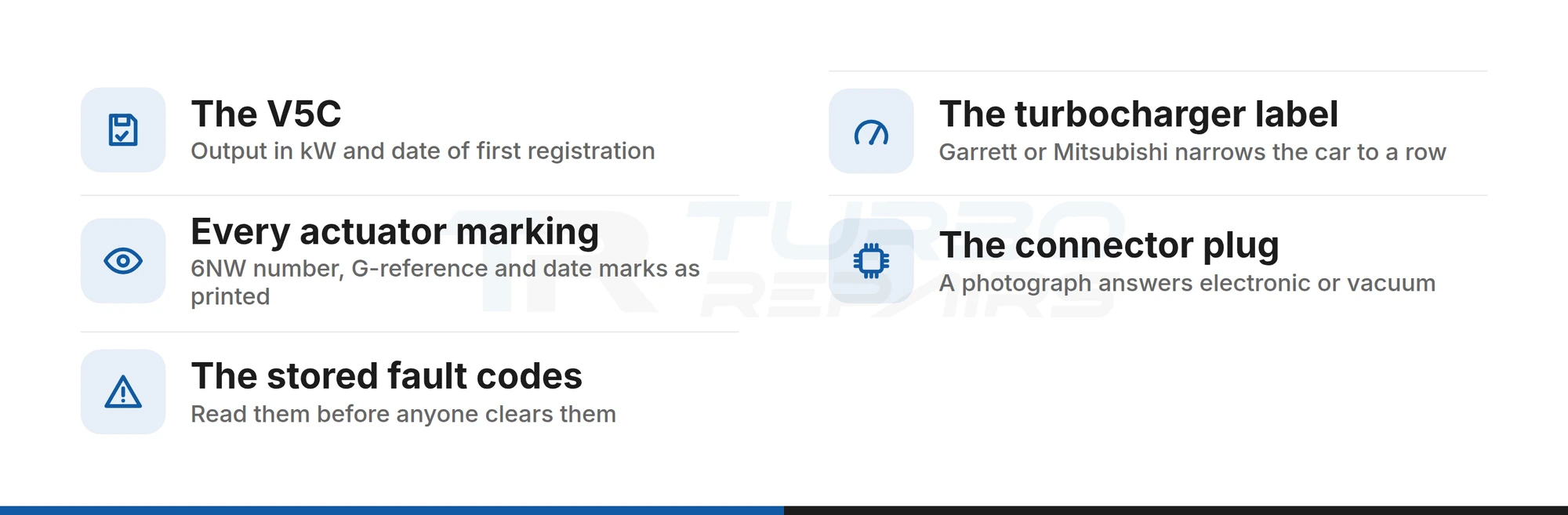
- The V5C. Section P.2 gives the output in kilowatts, and the date of first registration tells you which end of the Antara’s life the car comes from.
- The turbocharger’s label. In the listings, the 2.0 cars run Garrett turbochargers and the 2.2 a Mitsubishi TD04, so the maker’s name on the label is a quick way to narrow the car to a row of the table above.
- Every marking on the actuator. Photograph the maker’s name, the 6NW number, the G-reference and any other codes or date marks exactly as printed.
- The connector. A photograph of the plug on the housing answers the electronic-or-vacuum question outright.
- The stored codes. Read them, with any freeze-frame data, before anyone clears them.
None of this has to match a listing when your own actuator is being rebuilt, because it goes back onto the turbocharger it came off. The photographs let us confirm the unit before you post it, and on these two badges they are the quickest way to place the car.
What a Failing Captiva or Antara Actuator Does
The complaint the listings describe for this platform is consistent: a drastic loss of boost, often with the engine management forcing the car into limp-home mode. The codes that come with it are usually generic boost codes rather than anything that names the actuator.
- P0299 reports underboost: less pressure than the engine management asked for.
- P0234 reports overboost: more pressure than it asked for.
- P2263 reports a turbocharger boost system performance fault.
Each of those codes describes the result, not the cause. A split charge hose, a corroded connector and vanes that have stiffened inside the turbocharger can all produce them. Our fault code guide explains which signal each code is reporting on.
Patterns that point towards the actuator
- Power that drops out and returns after a restart. A fault that comes and goes points at the control side first: the actuator, its connector and its wiring. Read the codes while the car is still showing it.
- Boost that hunts or surges with no change in engine note. This fits an actuator that can no longer hold the position it is sent to, and it also fits a small leak in the pressurised pipework.
- Limp mode from the first pull of every journey. This fits a motor or gear train that has stopped driving, or a position sensor that has stopped reporting. It also fits seized vanes, which is why the next section matters.
Blue smoke, oil in the intercooler pipes or a rising whine point at the turbocharger instead. An actuator cannot put oil anywhere. Our guide to the symptoms of a failing turbo actuator goes further into the pattern around each one, and what the actuator does explains why these parts wear.
Actuator or Turbocharger? Check the Vanes First
An actuator that can no longer move the vanes and vanes that no longer let the actuator move them produce the same codes. The first needs the actuator rebuilt. The second needs the turbocharger rebuilt, and an actuator refitted to a stiff vane mechanism strains against it from the first drive.
Three checks separate them, and none needs special tools.
- The connector. With the ignition off, unplug the actuator and inspect both halves for corrosion, water and pushed-back pins, then refit it until it clicks home. A poor connection throws the same codes as a failed motor.
- The intake. Have the charge pipes and intercooler joints pressure-tested. A hose that only opens under boost reads as a boost-control fault and costs far less to fix than either part.
- The vanes, by hand. Let the engine cool completely, because the turbine housing gets hot enough to burn. Where the actuator drives the vanes through an external arm, free the arm and move the turbocharger’s lever gently through its whole range. Smooth, even travel points at the actuator; dragging, catching or stopping short points at the turbocharger.
Do not drive the car with the actuator unplugged to see what happens. The three checks tell you more, without the risk.
If the vanes are stiff, the turbocharger needs the work. For an early Antara 2.0, our Antara 2.0 CDTi turbocharger rebuild is the place to start; for the Captiva and the 2.2, start from our turbocharger repairs. Our guide to variable-vane turbochargers explains why vanes that free up on a long run have not repaired themselves. An actuator that has been pushing against a stiff mechanism has worked harder than it was designed to, so mention it on the form and we will test the actuator too.
Turbo Repairs · Epsom workshop
Vanes move freely? Send us the actuator on its own
Note the markings on the casing, the output and registration date from your V5C and the codes the car stored, then post the actuator without the turbocharger. It runs on our bench before it is opened, and the price is confirmed before any work begins.
Lifetime, unlimited-mileage warranty · Mail-in from the UK and internationally · Bench-tested and calibrated before it ships
Our Captiva and Antara Actuator Rebuild
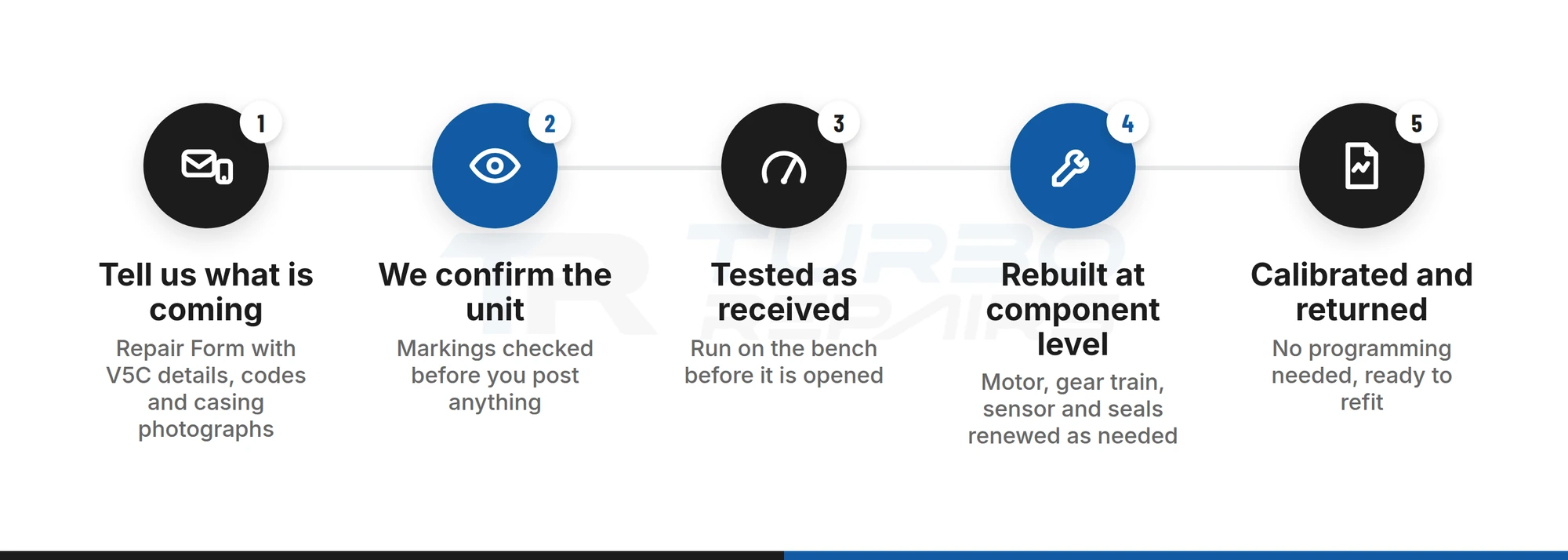
You, or the garage that looks after the car, remove the actuator and send it to our workshop at Unit 102 Reaver House, 12 East Street, Epsom, Surrey, KT17 1HX, United Kingdom. It is rebuilt there by our team of turbo specialists and electronic engineers, in this order.
- Tell us what is coming. On the online Repair Form, give the badge and registration, the output and date of first registration from the V5C, the stored codes, photographs of the actuator’s markings and connector, and what you found when you moved the vanes by hand.
- We confirm the unit. The markings are checked against the car before you post anything. If the photographs show a vacuum can rather than an electronic actuator, we tell you at this stage.
- We test it as received. The actuator is run on the bench before it is opened (see how the actuator is tested), so the fault we report is the one we measured.
- We rebuild it at component level. The motor, gear train, position sensor and seals are renewed as needed and the circuit board is reworked. Components with a known weakness in the original design are replaced with uprated parts rather than put back as they were, so the unit meets or exceeds original specification.
- We calibrate it and return it. Travel and position feedback are checked across the full sweep on dealer-level diagnostic and calibration tooling. Actuators require no programming, so it goes straight back onto the turbocharger; clear the stored codes once it is fitted.
Repairs start from £100 + VAT, and the exact price is confirmed once the unit has been identified and tested, before any work goes ahead. Turnaround is typically one to two working days from arrival, plus postage each way, and every rebuild carries a lifetime, unlimited-mileage warranty with no time limit.
The same process applies whichever badge the car wears, and independent garages send actuators in for their customers’ cars the same way. Packing and postage are covered on our FAQs page, and the other cars whose actuators we rebuild are listed under our electronic turbo actuator repairs.
Captiva and Antara Turbo Actuator FAQ
Is the Captiva turbo actuator the same as the Antara one?
The two badges are closely related: the listings put the Captiva 2.2 and Antara 2.2 on the same TD04 turbocharger, and the early 2.0 cars share the Z20S engine code. But the only actuator reference listed, Hella 6NW008412 under G-203, is catalogued against the Captiva 2.0 alone. Compare the markings on your own casing rather than relying on the badge.
Does the Captiva 2.2 have an electronic turbo actuator?
The listings we reviewed do not say. They document the 2.2’s Mitsubishi TD04 variable-geometry turbocharger and sell its actuator as a separate part, without stating the type. Look for a wiring connector on the actuator housing: if there is one, the unit is electronic and we can rebuild it.
What does G-203 mean on a Captiva actuator?
It is the G-reference on the Hella actuator listed for the Captiva 2.0 diesel, printed alongside the Hella number 6NW008412. Hella used that number on other applications too, so the G-reference is the part to match if you are buying a replacement. If your own unit is being rebuilt, nothing needs matching.
Do you repair the vacuum type of turbo actuator?
No. We rebuild electronic turbo actuators: the motorised units with a wiring connector on the housing. If the part on your turbocharger is a round can with a vacuum pipe, it is a different component and not one we rebuild.
Will a rebuilt actuator need programming on my Captiva or Antara?
No. Actuators require no programming: your own unit is calibrated on our bench and returned ready to refit. Clear the stored fault codes with a diagnostic tool once it is back on the car.
How much does a Captiva or Antara actuator repair cost, and how long does it take?
Repairs start from £100 + VAT, with the exact price confirmed once the unit has been identified and tested. Turnaround is typically one to two working days from arrival, plus postage each way, and every rebuild carries a lifetime, unlimited-mileage warranty.
Final Thoughts
The Captiva and the Antara share their diesels but not their paperwork. The one actuator reference that exists is filed under the Chevrolet 2.0, the 2.2 is documented through its turbocharger rather than its actuator, and a 2.0 Antara can sit at either end of the model’s life with different hardware at each.
That is why the evidence worth gathering is physical: the connector on the housing, the maker’s name on the turbocharger and the markings on the actuator, backed by the output and registration date on the V5C. Check the vanes by hand with the engine cold, and if they move freely, the actuator already on your turbocharger is the one to rebuild, whichever badge is on the tailgate.
Turbo Repairs · Epsom workshop
One repair for both badges: send the actuator, keep the turbo
Complete the Repair Form with your V5C details, stored codes and casing photographs, and we confirm the unit before you post it. It is tested, rebuilt at component level, calibrated and sent back ready to bolt on, with no programming needed.
Lifetime, unlimited-mileage warranty · Mail-in from the UK and internationally · Bench-tested and calibrated before it ships