

Summary P2563 means the engine management does not accept the position its turbo actuator is reporting. The generic description is turbocharger boost control position sensor circuit range or performance; Volkswagen group tooling words it as an implausible signal between the position asked for and the position achieved. It points at the feedback side of boost control, and it does not prove that the actuator or the turbocharger has failed.
Below is a lookup table for the codes turbo actuators set, generic and maker-specific, with what each one records and which of our pages covers it in depth.
The same P2563 is stored by vacuum-worked diesel turbos, electronic actuators and a petrol engine’s electric wastegate, so the number tells you which signal disagreed and never which hardware you own.
Every turbo actuator fault code reports on one of three signals: the command the engine management sends to the actuator, the position the actuator reports back, or the boost that finally arrives. Which of the three a code belongs to decides where testing starts. This page sorts the codes that way, agrees with what our model pages already record against each one, and points you to the page that covers your car.
Turbo Actuator Fault Code Lookup Table
The descriptions below are the ones our sources and model pages record. The exact wording on your diagnostic tool may differ, and for the maker-specific codes it varies by make, so treat this as an index rather than a verdict.
| Code | Signal it watches | What it records | Where we go deeper |
|---|---|---|---|
| P2562 | Position feedback | A fault in the boost control position sensor circuit itself. | This page; also recorded on our Freelander 2 page |
| P2563 | Position feedback | Position sensor circuit range or performance. A signal arrives, but not one the engine management accepts. | This page, below |
| P2564 to P2566 | Position feedback | Further faults on the same position sensor circuit. P2565, for example, is circuit high. | This page |
| P259E | Position feedback | Boost control position at low limit: the reported position is stuck at the bottom of its range. | Freelander 2 page |
| P2598 / P2599 | Position feedback | Boost control position performance, recorded on the 2.0 EcoBlue and later 2.2 TDCi Transit. | Ford Transit actuator page |
| P003A | Position, during adaptation | Position exceeded learning limit: in adaptation, the reported position fell outside the accepted range. | Ford S-Max 2.2 TDCi page |
| P0045 | Command circuit | Boost control “A” circuit open. Current that should have flowed did not. | Ford S-Max page |
| P0046 | Command circuit | Boost control circuit range or performance. It responds, but not as expected. | Chrysler 300C 3.0 CRD page |
| P0047 / P0048 | Command circuit | Boost control circuit low and high: the electrical loop is reading outside its limits. | Ford S-Max and Freelander 2 pages |
| P1033 | Command circuit (Jeep) | Boost pressure control, short to battery positive rather than open. | Jeep Grand Cherokee 3.0 CRD page |
| P132A / P132B | Maker-specific (Ford, Jaguar) | Turbocharger boost control, and boost control “A” performance. Published descriptions of P132A disagree. | P132A and P132B on the Ford Mondeo |
| P1952 / P1953 | Maker-specific (VW Touareg) | Listed as turbo control module 1 and turbo control unit 2 defective: codes about the control unit rather than the boost. | VW Touareg page |
| 2510 | Maker-specific (Mercedes) | Boost Pressure Control: the control unit did not receive the boost pressure it commanded. | Mercedes C-Class page |
| 3F57 / 3F77 / 4191 | Maker-specific (BMW) | Charge air pressure control, logged as a control deviation, with its companion code; 4191 is recorded as charge air pressure actuator. | BMW 5 Series and 3 Series pages |
| 1517 / 1507 / 1540 | Maker-specific (Volvo) | Turbo overboost; turbo control pressure too low; too high. Given by one specialist listing for the XC60 2.4 actuator. | Volvo D5 page |
| P0299 / P0234 / P2263 | Outcome | Underboost, overboost and boost system performance: which way boost missed its target, not why. | P0299 and P0234 guide |
Two things no row can do. None names the part that failed, because no code does. And none identifies the actuator on your car: our C-Class page records that a 2510 reads the same on every C-Class diesel, whichever actuator family is fitted. Identification comes from the references on the casing, and our Hella actuator index by part number starts from those.
P2563 and P2562: Position Feedback Codes
An electronic actuator carries a position sensor on its output, reporting where the mechanism actually is, and the engine management compares that report with the position it asked for. The longer explanation of that second loop is in our guide to what a turbo actuator does. P2562 and P2563 are both about the report.
The difference between them is the difference between a broken line and a bad answer. P2562 concerns the sensor circuit itself. P2563 is range or performance: a signal is arriving, but it is not one the engine management accepts. P2563 is a generic code, so any OBD-II reader can name it, and some tools drop the “sensor A” from the description.
Volkswagen group tooling is more candid about what triggers it. Ross-Tech’s VAG fault-code reference lists the same fault as 18995/P2563/009571, turbocharger boost control position sensor circuit: implausible signal, and notes it may be set when the actual and specified turbocharger requests are considered implausible. That is a failed comparison, not a failed sensor. A sensor reporting accurately that the vanes did not move sets the same code as a sensor that has stopped reporting properly.
The same reference lists what can cause it on VAG vehicles, and the list runs from the loom to the turbine housing: wiring and connections to the vane position sensor, the sensor itself, the engine control module, binding from adjustment or the turbocharger, excessive carbon build-up, and a vacuum leak at the actuator or the boost pressure control solenoid.
What P2563 does not prove
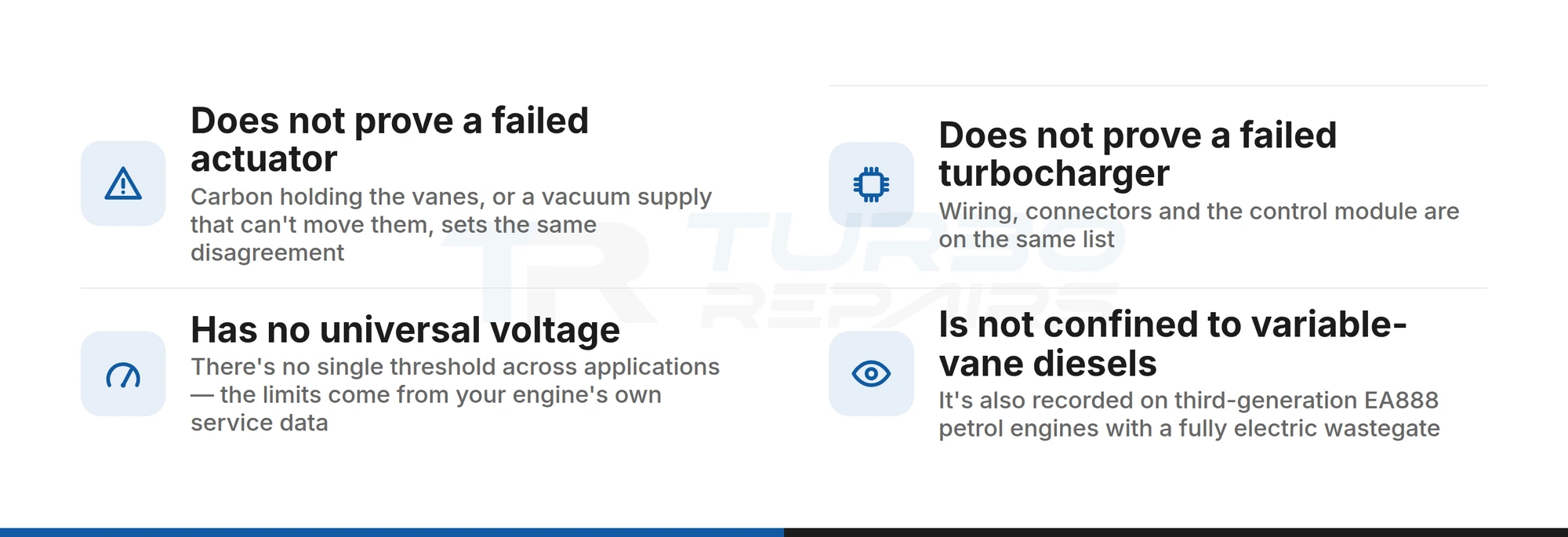
- It does not prove a failed actuator. Carbon holding the vanes, or a vacuum supply that cannot move them, produces the same disagreement between asked-for and achieved position.
- It does not prove a failed turbocharger. Wiring, connectors and the control module are on the same list.
- It has no universal voltage. Some code-lookup pages quote a single sensor voltage window for every car. There is no universal threshold across applications; the limits come from the service data for your engine.
- It is not confined to variable-vane diesels. Some lookup pages say P2563 appears only on variable-geometry turbos. Ross-Tech’s notes cover it on third-generation EA888 petrol engines with a fully electric wastegate, where, after a wastegate repair kit is fitted, the actual position should be checked against the adapted lower stop and the initial adaptation run. On those engines a P2563 after a repair can be a set-up question rather than a failed part.
The test that separates the actuator from the turbocharger
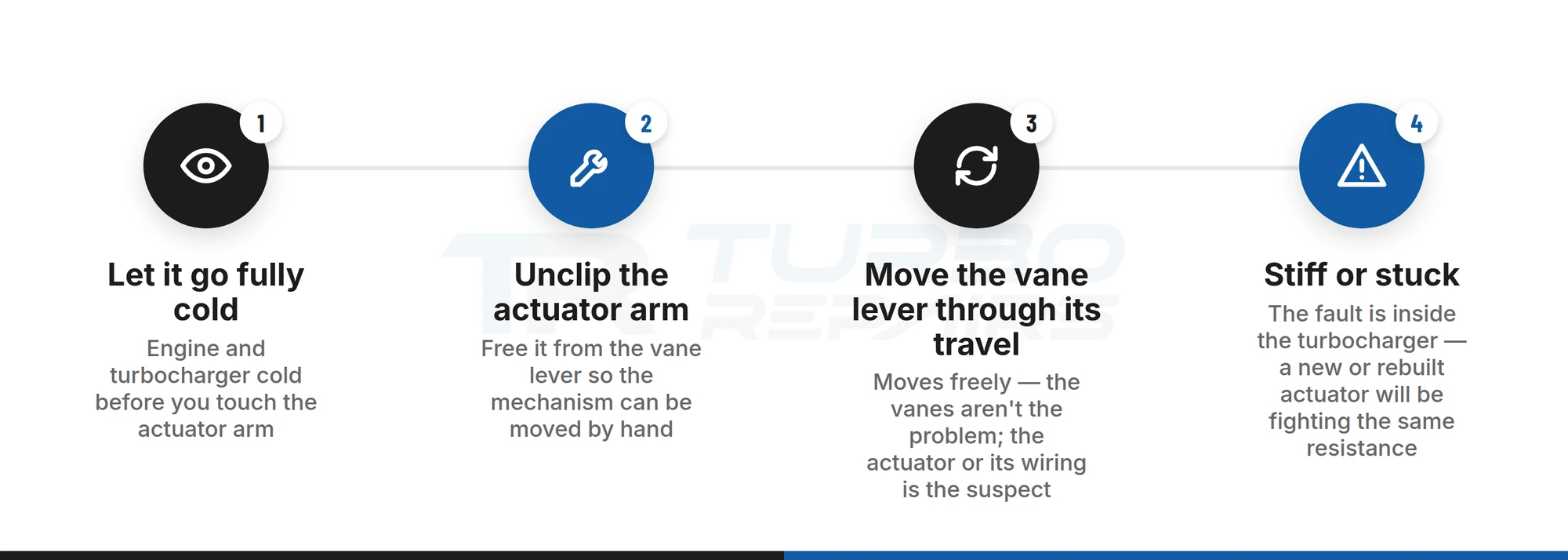
Once the wiring and connector have been checked, the question is whether the mechanism moves. With the engine and turbocharger fully cold, unclip the actuator arm and move the vane lever through its travel by hand. If it moves freely, the vanes are not the problem and the actuator or its wiring is the suspect. If it is stiff or stuck, the fault is inside the turbocharger, and a new or rebuilt actuator fitted to it will be fighting the same resistance.
If your actuator is a metal can with a vacuum pipe and no electrical plug, test the vacuum supply first; the causes listed above include exactly that. Our guide to turbo actuator symptoms sets out the full order of checks, including what to record before anything is cleared.
P0045 and Its Neighbours: Circuit Codes
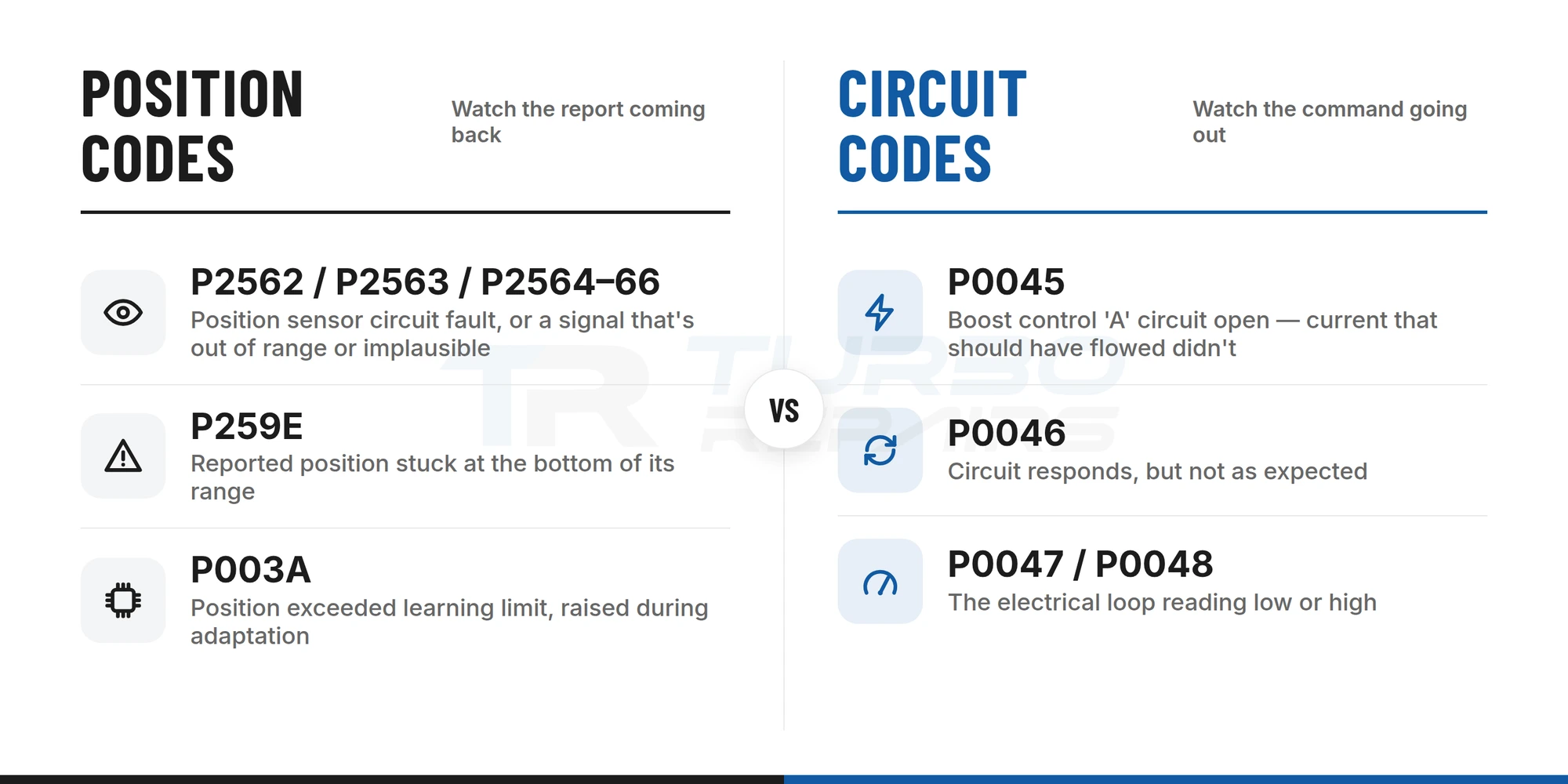
Position codes watch the answer coming back. Circuit codes watch the command going out. P0045 records that boost control circuit “A” is open, P0046 that it responds but not as expected, and P0047 and P0048 that it is reading low or high. Each describes the electrical loop the engine management drives the actuator through, not a component on it.
That loop has several places to break, and an open winding inside the actuator sets the same P0045 as a wire chafed through along the loom. Our Ford S-Max page takes the P0045 circuit, component by component, and explains how the half on the car is tested separately from the half that comes off.
Two combinations are worth recognising. When a command code and a position code are stored together, look at what both sides share before the unit itself: turbo circuits share supply and earth paths with other sensors, so one supply or earth fault can set codes in both directions. And P003A sits between the two families. It is a position code raised during adaptation, and the S-Max page records that a mechanically sound actuator will set it when stiff vanes hold it short of its stop.
Jeep’s P1033 is a maker-specific relative of this family: the boost pressure control circuit shorted to battery positive rather than open. A short is as likely to sit in the loom as inside the unit, which is why the Grand Cherokee page starts with the connector.
Turbo Repairs · Epsom workshop
The code narrows it down. The bench decides.
If the vanes move freely and the wiring checks out, send us the actuator with every stored code written down exactly as your tool showed it. We test the unit as received, before it is opened, so the fault we report is the one we measured.
Lifetime, unlimited-mileage warranty · Mail-in from the UK and internationally · Bench-tested and calibrated before it ships
Maker-Specific Codes a Generic Reader Cannot Name
Generic codes carry standard descriptions that almost every reader holds. A manufacturer’s own codes do not. Some use the same P format, such as Ford’s P132A and P132B and the Touareg’s P1952 and P1953; others use their own numbering, such as Mercedes 2510, BMW 3F57 and the Volvo codes above.
A basic reader handles these in one of three ways. It shows the number with no description, labels it unknown, or cannot see the manufacturer’s code at all and returns a generic outcome code in its place. Our Mercedes pages record exactly that last case: a generic reader usually reports P0299, P0234 or P2263 where Mercedes equipment shows 2510.
What each make’s codes say, in brief:
- Ford and Jaguar: P132A and P132B. Specialists record P132A as a turbocharger boost control code and elsewhere as a vane code, so even the printed descriptions disagree. The Mondeo and Transit pages cover why generic scanners return them as unknown.
- Mercedes: 2510, Boost Pressure Control, sometimes shown as 2510-001. It describes the control loop rather than the part, and it reads identically across the engines in a model range.
- BMW: 3F57 and its frequent companion 3F77, both charge air pressure control, and 4191, charge air pressure actuator. They need a BMW-capable tool to read with their proper text.
- Volvo: 1517, 1507 and 1540, from one specialist listing for the XC60 2.4. A pressure that reads too low at one moment and too high at another is what vanes out of position produce.
- Volkswagen Touareg: P1952 and P1953, listed as turbo control module and control unit defective, which puts the control electronics rather than the boost on the charge sheet.
- Jeep: P1033, the short-to-positive circuit code covered above.
If your reader shows a number with no text, write it down exactly as displayed, suffix included, and have the car read on equipment that covers the make before anything is replaced. A blank description is a gap in the tool’s database, not a sign the code is minor.
Why the Same Code Means Different Things by Make
A generic code has a standard number and a standard description. It does not have a standard test. Each manufacturer decides what its engine management measures before storing the code, and P2563 shows the spread clearly:
- The generic description calls it a position sensor circuit range or performance fault, which reads like a sensor problem.
- Volkswagen group tooling calls it an implausible signal between specified and actual position, which reads like a disagreement.
- Ford’s published OBD summary for its 2009 6.4-litre diesel describes the P2563 monitor as evaluating a variable-geometry control relationship under defined engine conditions, which reads like control behaviour.
One number, three different tests. That is why a description copied from another make’s page, or from a generic lookup, is a hint rather than a diagnosis.
The hardware behind the code differs as much as the test. On a vacuum-worked VAG diesel, the vacuum supply and its solenoid are suspects. Where the position sensor sits inside an electronic actuator, as our Transporter and Crafter page records for the units catalogued on those vans, the actuator and its wiring move up the list. On a third-generation EA888 petrol, an electric wastegate and its adaptation are in play. Only the electronic unit is an electronic actuator rebuild, so establish which part is bolted to your turbocharger before reading anything into the code.
The same caution applies to maker-specific codes. They belong to one manufacturer’s software, and a code list that crosses makes has usually been borrowed from somewhere else. The description that counts is the one from your own vehicle’s make.
Turbo Actuator Fault Code FAQ
What does the P2563 code mean?
Turbocharger boost control position sensor circuit range or performance. The engine management has received a position report from the turbo’s boost control that it does not accept. Volkswagen group tooling describes it as an implausible signal between the position asked for and the position achieved.
Does P2563 mean my turbo actuator has failed?
No. Wiring, the connector, carbon holding the vanes, a vacuum leak on vacuum-worked units and the control module can all set it. With the engine cold, unclip the arm and move the vane lever by hand: if it moves freely and the wiring checks out, the actuator becomes the main suspect.
What is the difference between P2562 and P2563?
P2562 concerns the position sensor circuit itself. P2563 means a signal is arriving but is out of range or implausible. Both are about the position report coming back from the boost control, not the command going out to it.
Is P0045 the same kind of fault as P2563?
No. P0045 records that the boost control circuit is open, so it concerns the command side: the loop the engine management drives the actuator through. P2563 concerns the position being reported back. When both are stored together, check the supply, earth and connector the two sides share before the unit.
Can P2563 appear on a petrol engine?
Yes. Ross-Tech’s notes cover it on third-generation EA888 petrol engines with a fully electric wastegate, including after a wastegate repair kit has been fitted, when the actual position should be checked against the adapted lower stop and the initial adaptation run.
Can you rebuild the actuator that set the code?
If it is an electronic actuator, yes. Your own unit is tested as received, rebuilt at component level, calibrated on the bench and returned ready to refit with no programming. Repairs start from £100 + VAT, typically take one to two working days on the bench, and carry a lifetime, unlimited-mileage warranty. Clear the stored codes once it is refitted.
Final Thoughts
A turbo actuator code is most useful once you know which signal it describes. A position code says the report coming back was wrong. A circuit code says the command going out failed to arrive. An outcome code says only which way boost missed its target. None names a part, and a maker-specific code is only as clear as the tool reading it.
So read the code on equipment that knows the make, write it down exactly, sweep the vanes by hand before blaming anything bolted to them, and let the test decide. If the evidence points at the actuator, send us that unit rather than buying a part to match a number.
Turbo Repairs · Epsom workshop
Vanes free, wiring sound, code still there? Send us the actuator
Post your electronic actuator with the stored codes and a photograph of its label. We rebuild it at component level, calibrate it to the turbocharger it came off and send it back ready to refit, with no coding needed.
Lifetime, unlimited-mileage warranty · Mail-in from the UK and internationally · Bench-tested and calibrated before it ships