

Summary We rebuild the turbocharger from a Toyota Hilux or Land Cruiser D-4D from £185 + VAT and return it bench-tested and ready to refit. The 2.5 and the 3.0 D-4D carry different turbos, and the 3.0 is listed with a different unit at each of its two power outputs, so the engine section below is the place to start.
On a 3.0 D-4D the engine management sets the boost and the turbocharger delivers it. A bigger turbo on its own therefore adds nothing to a standard Hilux, and rebuilding the original to factory specification gives nothing up.
One Toyota reference, 17201-30010, is listed for the 163 hp 3.0 D-4D in both the Hilux and the Land Cruiser, while the 171 hp version of the same engine takes a different turbocharger.
This page is about the turbocharger on Toyota’s D-4D diesels in the Hilux pickup and the Land Cruiser. It shows which engine and which turbo your vehicle carries, what wears out and why, what to rule out before the turbo comes off, and how we rebuild it.
- Vehicles: the Toyota Hilux from the seventh generation on, and the Land Cruiser with the 3.0 D-4D
- Engines: the 2.5 D-4D (2KD-FTV), the 3.0 D-4D (1KD-FTV) at 163 hp and 171 hp, and the 2.4 (2GD-FTV) listed for the later Hilux
- Boost control on the 3.0: variable vanes in the turbine housing, moved by an electric motor mounted on the turbo and directed by the engine management
- What we do: rebuild your own turbocharger, sent to us complete with the vane motor still attached
- Prices: a rebuild of your own turbo from £185 + VAT; a replacement turbo from £450 + VAT
- Bench time: typically one to three working days
- Warranty: lifetime, unlimited mileage
Which D-4D Engine Is in Your Toyota?
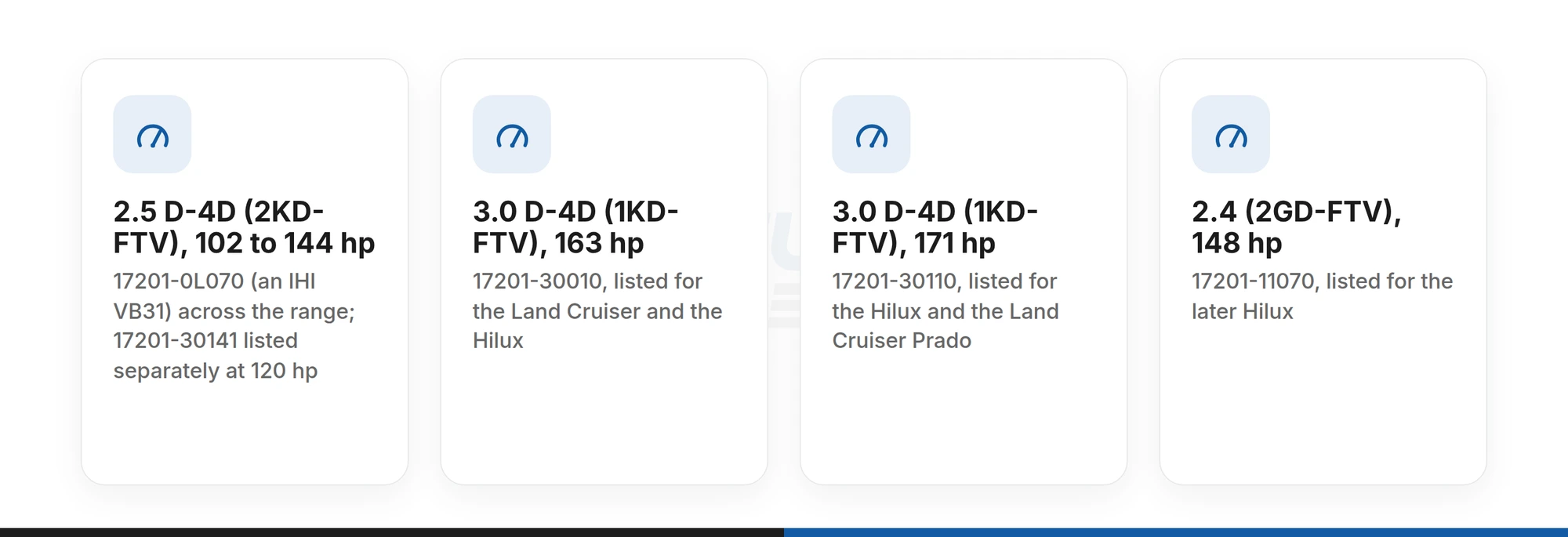
The D-4D badge on a Hilux or Land Cruiser covers more than one engine, and those engines do not share a turbocharger. The cylinder capacity in section P.1 of your V5C separates the 2.4, the 2.5 and the 3.0 on its own. On the 3.0, the power output then decides between two different turbos.
| Engine | Where the trade lists it | Toyota turbo reference as listed |
|---|---|---|
| 2.5 D-4D (2KD-FTV), 102 to 144 hp | The seventh-generation Hilux, two- and four-wheel drive, chassis codes KUN10, KUN15, KUN25 and KUN35 | 17201-0L070 (an IHI VB31) across the output range; 17201-30141 listed separately at 120 hp |
| 3.0 D-4D (1KD-FTV), 163 hp | The Land Cruiser, filed under J90, J95, J120 and J125, and the Hilux | 17201-30010 |
| 3.0 D-4D (1KD-FTV), 171 hp | The Hilux and the Land Cruiser Prado, and the same listing covers the Hiace and Fortuner | 17201-30110 |
| 2.4 (2GD-FTV), 148 hp | The later Hilux and its Fortuner sibling, depending on market | 17201-11070 |
Those references are how parts sellers list the turbos. The reference on your own turbo is the one that counts, and the next section explains how to read it. If you only have the registration, put it on the Repair Form and we will narrow it down before you send anything.
The power figure on a V5C is given in kilowatts, while turbo listings quote horsepower, so the 163 hp and 171 hp versions of the 3.0 can look alike at a glance. If you are unsure which yours is, the label settles it, and failing that the bench does.
Older Hilux trucks, and Land Cruisers with engines other than the 3.0, sit outside the listings this page is built on. We still rebuild their turbochargers. Send the details through the Repair Form and we will identify the unit with you before it is posted.
Other pickups and 4x4s have pages of their own, including the Mitsubishi L200, the Isuzu D-Max, the Ford Ranger, the Nissan Navara D40 and the Land Rover Defender, with the rest of the range on our Land Rover page. Those pages cover those vehicles only, and nothing on them implies a part that fits a Toyota.
Which Turbo Is on Your D-4D? Family Names and Toyota Numbers
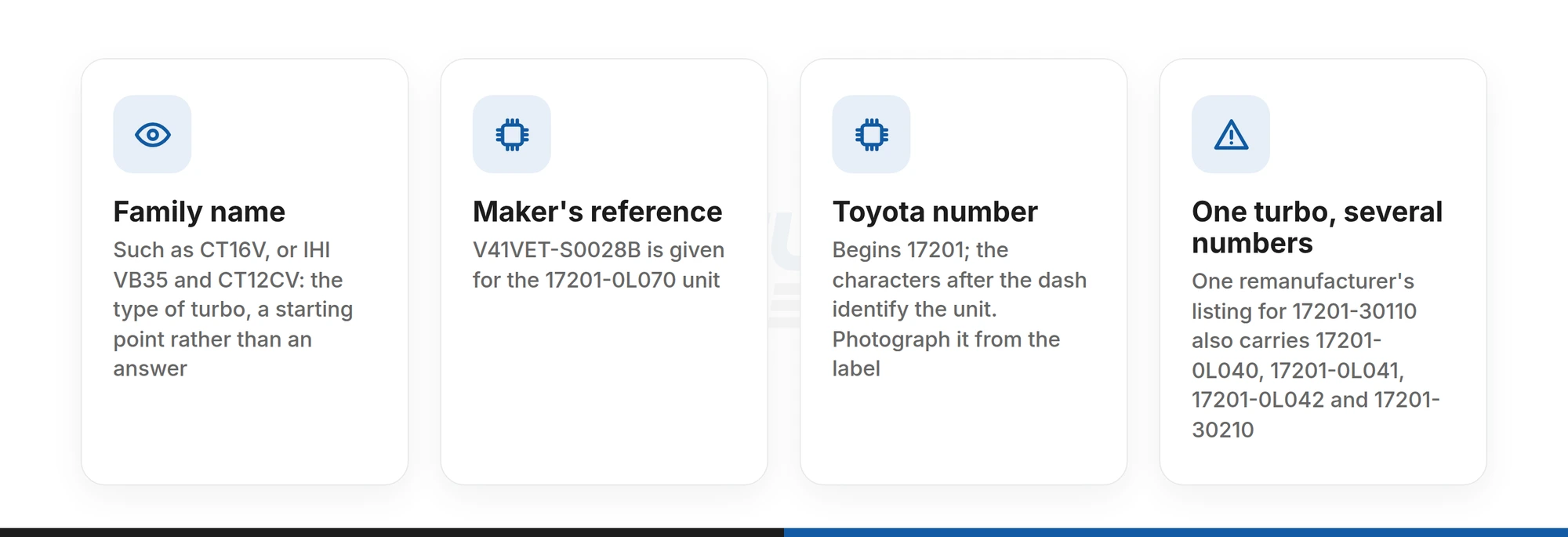
A Toyota turbocharger can be described in three ways: by a family name, by the turbo maker’s reference, and by Toyota’s own part number. Only the last of these identifies the unit on your engine, and it is the one we ask you for.
Family names narrow the search
Owners searching for a Hilux turbo often use a family name such as CT16V, and a 4×4 workshop that fits these engines describes the original turbo on the seventh-generation Hilux 3.0 as an IHI VB35 or CT12CV. On the 2.5, the 17201-0L070 unit is sold as an IHI VB31, with the maker’s reference V41VET-S0028B.
A family name tells you the type of turbo. It does not tell you the housings, the wheel sizes or the vane set it was built with for your engine, so it is a starting point rather than an answer.
The Toyota number identifies it
Every Toyota turbo reference in the listings we read begins 17201. The characters after the dash are the part that does the identifying, and that is the number to photograph from the label before the turbo comes off. Our guide shows how to find the part number on your turbo.
Toyota has also renumbered its turbos over time, and one remanufacturer files several Toyota numbers against a single unit. Its listing for 17201-30110 also carries 17201-0L040, 17201-0L041, 17201-0L042 and 17201-30210, and its listing for 17201-30141 carries 17201-30140, 17201-0L050 and 17201-0L080. A number on a quote that differs from the one on your label is therefore not always a different turbo, but it is a question to ask before you pay for anything.
Where the sellers disagree
On the 2.5 the listings do not draw one clean line. The 17201-0L070 unit is sold for outputs from 102 to 144 hp, and the separate 17201-30141 unit is sold for the 120 hp version that sits inside that range. Power alone cannot settle it on this engine; the label can, and if the label is burnt or missing we identify the unit on the bench before any work starts.
The vane motor goes with the turbo
On the 3.0 D-4D, boost is controlled by a ring of vanes inside the turbine housing. An electric motor on the side of the turbo moves them, and the engine management decides where they should be. Our guide to how a variable-vane turbo works explains the mechanism and why carbon makes it stick.
The same workshop reports that the genuine replacement turbo comes complete with its motor, and that the motor is not sold on its own. Leave it attached: the turbo comes to us complete, and the motor goes back on your engine with it.
What Fails on a D-4D Turbo
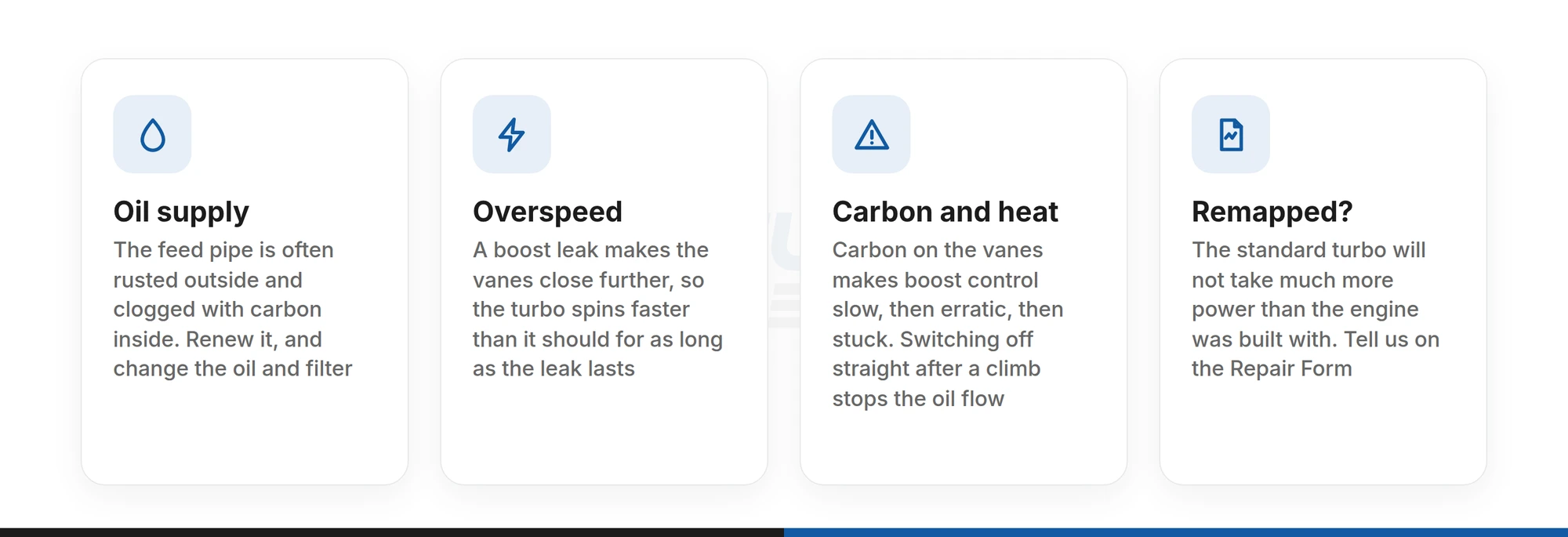
Workshops that fit the 3.0 describe its original turbo as small, responsive and generally reliable. When one does fail early, the causes named start outside the turbo: its oil supply, and anything that makes it spin faster than it was built to.
Oil supply
The shaft runs on a film of engine oil, and on these engines the feed pipe that delivers it is often found rusted on the outside and clogged with carbon on the inside. A partly blocked pipe starves the bearings while the engine still sounds healthy.
A rebuilt turbo fed through the old pipe is fed through the pipe that failed the last one. Renew it, and change the oil and filter, as part of the same job.
Overspeed
The engine management asks for a boost pressure and moves the vanes until it gets it. If boost is escaping through a split hose, a loose clamp or a leaking intercooler, the vanes close further to make up the difference and the turbo spins faster than it should for as long as the leak lasts. The leak causes the damage; the turbo is where it shows.
A sticking vane control can do the same thing faster. One workshop documents a factory 3.0 turbo that broke up after its vane control motor stuck, leaving the turbo overspeeding at high revs with more boost than it could handle.
The same workshop warns that the standard turbo will not take much more power than the engine was built with. A remap raises the boost the engine asks for, and past a point the airflow runs out and the small turbine shaft is the part at risk. If your truck has been remapped, tell us on the Repair Form.
Carbon and heat
Carbon on the vanes and in the turbine housing makes boost control slow, then erratic, then stuck. It builds on the short, cool journeys that never bring the exhaust up to heat, and a long run may free it for a while without curing it.
Heat works from the other side. A Hilux or Land Cruiser that tows or carries a load works its turbo hard for long periods, and switching off straight after a climb stops the oil flow while the bearing housing is at its hottest. A minute or two at idle first costs nothing.
Symptoms are covered in detail on our guide to common turbocharger problems, which sorts them by where in the turbo they start.
Turbo Fault or Engine Fault? What to Check First
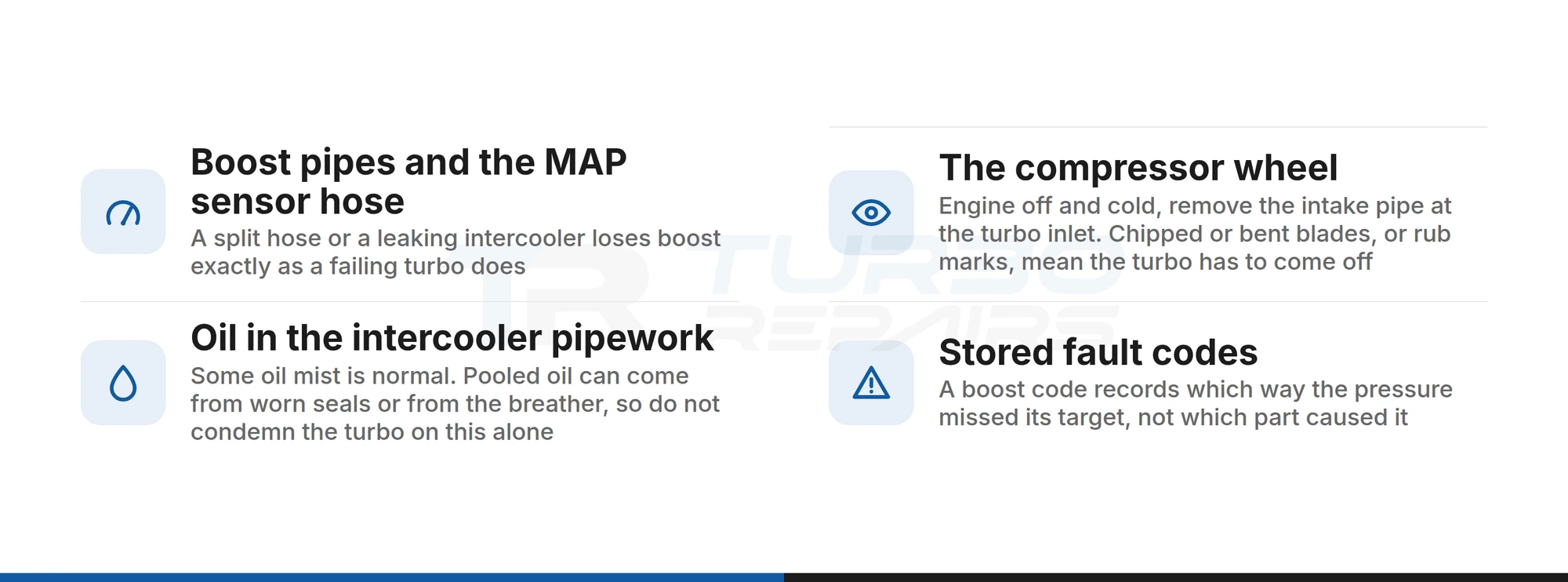
A D-4D that has lost power has not necessarily lost its turbo. These checks cost little and should come before anything is unbolted.
- Boost pipes and the MAP sensor hose. A split hose or a leaking intercooler loses boost exactly as a failing turbo does, and the turbo works harder to cover for it. Check every hose and clamp from the turbo outlet to the inlet manifold, and the small hose to the boost pressure sensor.
- The compressor wheel. With the engine off and cold, remove the intake pipe at the turbo inlet. Chipped or bent blades, or rub marks on the housing around the wheel, mean the turbo has to come off.
- Oil in the intercooler pipework. Some oil mist is normal. Pooled oil can come from worn turbo seals or from crankcase pressure pushed through the breather, so a turbo should not be condemned on this alone.
- Stored fault codes. A boost code records which way the pressure missed its target, not which part caused it. Our guide to overboost and underboost codes works through the suspects in order.
If those checks point at the turbo, stop driving the truck hard. A D-4D will move with a failed turbo, but the engine can lose oil through it, it will usually fall into limp mode, and a wheel that breaks up can send fragments into the intercooler and the engine.
Turbo Repairs · Epsom workshop
Not sure it is the turbo? Send us what you have found
Put the registration, the engine, any fault codes and a photograph of the turbo’s label on the Repair Form. We will tell you whether the turbo is worth sending, and which unit it is, before anything leaves your garage.
Lifetime, unlimited-mileage warranty · Mail-in from the UK and internationally · Bench-tested and calibrated before it ships
Rebuild or Replace on an Older Hilux or Land Cruiser
There are three ways to put a working turbo back on a D-4D: a new unit, an exchange or remanufactured unit, or your own turbocharger rebuilt. A rebuild of your own unit starts from £185 + VAT, and a replacement turbo from us starts from £450 + VAT.
The work on the truck is the same either way
One workshop puts the removal and refit at around five hours of labour on the 3.0, and recommends taking the exhaust manifold off for room. Manifold studs and gaskets are often seized on these engines and are worth budgeting for, along with the oil feed pipe and an oil and filter change. None of that changes with the route you choose, so the choice only moves the price of the turbo itself.
When a rebuild is the better route
Your own turbo is matched to your engine by definition. On an engine where one turbo can carry several Toyota numbers, and two sellers can list different units for the same output, that removes the one decision an exchange unit asks you to get right.
A rebuild also measures the condition of what you send rather than describing it. Every part is checked against its tolerances, so you know what was worn and what was replaced.
When replacement is the better route
A turbo that has broken up can take its housings with it. Workshops that fit these engines note that a blown D-4D turbo often has damage to the bearing housing and the compressor housing as well as the rotating parts. We measure every unit before work starts; if a housing is beyond use, we tell you, and a replacement is the honest answer.
What about a bigger turbo?
Much of what comes up for a Hilux turbo is about upgrades. On the 3.0 D-4D the engine management sets the boost target and moves the vanes to meet it, so bolting on a larger turbo by itself does not raise the boost or the power. Workshops that sell upgrades say the same: the extra power comes from changing the engine’s fuelling and boost, not from the turbo alone.
That makes the original-specification turbo the right part for a standard truck, and a rebuild returns it to that specification. We rebuild turbos to original specification and do not supply or fit upgrade turbos.
Our Toyota D-4D Turbo Rebuild
Every turbo is tested as it arrives, before it is opened, so the fault we repair is the fault the unit actually has. You get your own turbocharger back, not an exchange unit from a shelf.
- Strip and measure. The turbo is stripped to component level and each part is measured against the original tolerances.
- Renew what wears. Bearings, seals and piston rings are renewed with genuine OE or OEM-grade parts, and damaged wheels and shafts are replaced.
- Free the vanes. The variable-vane mechanism is cleaned of carbon and checked for free movement through its full travel.
- Balance and run. The rotating assembly is balanced, the turbo is rebuilt and it is run on the bench before it ships.
The vane motor comes back on the turbo it arrived with. If the vanes move freely on the bench but the fault on your truck pointed at boost control, we tell you before the rebuild goes ahead, because the motor or its wiring may need looking at too.
Before the rebuilt turbo goes back on, the cause of the failure has to be fixed on the truck: a new oil feed pipe, fresh oil and a new filter, a sound intercooler and boost hoses, and a clean air filter. On refit, the oil feed is primed by cranking the engine for 10 to 15 seconds without letting it start, as our guide to replacing a turbocharger sets out.
Sending your turbo in
- Tell us about the vehicle. Complete the online Repair Form with the registration, the engine, any fault codes, whether it has been remapped, and a photograph of the turbo’s label.
- Send it complete. The turbo comes to us with its vane motor still attached.
- Pack and post it. Seal every oil and air opening, pack the turbo in a rigid box and post it to Unit 102 Reaver House, 12 East Street, Epsom, Surrey, KT17 1HX, United Kingdom. Our FAQs cover packing and postage.
- We test, strip and report. We tell you what we have found before the rebuild goes ahead, then return the turbo bench-tested and ready to refit.
Independent garages and main dealers send turbos to us in the same way owners do.
Toyota D-4D Turbo Repair FAQ
How much does a Toyota Hilux turbo repair cost?
Rebuilding your own turbocharger starts from £185 + VAT, and a replacement turbo from us starts from £450 + VAT. Removal and refitting are charged by whoever does that work, along with any seized manifold studs, gaskets and the oil feed pipe. Our guide to turbo repair prices explains what moves the figure.
Is the Land Cruiser turbo the same as the Hilux turbo?
On the 163 hp 3.0 D-4D, the trade lists the same Toyota reference, 17201-30010, for both. The 171 hp version of the engine is listed with a different turbo, and the 2.5 D-4D is a Hilux engine with its own units. The reference on your turbo’s label is the one to go by.
Will a bigger turbo give my Hilux more power?
Not on its own. On the 3.0 D-4D the engine management sets the boost, so a larger turbo is driven to the same target as the original. Power gains come from changing the engine’s fuelling and boost, which also changes how hard the turbo works. We rebuild to original specification and do not supply upgrade turbos.
Should I take the vane motor off before sending the turbo?
No. Send the turbo complete with the motor attached. It comes back on the same turbo, and if our bench checks suggest the boost-control fault lies with the motor rather than the vanes, we tell you before any work goes ahead.
Can I keep driving my Hilux with a failing turbo?
Only gently and only as far as you have to. The engine can lose oil through a failed turbo, it will usually go into limp mode, and a wheel that breaks up can send pieces into the intercooler and the engine. Recovering the truck costs far less than replacing an engine.
How long will my Hilux or Land Cruiser be off the road?
Bench time is typically one to three working days from the day the turbo arrives. Add postage each way and the time your garage needs to remove and refit it.
Final Thoughts
A Toyota D-4D turbo starts with the engine: the 2.4, the 2.5 and each output of the 3.0 are listed with their own turbos, and the number on your turbo’s label settles which one you hold. Before it comes off, rule out the leaks and hoses that imitate a failed turbo and overspeed a healthy one.
On a standard Hilux or Land Cruiser a bigger turbo would add nothing the engine management has not already decided, so the original-specification unit, rebuilt and fed through a new oil pipe, is the part to put back.
Turbo Repairs · Epsom workshop
Put your Toyota’s own turbo back to factory specification
Complete the Repair Form with the registration, the engine and the number on the label, then send the turbo in with its vane motor attached. It is tested as received, stripped, measured and rebuilt, then bench-tested and returned ready to refit.
Lifetime, unlimited-mileage warranty · Mail-in from the UK and internationally · Bench-tested and calibrated before it ships