

Summary We rebuild the turbocharger from an Isuzu D-Max from £185 + VAT, and repair its turbo actuator from £100 + VAT where that actuator is electronic. Which turbocharger your truck carries depends on its engine: the 163 hp 2.5 twin-turbo, the 1.9 that followed it, or a 3.0. The engine section below tells you which you have and exactly what to send.
On a D-Max the older truck has the more complicated turbo system. The 2.5 sold on the second-generation pickup runs two turbochargers, a high-pressure unit and a low-pressure unit, while the 1.9 that replaced it is listed with one. So the first question on an older D-Max is not whether the turbo has failed but which of its two turbos has.
On the twin-turbo 2.5 the two turbochargers trade under codes one letter apart, VIHM for the high-pressure unit and VIHN for the low-pressure one, and a single letter is the difference between the right part and the wrong one.
This page covers the turbocharger and the turbo actuator on the Isuzu D-Max pickup, sorted by engine. It shows how to tell which unit your truck carries, what tends to fail on a working pickup, what a P0299 code does and does not tell you, and how the rebuild is done.
- Engines covered: the 2.5 twin-turbo diesel (163 hp), the 1.9 RZ4E diesel and the 3.0 diesel
- How many turbos: two on the 2.5 twin-turbo, a high-pressure and a low-pressure unit; one on the 1.9 and the 3.0 as listed
- Actuator repairs: electronic actuators only. A wiring plug on the actuator body is the sign; an actuator worked by vacuum is not one we repair
- Prices: your own turbocharger rebuilt from £185 + VAT, priced per unit on the twin-turbo; a replacement turbo from £450 + VAT; an electronic actuator repair from £100 + VAT
- Bench time: typically one to three working days for a turbo, one to two for an actuator
- Warranty: lifetime, unlimited mileage, on every repair
Which D-Max Do You Have? Engine by Generation
Isuzu has built the D-Max in three generations, and the UK has had a narrower run of engines than many markets. The cylinder capacity in section P.1 of your V5C separates the engines below on its own. The build year then tells you which generation of truck the engine sits in.
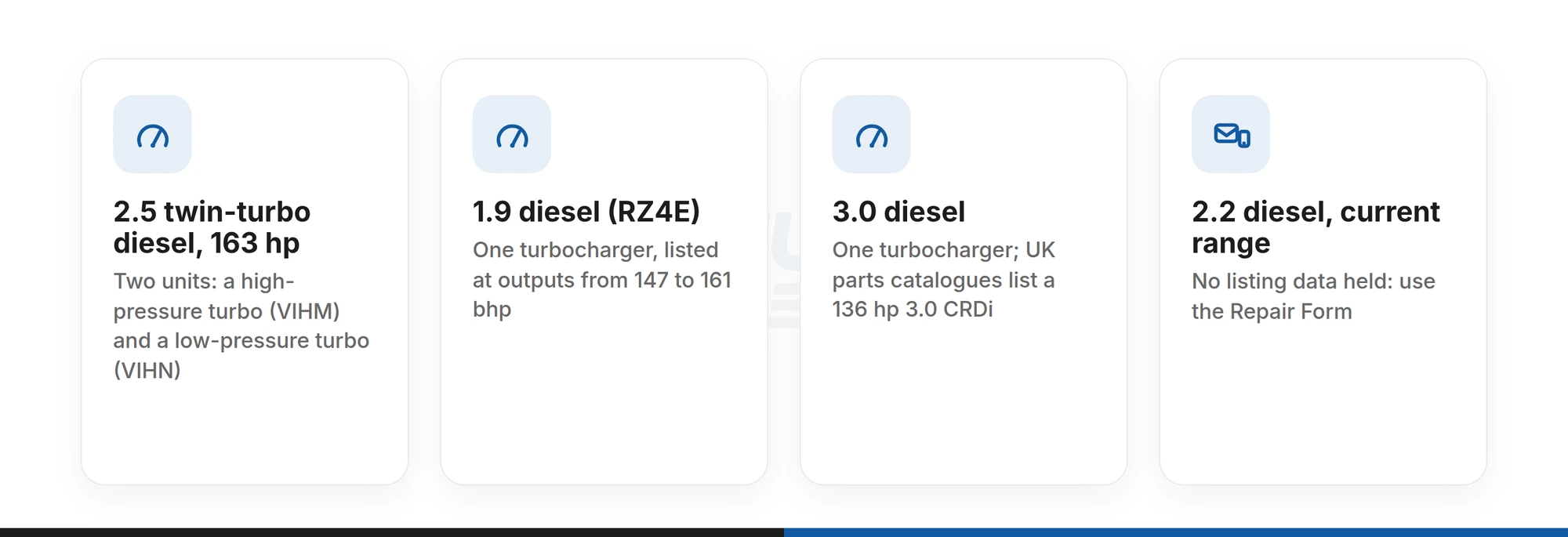
| Engine | Where it appears | Turbocharger as listed |
|---|---|---|
| 2.5 twin-turbo diesel, 163 hp | The second-generation D-Max as sold in Europe, including the UK, with 400 Nm and a six-speed manual | Two units: a high-pressure turbo (VIHM) and a low-pressure turbo (VIHN) |
| 1.9 diesel (RZ4E) | Listed for the D-Max from 2016 as a Euro 6 engine, and the engine the third-generation D-Max launched with in the UK | One turbocharger, listed at outputs from 147 to 161 bhp |
| 3.0 diesel | First-generation trucks; UK parts catalogues list a 136 hp 3.0 CRDi | One turbocharger; later 3.0 engines moved to variable geometry |
| 2.2 diesel | The current UK range | No listing data held: use the Repair Form |
Parts catalogues rarely use Isuzu’s own generation names. The 2.5 twin-turbo trucks are commonly filed as “D-Max II” under the chassis codes TFR and TFS, and the same labels turn up against the 3.0 CRDi. When you search for a part or describe your truck to us, the capacity and the power output identify it more reliably than the word “generation”.
The D-Max EV in the current range has no turbocharger, so nothing on this page applies to it.
The Turbocharger on Each Engine
The 2.5 twin-turbo: two units, one letter apart
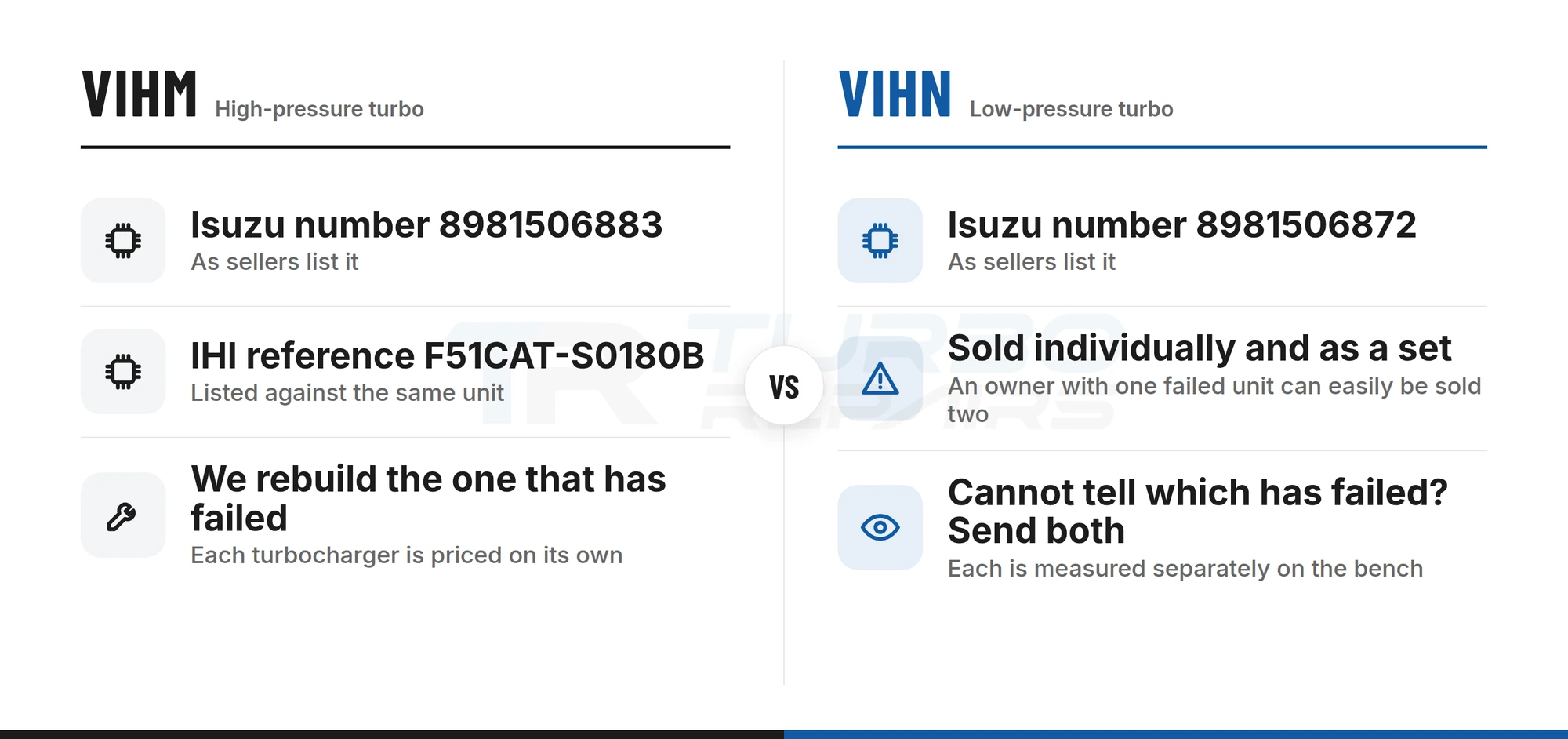
The 163 hp 2.5 makes its power from a two-stage pair. One turbocharger works at high pressure and the other at low pressure, and they are separate units with separate references. In the trade the high-pressure unit is sold as VIHM, listed against Isuzu number 8981506883 and IHI reference F51CAT-S0180B, and the low-pressure unit as VIHN, listed against Isuzu number 8981506872.
Those references are how sellers list them; the label on your own unit is what to match. Both are sold individually and as a set, which means an owner with one failed unit can easily be sold two. We rebuild the one that has failed, and each turbocharger is priced on its own.
If you cannot tell which of the pair is at fault, send both. Each is measured separately on the bench and we report what we find on each before any work goes ahead, so a sound unit goes back to you as it arrived.
The 1.9: one turbocharger
The 1.9 RZ4E is listed with a single turbocharger, at outputs from 147 to 161 bhp depending on the version. It is listed for the D-Max from 2016, and it carried over from the later second-generation trucks into the third generation, which went on sale in the UK with it.
One trade listing for the 147 hp version gives the reference 49335-04000, but listings across the range do not agree on a single number, so the label on your turbo is the reference that counts (see how to find the part number on your turbo). If the label is burnt or missing, send the unit anyway: we identify it on the bench before any work starts.
The 3.0: from fixed to variable geometry
Isuzu’s 4JJ1 3.0 diesels show how the turbo changed. The 4JJ1-TCX version introduced what Isuzu calls VGS, its name for a variable-geometry turbocharger, and the later 4JJ3-TCX, sold in the third-generation D-Max outside the UK, is documented with an electronic variable-geometry turbocharger. UK parts catalogues list a 136 hp 3.0 CRDi.
On a variable-geometry 3.0, a ring of vanes inside the turbine housing controls boost, and carbon on those vanes is a common cause of boost faults. Our guide to variable-vane turbos and sticking vanes explains why that fault comes and goes before it settles in.
The 2.2 in the current range
Isuzu UK now sells the D-Max with a 2.2 diesel, which it describes as a bigger turbo diesel engine. We hold no listing data for this engine’s turbocharger. If yours needs attention, put the reference from its label on the Repair Form and we will tell you what it is before you send anything.
Does Your D-Max Have an Electronic Actuator?
On a variable-geometry turbocharger the vanes are moved by an actuator bolted to the outside of the turbo. That actuator is either worked by vacuum, through a diaphragm and a rod, or it is electronic, with a motor, a gear train and a position sensor in a sealed housing. We repair electronic actuators only, from £100 + VAT and typically in one to two working days, and a rebuilt unit goes back on without programming.
No source we hold ties an electronic actuator to particular D-Max years in the UK, so we will not guess from the model year, and nor should a seller. The truck answers the question in a few seconds:
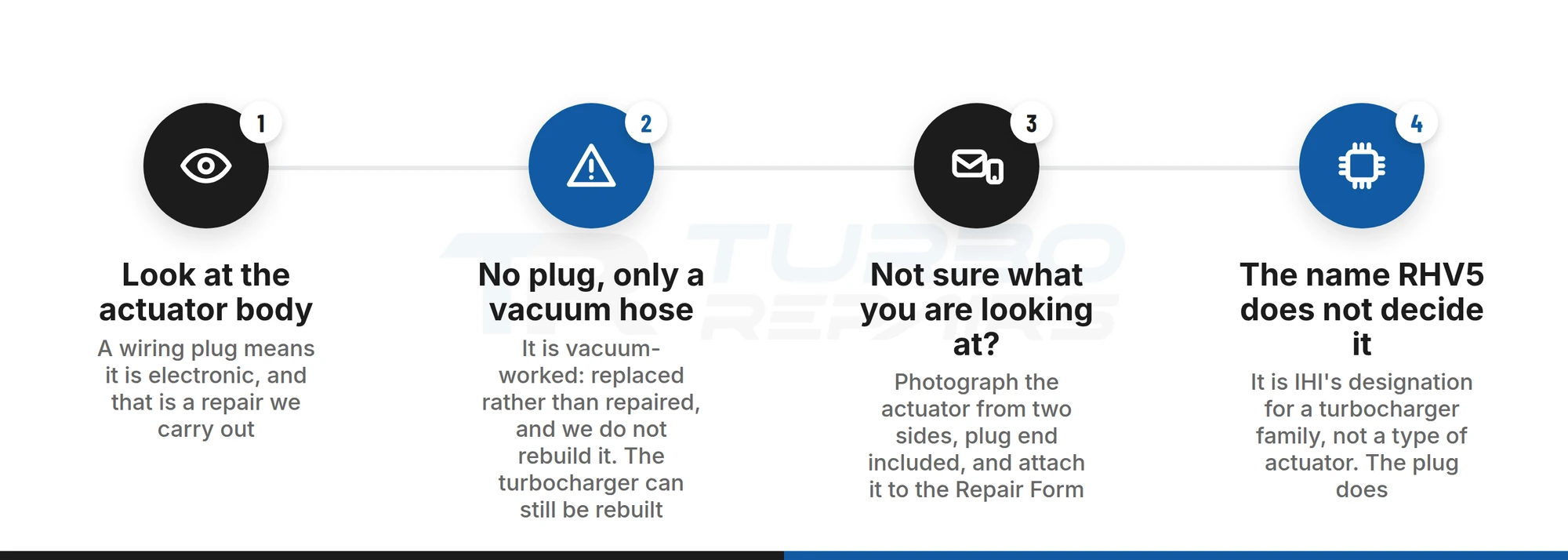
- A wiring plug on the actuator body means it is electronic. That is a repair we carry out.
- A vacuum hose to the actuator and no plug means it is vacuum-worked. That actuator is replaced rather than repaired, and we do not rebuild it. The turbocharger it sits on can still be rebuilt.
- Not sure what you are looking at? Photograph the actuator from two sides, plug end included, and attach it to the Repair Form.
D-Max owners searching for an actuator often meet the name RHV5. That is IHI’s designation for a turbocharger family, not a type of actuator, so the name alone does not tell you whether the unit is electronic. The plug does. If yours has one, send it in and we confirm it on the bench; if it is vacuum-worked, it is not a repair we offer.
Where the vane lever can be reached, one hand check separates the actuator from the turbo. With the actuator disconnected, a lever that sticks, catches or stops short puts the fault inside the turbocharger. A lever that sweeps freely through its travel puts the actuator back under suspicion. Our page on how electronic actuators are tested and calibrated explains what happens to an actuator once it reaches the bench.
Every electronic actuator we rebuild, across every make, is on our electronic turbo actuator repairs page. Other pickups have pages of their own, including the Mitsubishi L200, the Toyota Hilux, the Nissan Navara D40 and the Ford Ranger; those pages cover those trucks only, and nothing on them implies a part that fits a D-Max.
Turbo Repairs · Epsom workshop
Plug or vacuum hose? Tell us, and we will say what to send
Put your engine capacity, any stored fault codes and a photograph of the actuator on the Repair Form. If the actuator is electronic it can come to us on its own; if not, we will tell you whether the turbocharger itself needs to come in.
Lifetime, unlimited-mileage warranty · Mail-in from the UK and internationally · Bench-tested and calibrated before it ships
What Fails, and What Each Symptom Points To
A D-Max is usually bought to work. Isuzu UK quotes a one-tonne payload and 3.5 tonnes of towing for the current truck, and a turbocharger asked to deliver that load for long periods runs hotter and longer than one on a commuter car. Most turbo failures on a pickup trace back to three things that start outside the turbo: its oil, its air and its heat.
- Oil. The bearings inside the turbo float on engine oil. Overdue oil changes, the wrong grade, or a partly blocked feed pipe starve them, and the wear shows first as shaft play, then as noise or oil smoke.
- Heat. Switching off straight after a long climb or a heavy tow stops the oil flow while the bearing housing is at its hottest, and the oil left inside cooks into carbon. A minute or two at idle before switching off is the cheapest protection a working D-Max has.
- Air. Dust that gets past a damaged air filter, or through a split hose after it, wears the compressor wheel and upsets its balance. On a truck used on tracks or sites, the air filter matters as much as the oil.
How long a turbo lasts is decided by those habits more than by the odometer, which our guide to how long turbos last covers in more detail.
Reading the symptoms
- Blue smoke, or oil inside the intercooler pipework, points at worn bearings or seals in the turbocharger itself.
- A whine or whistle that rises and falls with boost points at the turbocharger or the pressurised pipework around it.
- A siren-like screech under acceleration can mean a wheel touching its housing. Stop driving and have it checked, because a wheel that breaks up can send fragments into the intercooler and the engine.
- Power loss with a stored code and limp mode that a restart sometimes clears points at the boost control: the actuator, or vanes it can no longer move.
- A flat engine with no code at all points at neither until the intake hoses, clamps and intercooler have been checked, because a split hose loses boost in exactly the same way.
On the 2.5 twin-turbo, none of these symptoms tells you which of the two units is at fault. That is a question for the bench, and it is why sending the unit you suspect, or both, beats buying a set on the strength of a symptom. Our guides to turbo failure symptoms and turbo actuator symptoms go through the full lists.
P0299 on a D-Max: Turbo, Actuator or Something Else
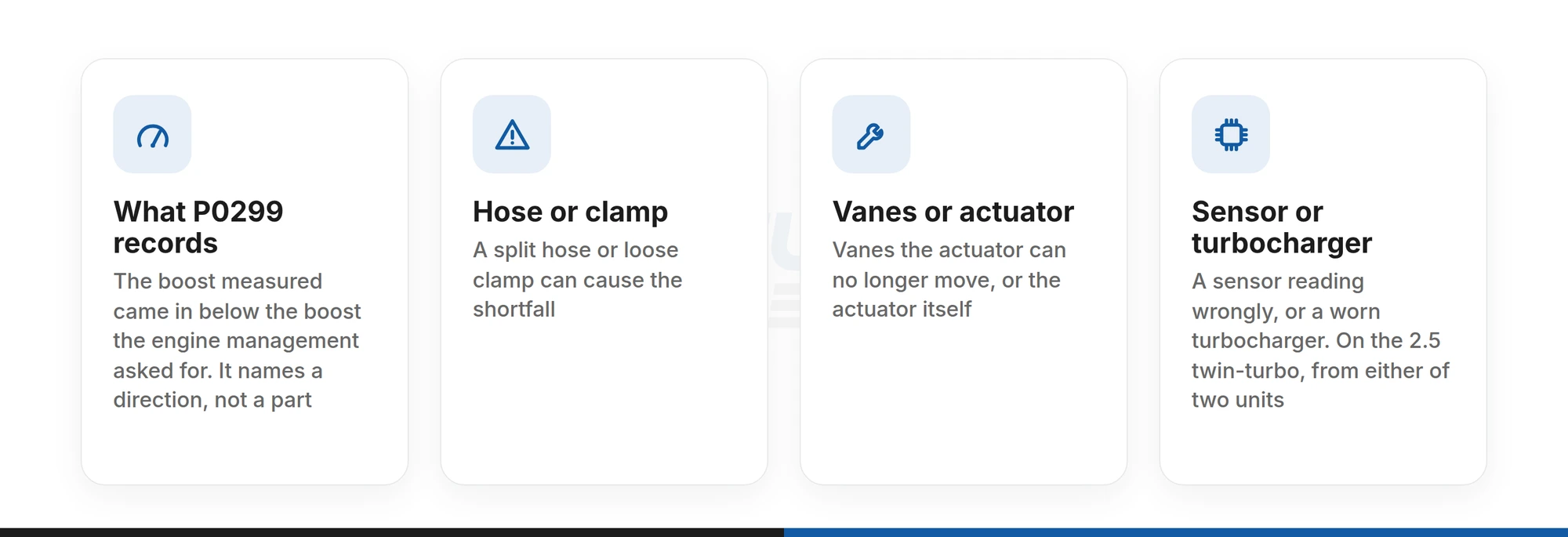
P0299 records that the boost measured came in below the boost the engine management asked for. It names a direction, not a part: on a D-Max the shortfall can come from a split hose or loose clamp, vanes the actuator can no longer move, the actuator itself, a sensor reading wrongly, or a worn turbocharger, and on the 2.5 twin-turbo from either of two units. Our guide to P0299 and the other boost codes works through those suspects in order, cheapest first, and it is worth following before anything is unbolted.
Our D-Max Turbo and Actuator Rebuild
Every unit is matched to your engine and tested as it arrives, before it is opened, so the fault we repair is the fault the unit actually has. You get your own turbocharger or actuator back, not an exchange unit off a shelf.
- Turbochargers are stripped to component level and every part is measured against the original tolerances. Bearings, seals and piston rings are renewed with genuine OE or OEM-grade parts, damaged wheels and shafts are replaced, and the rotating assembly is balanced before the unit is rebuilt and run on the bench.
- Electronic actuators have the parts that wear renewed at component level, the motor, the gear train and the position sensor, with the circuit board reworked. Each one is calibrated and tested on the bench before it ships, and it refits without coding.
Before a rebuilt turbo goes back on, the cause of the failure has to be fixed on the truck. That means a fresh oil and filter change, a clean oil feed and return, a sound air filter and intake, and the intercooler checked for oil. On refit the oil feed is primed by cranking the engine for 10 to 15 seconds without letting it start, as our guide to replacing a turbocharger sets out.
Sending your unit in
- Tell us about the truck. Complete the online Repair Form with the registration, engine capacity, power output, any fault codes and a photograph of the unit’s label.
- Send the right part. A turbocharger comes complete, with its actuator still attached. An electronic actuator being repaired on its own comes by itself. On the 2.5, send the unit you suspect, or both if you are unsure.
- Pack and post it. Seal every oil and air opening, pack the unit in a rigid box and post it to Unit 102 Reaver House, 12 East Street, Epsom, Surrey, KT17 1HX, United Kingdom. Our FAQs cover packing and postage.
- We test, strip and report. We tell you what we have found before the rebuild goes ahead, then return the unit bench-tested and ready to refit.
Independent garages and main dealers send D-Max units to us in the same way owners do.
Isuzu D-Max Turbo Repair FAQ
How much does an Isuzu D-Max turbo repair cost?
Rebuilding your own turbocharger starts from £185 + VAT, and a replacement turbocharger from us starts from £450 + VAT. On the 2.5 twin-turbo each unit is priced on its own, so a single failed unit is a single rebuild. An electronic actuator repair starts from £100 + VAT. Removal and refitting are charged by whoever does that work, and our guide to turbo repair prices explains what moves the figure.
Can you rebuild just one turbo on the 2.5 twin-turbo?
Yes. The high-pressure and low-pressure turbochargers are separate units, and we rebuild whichever has failed. If you are not sure which one it is, send both: each is measured separately and we report on both before any work is done.
Can you repair an RHV5 turbo actuator?
If it is electronic, yes. RHV5 is the name of IHI’s turbocharger family rather than a type of actuator, so check the actuator itself: a wiring plug on its body means it is electronic and can be repaired from £100 + VAT. If it is worked by vacuum, it is not a repair we offer.
My D-Max’s actuator is vacuum-operated. Can you still help?
We do not repair vacuum-operated actuators. We can still rebuild the turbocharger the actuator sits on, so if the turbo itself is at fault, send it complete with the actuator attached and we will report on both.
How do I find out which turbo my D-Max has?
Start with the cylinder capacity on your V5C, which separates the 1.9, 2.2, 2.5 and 3.0. The reference on the turbo’s own label then identifies the unit. If the label cannot be read, send the unit anyway and we identify it on the bench before any work starts.
How long will my D-Max be off the road?
Bench time is typically one to three working days for a turbocharger and one to two for an electronic actuator, counted from the day the unit arrives. Add postage each way and the time your garage needs to remove and refit it.
Final Thoughts
A D-Max turbo problem starts with the engine, because the engine decides how many turbochargers there are to suspect. On the 1.9 and the 3.0 there is one; on the 2.5 twin-turbo there are two, a letter apart in name, and only the bench can say which has failed.
The actuator question is settled at the truck rather than in a catalogue. A plug on the actuator means an electronic unit we can rebuild; a vacuum hose means the actuator is replaced and the turbo is rebuilt on its own merits. Either way, fix the oil, air or heat that caused the failure before the rebuilt unit goes back on.
Turbo Repairs · Epsom workshop
Get the turbo off your D-Max rebuilt, not replaced
Complete the Repair Form with your registration, engine capacity and the reference from the label, then send in the unit that has failed. It is tested as received, stripped, measured and rebuilt, then bench-tested and returned ready to refit.
Lifetime, unlimited-mileage warranty · Mail-in from the UK and internationally · Bench-tested and calibrated before it ships